

With the increased use of social media and digital platforms, cases of online defamation have highly increased . Any content posted online has its own set of consequences if the user is not using caution before exercising his Right to freedom of expression it can end up being defamatory. Freedom of expression comes with the responsibility of not to cause harm to anyone, nor infringe on others’ rights, safety and societal wellbeing. For Non-Resident Indians (NRIs), online defamation can have serious consequences. It can affect their social reputation, professional standing as well as their community relations both in India and abroad.
Understanding the Defamation vs Free Speech Dilemma
Misleading, false, inappropriate, hateful, harmful content or any content posted/ written/ uttered using a verbal or non verbal method, on a public platform or in private, with malicious intentions can spread quickly and remain accessible for a long time. It can have ample consequences for the victim. In case the victim is an NRI the consequences multiply many fold, as the geographical gap delays the victim NRIs to raise the alarm regarding the possible malicious intentions of the accused person. The harasser gets more space and time to plan his agenda against the NRI. Here comes NRI Legal World to help NRIs to take up this fight to its legal conclusion to protect the NRI and his family from the harasser.
Defining Online Defamation
Online defamation refers to the act of publishing any untrue, misleading, vulgar, obscene or harmful content about any individual or entity on any digital social media platforms, emails, blogs and public forums. And it is done with the aim to cause damage to the reputation, integrity and character of an individual or entity.
Online Defamation includes the following:
- Posting false allegations in written posts and comments or spreading untrue rumours on social media .
- Uploading edited or misleading photos or videos to harm someone’s reputation, integrity and character.
- Publishing defamatory blogs, reviews or news articles without verification of facts.
- Circulating false messages, audio clips and /or videos on WhatsApp, Telegram or any other social media apps.
- Spreading AI generated Deep Fake False videos or Photos of the NRIs or his family members to cause social or financial damage.

Types of Defamation
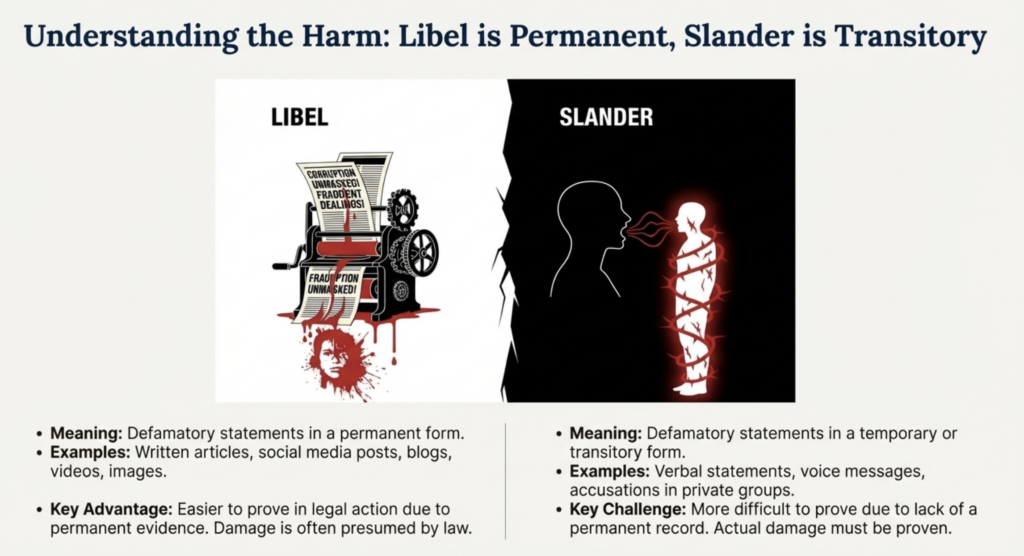
| Basis | Libel | Slander |
| Meaning | Libel refers to defamatory statements made in a permanent form. | Slander refers to defamatory statements that are expressed in a temporary or transitory form. |
| Forms of Expression | Such as Written articles, social media posts, blogs, videos, images published online. | Such as verbal statements or voice messages. |
| Proof of damage | Actual damage need not be proved; damage is presumed by law. | Actual damage must be proved by the aggrieved person. |
| Burden of proof | After proving publication and defamatory content, the burden generally shifts to the accused to justify the statement. | The burden of proof lies on the aggrieved person to show real harm to reputation. |
| Legal Action | Easier to prove due to permanent evidence. | Difficult to prove due to lack of permanent record. |
| Examples | Defamatory post on social media or false article in a newspaper | False verbal accusations made in public or during phone calls or in private groups. |
Legal Provisions and remedies Governing Online Defamation in India
The Bharatiya Nyaya Sanhita, 2023 has replaced the earlier provisions of the Indian Penal Code relating to defamation and now governs offences involving both offline and online defamatory acts.
- Section 356, BNS: This Section defines defamation and expressly includes defamatory statements or content published through digital and online platforms, including social media, websites, and electronic communication.
While Exception 10 provides a defence by stating circumstances in which defamation is not made out, clause (2) lays down the punishment for defamation, which may extend to imprisonment for two years, or fine, or both.
Role of the IT Act in Online Defamation Cases: Intermediary Liability
Section 79, IT act; Social media platforms (Facebook, Instagram, Youtube, etc) are treated as “Intermediaries.” Intermediary Third Party platforms are not automatically liable for defamatory content posted by users if:
- They follow due diligence.
- They act upon lawful orders.
- This is known as “safe harbour protection”.
Content Removal and Blocking is covered under Section 69A: The Government of India can order blocking or removal of online content.
NRI Legal World
Can a Victim file a Case Under the IT Act for Defamation?
Under the IT Act the police can not register a direct criminal case for defamation. However the victim can approach the civil court for punitive action. Victims can file a defamation case under the BNS, 2023 and simultaneously seek the removal of the content under the Information and Technology Act, 2000 (amended in 2008) which can hold the intermediary platform’s accountability under Section 79 of the same act.
For Simple legal understanding: The BNS punishes the offence of defamation, while the IT act regulates online platforms and enables removal of defamatory content from the internet.
Strategic Action Plan for NRI’s: Three paths to Justice
How can an NRI File online defamation case ?
An NRI who is a victim of online defamation may take the following legal actions:
1. Criminal Complaint: A criminal complaint may be filed with the police or State Cyber Cell or in the civil court under Section 356 of the Bharatiya Nyaya Sanhita, 2023.
2. Civil Suit for Damages: The victim may file a civil suit seeking monetary compensation for loss of reputation, mental harassment, and emotional distress.
3. Takedown of Defamatory Content: A request can be made to the concerned online platform for removal of defamatory content under the Information Technology (Intermediary Guidelines and Digital Media Ethics Code) Rules, 2021, by himself, police or by State Cyber Cell.

Key Steps NRIs Should Take in Online Defamation Cases:
- Collect Evidence & Identify the Nature of the offence: Preserve screenshots, URLs, videos, timestamps, and any available witness details.
- Clearly identify how the content has harmed you, such as:
- How much damage incurred to your personal or professional reputation.
- How it affects your family or relatives.
- Assess the financial damage incurred by the circulation of false or misleading information about you and your business entity
- define if it falls under hate speech category
- Also assess whether the content is false, misleading, or deliberately intended to harm your reputation.
3: Initiate Legal Proceedings: Depending on the nature and gravity of the case, an NRI may initiate criminal proceedings or civil Legal proceedings in India, either personally or through a duly appointed representative.
Police or Civil Court: Choosing the right way
If the matter involves serious criminal intent, threats, impersonation or repeated harassment, approaching the police or cyber cell is advisable. If the objective is content removal, injunction, or compensation, the NRI may directly approach the court through an advocate.Filling a police complaint is not mandatory in every defamation case. An NRI can directly consult and engage an advocate in India to issue a legal notice and initiate appropriate legal proceedings. It is advised to discuss your case with Legal Experts.
To File a Complaint: after careful consideration about the criminal intentions of the harasser, Lodge an online complaint through the Indian Cyber Crime Portal https://cybercrime.gov.in.NRI can Approach Local Embassy: Complaints can also be made through the local Indian Embassy or Consulate in the country of residence.
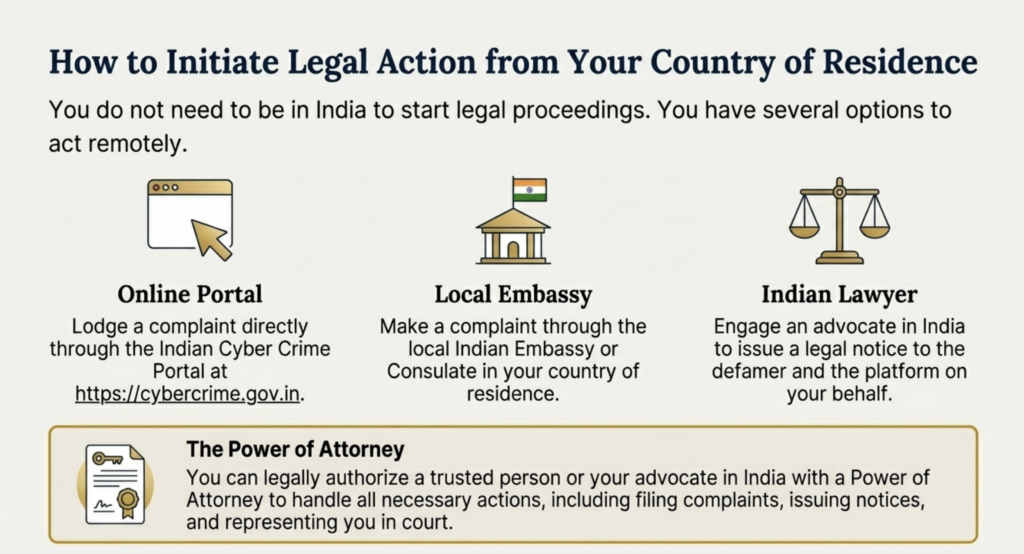
To Send a Legal Notice: A legal notice may be issued through an Indian lawyer to the person responsible for the defamatory action, and wherever required to the concerned social media platform or intermediary.
Grounds for seeking the compensation:
An NRI may seek compensation when false statements damage personal, professional, or business reputation.
- If the defamatory content has caused mental harassment or jeopardized the social standing of an individual.
- If the online post has resulted in financial loss, employment loss, or business loss.
- If the malicious or repeated publications have incurred irreparable damage to an individual or an entity.
Landmark Judgements for NRIs:
Subramanian Swamy v. Union of India: The Supreme Court upheld criminal defamation, recognising that reputation is an integral part of the right to life under Article 21 of the constitution.
Relevance for NRIs:The court affirmed that damage to reputation- personal, professional, or social is a legally enforceable injury and victims are entitled to seek legal remedy and compensation.
Tata Sons Ltd. V. Greenpeace International: The court held that false and misleading online content affecting the reputation of a person or organisation can justify injunctions and legal action, while balancing free speech.
Relevance for NRIs: This case is frequently cited in online defamation matters, especially where digital content harms reputation and business interests, making it relevant for NRIs facing defamatory online campaigns.
Managing online defamation case from abroad for NRIs
NRI can authorise any person or advocate with a Power of Attorney for filing complaints, issuing notices or court representation etc.
Jurisdiction in Online Defamation Cases Involving NRIs
Indian courts have jurisdiction if:
- The defamatory content is accessible or viewed in India
- The reputation of the NRI is harmed within India

Online Defamation case against NRI in India: In case an NRIs sitting abroad writes a post about Indian residents and defamatory post is visible in India. An Indian resident can file a defamation case against the NRI. It means the allegedly defamatory content is accessible in India and the reputation of the Indian resident is harmed within India. Also, the fact that the post was written outside India does not bar Indian jurisdiction, because online defamation is treated as occurring at the place where its impact is felt.
Declaring an NRI a Proclaimed offender in an Online Defamation case:
When an NRI ignores or never responds to the summons of appearance in the court without any explanation, then he/she can be declared as a proclaimed offender like in other criminal cases. Once an NRI is declared a Proclaimed Offender it can have severe ramifications like passport impoundment, property attachment, Look-out-Circular (LOC) and difficulty getting bail if an NRI is looking to visit India. NRI can be arrested on landing in India, but in exceptional cases they can sometimes get the order quashed by engaging lawyers to represent them.
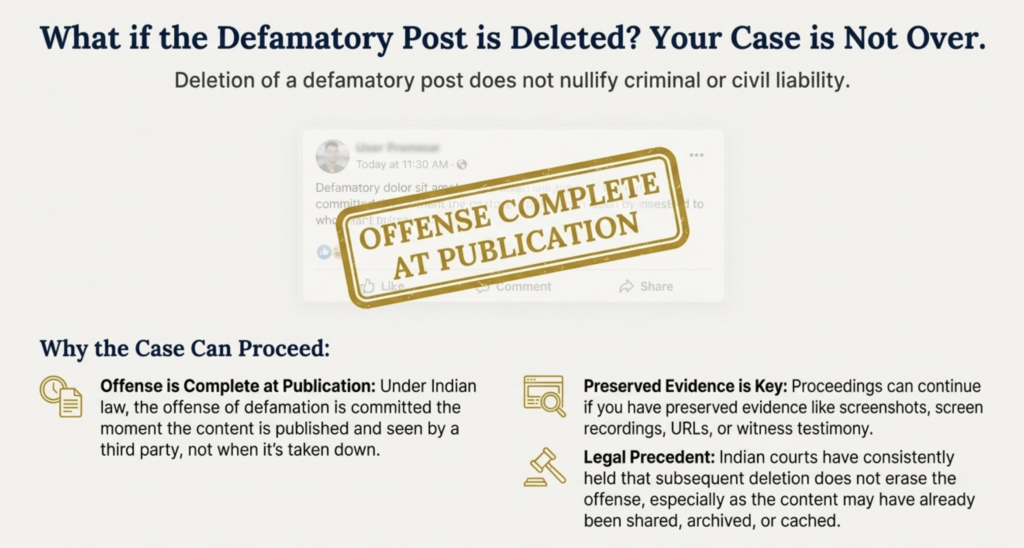
What happens to the defamation case if the original defamatory post is deleted from the platform?
Conclusion
Indian law offers both civil and criminal remedies to protect the reputation of NRIs, even in cases involving cross-border digital platforms and social media. Courts in India may exercise jurisdiction when defamatory content is accessible in India or when the reputation of the affected NRI is harmed within the country. However, prompt action, proper documentation, and credible evidence play a crucial role in achieving effective legal relief.
Want to know more about this topic- you can contact us: Email- info@nrilegalworld.com / Phone no: +919709692096
Frequently Asked Questions:
Ans. Online defamation refers to the act of publishing any untrue, misleading, vulgar, obscene or harmful content about any individual or entity on any digital social platforms, emails, blogs and public forums. And it is done with the aim to cause damage to the reputation, integrity and character of an individual or entity.
Online Defamation include the following:
- Posting false allegations in written posts and comments or spreading untrue rumours on social media .
- Uploading edited or misleading photos or videos to harm someone’s reputation, integrity and character.
- Publishing defamatory blogs, reviews or news articles without verification of facts.
- Circulating false messages, audio clips and /or videos on WhatsApp, Telegram or any other social media apps.
- Spreading AI generated Deep Fake False videos or Photos of the NRIs or his family members to cause social or financial damage.
Ans. Yes, NRIs can file online defamation cases in India. He/she can initiate criminal and/or civil defamation proceedings in India through a Power of Attorney or by engaging a lawyer to act on their behalf.
Ans. Yes, If the defamatory content affects the reputation of an NRI in India or is viewed in India, then Indian courts can assume jurisdiction under applicable cyber and criminal laws.
Ans. NRIs should preserve screen-shorts with date and Time.
- They should preserve URLs and platform details.
- Details of the person and the account where content has been posted.
- Witness statements or proof of circulation.
- Certified electronic evidence as per legal requirements.
Ans. Before declaring a person as PO, the court follows a strict procedure under the BNSS, which includes:
- Issue of summons.
- Issuance of bailable/non bailable warrant.
- Initiation of proclamation proceedings as a last resort.
Ans. If NRI cannot appear in court, he should send a lawyer on his behalf.
- File an application for dispensation from physical presence in court.
- Authorize a representative through Power of Attorney.
Yes, an Indian resident can file a defamation case in India against an NRI if:
The allegedly defamatory content is accessible in India and the reputation of the Indian resident is harmed within India.
The fact that the post was written outside India does not bar Indian jurisdiction, because online defamation is treated as occurring at the place where its impact is felt.
Ans: In case the original defamatory post is deleted from the internet does not nullify the criminal or civil liability. Under Indian law, the offence of defamation is complete at the moment of publication (i.e when the content is made available to a third party).
Even if the accused deletes the post later, proceedings can continue if:
- Screenshot, screen recording, URLs, metadata, or server logs are available.
- Witnesses or digital forensic evidence prove publication.
- Courts have consistently held that subsequent deletion does not erase the offence, especially in online defamation where content may already be shared, archived, or cached.
Yes, filling a police complaint is not mandatory in every defamation case. An NRI can directly consult and engage an advocate in India to issue a legal notice and initiate appropriate legal proceedings.
Latest Posts by NRI Legal World
- Will drafting and registration of Foreign Will in India: A Legal guide for NRIs
- Eviction of illegal tenants: A legal guide for NRIs
- When IELTS Marriage and Migration Becomes a Trap: The Dark Reality Behind Financial Sponsorship, and Marriage Pressure
- Legal status of Live-in relationship vs Civil Partnership deed in India
- Registration of Foreign Divorce Decree in India: Law, Procedure and Judicial Approach for NRIs
Client Testimonial- Offering solution to NRIs
Comments are closed