

Setting up Family trust for NRIs in India
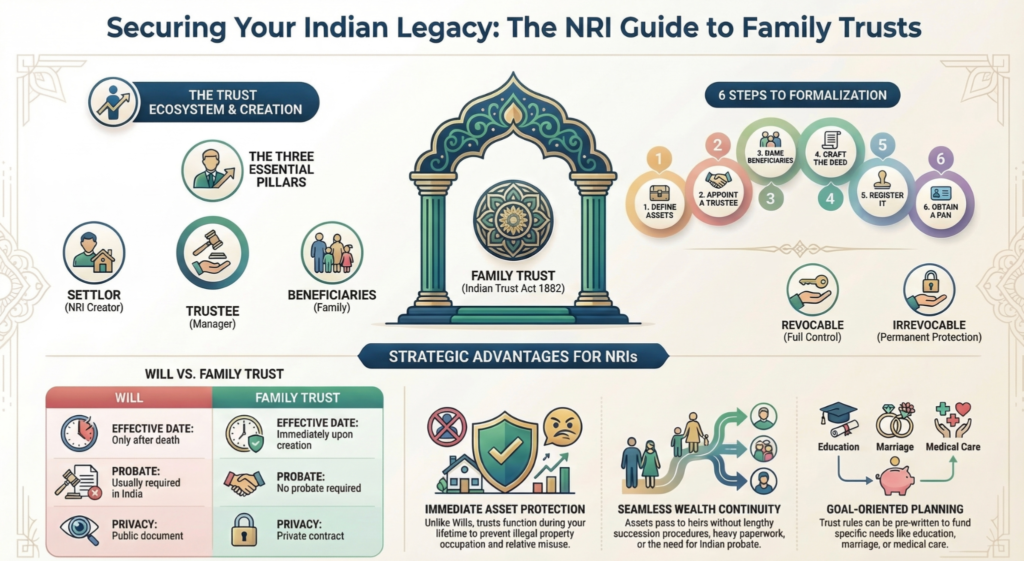
A family trust in India is a legal structure where a person transfers assets (like property, money or investments situated in India) into a trust and which is handled by a professional person who manages the assets of the person(settlor) for the benefit of the family members. A family trust is commonly used by NRIs to protect Indian assets and avoid legal problems in India. A family trust is a legal system to hold and manage family wealth safely for present and future generations.
The family trust can be created under the Indian trust act 1882 and is legally valid for NRIs
Parties in a Family Trust
A Family trust has three main roles:

- Settlor:
The NRI who creates the trust and transfers his own assets (like property, Money, Bank deposits, any other income, etc.) into the family trust.
The settlor is also the creator of the trust. The settlor creates the trust to protect Indian assets and avoid legal problems in India. The settlor has the power to change or cancel the family trust anytime.
- Trustee:
The person who manages the trust assets is a trustee. The trustee is also called the manager of the trust. The trustee must strictly follow the rules of the trust, these rules are formed by the settlor while creating a family trust. The trustee works for the settlor and the nominated beneficiaries of the family trust. The trustee manages property or income and distributes benefits among the beneficiaries of the family trust according to the trust rules.
- Beneficiaries:
The beneficiaries are the persons who benefit from the family trust. The Beneficiaries can be the spouse, children, parents or future generations of the settlor (creator) of the Family trust.
These are the three main parties of the family trust, which are necessary to create a family trust.
Types of family trusts commonly used by NRIs:

- Revocable trust: A revocable trust is a type of family trust that can be changed, modified or cancelled anytime by the person (Settlor) who created it
- Irrevocable trust: An irrevocable trust is a type of family trust that cannot be easily changed or cancelled once it is created and assets are transferred into it. The irrevocable trust is usually permanent and used for long-term protection and planning.
- Private family trust: A private family trust is a legal arrangement created to manage and protect assets only for specific family members, not for the public or charity.
Procedure to create family trust in India:

Here is the step by step guide to create a family trust in India for Indian assets:
- Decide assets to be included in a family trust
- Choose a reliable trustee to run the trust, he/she can be either from the family or someone outside the family.
- Decide the beneficiaries of the family trust.
- Draft a clear trust deed with a clear set of rules to govern the trust.
- Register the trust deed in India
- Obtain a PAN for the trust and open a bank account for the Family trust.
Why should NRIs create a Family trust in India?
- Protection of property in India:

As NRIs are living abroad and cannot personally manage property, they need a family trust to manage it.
A trust helps in:
- Preventing the illegal occupation on the property.
- Avoid misuse by the Relatives
- Ensure the property is properly managed
The trustee has a legal responsibility to protect assets in a family trust.
- Best way to avoid family disputes:
After the death of an NRI, it is common for property disputes to arise among the legal heirs due to various factors related to inheritance.
A family trust must clearly define:
- Who will be the beneficiary of the family trust?
- Who will benefit from the family trust?
- When will the beneficiary receive the benefit from the Family trust?
- Who will manage the trust?
This will help in reducing the legal disputes and family conflicts.

- Better way to wealth management and smooth transfer of wealth among family:
The Assets in a trust can pass to beneficiaries without lengthy succession procedures. Family trust helps in easier management of the property while the owner is alive than the inheritance which happens after the death of the owner. Hence, this results in lesser paperwork for heirs and faster distribution of assets.
- Management of rental or investment income:
The family trust makes the process of managing rental or investment properties easier.
If an NRI earns rent or investment income in India the Income will go to the trust account directly. The trustee distributes money to the beneficiaries according to the rule book of the trust. Maintaining proper records is mandatory in the family trust. Family trust creates a structured and transparent system for the management of rental or investment income along with estate management.
- Useful for long-term family planning:
The family trust is very useful for long-term family planning for NRIs. A family trust allows an NRI to plan for the future like in:
- Children’s education
- Marriage expenses
- Medical needs of parents
- Care of family members in case of disability etc.
The rules in a family trust can be written in advance for how the funds of the family trust will be used.
- Legal and financial organisation:
When a trust is properly created, it keeps records of assets, clarifies ownership and control of properties, and helps in the organised management of wealth between families.
This can reduce confusion in legal or financial matters
- Continuity of wealth:
Even after the NRI is living abroad or passes away, the trust continues to operate. The trustee manages the assets without interruption, ensuring stability for family members.
Difference between a Will and a Family trust

Benefits of Family trust for NRIs:
- The family trust protects the Indian property of an NRI
- The family trust makes the succession planning of an NRI clear
- The family trust reduces the family disputes
- The family trust helps in managing the income and assets of an NRI in an organised way
- The family trust provides long-term security for the family of NRIs
- The family trust provides continuity of wealth across generations
It is recommended to take professional legal advice before making any decision about wealth management.
NRI Legal can be contacted via phone number +919709692096 or email – info@nrilegalworld.com
Frequently Asked Question
Q: Can NRI open family trust in India?
Ans: NRI can open a private family trust in India for estate management.
Q: Can NRI start trust in India?
Ans: NRI can start trust in India to manage their property based in India.
Q: What are the benefits of making family trust in India?
Ans: NRI owners can manage the property while he is alive, unlike in the case of inheritance based transfer of property which happens after the demise of the owner. Usually NRIs choose the option Family trust to avoid disputes emerging from the inheritance based transfer of property results.
Q: What types of family trusts in India for NRIs?
Ans: NRI can opt for a private family trust for estate and wealth management in India.
Q: What are the pros and cons of making a family trust in India?
Ans: NRI can choose the family trust method of wealth management based on the details of the family members along with the details of the property. Pros and cons of the trust formation vary from case to case to bases. For many NRIs the trust formation offers better tax benefits and for some it reduces the chances of property based disputes in the family.
Comments are closed