

With the increasing global mobility of Indians, many Non-resident Indians enter into relationships governed by foreign laws, such as civil partnerships or domestic partnerships. These legal relationships, recognized in countries like the United Kingdom and parts of Europe, often grant rights similar to marriage.
However, a critical legal question arises; if an NRI enters into a civil partnership abroad, is that relationship recognized in India? In addition, can the partner claim rights over the NRIs property claim rights over the NRI’s property situated in India?
This issue sits at the intersection of personal laws, property laws, and private international law, making it both complex and evolving.
What is a civil partnership Deed?
A civil partnership is a legally recognized relationship between two individuals that provides rights and obligations similar to marriage, but without formally being called a “marriage”.
For instance, under the UK’s civil partnership Act 2004, partners in a civil partnership enjoy property rights, inheritance rights, tax benefits, maintenance and financial support rights. Such partnerships are formalized through civil partnership deed or registration, making them legally binding in that jurisdiction.
Legal recognition of foreign relationships in India
India generally follows the principle of “lex loci celebrations” meaning a relationship valid where it is formed may be recognized elsewhere. However, this is not absolute. Recognition in India depends on compatibility with Indian law, Public policy considerations, and Applicability of Indian personal laws.
Unlike marriage, which are governed under statutes like the Foreign Marriage Act, 1969, civil partnerships are not expressly recognized under Indian law. India does not currently have a statutory framework that recognizes civil partnerships, living relationships, same-sex marriages (as of now, not legally recognized), domestic partnerships equivalent to western jurisdictions.
Can a Civil partner claim Property in India?
For claiming property rights in India, there is no automatic right under any Indian law. A civil partnership entered abroad does not automatically grant property rights in India.
Indian property rights are governed by:
- Personal laws (Hindu law, Muslim law etc)
- Succession law like the Hindu Succession Act, 1956 and Indian Succession Act, 1925. These laws recognize spouses, children, and legal heirs.
A civil partner does not fall within the definition of a “spouse” under these statutes. Therefore, a civil partner has no automatic inheritance or ownership rights in Indian property.
Exception: If the NRI has purchased property jointly with the civil partner, or explicitly included the partner as a co-owner. Then the partner can claim rights but only to the extent of ownership documented in India. Because ownership depends on title documents, not relationship status.
What is the Role of a Will in a Civil Relationship?
A crucial exception to the non-recognition of civil partnerships in India lies in the concept of testamentary succession. Under the Indian Succession Act, 1925, an individual enjoys complete freedom to dispose of their property through a validly executed Will. The law does not restrict succession only to legally recognized relatives or spouses. Instead, any person irrespective of their relationship with the testator can be named as a beneficiary. This means that even though a civil partner may not be recognized as a “spouse” under Indian law, they can still lawfully inherit property, if explicitly mentioned in the Will. Therefore, where an NRI clearly and explicitly bequeaths their Indian property in favour of their civil partner. Such a disposition is legally valid and enforceable in India. Indian courts generally uphold the testamentary intent of the testator.
Can civil partners claim any maintenance or financial claims?
No, a civil partner cannot claim maintenance in India under Section 125 CrPC or 144 of BNSS and other Hindu Marriage laws. Because Indian law does not recognize civil partnerships as marriage.
Legal Position in India: Live-in Relationships vs Civil partnership Deeds
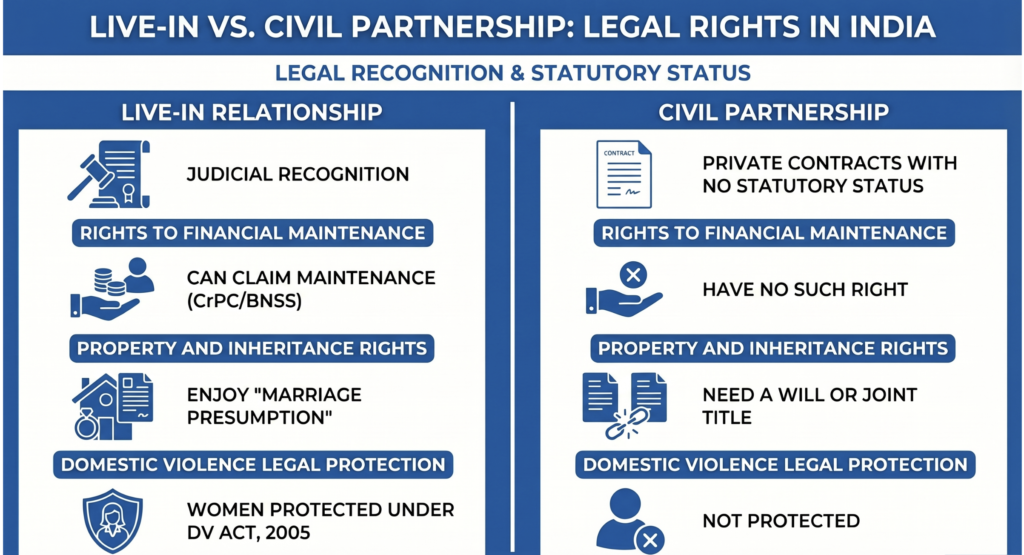
In India, there is a clear legal distinction between live-in relationships and civil partnership deeds. While one has gained judicial and statutory recognition, the other still remains outside the framework of Indian law.
No Specific law on Civil Partnership Deeds in India:
As of today, India does not have any specific legislation that recognizes or regulates civil partnerships. A civil Partnership deed is treated merely as a private contractual arrangement of two adults living together without marriage. It does not confer legal status equivalent to marriage rights such as maintenance, inheritance, succession are not automatically available.
Even if executed abroad, such partnerships are generally not recognized as valid marital relationships under Indian personal laws. Therefore, In India, a civil partnership deed cannot create enforceable spousal rights.
Judicial Recognition of Live-in relationships:
The Hon’ble Supreme Court in Indra Sarma v. V.K.V Sarma held that not all live-in relationships are entitled to protection, but those resembling a “relationship in the nature of marriage” may qualify for legal relief.
The court laid down key indicators:
- Duration of relationship.
- Shared household.
- Pooling of financial resources.
- Social recognition as a couple.
- Intention and conduct of parties.
This judgment is crucial because it distinguishes casual relationships from legally protectable live-in arrangements.
- Protection under Domestic Violence Law
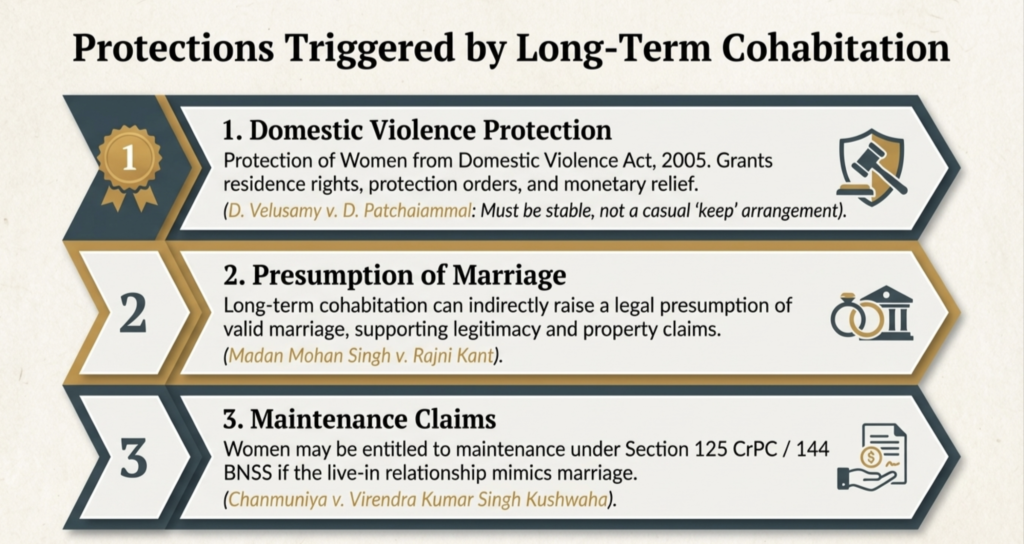
Under the protection of Women from Domestic Violence act, 2005, women in live-in relationships can seek protection orders, residence rights, monetary relief.
This was reinforced in d.Velusamy v. D. Patchaiammal, where the court clarified that a live-in relationship must be stable and marriage like not merely a “keep” or casual arrangement.
- Presumption of Marriage in Long Term Cohabitation:
In Madan Mohan Singh v. Rajni Kant, the Supreme Court held that long-term cohabitation may raise a presumption of valid marriage. This principle can indirectly support claims related to maintenance, Legitimacy of children, property disputes.
- Maintenance Rights in Live-in Relationships
In Chanmuniya v. virendra kumar Singh Kushwaha, The Hon’ble Supreme court took a progressive view that women in live-in relationships may be entitled to maintenance under Section 125 CrPC and 144 of BNSS if the relationship is similar to marriage. However, this is not automatic and depends on facts.
In the Indian legal framework, a clear distinction exists between live-in relationship and civil partnerships. While live-in relationships are legally recognized in India to a limited extent through judicial precedents and statutes like the protection of Women from Domestic Violence Act, 2005 civil partnership deeds do not have any legal recognition under Indian law.
For NRIs, this distinction becomes particularly important. A civil partnership that may be valid and legally enforceable in foreign jurisdiction does not automatically receive recognition in India, especially in matters relating to maintenance, succession, and matrimonial rights. At present there is no specifically recognized law governing civil partnerships in India. However such arrangements can still be contested before Indian courts, and the judiciary may, depending on the facts and circumstances, adjudicate upon the rights and obligations arising from such relationships.
On the other hand, if such a relationship functions as a live-in relationship “in the nature of marriage”, Indian courts may, in limited circumstances, extend certain protections particularly to prevent injustice or exploitation, as seen in cases like Indra Sarma v. V.K.V Sarma. Therefore, NRIs must exercise caution. A civil partnership deed alone is not sufficient to secure legal rights in India. To safeguard their partner’s interests, it is advisable to execute a valid Will for property succession. Consider joint ownership of assets and understand the limitations of Indian law regarding non-marital relationships.
Ultimately, while India has taken progressive steps in recognizing live-in relationships, civil partnerships still remain outside the legal framework, making proactive legal planning essential for NRIs.
Frequently Asked Questions:
Q1. Are Live-in relationships legal in India?
Ans. Yes, live-in relationships are legal in India. Courts have recognized them under certain conditions, especially when the relationship is “in the nature of marriage”. Legal protection is also available under the Protection of Women from Domestic Violence Act, 2005.
Q2. Is there any law governing civil partnership deeds in India?
Ans. No, there is no specific law in India that recognizes or governs civil partnership deeds. They are treated only as private agreements and do not provide marital rights.
Q3. Can a civil partner claim maintenance in India?
Ans. No, a civil partner cannot directly claim maintenance under Section 125 CrPC, as Indian law does not recognize civil partnerships as marriage.
Q4. Can a partner in a live-in relationship claim maintenance?
Ans. Yes, in certain cases, if the relationship qualifies as “in the nature of marriage”, courts may grant maintenance, as observed in Chanmuniya v. Virendra Kumar Singh Kushwaha.
Q5. What is meant by a relationship “in the nature of marriage”?
Ans. It refers to a relationship where partners live together for a significant period; Present themselves socially as a couple, Share household and financial responsibilities. This concept was explained in Indra Sarma vs. V.K.V. Sarma.
Comments are closed