
In north India, particularly in states like Punjab, Haryana, and Himachal Pradesh, the aspiration to study abroad or to settle abroad through IELTS has evolved into a powerful social movement. For many young women, it represents independence, economic freedom, and a chance to rebuild their lives on their own terms.
However, beneath this aspirational narrative lies a troubling and under-discussed reality- a pattern of financial involvement by men that later transforms into coercion, legal threats and forced expectations of marriage or immigration sponsorship.
What appears to be personal support frequently transforms into a contested “investment”, giving rise to disputes that are increasingly entering the legal domain.
The Unofficial Financial Transaction in Exchange for Marriage Promise
A recurring pattern has emerged where:
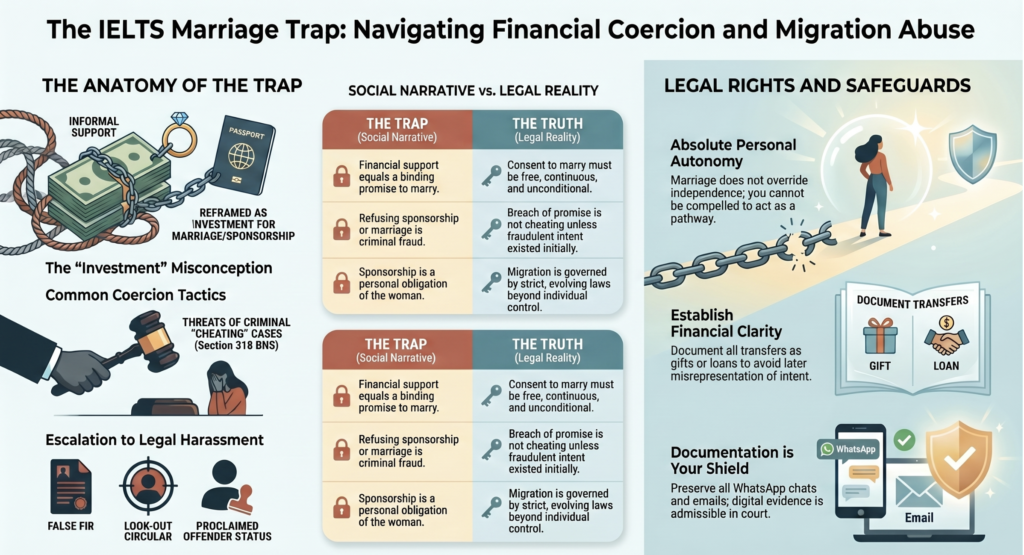
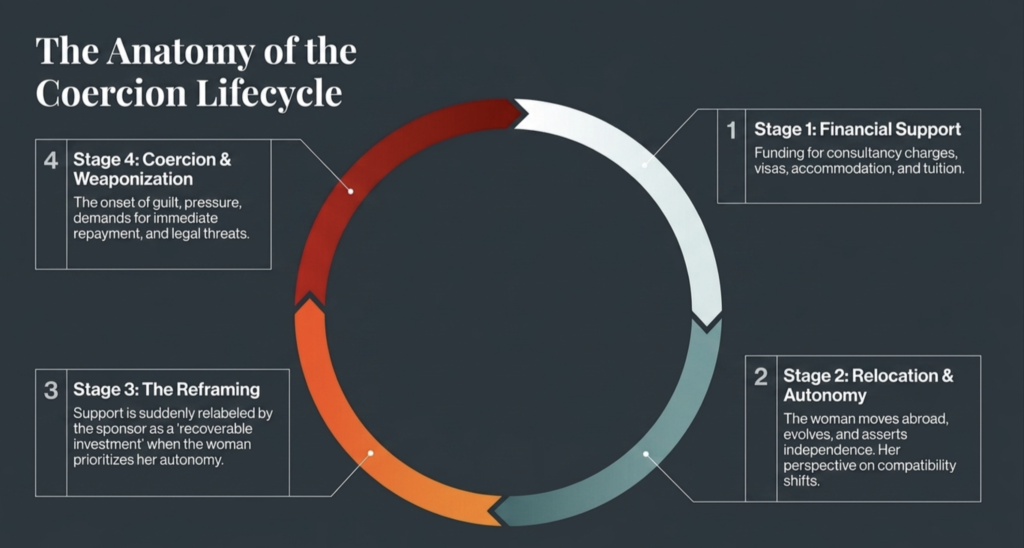
- A man (or his family) funds a woman’s IELTS coaching fees, visa application costs, consultancy charges, airfare, accommodation expenses and education abroad with the hidden motive that after getting the visa the woman will sponsor the man and his family. Such financial assistance creates a strong sense of obligation, even when no legal obligation exists.
- There is no formal agreement, but an implicit understanding of future marriage is created. The most critical issue here is the absence of any written or legally binding agreement. Instead, there is often a silent or verbal expectation that the relationship will lead to marriage. This “understanding” is rarely discussed in clear terms, leading to different interpretations by both parties later.
- The woman relocates abroad and begins her independent journey. After moving abroad, her life undergoes significant changes. She is exposed to new environments, cultures and opportunities. With independence, her perspective about relationships, compatibility and personal goals may evolve, which is completely natural but often not accepted by the other party.
At first glance, this may appear to be a relationship based on trust. But legally, this arrangement is deeply ambiguous because it lacks:
- Written contracts- without documentation, it becomes extremely difficult to legally establish the purpose of the financial transaction. Courts rely heavily on evidence, and the absence of written proof weakens claims.
- Defined obligations- There is no clarity on what the woman is expected to do in return. Since nothing is defined, expectations later turn into disputes.
- Clear consent regarding marriage- Consent to marry must be explicit and continuous. It cannot be assumed from financial support. A person has the right to change their decision at any time before marriage.
What begins as support often later gets reframed as a recoverable “investment” tied to personal commitment.
Withdrawal of Consent and the Onset of Coercion
The situation becomes contentious in the following scenarios:
- When a woman decides not to marry or not to continue the marriage after going abroad: A woman has an absolute legal right to refuse marriage at any stage before it is solemnized or to discontinue marriage once solemnized. However, this decision is often seen as betrayal or fraud by the other party, especially when financial involvement exists.
- When a woman finds incompatibility with the other party: Over time, differences in personality, values, or behaviour may become evident. These may be considered valid reasons to reconsider marriage, but they are often dismissed or ignored.
- When a woman chooses autonomy over obligation: The woman may prioritize her independence, career, and personal well-being over societal or relational pressure. This assertion of autonomy often triggers conflict.
Challenges faced by NRI women when they fail to sponsor the Husband
- Threats of filing criminal cases- The most common tactic is threatening to file a cheating case under criminal law. Most threats revolve around filing a case under Section 318 of Bharatiya Nyaya Sanhita (BNS). However, the legal position was especially clarified by the Punjab and Haryana High Court, which is very clear that breach of promise does not automatically amount to cheating unless a fraudulent or dishonest intention existed from the very beginning.
- Pressure to repay large sums immediately- The man or his family may demand immediate repayment of money, often exaggerating the amount or adding undocumented expenses without considering that the woman is also managing her financial expenses abroad. Rent, Utilities, groceries, taxes and transportation expenses in foreign countries are significantly higher than in India.
- Mental harassment- statements like “you ruined my life” or “you used me” are used to create guilt and force compliance, which constitutes mental harassment.
- Harassment of parents and family- the man and his family not only torture the woman but also her parents and family through repeated calls, visits, and threats demanding repayment of money or fulfillment of migration promises.
Marriage Cannot Be Enforced Through Financial Contribution
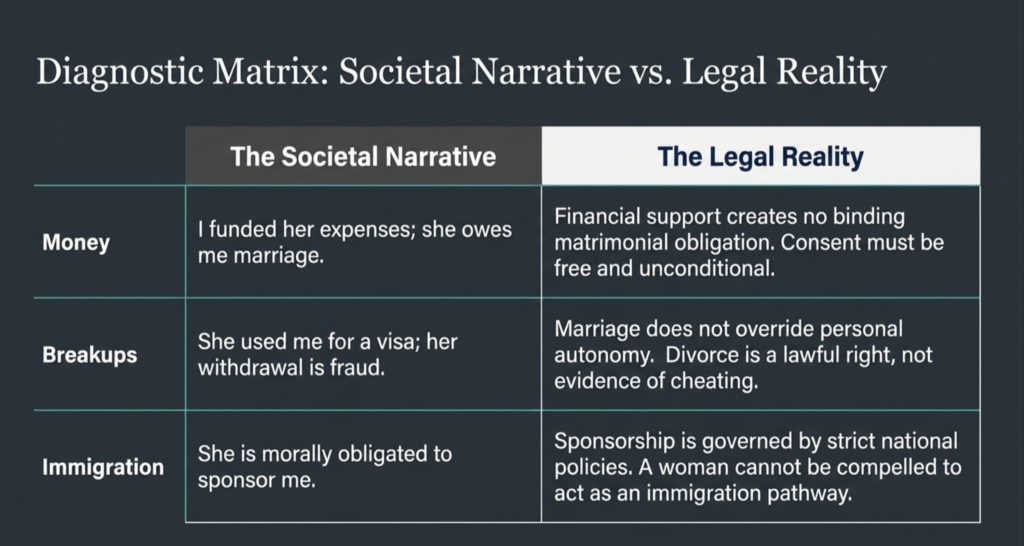
A fundamental legal principle is that Consent to marry must be free, continuous, and unconditional. Financial support does not create a binding obligation to marry, and it does not give rise to enforceable matrimonial rights to anyone. Giving financial support to someone does not justify coercion or threats.
If money has been transferred, the legal remedy lies in civil law, not in criminal law. However, threatening someone about criminal prosecution to recover money may itself be unlawful. As per Section 351 of the Bharatiya Nyaya Sanhita,2023, criminal intimidation includes threats to reputation and pressure to act against one’s will.
Changing Immigration Rules and the Downfall of IELTS Marriage
While much of the pressure on women revolves around sponsoring others abroad, the reality is that even securing Permanent Residency (PR) for oneself has become increasingly difficult. Countries like Canada, Australia and the United Kingdom have significantly tightened immigration rules in recent years.
Key challenges in obtaining PR:
- Frequent changes in immigration policies- Immigration systems are constantly evolving. Points-based systems, eligibility criteria, and occupation lists change frequently, which makes long-term planning uncertain and stressful.
- Rising CRS and Eligibility scores- In countries like Canada, the Comprehensive Ranking System (CRS) cut-offs have increased, making it extremely competitive to score even for qualified candidates.
- Limited Job opportunities- Many students are unable to secure jobs aligned with their field of study, which directly affects their eligibility for PR pathways.
- Requirement of Skilled work experience- Permanent Residency (PR) often requires specific skilled experience, which is difficult to obtain immediately after graduation, especially for international students.
- Employer Sponsorship barriers- Securing an employer willing to sponsor a visa is highly challenging, as companies prefer local candidates due to compliance and cost issues.
In such a restrictive environment, expecting a woman to sponsor another individual, arrange dependent visas or to facilitate PR becomes legally unrealistic and practically impossible.
Marriage for the Sake of Spouse Visa and Family Visa
A parallel and equally concerning pattern emerges in cases where marriage has already taken place, but the underlying expectations remain rooted in migration and settlement abroad. In many cases:
- A woman marries in India and later moves abroad for studies or work
- The husband and his family expect that she will sponsor him, arrange his visa, or secure permanent residency (PR) for him
- The marriage, though legally valid, becomes conditionally tied to immigration outcomes rather than emotional or personal compatibility
What begins as a marital relationship gradually turns into an immigration expectation, placing disproportionate responsibility on the woman.
There are many complications due to which migration expectations fail, such as:
- Sponsorship is not legally possible due to strict visa regulations
- PR is delayed, rejected, or highly uncertain
- The woman herself is struggling to secure her own status abroad
- The relationship deteriorates due to distance, pressure, or incompatibility.
These failures are often systemic, not personal, yet this distinction is ignored, and the blame shifts to the woman.
In some cases, even when a woman takes her husband abroad as a primary applicant or sponsor, the power dynamics in the relationship begin to shift negatively. Despite the woman’s financial contribution and role in facilitating migration, the husband may start asserting control over her personal and professional life just because he has funded the expenses of sending her abroad.
- This control may include restricting her independence, monitoring her activities, influencing her career decisions, or dominating household and financial matters.
- The imbalance creates emotional strain, leading to conflicts, incompatibility, and a gradual breakdown of mutual respect in the relationship.
- The woman, already managing financial pressure, immigration uncertainty, and work responsibilities, may experience additional psychological stress due to this controlling environment.
- These situations highlight that migration does not automatically lead to progressive or equal relationships. Such patterns ultimately contribute to separation or divorce due to sustained incompatibility and emotional distress.
Divorce After Migration: A Legal Right, Not a Wrong
When migration does not materialize, allegations of cheating or false promises are made against women despite the lack of any legal obligation. The character of the woman is questioned, and motives are represented, even the family members of women face pressure and harassment. Legal threats are used by the other party as tools of coercion, and emotional guilt is imposed on women for circumstances that are beyond their control.
Such pressure leads to marital breakdown, and the woman may choose divorce. However, this is often misrepresented by society as “women are using marriage for personal gains”, and divorce is considered a betrayal rather than a legal remedy for separation.
Legally, the position is clear:
- Marriage does not override personal autonomy
- Either spouse can seek a divorce if the relationship fails
- Divorce is a lawful right, not evidence of fraud
Marriage is based on consent and compatibility, and immigration is governed by law and policy. A woman cannot be compelled legally or morally to act as an immigration pathway for her spouse.
The Legal Blind Spot: Ignoring Ground Realities
One of the most concerning aspects is that these real-life challenges are often completely ignored when allegations are made against women in India. While courts have taken progressive views at the ground level, FIRs are still registered against women without deeper scrutiny. Social narratives often favour the complainant without fully understanding the entire context. The woman’s struggle abroad is rarely considered.
This creates a perception of legal and social imbalance where expectations are imposed without acknowledging reality, and pressure is justified without understanding the circumstances. Even when money is returned, harassment often continues with repeated threats, social pressure and attempts are made to control the personal decisions of women. This suggests that the issue is not financial, but rather control, entitlement, and ego.
Escalation into False FIRs, proclaimed offender status and look-out circular
In several cases, when a woman is unable to take the man abroad, secure his visa, or facilitate Permanent residency (PR), the situation is deliberately reframed as deception or fraud. As a result:
- False FIRs are filed alleging cheating, criminal breach of trust, or misrepresentation.
- Non- cooperation allegations are raised if the woman is abroad and unable to immediately appear before investigating authorities. This is frequently used to portray her as absconding, even when her absence is due to visa restrictions, employment obligations or financial constraint.
- Proclaimed Offender (PO) proceedings are initiated in extreme cases. If a woman does not appear before the court due to the practical difficulties of international travel, the court may proceed to declare her a proclaimed offender under procedural law.
- Look-out circulars (LOCs) are issued, which restrict her movement. This can result in detention or questioning at airports upon entry into India, effectively limiting her ability to travel freely or return home without fear of arrest.
When matters escalate to FIRs, proclaimed offender proceedings, or lookout circulars, a woman can take following steps in such cases:
- Seek anticipatory or transit bail- if there is an apprehension of arrest upon arrival in India, the woman can apply for anticipatory bail or transit bail to ensure protection from immediate custody.
- Apply for cancellation of look-out circular (LOC)- LOCs can be challenged before the appropriate High court or authority. Courts have held that LOCS should not be used as a tool of harassment in private disputes without serious criminal intent.
- Contest Proclaimed Offender (PO) proceedings– If declared a proclaimed offender due to non-appearance, the woman can approach the court to set aside such orders by providing valid reasons such as being abroad, lack of notice, or inability to travel.
- Maintain documentary proof of stay abroad- Travel records, visa status, employment documents and communication records can be used to demonstrate that non- appearance was not intentional evasion.
Legal Safeguards and Preventive Measures for Women
In situations where financial support, emotional expectations and legal threats become entangled, it is essential for women to understand that they are not without protection. Both law and practical awareness provide multiple layers of defense if used in a timely and correct manner.
- Establish financial clarity from the beginning- One of the root causes of such disputes is the absence of clarity in financial transactions. In the absence of documentation, the other party may later misrepresent the nature of the transaction, claiming it was conditional or induced by promise.
Women should clearly understand whether the money being given is a gift, a loan or support. Women should avoid accepting large financial assistance without written acknowledgement. If money is taken, women should maintain records of bank transfers, messages or agreements.
- Avoid Informal or conditional financial dependency- Financial dependency often becomes the foundation of control. Women should refrain from accepting money tied to implicit expectations of marriage or future benefits.
Women should be cautious if financial help is repeatedly accompanied by statements like, “I am investing in our future” or “we will settle abroad together later”. Such statements are later used to construct a narrative of obligation, even when no legal agreement exists.
- Preserve every form of communication- Documentation is one of the strongest legal protections. Women should save WhatsApp chats, emails, call records and financial proofs and avoid deleting conversations. Women should keep backups of important communication. Digital evidences are also admissible in courts now.
Courts rely heavily on such evidence to determine whether the relationship was genuine or not and whether any false promises were made.
- Respond strategically to threats- When threats of FIR or legal action begin, panic often leads to wrong decisions. Women should avoid reacting emotionally or making any impulsive payments. Women should not admit liability under pressure. Women should respond calmly in such a situation, and if needed, they should respond through legal notice. Many threats are pressure tactics, not legally sustainable cases.
- Seek early legal advice- Delaying legal consultation can worsen the situation. Women should consult a lawyer as soon as threats begin, money demands escalate, or marriage pressure becomes coercive. Early advice helps in assessing legal risk, planning defense strategy and preventing escalation of money demands.
- Protection against criminal intimidation- If threats become serious, legal remedies are available. Under section 351 of the Bharatiya Nyaya Sanhita (BNS), women can file a complaint for threats to their reputation and safety. Women can take action against coercion or harassment by filing a complaint under section 351 of BNS. The law does not just defend against false cases, but it also protects against those who misuse threats as a weapon.
- Challenge the FIR at the earliest stage- If an FIR is filed against a woman, then the woman has the right to approach the High Court under section 528 of the Bharatiya Nagarik Suraksha Sanhita (BNSS) to quash the FIR. Courts, including the Punjab and Haryana High Court, have repeatedly quashed FIRs in cases of failed relationships and prevented the misuse of criminal law in personal disputes. An FIR is not the end, it can be legally challenged and set aside.
- Do not succumb to PR or sponsorship pressure- People must understand that sponsorship and PR are governed by strict immigration laws, no individual can be forced to sponsor another person. Even genuine spouses face legal and financial scrutiny. Women should clearly communicate their inability or unwillingness and avoid making false promises under pressure, because agreeing under pressure may create further complications legally.
- Protect Family from Indirect Pressure- often the pressure shifts to the woman’s family also, women should inform all family members about the situation early and advise them not to engage in negotiation under fear. Women should keep communication transparent within the family because isolation increases vulnerability, and awareness strengthens defense.
- Understand your absolute legal rights- Every woman must internalize that she has a fundamental right to refuse marriage, she cannot be forced into any relationship, and financial help does not create ownership or obligation. Clarity of rights removes fear, and fear is often the biggest tool of control.
This issue is not about money, migration or a failed relationship, it is about control being disguised as expectation. The law is clear, no person can be compelled into marriage, sponsorship or continued relationships based on financial involvement. Consent remains central, autonomy remains absolute, and legal rights cannot be overridden by social narratives. Until these distinctions are understood, the misuse of emotional, financial and legal pressure will continue, turning aspirations into disputes and independence into liability.
For more information on the issue contact us at info@nrilegalworld.com/+919709692096
Frequently asked questions
Q.) Can financial support for IELTS or studying abroad create a legal obligation to marry?
Ans.) No, financial support does not create any legal obligation to marry. If a person files a case of cheating, then it must be evident that there was a fraudulent or dishonest intention from the very beginning of the relationship. A later refusal to marry or a change in circumstances does not convert financial help into a legally enforceable promise of marriage.
Q.) Can a man file a cheating case if the woman refuses to marry after going abroad?
Ans.) A complaint can be filed, but it does not automatically amount to a valid criminal case. Courts have repeatedly clarified that mere breach of a promise to marry is not cheating unless there is strong evidence that the promise was false at the time it was made. Most such disputes are viewed as personal relationship breakdowns rather than criminal offences.
Q.) What should a woman do if she is threatened with an FIR or legal action?
Ans.) She should avoid panic and should not take any hasty decisions under pressure. It is important to preserve all communication records, avoid making admissions of liability and consult a lawyer at an early stage. Many threats are used as leverage, and a timely legal response can prevent escalation or misuse of the process.
Q.) Can a woman be forced to sponsor someone for a visa or Permanent Residency after marriage?
Ans.) No, sponsorship and PR are governed by immigration laws, eligibility criteria and government policies, not by marital expectations. Even in a valid marriage, there is no legal obligation on a spouse to sponsor the other, especially when eligibility conditions are not met.
Q.) What if the woman is unable to take her husband abroad after marriage?
Ans.) Failure to secure a visa or PR cannot be treated as a legal wrong. Immigration outcomes depend on multiple external factors such as policy changes, job requirements and eligibility thresholds, which are beyond individual control. A woman cannot be held liable for outcomes that are regulated by foreign immigration systems.
Q.) What legal remedy is available if a false FIR is filed?
Ans.) If an FIR is filed without a sufficient legal basis, the aggrieved person can approach the High Court seeking quashing of the FIR under Section 528 of the Bharatiya Nagarik Suraksha Sanhita (BNSS). Courts have consistently intervened in cases where criminal law is misused to settle personal disputes, particularly in matters arising out of failed relationships.
Comments are closed