
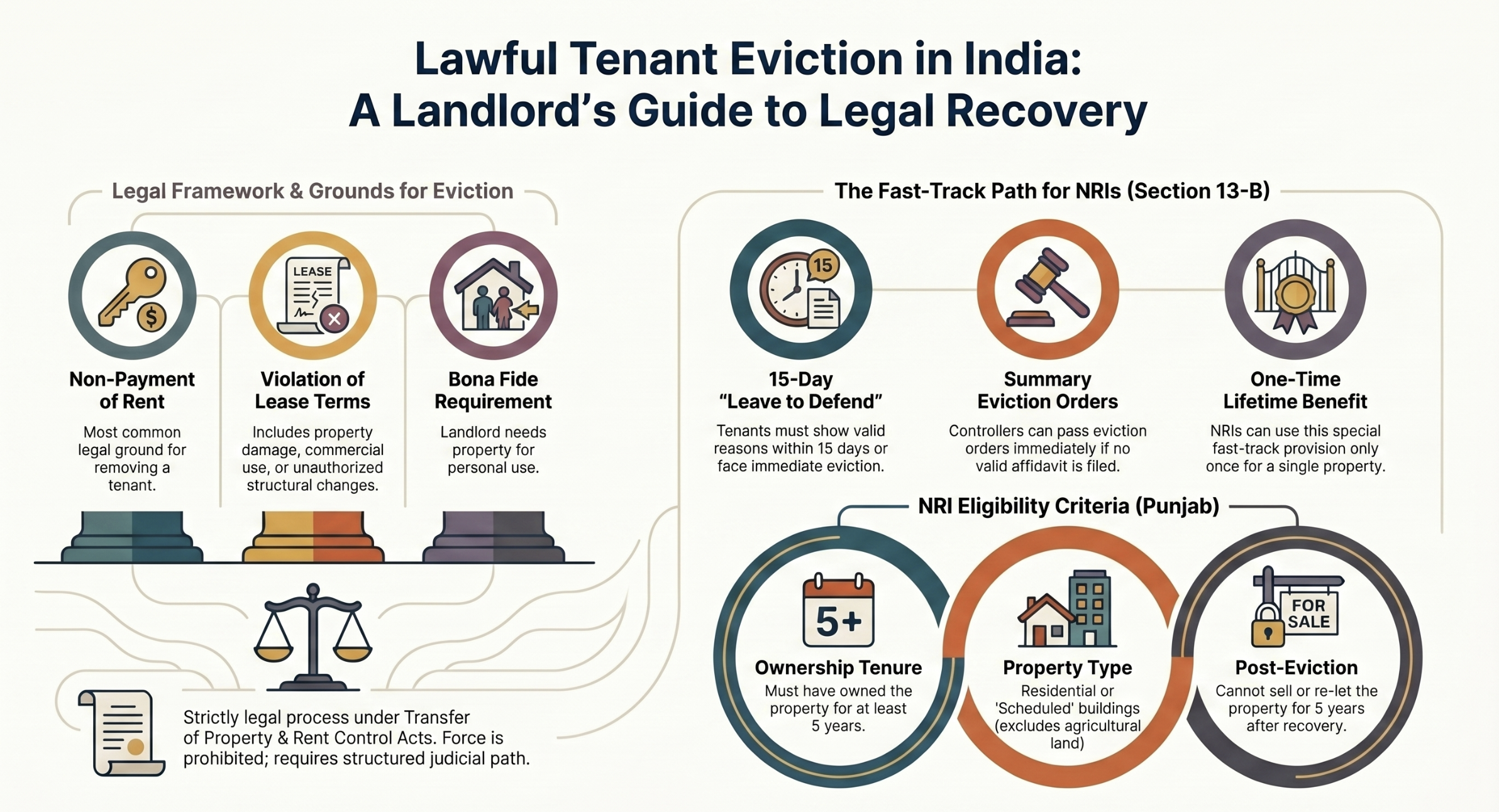
Owning a property is a major investment and a source of security for many people. However, one of the biggest challenges/problems that the property owner faces is dealing with illegal tenants. Illegal tenants are the people who occupy property without proper legal rights or refuse to leave even after their agreement ends. Eviction of illegal tenants is a legal process; it is not something that can be done forcefully. Many landlords make this mistake by taking the law into their own hands, which can lead to serious consequences. There is a proper legal procedure for the eviction of illegal tenants that the landlords must follow.
Who are illegal tenants?
An illegal tenant is not always someone who entered illegally, in many cases, it is a person who initially entered legally but later became illegal due to certain actions or situations. A person becomes an illegal tenant when they no longer have a legal right to stay in the property but they still continue to occupy it.
Types of illegal tenants
1) Tenant not paying rent: These are the tenants who do not pay their rent regularly and violate the financial obligations. Initially these tenants are known to be legal tenants but after they fail to pay their rent on the fixed time they are termed as illegal tenants and they are liable for eviction
2) Overstaying Tenants: These are the tenants who refuse to vacate the property after the expiry of the agreement. Any tenant does not have any legal right to stay in the property once their agreement expires.
3) Tenants violating terms of agreement: The tenant who breaks the terms and conditions of the agreement, such as causing damage to property, using the property for illegal use, commercial use of residential property or any condition agreed in the agreement, will be termed as an illegal tenant
4 ) Unauthorised occupant: An unauthorised occupant is a person who never had permission to occupy the property, but he still enters the property or stays in the property without any legal right. Common types of unauthorized occupants are a stranger occupying vacant property, a relative refusing to leave, a servant/caretaker overstaying etc.
Legal rights of landlords in India
1 ) Right to receive rent on time
2) Right to peaceful possession after the lease Ends
3) Right to claim damages or unpaid rent
4 ) Right to evict tenant for valid reasons
Legal Grounds of Eviction of Tenant:
1) Non-payment of Rent: This is the most common and strongest ground for eviction. If the tenant does not pay rent, then the landlord gets a strong legal right to evict the tenant
2) Expiry of lease agreement: A lease is always done for a fixed period of time. After the lease expires, the tenant must vacate the property. If the tenant refuses to leave, the landlord has the full right to evict the tenant through the court process.
3) Violation of terms of agreement: Every rent agreement has certain terms and conditions which are to be followed by the tenants, if the tenants violate these terms, it becomes a breach of agreement, therefore the landlord gets a valid ground for the eviction.
4) Personal use by owner: A landlord can seek eviction if the property is genuinely required for personal use or for use by close family members. This ground is recognized under most rent control laws in India and it is known as a Bona fide requirement. This court verifies the genuineness of the landlord’s claim by examining factors like genuine need, availability of alternative accommodations etc.
5) Unauthorised Occupation: Unauthorised occupation is when a person is living in a property in which he has no legal permission to stay, or continues to stay even after the permission to stay. The law says that no one can stay in someone’s property without permission; in such cases the law provides the legal grounds of eviction to the landlord.
Laws Governing eviction in India
Eviction of tenants in India is not a simple or forceful act; it is strictly governed by law. Different laws are applied depending on the different types of situation like the type of property and state rules. The legal framework governing eviction in India creates a careful balance between the rights of landlords and tenants. Laws like the Transfer of Property Act, 1882, the State Rent Control Act and the Civil Procedures Code, 1908 ensures that eviction is carried out in a fair, structured and lawful manner. While the landlords are given the right to recover possession and claim dues, tenants are protected from arbitrary and forceful eviction.
1 ) Transfer of Property Act, 1882: This is the basic law governing landlord & tenant relationships in India. It is applied when there is no Rent Control Act applicable, or when the property is not protected under rent laws
2) State Rent Control Acts: These are the special laws that are made by the states to protect the tenants, such as the Delhi Rent Control Act, 1958, Punjab Rent Act. These laws protect tenants from arbitrary or unfair evictions
3 ) Code of Civil Procedure, 1908 (CPC): This law governs the procedure of eviction cases. Section 9 of the CPC states that Civil courts can hear the eviction cases. CPC ensures the fair trial and legal procedure of the eviction cases.
Special provisions for NRIs for eviction of tenants from their properties in Punjab, India
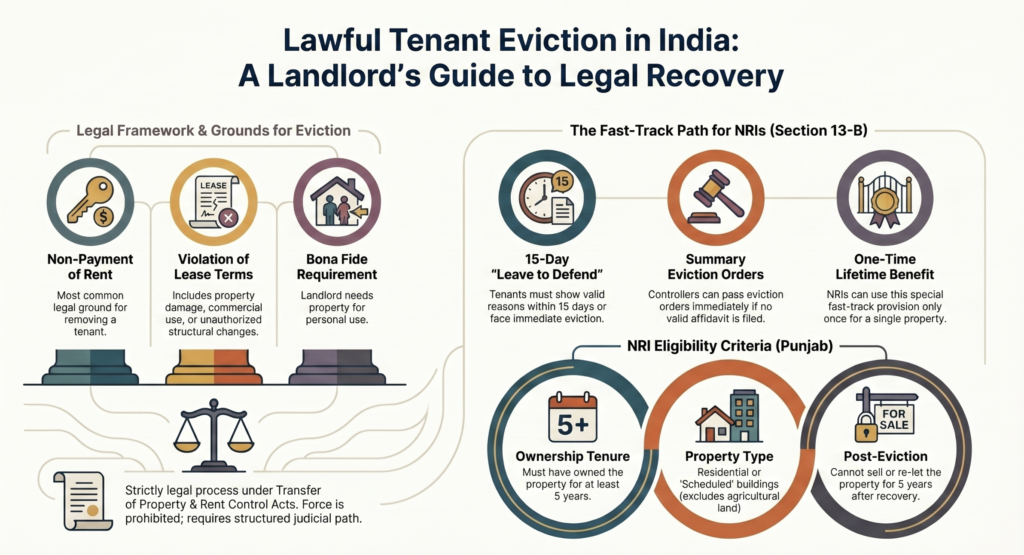
The law in Punjab gives a special benefit to Non-Resident Indians (NRIs) who are facing problems with tenants not vacating their property. This benefit is provided under section 13-B of the East Punjab Urban Rent Restriction Act, 1949. The purpose of this provision is to help NRIs, who are living in abroad , to get back possession of their own property easily & immediately in Punjab when they genuinely need it
In simple terms, this law says that if you are an NRI and you require your house or shop for your own use or for a family member, you can approach the court for eviction of the tenant. Unlike normal cases you do not have to prove that the tenant has done something wrong like not paying rent etc, therefore your genuine need to use the property is considered as valid ground for eviction.
Key aspects of the act-
A ) Defines an NRI- Section 2 (dd) of the act provides a clear definition of an NRI, according to this act, “Non-resident Indian” means a person of Indian origin, who is either permanently or temporary settled outside India for employment, for carrying on a business or vocation, for any other purpose , or in such circumstances that indicate his intention to stay outside India for an uncertain period.
B) Eligibility of owner – According Section 13B(1) of the act an Nri who has returned to India and needs the residential/commercial property for their own use or for any family member dependent on them, can exercise their right for eviction under this act.
C) Fast track procedure- Section 13-B of the act uses a special fast-track procedure under section 18-A of the East Punjab Urban Rent Control Act, 1949The cases under section 13-B are not decided like the normal Eviction cases, they follow section 18-A, which creates a summary(fast track) procedure as follow:-
1 ) Filling of petition- Following section 18-A(2) an NRI files eviction petition under section 13-B of the act. This petition is filed before the Rent Controller that is appointed by the state.
2 Issue of special summons- Controller issues special summons to the tenant under section 18-A(3) of the act. These are not the ordinary summons, in this the controller clears the tenant to respond within 15 days & the tenant needs a permission (“leave to defend”) to contest
3 Tenant must apply to defend – under section 18-A(4) the tenant must file an affidavit in the court, disclosing the facts and showing valid reasons to defend. The tenant cannot contest automatically, they need a permission from the court known as leave to defend. The affidavit must be filed within 15 days of the service of summons.
4 Automatic eviction – under section 18-A(5) if the tenant fails to apply affidavit within 15 days , or fails to disclose valid grounds then the Controller shall pass an eviction order immediately, without any trial, evidence stage & any kind of long hearings
5 If leave is granted– under section 18-A(6) if the controller is satisfied that tenant has raised trialable issues or valid grounds then the leave to defend is granted to the tenant and the case proceeds like a regular trial
6. Final decision – Under Section 18-A(7), the controller passes a final order after hearing from both sides. If the landlord proves a Bonafide need then eviction is granted.
Conditions to use section 13-B for NRIs
1) Ownership tenure – The Nri must have owned the property for at least 5 years before filing the eviction petition. If the ownership is below 5 years, the eviction petition is invalid under this act.
2) Bonafide requirement– The Nri must require the property for his/her own residence or for own business/vocation or personal use, that means the requirement must be genuine.
3) Applicable for one property only– An NRI can use this provision for the eviction of only one of his several properties. The Nri has the right to select any one of his properties on which he wants to exercise his right.
4) Applicability of property– Section 13-B covers residential buildings, and scheduled buildings( buildings used partly for residence and partly for profession, like office of a doctor/lawyer). It may also be applied to commercial use depending on interpretation of scheduled building of the act. This act cannot be used in agriculture property.
5) One time benefit– According to Section 13-B(2), an NRI can use this special provision only once in his lifetime on one of his properties.
6) Restriction after eviction– After getting the eviction of the tenant from the property, as per Section 13-B(3), the NRI cannot re-let the property and cannot transfer the property in any form such as sale/gift to anyone for at least a time period of 5 years. If the NRI violates this condition the evicted tenant can apply for restoration of property.
Process of Eviction of tenants from NRI property
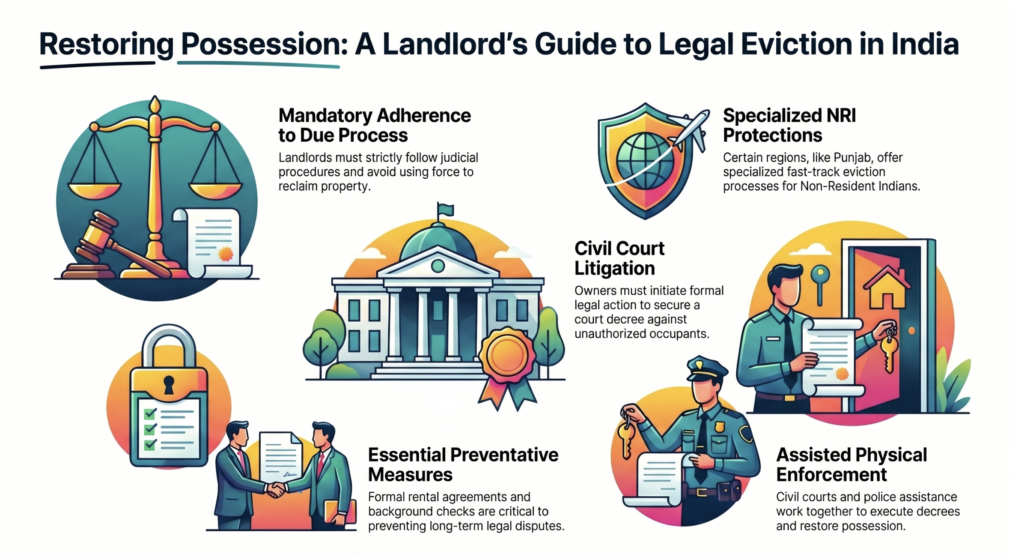
Step 1: Termination of tenancy: It is the very first step, in this, the landlord legally ends the tenancy before eviction by sending a legal notice under the Transfer of Property Act 1882
Step 2: Filing of eviction suit: If the tenant does not vacate the property after notice, the landlord files an eviction suit in a civil court under Transfer of Property Act or the Relevant State Rent control act
Step 3: Service of summons: Once the suit is filed, the court issues a summons to the tenants. Summonses are served under Bhartiya Nagarik Suraksha Sanhita (BNSS).
Step 4: Reply by Tenant: After the tenant receives the summons, the tenant files a written reply as their defence in court. This written reply is known as a written statement, in which the tenant may deny allegations, claim lawful possession or raise legal objections, etc.
Step 5: Evidence & Hearing: This is the main stage of the case, in which both parties present their evidence, such as documents, rent agreement, notices, rent receipts, etc., in the court
Step 6: Judgement/Eviction order: After hearing both sides, the court gives its final judgement. If the landlord succeeds, the court may pass an eviction decree/order or grant the tenant a particular time to vacate the property. If the landlord fails, the court may dismiss the suit.
Step 7: Execution of Decree: If the tenant still refuses to vacate the property, the landlord can file an execution application in the court. The court may authorise police assistance or allow forceful eviction through a court officer
Procedure for execution of decree
The process of execution of decree is the stage where the court ensures that the landlord actually gets physical possession of the property after winning the case. It is governed by 0rder XXI of the Code of Civil Procedure 1908.
Step 1: Obtaining certified copy of decree- After the eviction order is passed, the landlord applies for the certified copy of the decree/order from the court. It is required to start the execution proceedings.
Step 2: File execution petition- The landlord then files an execution application in the same court. This is a request asking the court to help in enforcing its order and getting back possession of the property.
Step 3: Request for Police and SDM help- If there is any fear that the tenant may not cooperate or may create problems, the landlord can request the court to provide police help and involve the SDM. This ensures safety and smooth execution.
Step 4: Court passes execution order– The court reviews the application and issues an order for execution. It may also direct the police to assist and inform the local administration, including SDM.
Step 5: Contact Police and SDM office– After receiving the order, the landlord approaches the local police station and SDM office with the court documents. This helps in planning and coordination.
Step 6: Fix a date for eviction– A date is fixed for execution with the help of the court officer known as bailiff, police officials including SDM if involved. Everyone is informed in advance.
Step 7: Visit to the property– On the fixed day, the bailiff visits the property to carry out the eviction. Police authorities are present to maintain peace and prevent any disturbance. The SDM may also supervise the process if required.
Step 8: Removal of tenant– If the tenant refuses to vacate, the bailiff, with the police support, can remove the tenant. If the property is locked, it can be opened as per court permission.
Step 9: Handing over possession– Once the property is vacated , possession is officially handed over to the landlord. The landlord can then take control of the property.
Step 10: Report to court- This is the final step in which the bailiff submits a report to the court confirming that the eviction has been successfully carried out. The case is then closed.
HOW TO PREVENT ILLEGAL TENANCY?
1 ) Written Agreement – A written rental agreement is the most important safeguard for a landlord. The agreement should include details like rent, duration of tenancy, security deposits, notice period etc. It is advisable to register the agreement under the Registration Act,1908, especially if lease is for more than 11 months.
2 ) Police Verification – Police verification helps in confirming the identity and background of the tenant. The landlord should submit tenant details such as ID proof, Photographs etc. to the local police station. This protects the landlord from legal complications or liability if the tenant is involved in any crime or illegal activities
3) Background check – A proper background check of the tenant reduces risk of renting to problematic tenants. The landlord must verify the tenant’s employment status, income stability, any history of defaulting on rent or disputes
4) Clear Terms and Conditions – All the terms and conditions related to the agreement/lease of the property must be cleared in the starting itself. If the terms and conditions are cleared already then it makes easier for the landlord to take legal action if the tenant violates conditions
Role of police in Eviction of illegal tenants from property in India
In India, the police have a limited but important role in eviction matters. Police cannot act independently to remove a tenant from the property, but it can remove the tenant from the property if the landlord obtains a valid eviction decree/ order from the court. Eviction is primarily a civil matter that is governed by laws like Transfer of property Act, 1822 and procedures under the Code of Civil Procedures,1908.
- Police cannot evict without a court order: Eviction is a civil matter, and only a competent court can order eviction therefore, police do not have the authority to evict the tenant on the landlord’s complaint. Any forceful eviction without legal process can be termed as illegal.
In the landmark judgment in Krishna Ram Mahale v. Shobha Venkat Rao Supreme Court of India highlighted the principle that “A person in possession cannot be disposed of without following due process of law”. That means even if the tenant is illegal or has no right to stay in the property, the landlord still cannot remove the tenant forcibly from the property. This judgement protects people from misuse of power and illegal force.
The principle established in this judgement makes it clear that possession is protected by law. Regardless of ownership disputes, the landlord always has to follow legal procedure through courts, and the police can only assist after a valid order.
2) Assistance after court order: Once the court passes an eviction decree, the landlord can initiate execution proceedings. During the execution, the court may direct the police to assist in enforcing the order. Following the court directions, police can help in removing the tenant if they refuse to vacate & ensuring that the court orders are properly implemented
In the landmark judgement in Samee Khan v. Bindu khan the Supreme Court of India established the principle that Justice must be enforced, not just declared. Which means courts are empowered to take all necessary steps, including directing police assistance to ensure compliance with their order. In eviction cases, this principle protects landlords from unnecessary delay and obstruction while maintaining due process of law; it ultimately ensures that court decisions are meaningful, effective and enforceable in reality.
3) Maintenance of law and order: The primary role of the police during the eviction is to maintain peace. Police prevent violence or clashes between landlord and tenant, damage to the property or public disturbance etc. If any party creates trouble, police can take action under criminal law to control the situation.
For more information on the topic contact us at info@nrilegalworld.com / +919709692096
Frequently Asked Questions:
1.Q) I am the landlord of the property. The tenant has not paid me rent for the last 6 months. What should I do?
Ans: Firstly, you should send a legal notice demanding rent payment. If the tenant still fails to pay, then you can file an eviction suit on the ground of non-payment of rent.
2.Q) The tenant agreement has expired, but the tenants refuse to vacate my property. I am an NRI based in Canada. Can I use force to get tenants out?
Ans: No, even after the expiry of the agreement, you cannot forcibly evict the tenants. The proper step is to file an eviction case in court
3.Q) I am an NRI landlord. I immediately want my property back for my own personal use. What can I do?
Ans: There is a special provision for the NRI properties located in Punjab, India where NRI landlords can file for eviction under Section 13-B of the East Punjab Urban Rent Restriction Act, using a fast-track procedure NRI Landlord can take back his property.
4.Q) After winning the eviction case, tenants still refuse to vacate. What can I do as an NRI landlord?
Ans: You can file an execution petition, and the court may authorize police assistance to evict the tenant
5.Q) can I complain to the police to remove tenants from the property?
Ans: No, the police do not have the authority to evict the tenant. Eviction can only be done after a valid court order. Police helps in executing the court orders in case the tenant refused to follow the court orders.
Comments are closed