

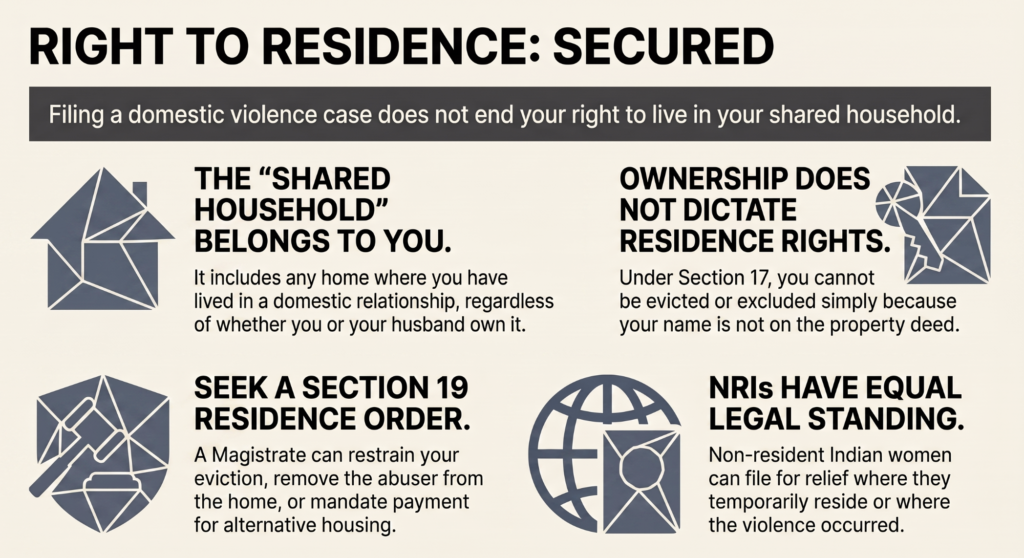
For a woman, facing domestic violence can be particularly challenging, especially when questions arise about her right to continue living in the matrimonial or shared household in India. Domestic violence is not limited to physical abuse, it may also include emotional abuse as well as acts that threaten or restrict a woman’s access to her home. The Protection of Women from Domestic Violence, including the right to seek protection and residence related relief. A woman does not automatically lose her right to reside in a shared household merely because she has filed a domestic violence case against her husband or his family. However, the nature of her right, the circumstances of her residence and the relief that may be granted by the court depend on the facts of each case.
The Domestic Violence Act treats NRIs and Resident Indians equally. It does not have any specific mention for NRIs. Hence, for an NRI woman who has been living in India or has a matrimonial home in India, understanding the concept of a “shared household” and the remedies available under the Domestic Violence Act is of utmost importance. This blog explains her rights after filing a domestic violence case, whether she can continue residing in the shared household and when she may seek alternative accommodation or other residence-related relief from the court.
Defining a Shared Household according to the act
“A shared household means a household where the person aggrieved lives or at any stage has lived in a domestic relationship either singly or along with the respondent and includes such a household whether owned or tenanted either jointly by the aggrieved person and the respondent, or owned or tenanted by either of them in respect of which either the aggrieved person or the respondent or both jointly or singly have any right, title, interest or equity and includes such a household which may belong to the joint family of which the respondent is a member, irrespective of whether the respondent or the aggrieved person has any right, title or interest in the shared household;”
Right to residence Under Section 17 of the Act: Section 17 of the Domestic Violence Act provides that every woman in a domestic relationship has the right to reside in the shared household, irrespective of whether she has any right, or beneficial interest in that property. It further protects her from being evicted or excluded from the shared household except through due legal process.
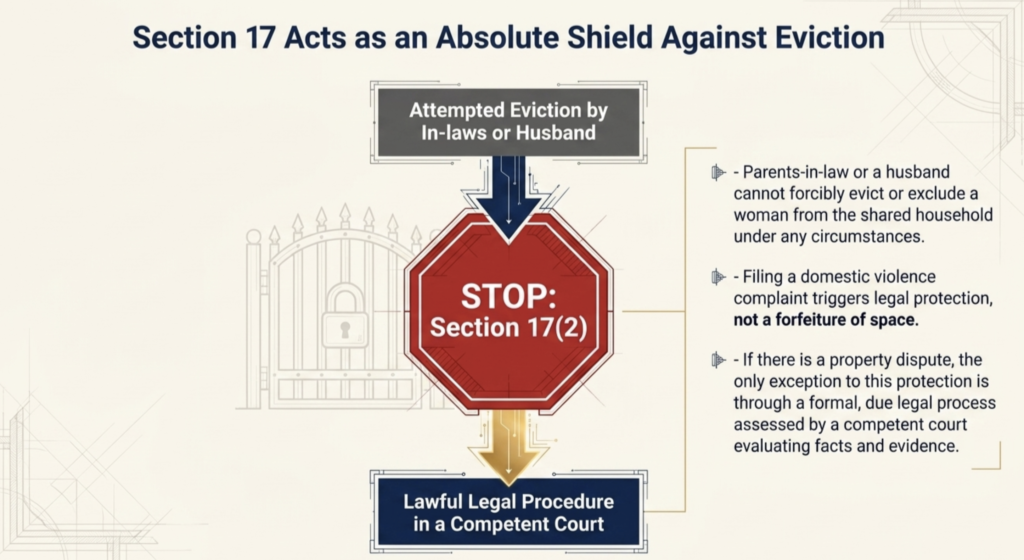
In simple terms, a husband or in-laws cannot dictate “The house is not in your name, so you must leave.” Such a claim alone has no legal validity under the Act.
If a woman files a domestic violence complaint alleging abuse, her right to reside in the shared household does not automatically end. Instead, she may approach the Magistrate seeking a residence order under Section 19 of Domestic Violence Act. The court will then assess whether she could continue living in the shared household, or be provided alternate accommodation or any other suitable arrangements.
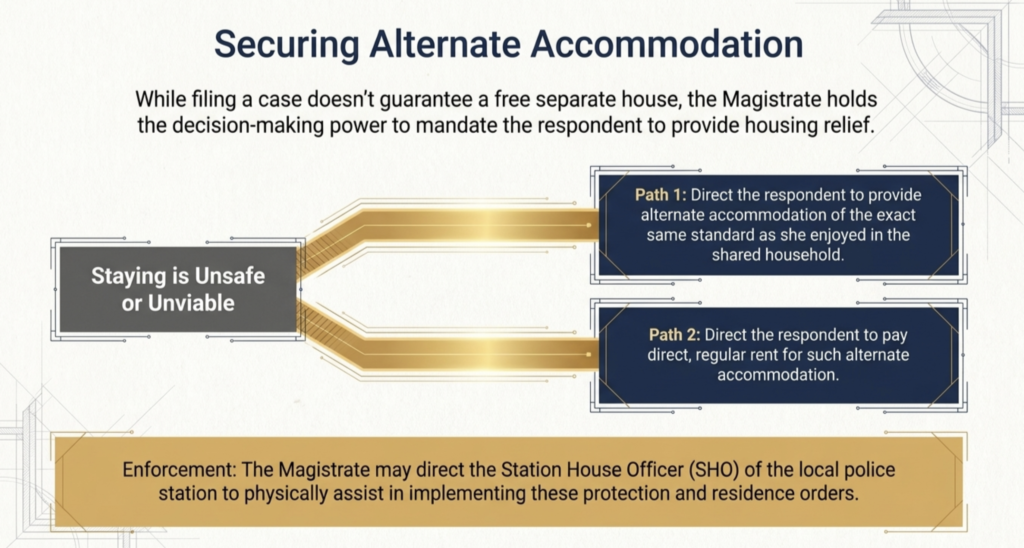
Section 19 of the Act also empowers the court to direct the respondent to provide similar standard alternate accommodation or pay rent for the aggrieved woman.
Ownership of Shared household
Ownership is not the deciding factor for residence rights under the Domestic Violence Act.
In the Landmark judgement of Satish Chander Ahuja v. Sneha Ahuja, 2020 the concept of “shared household” cannot be restricted only to property owned by the husband. The court held that a woman’s right to reside can exist even without ownership or title in the property. Therefore, residence rights under the Domestic Violence Act and property ownership rights operate independently.
The Parents-in-laws cannot forcibly evict or exclude a woman from the shared household simply because she has filed a domestic violence case. Section 17(2) clearly prohibits such eviction except through lawful procedure. If there is a dispute, only a competent court can decide the issue after examining the facts and evidence.
At the same time, filing a domestic violence case does not automatically transfer ownership of the property to the victim of domestic violence, nor does it necessarily give her an unconditional right to remain in a particular property forever. The magistrate may grant appropriate residence orders after considering the circumstances of the case. Under Section 19 of the Act, the court can, among other things:
- Restrain the respondent from dispossessing the woman from the shared household.
- Restrain the respondent from disturbing her possession.
- In appropriate circumstances, direct the respondent to remove himself from the shared household.
- Restrict certain persons from entering the portion of the shared household where she resides.
- Restrain alienation or disposal of the shared household.
The woman can seek alternative accommodation under the Protection of Women from Domestic Violence Act, 2005. Under Section 19(1)(f) of the Domestic violence Act, 2005 but women do not automatically get a separate house or rent merely because she has filed a domestic violence case. The Magistrate has the decision making power, if required, to direct the respondent to provide the aggrieved woman with accommodation of the same level as she enjoyed in the shared household; or pay rent for such accommodation. In addition to this the Magistrate may direct the SHO of the local police station in whose jurisdiction the Magistrate has been approached to assist in the implementation of the protection order in a domestic violence case.
Can an NRI women file domestic Violence case in India?
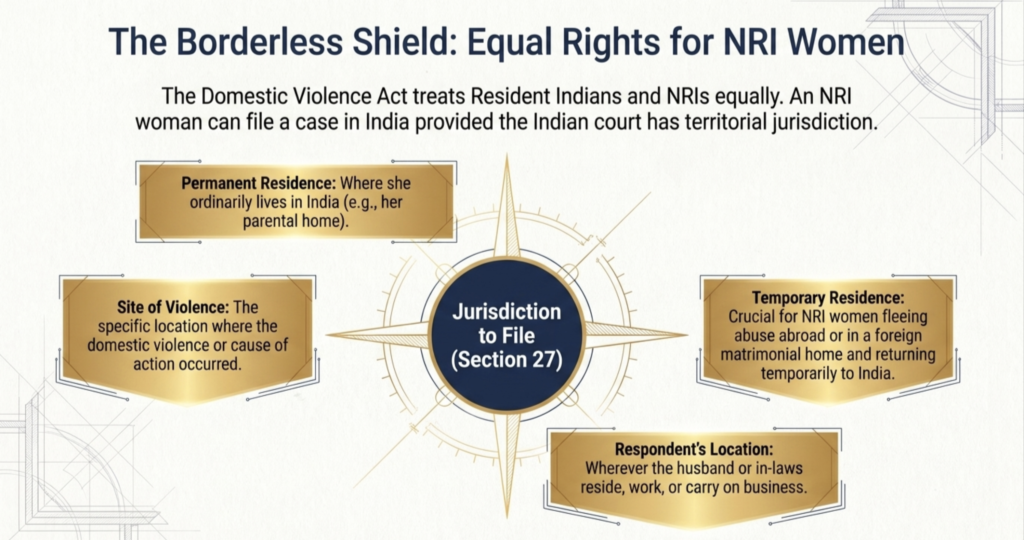
Yes, an NRI woman can file a domestic violence case in India under the Protection of Women from Domestic Violence Act, 2005, provided the Indian court has territorial jurisdiction under Section 27. Her NRI status does not by itself prevent her from seeking relief in India. Under Section 27(1), the application can be filed the Judicial Magistrate first class or Metropolitan Magistrate having jurisdiction over any one of these places:
- Where the woman permanently resides for example, if she ordinarily lives in India at her parental home.
- Where she temporarily resides this is particularly important for an NRI woman who comes to India after facing domestic violence abroad or in her matrimonial home.
- Where the respondent (Husband/ In-Laws) resides, works or carries on business.
- Where the domestic violence/cause of action occurred.
For more information contact NRI Legal World: info@nrilegalworld.com / +919709692096
Frequently asked Questions:
Q1. Can a victim of domestic violence seek other reliefs apart from the right to reside in the shared household?
Ans. Yes, The Domestic Violence act provides several forms of relief, including protection orders, residence orders, monetary reliefs, custody orders and compensation orders, depending upon the circumstances of the case. Therefore, a domestic violence proceeding need not be limited only to the question of residence.
Q2. What if the woman has already been removed from the shared household in a domestic violence case?
Ans. If the woman was already removed from the shared household then she may seek appropriate relief from the magistrate. Section 17(2) of the Domestic Violence Act, provides that an aggrieved woman shall not be evicted or excluded from the shared household by the respondent except in accordance with the procedure established by law.