
For Non-Resident Indians (NRIs), buying a house, apartment, or other real estate in India is often a significant financial investment. However, problems can arise when a builder delays possession, fails to provide promised amenities, changes the specifications, demands unjustified charges, refuses a refund or otherwise fails to fulfil contractual and statutory obligations. At that stage, one question commonly confuses NRI homebuyers:
Should I approach RERA or the Consumer Forum for property related complaints?
Both RERA and the Consumer Forum can provide remedies against builders in appropriate cases, but they are created under different laws and serve somewhat different purposes. An NRI should not choose a forum merely because someone says that “RERA is for property disputes” or “Consumer Forum is better for buyers/consumers.”
The correct choice depends on the nature of the dispute, the relief required, the buyer’s status (whether they qualify as a consumer), the project’s RERA status, jurisdiction (territorial and pecuniary), limitation, and the overall facts of the case. The Supreme Court has also clarified that RERA does not automatically exclude the jurisdiction of the Consumer Forum. In M/s Imperia Structures Ltd. v. Anil Patni, the court recognized that an eligible homebuyer can have concurrent remedies under RERA and Consumer law.
This makes it particularly important for NRIs to understand the difference before deciding where to file their case.
Understanding RERA and the Consumer Forum
Before deciding whether to approach RERA or the Consumer Forum, an NRI homebuyer must first understand that they are not two versions of the same thing. RERA is a specialized law and regulatory framework created specifically for the real estate sector. Whereas the Consumer Forum is a dispute redressal forum created under consumer law to protect consumers from deficiency in goods or services and unfair trade practices.
In simple terms, RERA is concerned with regulating the real estate industry and enforcing the obligations imposed on promoters, while the Consumer Forum is concerned with resolving a consumer’s grievance against a service provider or seller.
Understanding RERA
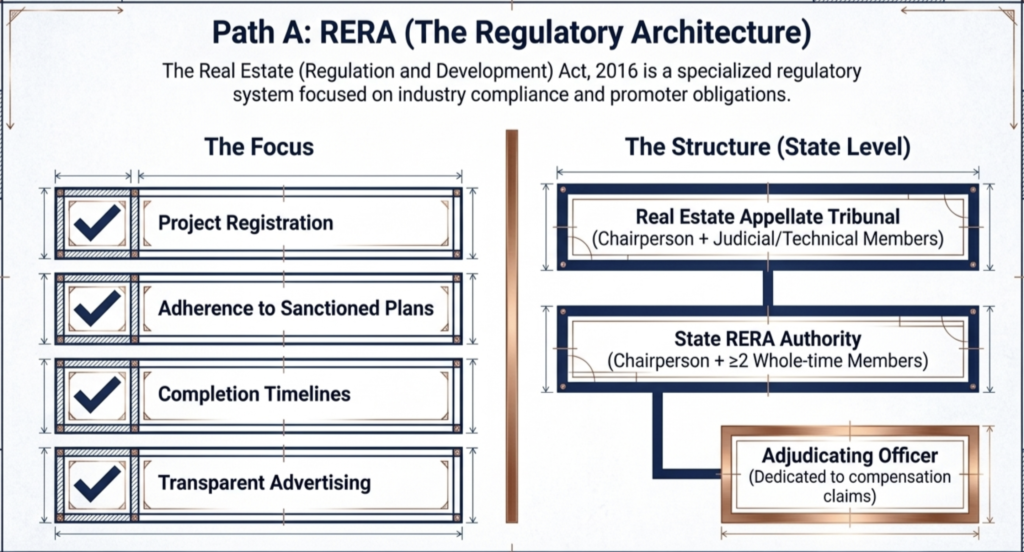
The Real Estate (Regulation and Development) Act, 2016 (RERA) was enacted specifically to bring greater regulation, transparency and accountability to the real estate sector and to protect the interests of homebuyers. Unlike general consumer law, RERA deals specifically with the relationship between real estate promoters, developers, real-estate agents and allottees.
One of its major features is that eligible real estate projects are required to be registered with the relevant State RERA authority. Promoters are required to provide specified information about their projects, including details relating to the project, approvals, sanctioned plans, timelines and other prescribed disclosures. RERA also imposes specific statutory obligations on promoters, such as
- Registration and disclosure of real estate projects
- Advertisements and representations made to prospective buyers
- Adherence to sanctioned plans and specifications
- The timeline for completion and possession
- Promoter obligations towards allottees
- Maintenance and transfer of title
- Interests and refund in specified circumstances
- Penalties for violations of the Act
- Changes to sanctioned plans and specifications
Therefore, RERA is not simply another court where a person files a complaint against a builder. It is a specialized regulatory system created specifically for real estate, with a regulatory authority, adjudicating mechanism and appellate tribunal.
Consumer complaint mechanism for NRIs
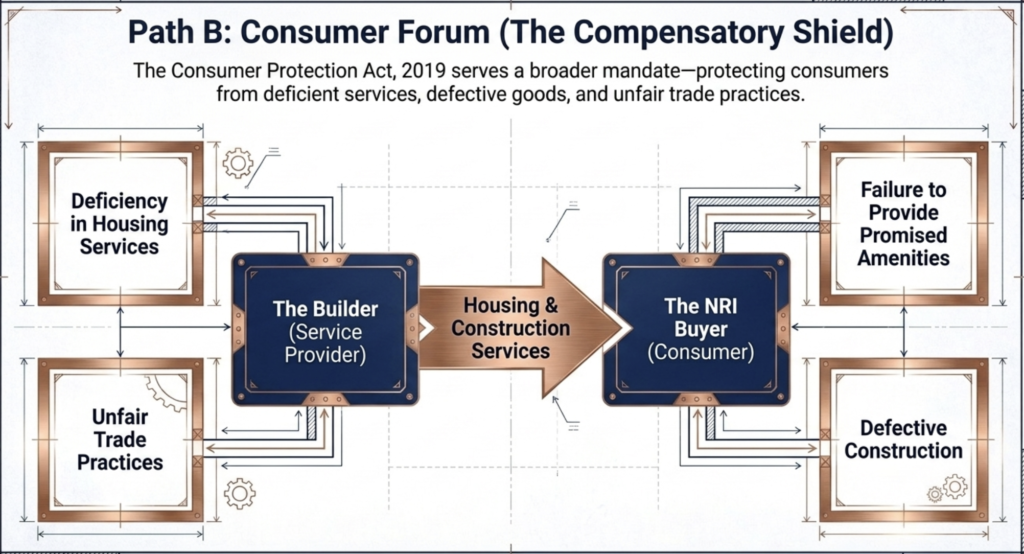
The Consumer Protection Act, 2019, on the other hand, is not limited to real estate. It protects consumers in relation to a much wider range of goods and services. A person may approach a Consumer Forum when a consumer dispute arises because of matters such as deficiency in service, defective goods, unfair trade practices or other violations recognized by consumer law.
Real estate buyers can fall within this framework because purchasing a residential property from a builder can involve the provision of housing and construction services. This means that an NRI who purchases a home from a builder may, where the statutory requirements are satisfied, be a consumer, and the builder may be treated as a service provider for consumer law. For example, if a builder:
- Delays possession
- Provides defective construction
- Fails to provide promised amenities or imposes unjustified charges
- Engages in an unfair trade practice
- Fails to provide the services promised to the buyer
- Provides deficient housing or construction services
The important distinction is that the Consumer Forum does not regulate the real estate industry as RERA does. Its role is to hear and decide consumer disputes and provide appropriate relief where a consumer’s rights have been violated.
Composition of RERA Authorities
RERA creates a specialized regulatory structure at the State level. Under Section 21 of RERA, the Real Estate Regulatory Authority consists of a chairperson and not less than two whole-time members, appointed by the appropriate government. RERA also provides for an Adjudicating Officer to adjudicate claims for compensation under specified provisions of the Act.
Now, you may be wondering what this RERA authority actually means in practical terms. For example, in Punjab, we have the Punjab Real Estate Regulatory Authority, commonly known as Punjab RERA. So, when a dispute relates to a RERA-covered project in Punjab, this is the state-level authority that an eligible homebuyer may approach, depending on the nature of the dispute and the relief being sought.
Above the authority is the Real Estate Appellate Tribunal, which hears appeals against specified orders passed by the RERA authority or adjudicating officer. The Appellate Tribunal has a chairperson along with judicial and technical/administrative members as provided under the Act.
Therefore, RERA is not simply a forum where a buyer files a complaint. It is part of a broader regulatory and adjudicatory system specifically created for the real estate industry.
Composition of Consumer Forum/Commission
The Consumer Protection Act, 2019 establishes a three-tier consumer dispute redressal system:
District Consumer Forum
The District Forum consists of a President and members as prescribed under the Act and applicable rules. The President must be a person who is, has been, or is qualified to be a District Judge, while members are required to meet the prescribed age, educational and professional experience requirements.
State Consumer Forum
The State Forum consists of a President and members as provided under the Act and applicable rules. The President must be a person who is or has been a Judge of a High Court, while members must fulfil the prescribed eligibility requirements, including the required age, educational qualifications and professional experience.
National Consumer Disputes Redressal Forum
The National Consumer Disputes Redressal Commission (NCDRC) functions at the national level and consists of a President and members as prescribed by law. The President and members are appointed by the Central Government in accordance with the qualifications and conditions prescribed under the Consumer Protection Act and the applicable rules.
Thus, while RERA is a specialized real estate regulatory framework, Consumer forums are specialized forums for customer disputes involving different sectors, including housing services where the purchaser qualifies as a consumer.
Concurrent Remedies Available to Homebuyers
One of the biggest misconceptions among homebuyers is that once a project is registered under RERA, the Consumer Forum can no longer be approached. The Supreme Court has rejected this broad proposition in the landmark case of M/s Imperia Structures Ltd. V. Anil Patni & Ors., (2020) 10 SCC 783. This is the most important judgment for understanding the relationship between RERA and Consumer Forums.
The developer had launched the “ESFERA” housing project in Gurgaon. Homebuyers booked apartments and entered into agreements with the developer. Disputes arose because of delay and non-completion of the project, and several buyers approached the Consumer Forum seeking relief. The developer argued before the Supreme Court that after RERA came into force, disputes concerning the project should be dealt with exclusively under RERA. It also questioned whether the buyers qualified as consumers.
The Supreme Court rejected the argument that RERA had completely displaced the consumer-law remedy. It examined the provisions of RERA, including Sections 18, 79 and 88, and held that the remedies under the Consumer Protection Act and RERA can operate concurrently. An eligible homebuyer is not automatically prevented from approaching the Consumer Forum merely because the project is covered by RERA.
This judgment addresses that a RERA-registered project does not automatically mean that the NRI has to file the case only before RERA. If the NRI qualifies as a “consumer” and the consumer complaint is otherwise maintainable, the Consumer Forum route can remain available. However, Concurrent remedies should not be misunderstood as an invitation to file duplicate proceedings seeking the same relief before multiple forums. The choice should be made after examining the facts, jurisdiction, relief sought, and litigation strategy.
RERA or Consumer Commission: Factors NRIs Should Compare
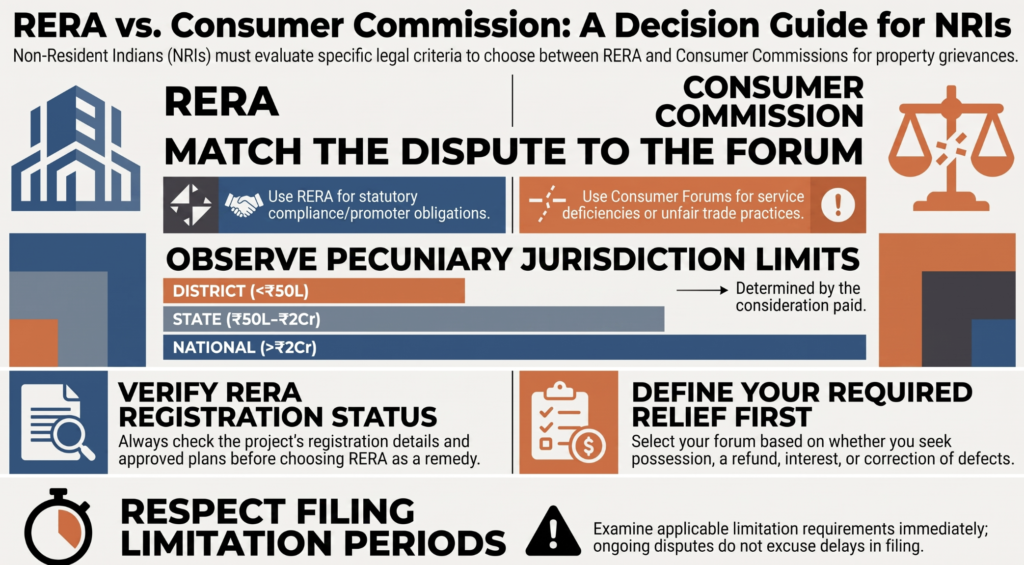
When Non-Resident Indians (NRIs) face issues with property developers, they must decide between filing a claim with RERA or a Consumer Commission. Selecting the appropriate forum depends on whether the primary grievance involves statutory compliance or a deficiency in service. NRI Investors should prioritize their specific goals, such as seeking a full refund, claiming interest, and demanding possession of the unit. It is also vital to verify the project’s registration status and confirm the pecuniary jurisdiction based on the total amount paid. Making an informed choice between these two regulatory bodies is essential for securing a favorable legal resolution.Before filing a case, an NRI must compare the two remedies based on the following factors:
Nature of the dispute
If the dispute is primarily about RERA compliance and the promoter’s statutory obligations, RERA may be the more natural forum. If the dispute is primarily about deficiency in service or unfair trade practice, a Consumer Forum may be particularly suitable
Status of the Project
The RERA registration status of the project should be checked, along with the project’s registration details, approved plans and current status.
Consumer Status
If the NRI intends to approach the Consumer Forum, it is important to establish that the purchaser qualifies as a consumer under the Consumer Protection Act.
Relief required
The NRI should first decide what he or she actually wants:
- Possession
- Refund
- Interest
- Compensation
- Correction of defects
- Promised amenities
- Enforcement of contractual or statutory obligations
- Another legally available remedy
The forum should then be assessed in light of that objective
Jurisdiction of consumer commission complaints
Both territorial and pecuniary jurisdiction should be verified before filing the case. Pecuniary jurisdiction of the Consumer Forum is determined on the basis of the value of the goods or services paid as consideration.
The District Consumer Forum has jurisdiction where the value of the consideration paid does not exceed Rs.50 lakh
The State Consumer Forum has jurisdiction where the value exceeds Rs.50 lakh but does not exceed Rs.2 crore.
The National Consumer Forum has jurisdiction where the value of the consideration paid exceeds Rs.2 crore.
Limitation
The limitation requirements applicable to the chosen proceeding should be examined before filing. Delay in approaching a forum should not be ignored merely because the dispute with the builder is continuing.
Existing Proceedings
If the NRI has already filed proceedings before one forum/authority, the implications of starting another proceeding seeking substantially the same relief should be carefully assessed, as starting multiple proceedings for the same cause can create legal complications.
Filing Before Both Forums Is Not Automatically the Best Strategy
The Supreme Court’s recognition of concurrent remedies does not mean that an NRI should automatically file both a RERA complaint and a consumer complaint. The judgment in Imperia Structures v. Anil Patni establishes that an eligible consumer can have remedies under both legal frameworks. It does not mean that every homebuyer should pursue duplicate proceedings for the same relief.
Starting multiple proceedings can create additional procedural and strategic complications. The fact that both forums/authority are available does not mean that an NRI is expected to guess which one is better. The choice should be driven by the dispute and the relief, not by the name of the forum/authority.
For a dispute centred on real-estate regulation and promoter obligations, RERA will often be the natural starting point. For a dispute centred on deficiency in housing services, unfair trade practices and consumer compensation, the consumer forum may be the more natural starting point.
Where the dispute genuinely falls within both frameworks, the NRI should compare the specific relief, jurisdiction, maintainability, limitation and enforcement considerations before making the final choice.
For more details contact NRI Legal World: info@nrilegalworld.com /+919709692096
Frequently Asked Questions
Q.) Can an NRI file a case against an Indian builder under RERA?
Ans.) Yes, an NRI who has purchased a property covered by RERA can approach the appropriate RERA authority if the dispute falls within its jurisdiction. Being an NRI does not by itself prevent a person from seeking relief under RERA.
Q.) Can an NRI approach the Consumer Forum against a builder?
Ans.) Yes, provided the NRI qualifies as a consumer under the Consumer Protection Act, 2019 and the dispute is otherwise maintainable. Issues such as delayed possession, defective construction, deficiency in service and unfair trade practices may give rise to a consumer complaint.
Q.) Is RERA better than the Consumer Forum for an NRI?
Ans.) RERA is generally the more natural forum where the dispute primarily concerns the promoter’s obligations and compliance under real-estate law, while the Consumer Forum may be more appropriate where the central grievance is deficiency in housing services or an unfair trade practice. The exact relief sought and the facts of the case should determine the choice.
Q.) If my project is registered under RERA, can I still approach the Consumer Forum?
Ans.) Yes, the Supreme Court in M/s Imperia Structures Ltd. V. Anil Patani held that the remedies under RERA and consumer law can operate concurrently. Therefore, RERA registration does not automatically take away an eligible homebuyer’s remedy before the Consumer Forum.
Q.) Should I file cases before both RERA and the Consumer Forum?
Ans.) Not automatically, although remedies may be available under both laws, filing parallel proceedings for the same dispute can create unnecessary procedural and strategic complications. The better approach is to compare the available remedies and choose the forum that provides the most appropriate route to the relief you actually want.