
Domestic violence cases involving NRIs, OCIs and Indian citizens abroad often require a careful balance between the laws of the country where the abuse is taking place and the Indian laws, especially when there is a strong connection such as marriage in India, Indian residency, property or children.
India’s Protection of Women from Domestic Violence Act, 2005 provides important remedies such as protection orders, residence rights, monetary relief, custody arrangements, and compensation. However, its application in international situations depends heavily on jurisdictional facts of the case.
Understanding jurisdiction of Domestic Violence cases according to the act
Section 27 of the Protection of Women from Domestic Violence Act, 2005 deals with jurisdiction. Under Section 27(1), the competent Magistrate’s Court is the court within whose local limits:
- The aggrieved woman permanently or temporarily resides, carries on business or is employed; or
- The respondent resides, carries on business or is employed; or
- The cause of action has arisen.
Furthermore, according to the Section 27(2) of the same act, an order passed under the DV Act is enforceable throughout India. This provision is extremely important for women who return to India after facing matrimonial difficulties abroad.
Important recent Delhi High Court Decision:
The question of jurisdiction becomes particularly important when an NRI woman alleges that she suffered Domestic Violence outside India but seeks remedies in India. Indian courts have considered several aspects of this issue, including the territorial operation of the Domestic Violence Act, the meaning of temporary residence, the right to approach an Indian court after returning to India, and the right to reside in a shared household.
Puneet Arora v. Kanika Khera & Ors. Delhi High Court 2025
In this case, the allegations of domestic violence pertained to a period when the parties were residing in Ontario, Canada. The Delhi High Court considered whether an Indian Magistrate could exercise jurisdiction under the Protection of Women from Domestic Violence Act, 2005 in respect of alleged acts occurring outside India.
The Court held that the DV Act does not contemplate extra-territorial operation and observed that its applicability is confined to the territory of India. Observed that the Act extends its to the territory of India. It reasoned that an Indian Magistrate cannot simply exercise jurisdiction over incidents occurring abroad/outside India as if occurring abroad as if the statute possessed extraterritorial reach.
Note: Ultimately, the applicability of these principles depends on the facts and circumstances of each case, and the question of jurisdiction must be determined by the court on the basis of the applicable law and the specific facts before it.
Kaushal Arvind Thakker v. Jyoti Kaushal Thakker & Anr. Bombay High Court, 2024
The Bombay High Court considered a case where allegations of domestic violence were connected with the parties’ residing abroad. The court examined Section 1(2) and Section 27 of the DV Act and discussed whether acts of domestic violence committed on foreign soil could be taken into consideration by an Indian Magistrate.
The Judgement discussed the argument that the DV Act does not extend beyond India. However, while considering Section 27, the Court also examined the independent jurisdictional bases contained in Section 27(1)(a) and (b), including the residence of the aggrieved person and the respondent.
Note: No single decision can be applied universally; each case must be examined independently in light of its particular facts, circumstances and the law applicable to those facts.
Alternate complaint mechanism for NRI women in Domestic Violence case
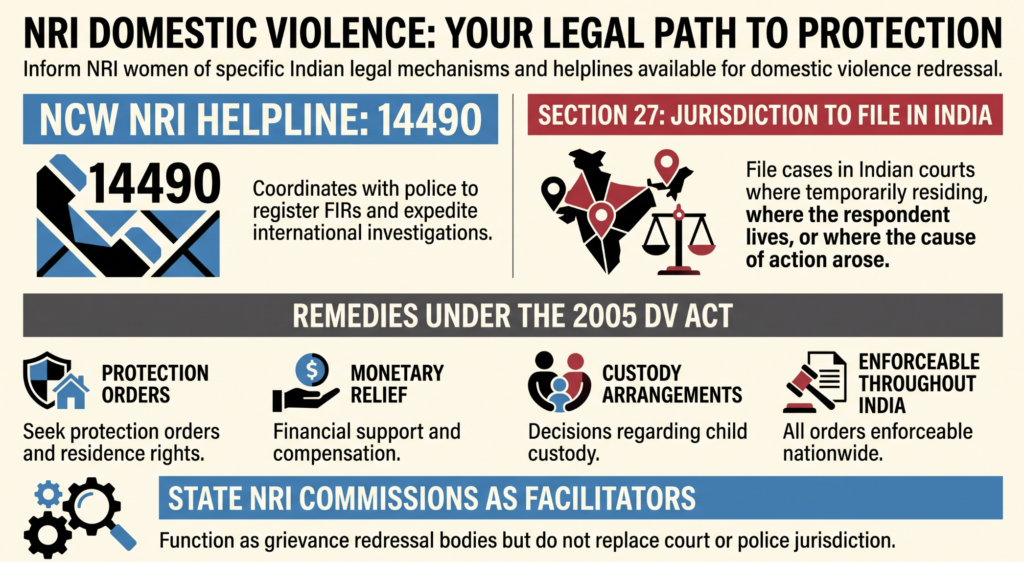
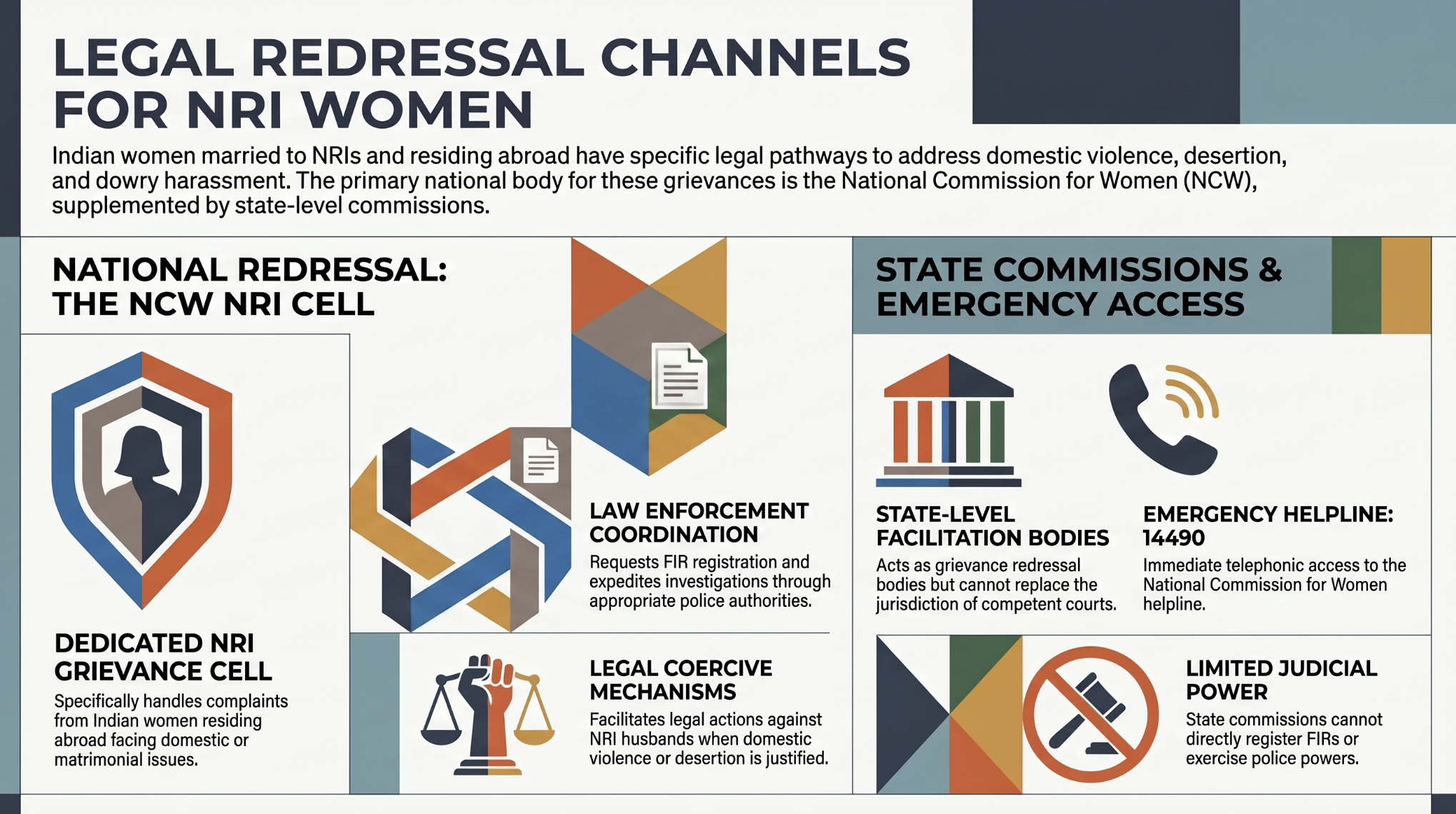
The National Commission for Women (NCW) has a dedicated NRI Cell to deal with complaints arising out of NRI marriages. The NCW states that the NRI Cell receives complaints of women who are residing abroad. Suppose an Indian woman is married to an NRI husband and, after marriage, the couple move to the UK. If she faces domestic violence, desertion or dowry related harassment, she can approach the National Commission of Women NRI Cell where her complaint falls within its mandate. The NCW can take up the matter with the concerned police authorities. According to the NCW, its intervention may include requesting police authorities regarding registration of an FIR, expediting investigation, appropriate coercive mechanisms against an NRI husband, where legally justified.
National Commission for Women (NCW) Women Helpline: 14490
Is NRI commission an option for NRIs women in such cases? Please elaborate on this one?
Yes, where the relevant state has an NRI commission or NRI related grievance mechanism, an eligible woman may approach it for assistance, depending on the Commission’s statutory jurisdiction. However, an NRI commission generally functions as a grievance redressal/facilitation body and does not replace the jurisdiction of a competent court. For example, the Punjab and Haryana High court has held that the Punjab state commission for NRIs could not itself direct registration of an FIR or exercise power belonging to the Police/courts. For NRIs matrimonial complaints at the national level, the NCW NRI cell is specifically intended to coordinate assistance in NRI marriage disputes.
Know theRight of a woman to reside in her In-Laws home after filing a domestic violence case https://nrilegalworld.com/right-of-a-woman-to-reside-in-her-in-laws-home-after-filing-a-domestic-violence-case/
What should a woman keep ready before making a complaint?
A woman should keep relevant information and documents available, such as her identity and contact details and details of the person against whom the complaint is being made, address and contact details of the husband or other respondent, marriage related documents, details of incidents of violence, medical records of injuries. A woman should not delay seeking help merely because she does not have every document. In an emergency or serious situation, safety should take priority.
Domestic Violence in an NRI marriage is often more complicated than an ordinary matrimonial dispute because it may involve two countries, different legal systems, questions of territorial jurisdiction, service of legal documents, enforcement of orders and the practical difficulty of accessing authorities from abroad. The Protection of Women from Domestic Violence Act, 2005 provides important remedies against domestic violence but in a cross border situation, the applicability of Indian law and the jurisdiction of an Indian court must be determined carefully on the facts of each case.
For information regarding the topic you can contact our expert team: info@nrilegalworld.com / +919709692096
Frequently asked Question:
Q1. If domestic Violence completely happened abroad, can NRI women still approach an Indian court?
Ans. Yes, an NRI woman can approach Indian courts. Because PWDV Act provides jurisdiction based on factors including where the aggrieved woman permanently or temporarily resides, where the respondent resides, or where the cause of action arose. Therefore, an NRI woman should obtain a jurisdiction on specific legal assessment rather than assuming that the place of marriage alone decides jurisdiction.
Q2 If the marriage was registered in India, but the couple live abroad. Where can they seek legal protection in a case like a marriage dispute ?
Ans. NRIs have remedies in the country where they currently live as well as potentially in India, depending on the applicable laws and jurisdiction. The appropriate forum depends upon the nature of the abuse, residence of the parties, location of the shared household, children, and other relevant facts.
Q3. Can an NRI Woman file a complaint in India without coming back to India?
Ans. Yes, an NRI woman may be able to initiate domestic violence proceedings in India without personally returning to India, depending on the facts of the case and the procedure permitted by the concerned court. She can authorise a trusted person through a properly executed Power of Attorney to assist with filing and pursuing the proceedings on her behalf. However, a POA does not automatically mean that the woman will never be required to appear personally because her personal presence will be required at certain stages, especially where the court considers her evidence, statement, examination or cross-examination necessary. The court may also permit appropriate modes of appearance in accordance with the applicable procedure.
Q4. Can an NRI woman approach the Indian Embassy or consulate for help?
Ans. Yes, An NRI woman facing domestic violence, harassment, abandonment or other marital difficulties abroad can approach the nearest Indian Embassy or consulate for consular assistance. The Mission may help her, understand her, and give her the local remedies, assist in approaching the local authorities, and where available connect her with local support organisations NGOs shelters or legal assistance. The Embassy or consulate does not act as her private lawyer or court and cannot itself decide the matrimonial dispute. If she wants to pursue legal proceedings in India, she should separately consult an Indian lawyer regarding the appropriate remedy, jurisdiction and procedure.
Q5. Does the jurisdiction for divorce and Domestic Violence proceedings depend on the same rules?
Ans. No. Divorce and Domestic Violence proceedings are governed by different statutory provisions, and their jurisdiction cannot automatically be treated as identical. For example, where the Hindu Marriage Act, 1955 applies, Section 19 specifically jurisdiction for matrimonial petitions. Depending on the circumstances, jurisdiction may arise where the marriage was solemnised, where the respondent resides, where the parties last resided together, or in certain circumstances where the wife is residing.
Q6: Does dowry and domestic violence come under the same law in India?
Ans. No. Dowry and domestic violence are governed by different laws, although the same facts may give rise to proceedings under more than one law. Dowry is principally governed by the Dowry Prohibition Act, 1961 Section 2 defines dowry as property or valuable security given or agreed to be given directly or indirectly, in connection with giving/taking and demanding dowry respectively.
On the other hand domestic violence is dealt with under the Protection of Women Domestic Violence Act, 2005 (DV Act), Section 3 covers different forms of domestic violence, while Section 18to 23 provides various remedies such as protection, residence, monetary, custody and interim orders.
Therefore every dowry related act may amount to domestic violence in appropriate circumstances, but every act of domestic violence is not necessarily a dowry offence.
Q7. What if the both the spouses live abroad but married in India. After 10 years of marriage wife is accusing husband of Domestic Violence abroad. What legal remedies wife can use under the Indian law?
Ans. If both spouses are living abroad and the alleged domestic violence also happened abroad, an Indian DV case becomes difficult and may face strong jurisdiction objections. The fact that they are Indian citizens or that their marriage took place in India does not automatically give an Indian court jurisdiction. The court will mainly look at Section 27 of the DV Act where the wife/ respondent resides, works or carries on business, and where the cause of action arose. The Supreme Court in Shyamlal Devda vs Parimala (2020) held that the wife’s residence, even temporary residence in India, can give jurisdiction under section 27. However the Delhi High court in Puneet Arora v. Kanika Khera (19 August 2025) took a restrictive view where the alleged incidents occurred in Canada. The court held that the DC Act does not contemplate extra-territorial operation and considered the Indian court’s jurisdiction over incidents occurring outside India to be problematic. However, the wife can seek the help of Indian Consulate in the country or can also contact National Comission for women in India.
Q8. What are the powers of National Commission for Women in India?
Ans. The National Commission for Women (NCW) is a statutory body, and it has certain quasi-judicial powers but it is not a court. NCW was established under the National Commission for Women Act, 1990. Under section 10(4), while investigating specified matters, NCW has powers similar to those of a Civil Court, such as summoning persons and examining them on oath, requiring documents, receiving evidence on affidavits, requisitioning public records and issuing commissions for examination of witnesses/documents. It investigates complaints, facilitates redressal, takes up matters with authorities, and can recommend/action-monitor. Its complaint mechanism itself states that it may monitor police investigation, statutory implementation, mediation/counselling, and constitute inquiry committees.