
A Lease of property for an NRI means giving property (land, house, shop, etc.) on rent for a fixed period of time while the ownership remains with the NRI owner. The tenants get the right to use the property according to the terms and conditions mentioned in the lease agreement.
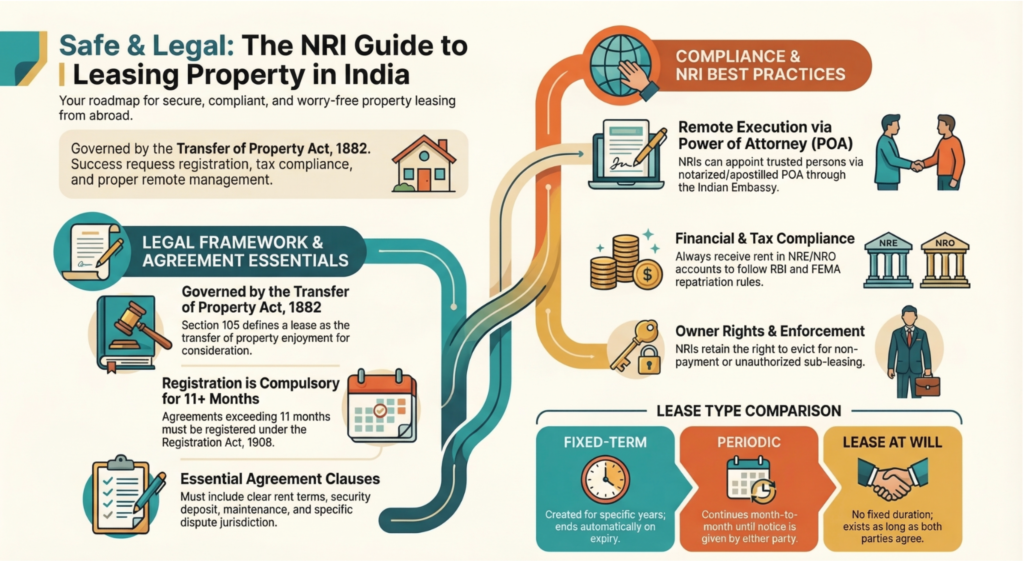
The lease of property in India is mainly governed by the Transfer of Property Act,1882.Under the Transfer of Property Act,1882, Section 105 defines a lease as the transfer of a right to enjoy immovable property for a certain time in consideration of the price paid or promised.
When an NRI gives his property, located in India, on lease, the same legal rules apply as for a resident Indian, but additional compliance like taxation (TDS) and a specific power of attorney is involved.
Explaining the lease agreement for NRIs
A lease agreement is a legal contract between the owner and the tenant of the property. The agreement allows the tenants to use the property for a fixed period of time(e.g.11 months, 3 years, 5 years, 9 years, etc.) in exchange they get rent or lease amount. In a lease agreement, the ownership of property does not transfer to the tenants.
Parties in a lease agreement:
There are two parties in a lease agreement; these parties are as follows:
- LESSOR: The owner of the property is the lessor in the lease agreement. The lessor is the person who leases the property to the lessee
- LESSEE: The person who takes the property on Lease(tenant).
Types of Leases:
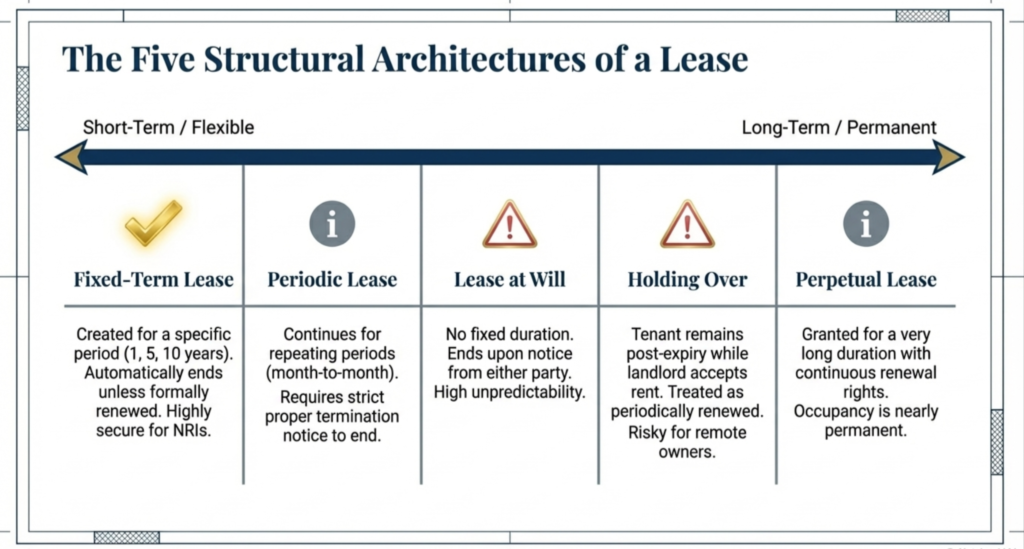
- Fixed-term lease: A fixed-term lease is created for a specific period of time, such as one year, five years or ten years. Once the agreed period ends, the lease automatically comes to an end unless both parties decide to renew it.
- Periodic lease: A periodic lease continues for repeating periods, such as month to month or year to year. It does not have a definite ending date and continues until either the landlord or tenant gives proper notice to terminate the agreement.
- Lease at will: A lease at will exists as long as both the owner and the tenant agree to continue it. There is no fixed duration, and either party can end the lease whenever they want to by giving notice.
- Leasing by the Holder over: This type of lease arises when a tenant remains in possession of the property after the lease term has expired, and the landlord continues to accept the rent. In such a situation, the lease is treated as renewed, usually periodically.
- Sub-lease: A sub-lease occurs when the original tenant transfers some part of the property or all of the leased property to another person for a certain time. The original tenant still remains responsible to the landlord unless the agreement states otherwise.
- Perpetual lease: A perpetual lease is granted for a very long duration with a right of continuous renewal. It allows the tenant to occupy and use the property almost permanently, although the ownership still remains with the original owner.
Rights of lessor(owner) of property:
- Right to receive rent: the lessor has the right to receive the rent at the agreed time and place as mentioned in the lease agreement.
- Right to take back possession after lease ends: after the lease period expires, the lessor has the right to get back possession of the property from the lessee
- Right to evict the lessee in case of breach: the lessor can evict the tenant if:
- Rent is not paid on time
- Property is misused by the tenants
- Any of the terms of the lease agreement are violated
- Damage is caused to the property by the tenant.
- (The eviction is usually done through a legal process).
- Rights to inspect the property: the lessor has the right to inspect the condition of the property with reasonable prior notice to the tenant.
- Right to compensation for damages: If the tenant damages the property beyond normal wear and tear, the lessor can claim compensation.
- Right to terminate lease in certain cases: The lessor can terminate the lease if the tenant becomes insolvent or if the tenant misuses the property for any illegal purpose.
Tips for NRIs while giving their property on rent in India
Important clause that should be mentioned in the Lease Agreement:
- Parties Name clause: The names of the parties should be mentioned in the lease agreement, who is the lessor and the lessee in the agreement, with document proofs (Adhaar card, Passport, etc).
- Property description clause: There should be complete details of the property, including the address and ownership document of the property, the area of the property, etc.
- Term period of the lease: The duration period of the lease must be clearly mentioned in the lease agreement (starting date of the lease, ending date of the lease and renewal time as well as the conditions).
- Rent payment clause: The details of the rent payment (monthly or yearly), the rent payment due date, the mode of payment of rent, rent increase terms and conditions should be mentioned in the rent payment clause of the lease agreement.
- Clause for other payments: The lease agreement must clearly mention the responsibility of the payment for the usage of utilities like electricity bill, water charges, power backup bill , municipal council/ other administrative charge like property tax and maintenance charges for the property.
- Security deposit clause: There should be a specific mention of the security amount, and the condition for refunding the security amount should be clearly mentioned in the security clause of the lease agreement
- Maintenance and repair clause: The maintenance and repair clause should be clearly mentioned in the lease agreement
- Termination clause: In the termination clause, the condition for ending the lease should be mentioned due to breach of agreement and early termination rules, and the time of notice period should also be mentioned
- Forfeiture of the Lease agreement: The forfeiture of the lease agreement means the termination of a lease agreement before the expiry of the lease due to breach of the conditions by the lessee
- Purpose of use of Property: The purpose of use of the property should be clearly mentioned in the lease agreement. Restrictions related to the use of the property should also be written in the lease agreement
- Sublease clause: If the owner wants to prohibit the tenant from subleasing the property to another person, the NRI must mention it in the lease agreement.
- Inspection clause: The purpose of the inspection clause is to inspect the property and check damages to the property, so an inspection clause is necessary in the lease agreement.
- Damage to the property: In the damage clause, the tenant is responsible for the damage caused by them, except for normal damage to the property.
- Alteration Clause: Agreement must include that no major alteration must be done by the lessee and must also mention the type of alterations the lessee is allowed to do on the property.
- Dispute resolution: The court Jurisdiction should be clearly mentioned in the Lease agreement, so if any dispute occurs, it should be clear how to solve the dispute.
- Registration clause: There should be proper mention of who will pay the stamp duty and registration charges of the lease agreement.
- Force major clause: In this clause, it is mentioned what will happen if any unexpected event (Fire, Flood) occurs and who will pay for the loss of damages
Note: Registration of the lease agreement is mandatory in India to protect the clauses of the agreement.
NRI Legal world
Important Tips for NRIs:
- The NRIs must register the lease agreement.
- The lease agreement should be registered under the Registration Act,1908
- The NRI should prepare a Lease agreement with a proper legal consultant.
- The NRI can appoint a trusted person through a Specific power of attorney for getting the lease registered.
- In the power of attorney, the role and duties of a legal (trusted) person should be mentioned in the power of attorney.
- The NRI should clearly mention the Rent and payment mode and terms and conditions in the lease agreement.
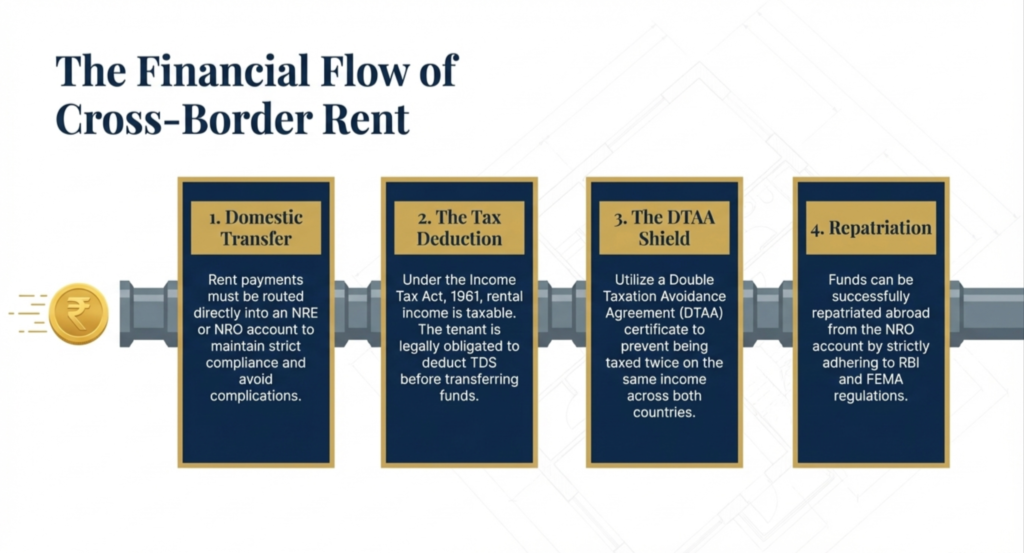
- The NRI should always receive rent in an NRE/NRO account to maintain tax complications.
- The NRI should always do a police verification of the tenant for safety purposes.
- The NRI should always follow the RBI(Reserve Bank of India) and FEMA(Foreign Exchange Management Act)rules for the transfer of rent money to foreign countries.
- The jurisdiction of the court should be mentioned in the lease agreement.
Do’s and Don’ts of a Lessee (Tenant)
According to the Transfer of Property Act,1882 (section 108)
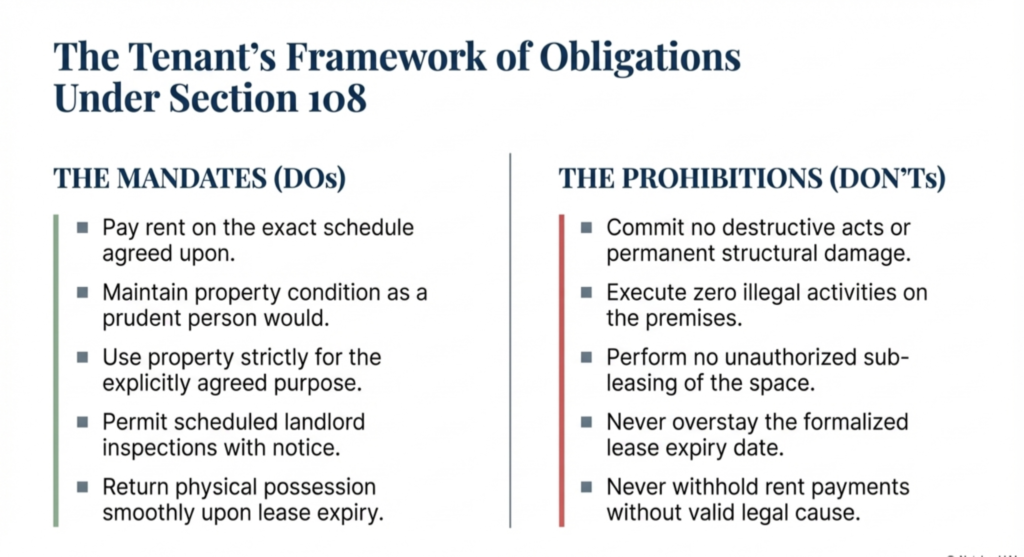
Do’s of a lessee:
- Pay rent on time: The lessee must pay the rent on time to the lessor as agreed in the lease agreement
- Care of the property: The lessee must maintain the property as a prudent person would.
- Use property as lease agreement: The lessee must use the property as agreed in the lease agreement.
- Follow the terms and conditions of the lease agreement: There should not be any violation of the terms and conditions as mentioned in the lease agreement
- Allow inspection: The lessee should allow the landlord(lessor) to inspect the property time to time as mentioned
- Return possession of the property: After the expiry of the lease agreement, the lessee should return the possession of the property to the lessor.
Do not’s of a lessee:
- Lessee should not damage the property: The lessee should not commit any destructive act or any permanent damage to the property
- Lessee should not use property for illegal purposes: The lessee should not use the property for any illegal activity. Lessee can only use the property for the purpose as mentioned in the lease agreement
- Lessee should not sublease the property: the lessee should not sublease the property without the permission of the lessor(If prohibited). If the agreement restricts sublease, the tenant cannot transfer possession to another person
- Lessee should not stay after the expiry of the lease agreement: The lessee should vacate the property after the expiry of the lease period and give possession back to the lessor(owner) of the property.
- Lessee should not stop paying rent without any legal reason: The lessee should not stop paying rent until the lessor is legally justified
FAQ (Frequently Asked Questions):
Q) Can an NRI lease property in India?
Ans: Yes, an NRI can lease property in India without taking any special permission from the Reserve Bank of India if the property is legally purchased or inherited.
Q) Is registration of the lease agreement compulsory?
Ans: Yes, registration of the lease agreement is compulsory. Even in the case the lease period is less than 11 months, it is advisable to register the lease agreement to make it legally valid in the court of law.
Q) Can an NRI sign a lease agreement from abroad?
Ans: No, an NRI cannot sign the lease agreement papers from abroad because it will not be possible to get the document registered with the registrar( Tehisldar). The recommended way is that the NRI land owner can authorise a trustworthy person with a valid power of attorney (special power of attorney) to make a lease agreement in India on the behalf of the NRI owner. It is mandatory to register a Lease agreement in India for the implementation of the clauses in the court of law if required.
Q) Which type of property can be leased?
Ans: An NRI can lease all kinds of properties like agriculture land, residential and commercial property.
Q) Is there any tax on rent received by an NRI?
Ans: Yes, rent received by an NRI is taxable in India under the Income Tax Act,1961, if an NRI has a DTAA certificate (Double Taxation Avoidance Agreement) certificate. NRI should have a PAN number in India and should file Income tax return in India regularly to receive the tax benefits.
Q)How can an NRI do the repatriation of rent (sending money abroad)?
Ans: The NRI can send the rent money abroad using an NRO account. All commercial property agreements have to follow GST rules, the owner and the lessee have to have the GST accounts, where the GST will be deposited and accounted for.
Q) If a violation of the agreement occurs, what can a lessor do?
Ans: If a lessee violates the legal lease agreement, the lessor has certain legal remedies (Eviction suit, Termination of lease, Damages for breach, Repair and deduction, etc.) under the Transfer of Property Act,1882. This is where the registration of the lease agreement is important as the NRI land owner can seek help from the court.
Q) If, after expiry of the lease agreement, the lessee has not vacated the property, what can the NRI lessor do?
Ans: The NRI lessor can file an eviction suit in case the tenant refuses after the serving of notice by the lessor. In case the NRI owner can not visit India he/she can authorize a trusted person with a valid power of attorney to initiate legal proceedings on the behalf of the NRI land owner.
Q) How can an NRI file an eviction suit without coming to India?
Ans: The NRI can appoint a legal consultant or a trusted person through a specific power of attorney, and the attorney should be notarised and embossed through the Indian Embassy/consulate.
Comments are closed