
Punjab Village Lal Dora Property Ownership Guide for NRIs
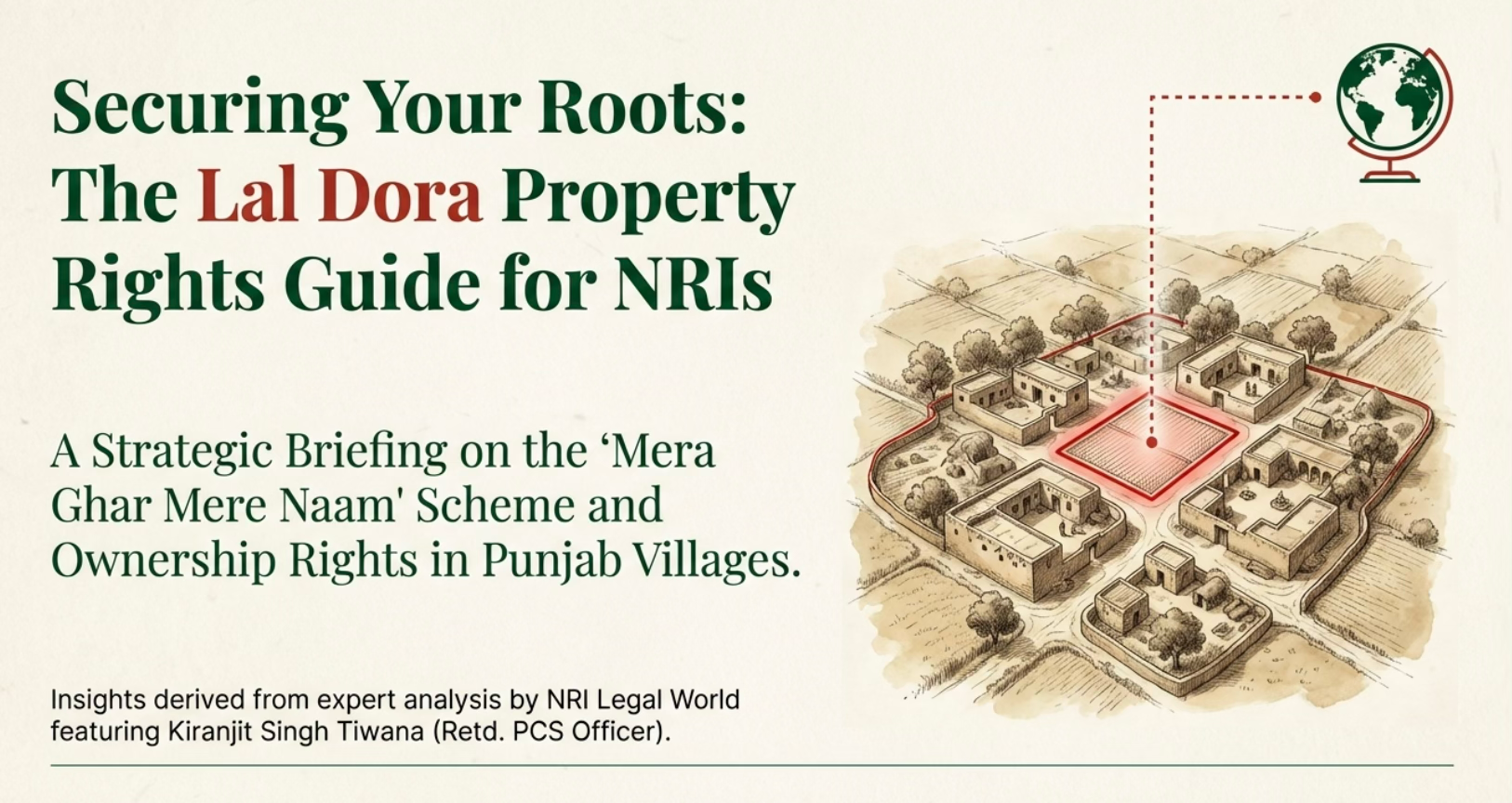
For generations the properties lying in the villages were kept out of the loop of land revenues, hence there were no formal land records available for the houses and other plots existing in the villages. The village settlements were separated from the rest of the agriculture land represented by marking a clear red border on the revenue maps which is, in a literal sense, called Lal Lakir/Lal dora properties. Thus the plots, houses or any other type of property existing within these Lal Dora come to be known as Lal Lakir Properties. Legally these are called Abadi deh land.
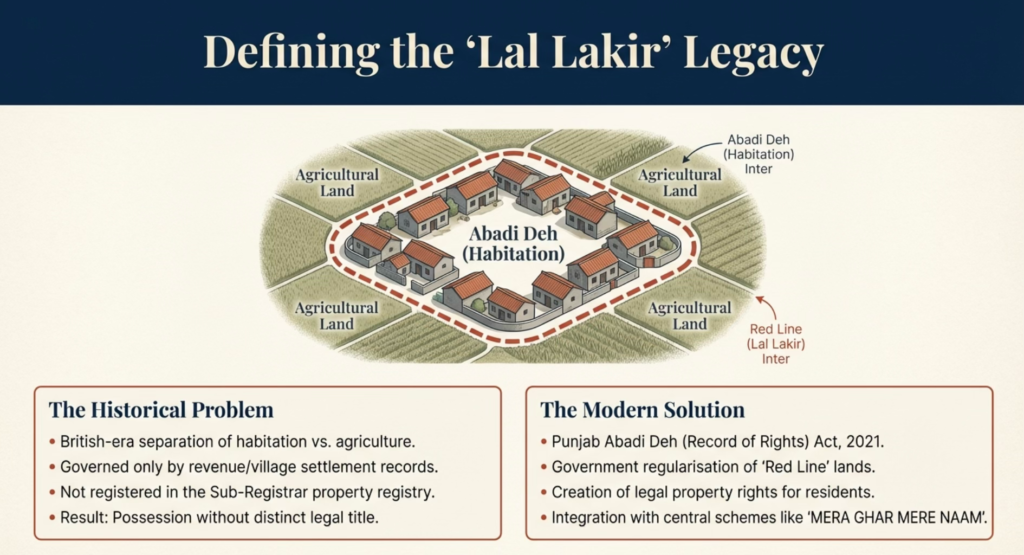
A historic transformation is currently underway in Punjab as through the “Mera Ghar Mere Naam” scheme all over in India. The Punjab government is finally making and digitising the land record of villages under this scheme. For the NRIs, this is a double-edged sword as on the one hand it is offering a chance to secure pind/village properties by means of clear legal titles and clearing any doubt/ cloud around the ownership. On the other hand, in the absence of possession on the property and geographical gap NRIs are fearing the wrongful claims can be made against their village property and the time window of the correction is only 30 days.
From no Papers to a Legal certificate of ownership
From the British era village settlements and properties were exempt from revenue records, they lacked clear land ownership records i.e Fards. Property owners relied solely on the possession or a simple handwritten affidavit sometimes written on plain papers. In the lack of formal documentation the Lal Lakir property owners were denied loans by the banks .
The “Mera Ghar Mere Naam” scheme the property ownership will be established by a formal Certificate of Ownership.
Understand the process of Lal Lakir properties
This is a two-stage process: first, the government identifies and certifies your rights; only after this certificate is issued, only then the property be formally registered for future sales, leases, or transfers.
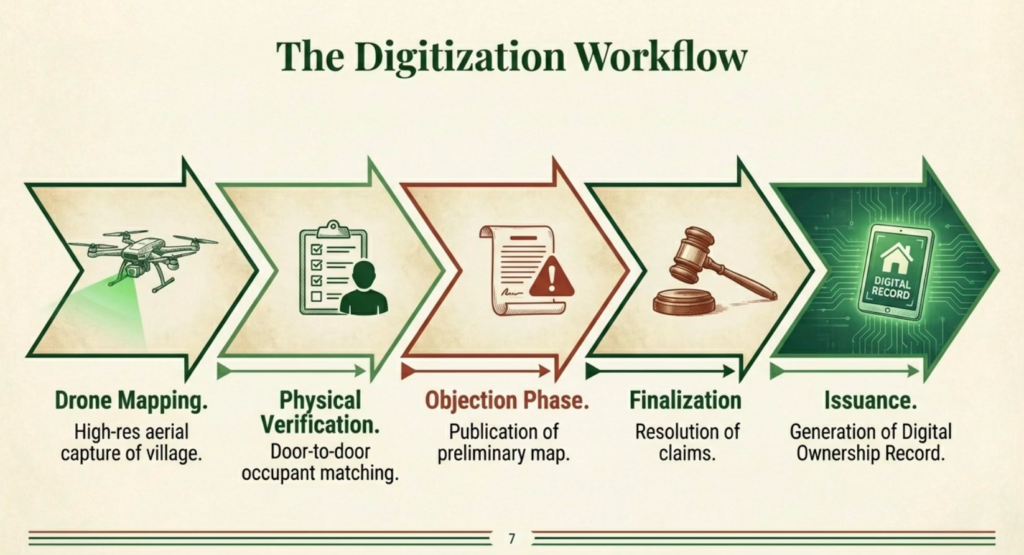
The revenue authorities, in association of survey of India, will identify the village land following a precise three step trajectory:
- The Drone Mapping – The authorities use a drone to capture the high definition digital map of every structure within the Lal Lakir following which assigning an initial identification number to every home and open plot.

2) The Public Verification: This is the most critical stage for NRIs. After the drone mapping the Survey team will conduct a door-to-door verifications to match the digital draft with the physical possession holders of the plots and houses and seek confirmation about their ownership claims. Both the digital draft and physical verifications are marked and then published as a tentative map for public scrutiny.
The public is given a total of 30 days of the time to raise their objections to the title ownership of the property, after the map is published for scrutiny. Once the objections are raised the district level land revenue authorities must clear the case of ownership within the next 30 days.
3) Final land record: The authorities release the final digitised map of the village land record by assigning a particular number to each and every house or plot. This serves as the definitive digital record forming the basis for your legal Certificate of Ownership.
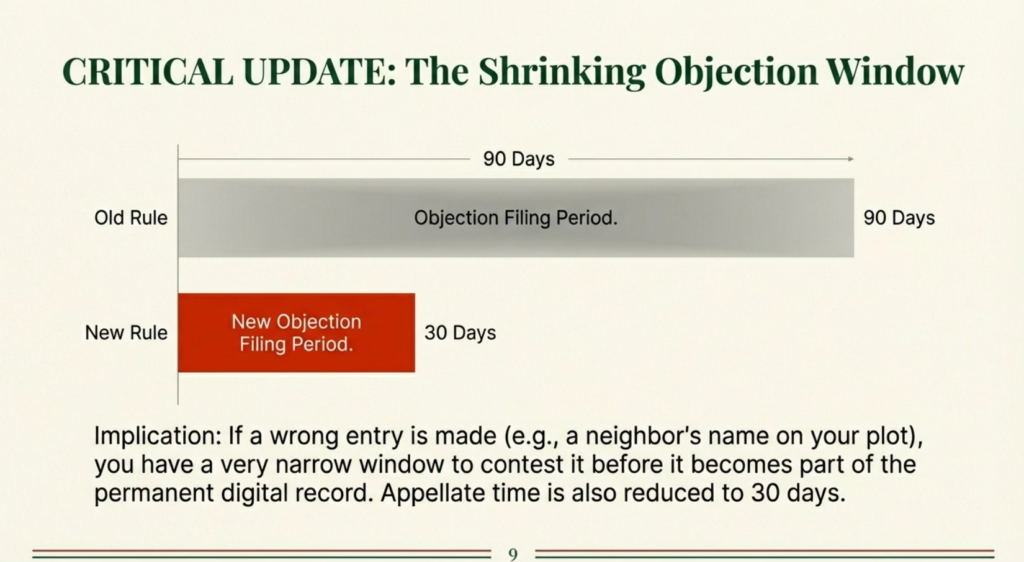
The 30-Day Window for Objections
The most significant—and potentially risky—change for the diaspora is the drastic reduction in legal timeline to raise objections on the ownership reflected in the tentative map prepared after the drone shots and physical verification. Previously, property owners were given a 90-day window to file objections or appeals. This has now been reduced to just 30 days.
Thus resident Indian or NRI owners have only 30 days to raise any objection in the map contesting an incorrect entry in the title of ownership. Thus, strategic and timely vigilance is now mandatory, especially for NRIs, as their Physical absence from Punjab is no longer a valid legal excuse for missing these deadlines. Non Resident Indians (NRIs) have a narrow window to object and apply for correction of an incorrect entry regarding the boundary or ownership to prevent the error from becoming permanent in the land record.
How the NRIs can strengthen their claim for on the shared Village household or plot
In the absence of any existing land records of the village plot or house, proving the ownership is hard for NRIs. Moreover, in most of the cases NRI’s village house /plot is either a joint property in the family or the NRIs visit the village only as guests after a gap of years. To establish claim preemptively, NRI you should compile a file containing following evidences:
1) Utility Records: NRIs can present electricity bills, water connection receipts, or landline telephone bills in the name.
2) Wills & family settlement agreements: NRI can present the Will of inheritance specifically mentioning the village property, any old Agreements to Sell or any other family property agreement regarding the internal family division.
3) The Kursinama (Family tree lineage record): This is an essential step for NRIs. NRI must ensure the property is recorded in the names of all rightful heirs (siblings) to prevent future inheritance disputes. In the absence of paper, the testimonies of village elders (Lambardars or Sarpanches or any other panchayat members) are vital.
4) Social Proof: Photographs of family functions held at the village house—such as an Akhand Path Sahib—can serve as secondary evidence for NRIs to claim their rightful share.
Remote solution for NRIs – Protecting their right from abroad
Distance is not a problem for resolving any property related issue in India. NRIs can protect
their land title and ownership of their property from a distance. NRI can use proactive protective measures to protect their property.
Directions for Preemptive Filing for NRIs:
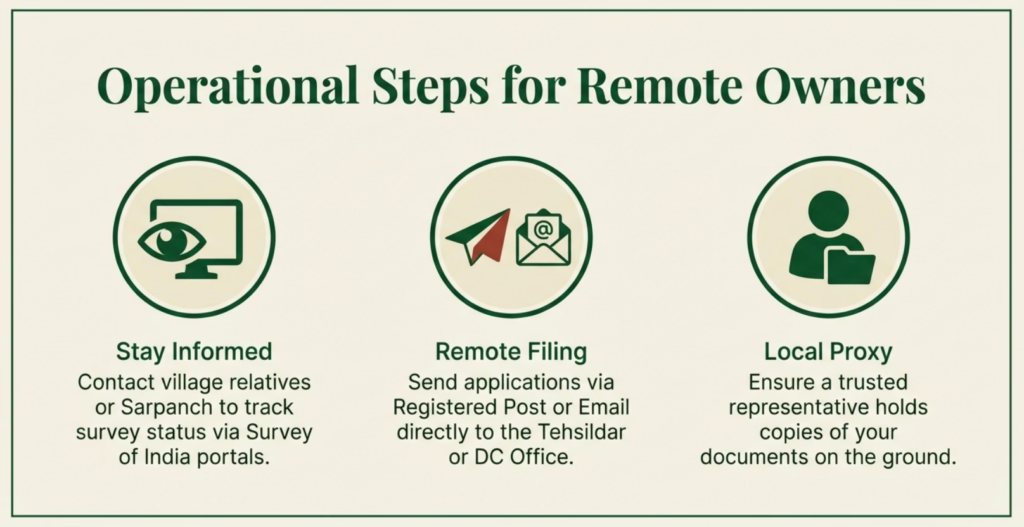
1. Submit a Formal Application: It is imperative that NRIs submit a formal claim via registered post or email to the concerned district authorities like Tehsildar, Sub-Divisional Magistrate (SDM), or District Collector. NRI can also request the authorities to protect his legal ownership of the property. NRI can request authorities to be notified if any appeal is filed to change the ownership of the property in the absence of the NRI owner.
TIP: NRI owner should contact local District Collector, Patwari the Tehsildar’s office immediately to determine the current status of drone mapping in their village.
NRI Legal World
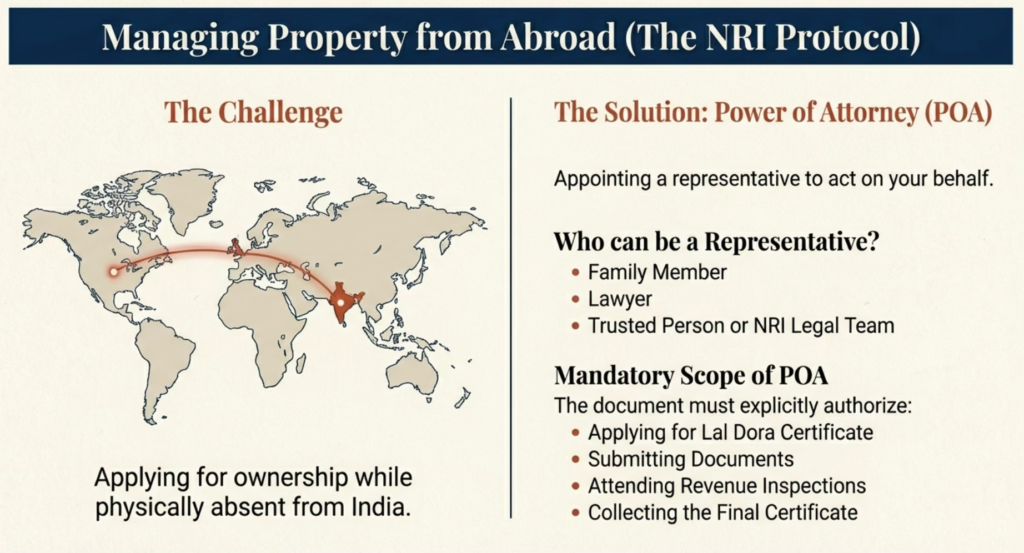
2. Appoint a local legal proxy: NRI can provide copies of your documentation of ownership to a trusted relative or neighbour and instruct them to present these to the survey team during the door-to-door phase to ensure NRIs name is entered correctly on final Legal Record. The NRI owner can legally equip the local proxy with a registered Power of Attorney to handle the case with more authority.
The “Mera Ghar Mere Naam” scheme is putting an end to a traditional possession-based era and beginning of a “Fard”- a clear land record based future for Punjab’s villages. As this scheme is progressing from village to village, it is actively formalising a new set of land ownership records, which is transforming a village based property into a bankable, legal asset. However, the speed of this digital rollout requires you to be your own advocate. You can seek more consultation on the matter by reaching us on info@nrilegaloworld.com / +919709692096
Frequently asked questions:
Q: How can an NRI protect ownership of their Lal Lakir properties in India?
Ans: Non-Resident Indians (NRIs) can protect their Lal Lakir (Lal Dora) properties by actively participating in the “Mera Ghar Mere Naam” scheme which is currently being implemented in Punjab. To safeguard your ownership, NRI can follow these steps based on the sources:
1) NRI must stay Informed, as you are abroad, it is crucial to remain vigilant by continuously staying in touch with relatives, neighbors, or the village Sarpanch to know when the survey and verification teams are visiting your village.
2) NRI should provide valid legal Proof of Ownership of the property in the village. In case the NRI does not have any legal document available, the NRI can produce the following evidence to strengthen their claim to the property.
Q: How can the NRIs strengthen their claim on their shared house in Pind/ Village in Punjab, India?
Ans: In most of the cases NRI’s village house /plot is either a joint property in the family and the sibling or any other resident Indian family member is living in the house. Usually, NRIs visit their village only as guests after a gap of years and that too for a smaller period of time. To establish claim preemptively, NRI you should compile a file containing following evidences:
1) NRIs can present electricity bills, water connection receipts, or landline telephone bills in their name.
2)NRI can present the Will of inheritance specifically mentioning the village property, any old Agreements to Sell or any other family property agreement regarding the internal family division.
3) NRIs can present a Kursinama/family tree to claim ancestral rights on the property. This is an essential step for NRIs. In the absence of paper, the testimonies of village elders (Lambardars or Sarpanches or any other panchayat members) are vital.
4) NRI can also provide the photographs of family functions held at the village house—such as an Akhand Path Sahib. It can serve as a secondary evidence for NRIs to claim their rightful share.
5) NRI can directly contact the district authorities.
Q) Can NRIs Protect their Lal Lakir Village/Pind house without coming to India?
Ans: If you cannot travel to India, you can still protect your rights from abroad. You can directly contact District authorities. You can send a formal application via registered post or email to the concerned Tehsildar, SDM, or District Collector (DC).In your application, provide the location and, if possible, the boundaries of your house to ensure no one else’s name is wrongly attached to it.
Q) If someone wrongly records NRIs village house in his own name How can the NRIs fix this matter?
Ans: If your property is incorrectly recorded or if someone else claims it, you must file an objection with the SDM or District Collector within this 30-day timeframe.
Q) What is the timeline to raise objections to Lal Lakir property Registration?
Ans: Once the initial drone map and survey are completed, there is a strict window for filing objections. The government has reduced this period from 90 days to 30 days.
Q) I am a US citizen originally from Punjab. After my parents passed away, my ancestral land in the village (Lal lakeer), was unlawfully occupied by our relative who is a distant cousin of my father. Now I notice that the government has launched a scheme to register the properties and they would conduct drone surveys to mark Lal Lakeer properties. My property falls under Lal Lakeer, and I don’t have formal papers for it. The property is under the illegal occupation of someone from our village. What options do I have in this situation?
Ans: You can share the evidence to local district authorities to establish your claim on the property. You have two problems at hand first is to free your property from illegal occupation for which you can approach civil court. Second issue here is to file your claim to the district revenue authorities to not update the name of the illegal occupant in the ownership list in the newly constructed land revenue of the village land. Gather all the possible evidence to strengthen your claim on the property. Take a step by step legal guidance from a legal professional.
Comments are closed