
For Non-resident Indians (NRIs), a cheque bounce case in India can quickly turn into a serious legal problem. What often begins as a routine financial transaction rent, a business payment, a family loan, a credit card liability, or an EMI can lead to criminal proceedings under the Section 138 of the Negotiable Instruments Act, 1881. Many NRIs discover the case only when a bank informs them, or their family receives court papers, when they declare PO they are stopped at an Indian airport. By that stage, summons, warrants, or adverse court orders may already have been passed. Managing such proceedings from another country while balancing employment, visa conditions, and family life is extremely difficult without structured legal assistance in India.
Cheque bounce case and its implications for NRIs
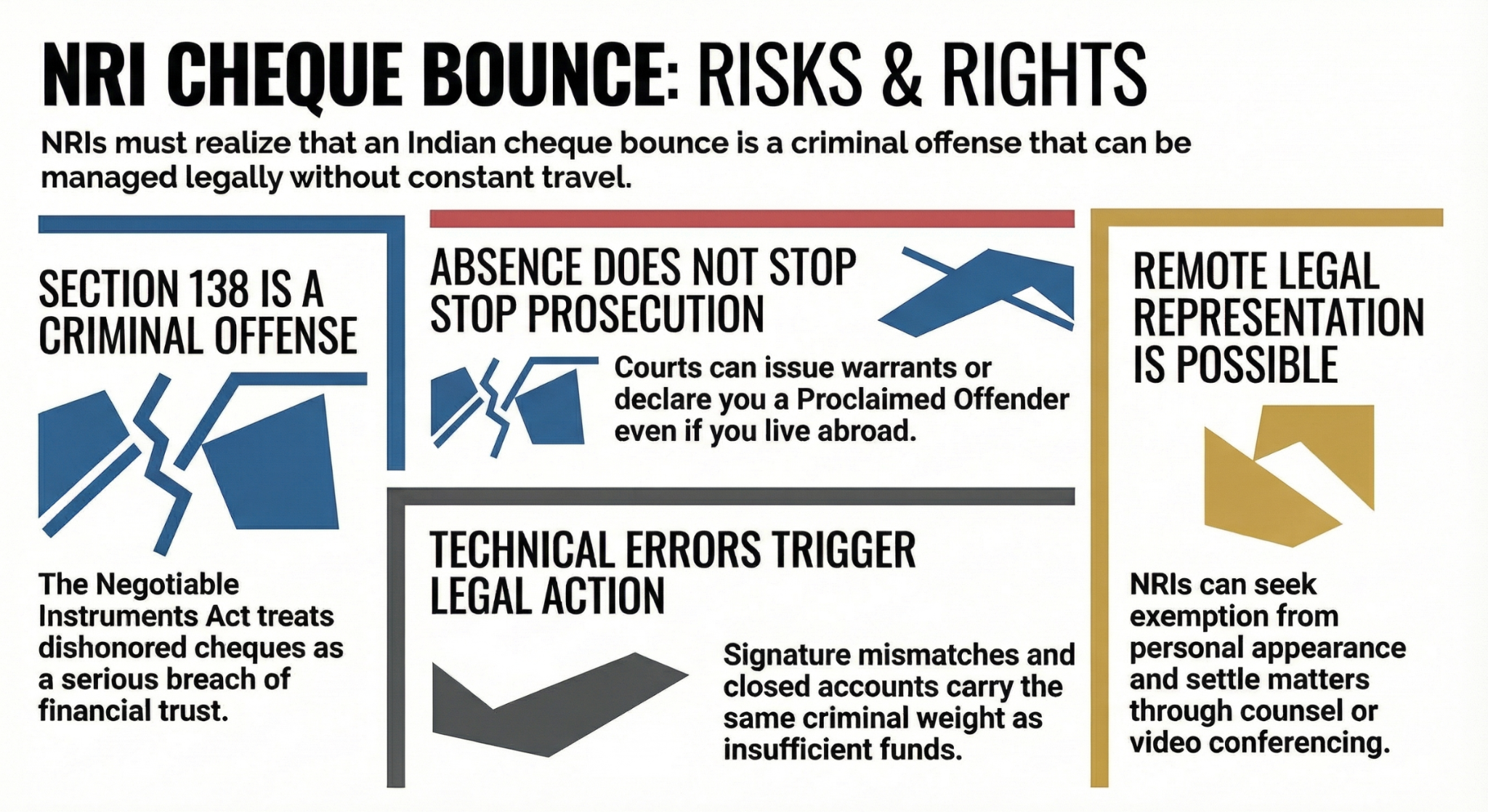
Dishonour of a cheque occurs when a bank refuses to honour a cheque presented for payment. This can happen due to insufficient funds in the drawer’s bank account, Mismatch in signature, closed bank account, amount exceeding arrangement with the bank. In India, a bounced cheque is taken seriously because it undermines financial trust. If the cheque was issued for fulfilling a legally enforceable liability, its dishonour can trigger criminal proceedings under the Section 138 of the Negotiable Instruments Act, 1881.
Understanding the Section 138 of the Negotiable Instrument Act, 1881
A cheque issued in India that is dishonoured for insufficiency of funds or similar reasons can result in a criminal complaint. Your residence outside India does not stop the court from issuing summons, issuing bailable or non- bailable warrants.
However, the law does provide practical remedies for NRIs including representation through counsel exemption from personal appearance, bail protection, settlement, compounding and even quashing in appropriate cases.
The Real challenges Faced by NRIs
- NRI cheque bounce matters usually involve cross-border complications.
- Service of notice at old Indian addresses. Legal notice and summons often reach a place where the accused no longer resides.
- Multiple cases for the same transaction. Several cheques issued for one loan may result in separate complaints.
- Travel and employment constraints: Frequent court appearances are not practical for someone working abroad.
- Parallel recovery proceedings: civil recovery actions may run alongside the criminal complaint.
- Risk at Indian airports: Missing court dates can lead to warrants or LOCs.
Common situation leading to NRI Cheque Bounce cases
Most cases arise due to life transactions such as relocation abroad, business closure, or income disruption. Few typical examples include:
- Security cheques given before moving overseas and later presented.
- Post dated rent cheques for Indian property.
- Business partnership disputes.
- Family loan transactions during India visits.
- Credit card or personal loan cheques after job loss abroad etc.
Documents NRIs should keep ready if the cheque bounce
Before deciding the legal course, the following are examined:
- Cheques and bank return memos.
- Statutory demand notice.
- Email/message communications.
- Proof of payments or settlement discussions.
- Passport, Visa, and employment details.
- List of all pending cases.
These documents determine whether the matter should be defended, compounded, settled, quashed.
Legal rights for NRIs in Cheque Bounce Case
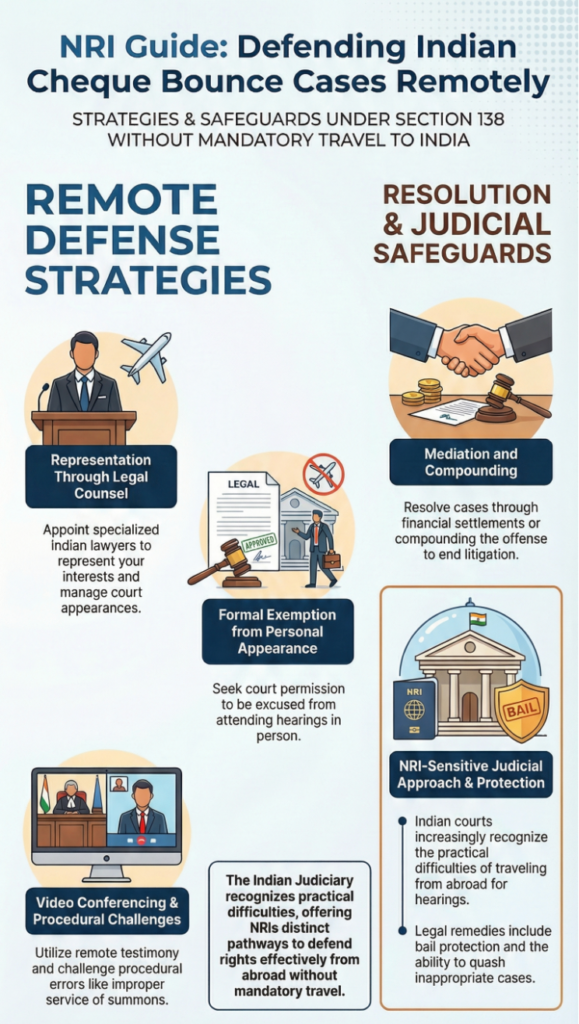
Even while living abroad, an accused has clear rights in the legal scenario:
- Right to be represented through a lawyer: Personal appearance on every date is not mandatory in many cases. NRI can authorise his attorney to appear on his behalf.
- Right to seek exemption from personal appearance. The NRI can seek the exemption from the physical appearance from the court by submitting his request. It’s up to the court to decide on the relaxation. The courts consider employment and residence abroad a valid reason to seek exemption.
- Right to bail: The accused has a right to protection from arrest is available through proper legal procedure.
- Right to settlement and compounding: The matter can be legally closed upon the payment and court’s approval.
- Right to contest the case on merits: If the complaint is weak or legally defective.
Examples for a few Case laws for NRIs:
Indian Bank Association v. Union of India
Cheque bounce litigation in India was once known for long delays. To address this, the Supreme Court issued detailed procedures to make the process faster and more efficient.
The court directed that evidence should be taken on affidavit, Summons should be served through speed post and modern modes, Cases should conduct day-to-day hearings, Compounding of offences should be encouraged at an early stage.
For NRIs, this judgement is extremely significant because it reduces unnecessary delays and supports simplified procedures, making it easier to handle the case from abroad and resolve it quickly.
Bhaskar Industries LTd. V. Bhiwani Denim & Apparels LTD
One of the biggest practical difficulties for NRIs facing a cheque bounce case in India is repeated court appearances. In this important judgement, the Supreme Court recognised that insisting on the physical presence of the accused is not every hearing is always necessary.
The court held that a Magistrate has the discretion to allow the accused to appear through a lawyer and dispense with personal attendance if their presence is not essential for the progress of the case. This principle applies particularly in summons cases like cheque dishonour matters.
This judgement provides major relief to overseas Indians, as it allows them to defend the case through counsel without travelling to India for every date, saving time, cost and professional disruption.
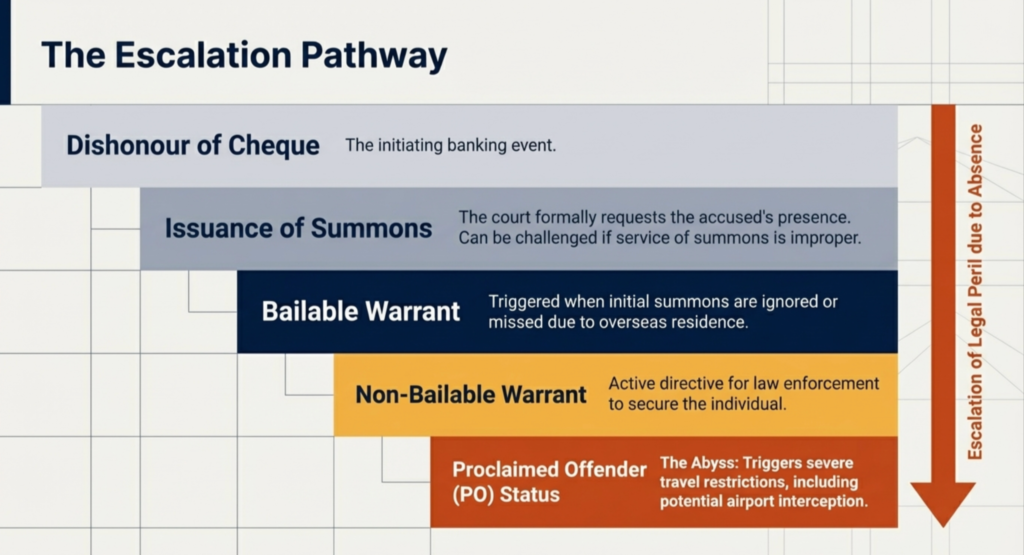
Cheque bounce litigation under Section 138 of the Negotiable Instruments Act carries serious legal and practical consequences for non-Resident Indians, even when they are living abroad. Physical absence from India does not stop criminal proceedings summons bailable warrant, and even the possibility of being declared a proclaimed offender could arise if the matter is ignored.
For NRIs, the risk is higher because financial dealings in India such as property transactions, family arrangements, business commitments, EMIs, or investments are often handled through authorised representatives, post dated cheques, or old bank accounts that are not regularly monitored. A simple banking lapse, signatures mismatch, account closure or insufficient funds can therefore escalate into criminal prosecution.
However, the law also provides practical safeguards and relief mechanisms. NRI can approach through counsel in many stages, Seek exemption from personal appearance, compound the offence, Settle the matter through mediation, Challenge improper service of summons, Use video conferencing where permitted by courts.
Indian courts have increasingly taken a pragmatic and NRI sensitive approach, recognising the genuine difficulty of travelling repeatedly from abroad while ensuring that the complainant’s rights are protected.
For more information on the issue you can contact us via email or phone numbers given below: info@nrilegalworld.com / +919709692096
Frequently Asked Questions
Q1. Can an NRI be prosecuted for cheque bounce in India while living abroad?
Ans. Yes, If a cheque issued by an NRI is dishonoured in India, a complaint can be filed before the competent Indian court. Physical absence from India does not stop the legal proceedings.
Q2. Is personal appearance in court mandatory for NRIs?
Ans. Courts often allow NRIs to appear through an advocate and grant exemption from personal appearance, especially during the initial stages. Personal appearance may be required at specific stages such as evidence or settlement, but even that can sometimes be done through video conferencing.
Q3. Can a cheque bounce case be settled without coming to India?
Ans Yes The offence is compoundable. Settlement can be done through Power of Attorney holder and Mediation.
Q4. What are the common reasons for cheque bounce in NRI cases?
Ans. There are many reasons for cheque bounce like Insufficient Funds, Account closed, Signature mismatch, Post dated cheque presented early, Cheques issued for property or business transactions in India. Cheque Issued by family members or authorised signatories.
Q5. Can an NRI be arrested in a cheque bounce case?
Ans. Cheque bounce is a bailable offence, but arrest can happen if the accused repeatedly ignores the court orders or a non-bailable warrant is issued for non appearance.
Q6. What is the Punishment for Cheque bounce in India?
Ans: The court may impose the Imprisonment up to 2 years, or Fine up to twice the cheque amount.
Q7. Can multiple cheque bounce cases be filed for different cheques?
Ans. Yes Each dishonoured cheque can give rise to a separate complaint, even if issued in the same transaction.
Q8. Can the case be quashed by the High Court?
Ans. Yes, in appropriate circumstances such as settlement between parties or technical defects the NRI can approach the High Court for quashing of proceedings.
Q9. What documents are required for NRIs to defend a cheque bounce case?
Ans. Documents required NRIs to defend a cheque bounce case:
- Copy of cheque and bank memo.
- Legal notice and postal proof.
- Power of Attorney.
- Passport and visa details.
- Proof of residence abroad.
- Transaction documents (loan, agreement, property deal etc).
Q10. Is Mediation possible in NRI Cheque Bounce Cases?
Ans. Yes, Courts actively refer such matters to mediation, which helps in faster cost effective and travel free settlement.
Comments are closed