

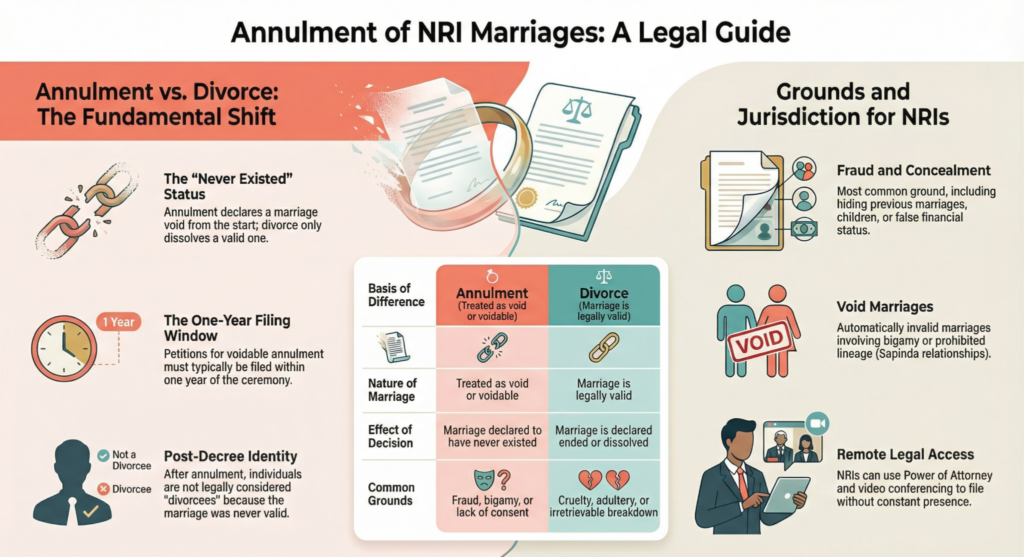
For many Non Resident Indians (NRIs), marriage is not just a personal relationship, it is a legal bridge between countries, cultures, and immigration systems. A wedding may take place in India, while the couple lives abroad, relies on visas, sponsorships, and foreign residency laws. When such a marriage is later discovered to be fundamentally flawed due to fraud, misrepresentation, or lack of valid consent, ending it through divorce is often legally incorrect. This is where annulment of marriage becomes critically important.
Annulment does not only dissolve a marriage, but also it legally declares the marriage as void, as if it never happened. For NRIs, this distinction carries serious consequences for future remarriage, immigration status, property rights, and international recognition of marital status and for other documentation.
The key distinction between the divorce and annulment is that the status of the person is not affected after the annulment of the marriage, however after the divorce the estranged spouse are called divorcee. As in case of annulment the marriage is declared to have never existed.

Which laws govern the Annulment of marriage for NRIs?
Annulment depends on the law under which the marriage was solemnized, the resident status or nationality or citizenship status are not the major concern under the law.
- Hindu Marriage Act, 1955: It applies if both parties are Hindus, Buddhists, Jains, or Sikhs by religion and the marriage is solemnized with these religious ceremonies.
- Special Marriage Act, 1954: It applies in the case of Inter religious marriages.
This blog focuses primarily on Hindu Marriage Act and Special Marriage Act as they cover most of the NRI cases.
Difference between the Annulment of the marriage and the Divorce:
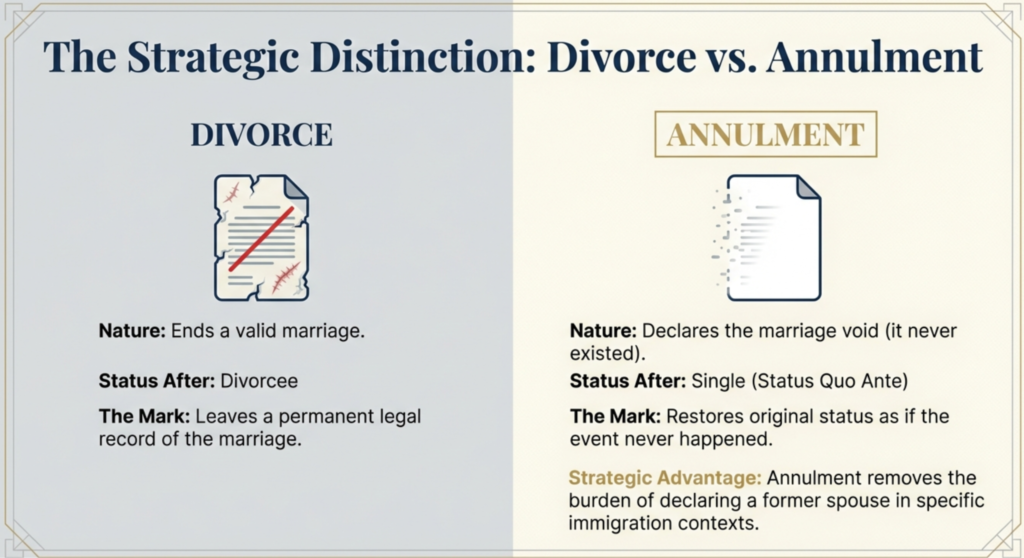
| Basis of Difference | Annulment | Divorce |
| Nature of Marriage. | Treated as void or voidable. | Marriage is valid. |
| Effect after the legal decision | After the legal decision the marriage is declared to have never existed. | After the legal decision the marriage is declared ‘ended/dissolved’ once the divorce decree is published. |
| Grounds for application | Marriage is void or voidable on the grounds of fraud, forced marriage or marriage without consent, bigamy, incapacity etc. | Marriage has irretrievably broken down due to the factors like cruelty, adultery, unsound mental health or any other reasons. |
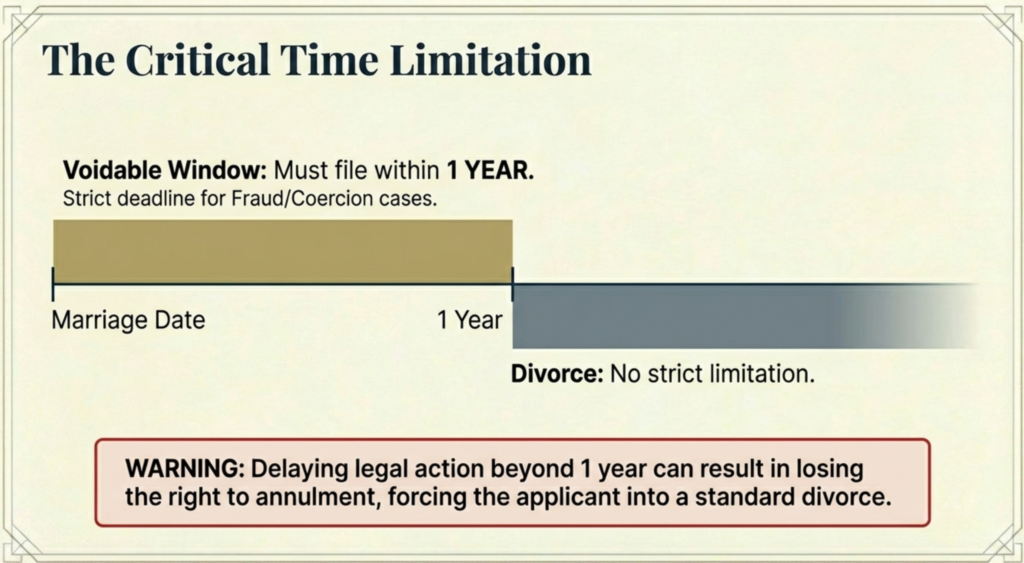
| Time limitation to file the petition | Voidable annulment must be filed within prescribed time. That is within one year after the marriage was solemnized. | No strict limitation to file divorce |
| Scope of remarriage | Remarriage is allowed once an annulment decree is passed. | Remarriage is allowed after the divorce decree is passed. |
| International legal validity of the final decree | Critical for immigration and remarriage abroad. | Generally easier to register and get recognition abroad. |
Grounds for the annulment of marriage:
- Void Marriage (Automatically Invalid)
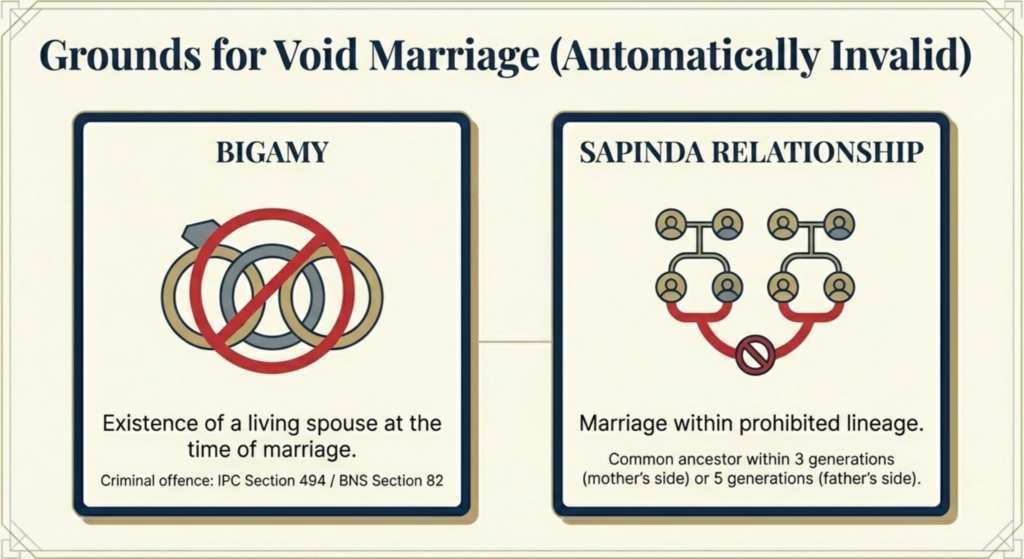
These marriages are null from the beginning.
- Bigamy: It is very common in NRI fraud marriages that one spouse already had a living spouse at the time of marriage. It is a criminal offense under IPC section 494. In addition, section 82 of Bharatiya Nyaya Sanhita.
- Sapinda Relationship: Marriage within prohibited lineage. (marriage between individuals sharing a common ancestor within three generations on the mother’s side or five generations on the father’s side).
Key note: A decree of annulment is still required for official recognition, especially for immigration and remarriage abroad.
- Voidable Marriage:
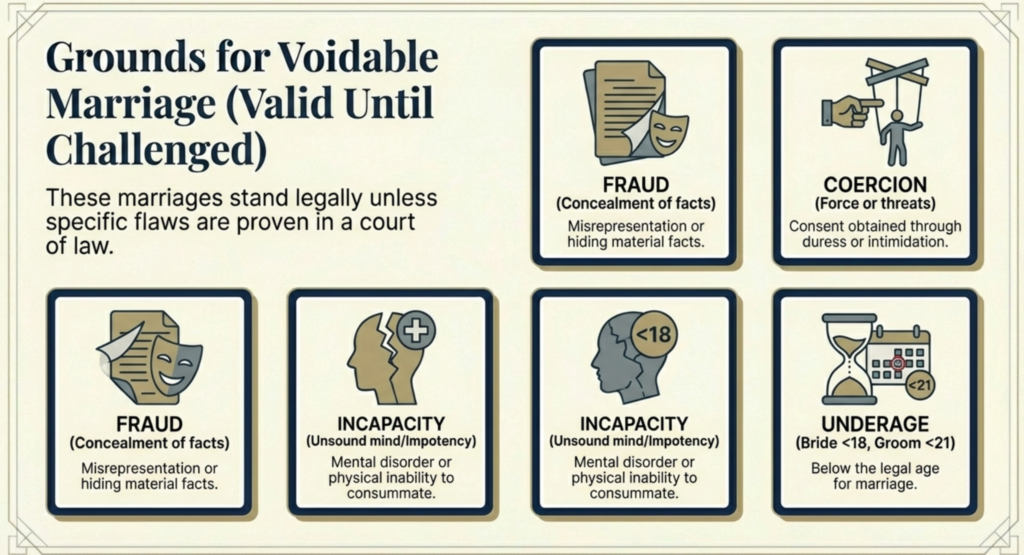
These marriages are considered as valid until annulled by the Court.
- Fraud: It is the most commonly used ground for the annulment of NRI marriages. It includes fraud, concealment of facts as hiding the previous marriage or divorce, children from earlier marriage, false immigration status, sexual incapacity or impotence, mental illness, criminal history of the spouse. These grounds need to be proved in the court of law with all the supporting evidence and testimonials.
- Force or Coercion: If the marriage is performed without the consent of the partners/ both the partners. Also, if a partner or \both the partners were pressured to marry or were threatened, or emotionally blackmailed to do the marriage.
- Impotency: The marriages where the sexually incapacity or impotency or other Incurable conditions are involved and were existing at the time of marriage, makes the marriage voidable once it is established in the court of law.
- Unsoundness Marriage: In case, a partner or both the partners found incapable of giving valid consent at the time of marriage.
- Underage Marriage: Bride under 18, groom under 21 of age.
Jurisdiction: Where Can an NRI File for Annulment of the marriage?
Under Section 19 of Hindu Marriage Act and under Section 31 of Special Marriage Act, the annulment can be filed in India. The jurisdiction for filling for the annulment can be filled on any of the three conditions given below. :
- Where marriage was solemnized.
- Where respondent resides.
- Where the parties last resided together
For NRIs, physical presence in India is not mandatory throughout the case. The use of power of attorney is permitted to complete the process of the annulment of marriage and evidence can be recorded through the video conferencing with the permission of the courts.
Important Case insights:
Neeraja Saraph v. Jayant V. Saraph (1994) SCC461, the Supreme Court of India: In this case the judgment deals with the vulnerability of Indian women married to Non-Resident Indians (NRIs). Though it did not directly decide recognition of a foreign divorce or annulment decree, it exposed the serious legal hardship faced by Indian spouses when NRI husbands obtain relief abroad. This judgement laid the foundation for stricter judicial scrutiny of foreign matrimonial decree in India.
Sameer Pareek v. Shweta Pareek 2025, in this case the Delhi High Court upheld the decree of annulment granted by the family court under Section 12(1)(c) of the Hindu Marriage Act, 1955. The court held that the husband’s representation of himself as never married on a matrimonial website, despite being a divorce with a child, amounted to deliberate concealment of a material fact. The court further observed that misrepresentation of income was also a material factor influencing the wife’s decision to marry.
Moreover, it was held that such concealment and false representation vitiated the wife’s free and informed consent, striking at the root of the marriage, Consequently the marriage was declared voidable and annulled, and the Family Court’s decree of nullity was affirmed.
To know more about the annulment of marriage and grounds for the annulment reach a professional expert. Contact NRI Legal World at info@nrilegalworld.com or +919709692096
Comments are closed