
Understanding the Alimony Rights for NRIs under The Hindu Marriage Act,1955 and The Special Marriage Act,1954
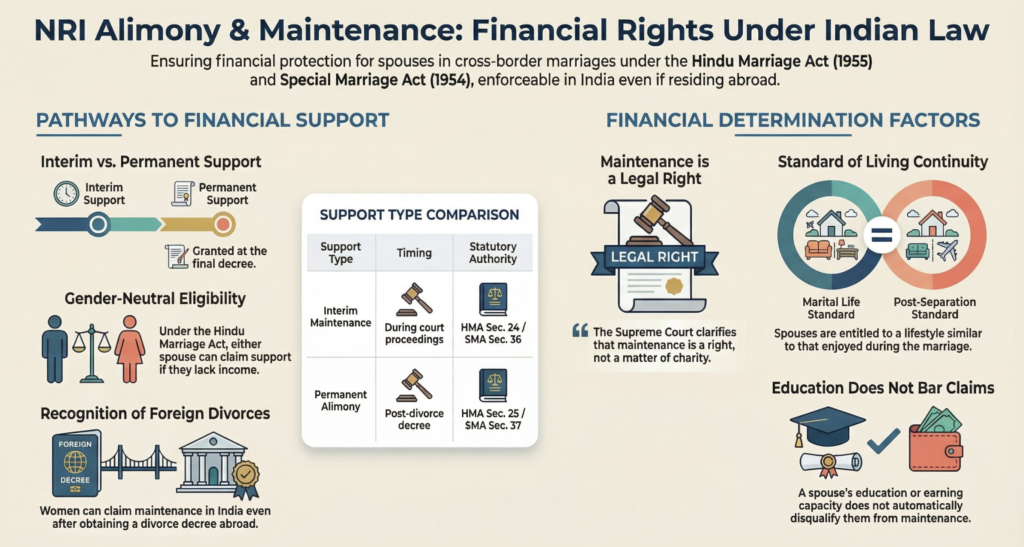
Alimony means the amount of money that a court orders one spouse to pay to the other spouse for their maintenance and support. The main aim of the alimony is to make sure that the wife or the dependent spouse can live a reasonable life after the marriage ends.
With the rise in cross border marriages, disputes involving Non-Resident Indians (NRI) have become increasingly complex especially when it comes to financial rights after the separation. One of the most critical aspects in such cases is the right to alimony and maintenance, governed by statutes like the Hindu Marriage Act, 1955 and the Special Marriage Act, 1954. The Indian law ensures that spouses are not left financially vulnerable after the separation, regardless of their place of residence. However, NRI matrimonial disputes often involve additional challenges such as jurisdictional conflicts, enforcement of foreign judgment, and disclosure of overseas income. This makes it essential to understand how Indian courts interpret and enforce alimony rights in cross border scenarios. The aim of this blog is to provide a clear insight into the legal framework, practical challenges, and remedies available to NRIs seeking or contesting alimony in India.
Eligibility/Criteria for filing Petition for Alimony
Both of the partners can claim alimony under the The Hindu Marriage Act,1955 and The Special Marriage Act,1954. The wife can claim maintenance from her husband if she is unable to support herself after the divorce or separation. The Husband can also claim maintenance from his wife if he is physically incapacitated or cannot maintain himself. The courts consider various factors of both partners like assets, income, expenses, physical well-being, dependents etc to ascertain the requirement of the alimony before passing the final order.
Types of Alimony based in The Hindu Marriage Act:
Interim Alimony- under Section 24 of The Hindu Marriage Act: It allows interim alimony during the divorce process. Interim alimony means temporary financial support that a court orders until the final decision on the divorce petition or maintenance case is made.
Permanent Alimony – under Section 25 of The Hindu Marriage Act, governs the permanent alimony based on financial status. At the time of passing a final decree, whether for divorce or judicial separation the court can consider the financial condition of both and order permanent alimony. It can be a monthly amount or a one-time lump sum.
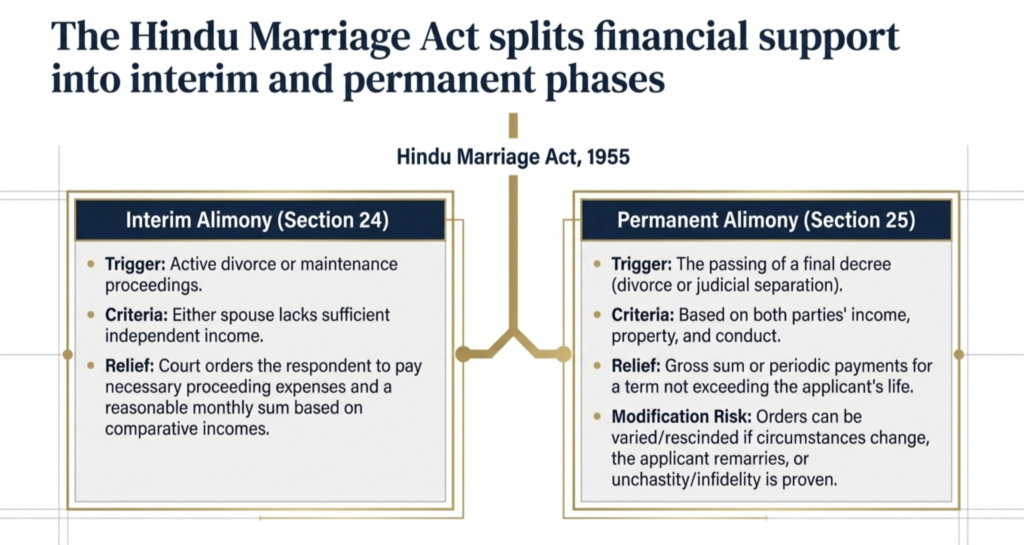
The Hindu Marriage Act 1955 governs divorce and alimony under section 24 and section 25:
That the law says under Section 24 of the Hindu Marriage Act 1955-Where in any proceeding under this Act it appears to the court that either the wife or the husband, as the case may be, has no independent income sufficient for her or his support and the necessary expenses of the proceeding, it may, on the application of the wife or the husband, order the respondent to pay to the petitioner the expenses of the proceeding and, monthly during the proceeding, such sum as, having regard to the petitioner’s own income and the income of the respondent, it may seem to the court to be reasonable.
The law says under Section 25 of The Hindu Marriage Act 1955- Permanent alimony and maintenance. – (1) Any court exercising jurisdiction under this Act may, at the time of passing any decree or at any time subsequent thereto, on application made to it for the purpose by either the wife or the husband, as the case may be, order that the respondent shall, while the applicant remains unmarried, pay to the applicant for her or his maintenance and support such gross sum or such monthly or periodical sum for a term not exceeding the life of the applicant as, having regard to the respondent’s own income and other property, if any, the income and other property of the applicant and the conduct of the parties, it may seem to the court to be just, and any such payment may be secured, if necessary, by a charge on the immovable property of the respondent.
(2) If the court is satisfied that there is a change in the circumstances of either party at any time after it has made an order under sub-section (1), it may, at the instance of either party, vary, modify or rescind any such order in such manner as the court may deem just. (3) If the court is satisfied that the party in whose favour an order has been made under this section has remarried or, if such party is the wife, that she has not remained chaste, or, if such party is the husband, that he has had sexual intercourse with any woman outside wedlock, it shall rescind the order.
Types of Alimony based in The Special Marriage Act:
Temporary alimony under the Special Marriage Act, 1954 (section 36) is given during the divorce proceedings. Permanent alimony and maintenance ( under Section 37 of the Special Marriage Act ) is given once the divorce is final, the court can order permanent financial support.
The Special Marriage Act, 1954Section 36 of the act empowers the court to grant interim alimony to the wife who lacks sufficient income, ensuring her financial support and covering necessary expenses during the proceedings. If the wife lacks adequate income, the court may direct the husband to bear her support and essential litigation expenses. Upon the wife’s request, the court can order the husband to make weekly or monthly payments, taking into account his income and fixing a sum the court finds just
“ The Special Marriage Act, 1954, Section 37: The amount depends on the financial condition of both their lifestyle during marriage and other factors.(1) Any court exercising jurisdiction under Chapter V or Chapter VI may, at the time of passing any decree or at any time subsequent to the decree, on application made to it for the purpose, order that the husband shall secure to the wife for her maintenance and support, if
necessary, by a charge on the husband’s property, such gross sum or such monthly or periodical payment of money for a term not exceeding her life, as, having regard to her own property, if any, her husband’s property and ability [the conduct of the parties and other circumstances of the case], it may seem to the court to be just.
(2) If the district court is satisfied that there is a change in the circumstances of either party at any time after it has made an order under sub-section (1), it may, at the instance of either party, vary, modify or rescind any such order in such manner, as it may seem to
the court to be just. (3) If the district court is satisfied that the wife in whose favour an order has been made under his section has remarried or is not leading a chaste life, [it may, at the instance of the husband, vary, modify or rescind any such order and in such manner as the court may deem Just.]”
Difference between maintenance and alimony in divorce case
Maintenance means financial support provided by the husband during the subsistence of marriage or during the court proceedings. It can be interim, temporary or ongoing. It is covered under section 125 CrPC and 144 of BNSS.
Alimony means financial support granted after divorce or judicial separation; it is usually final in nature (lump sum or periodic). It is granted under matrimonial laws like special marriage Act or Hindu marriage Act.
Can an NRI woman claim alimony in India after obtaining a divorce abroad?
Yes, a woman who has obtained a divorce abroad can still claim alimony (maintenance) in India, but it depends on certain legal conditions. The NRI women should have valid grounds to file an alimony petition. The valid ground could be that the NRI woman is not able to sustain or maintain herself financially.
Key points:-
- The foreign divorce decree should be recognized in India.
- Indian Courts will first examine whether the foreign divorce decree is valid under Indian law as per Section 13 of the civil procedure code, 1908.
- Before recognizing the foreign divorce in India the Indian courts look closely if the foreign divorce is passed by a competent court and if the grounds of foreign divorce are recognized under Indian law (like cruelty, desertion etc) and both the parties had a fair opportunity to be heard during the divorce proceedings in the foreign courts.
- Right to claim Maintenance Even after a foreign Divorce a woman can file for maintenance under Section 125 CrPC or personal laws like Hindu marriage act (Section 25 permanent alimony).
- Indian courts have held that maintenance is a separate right, and it can be claimed if the wife is unable to maintain herself.
- In case of NRI divorces, alimony and maintenance petitions, if the husband has Income/assets traceable in India, then the maintenance orders of the court can be enforced effectively.
Can both of the spouses claim the maintenance and alimony during the divorce?
Yes, any of the spouses can seek alimony in India. Indian law is gender neutral in certain aspects. As in:
Under section 24 of the Hindu marriage Act, 1955, either spouse (husband or wife) can claim interim maintenance if they lack sufficient income. However, under section 125 CrPC and now 144 of BNSS, wives, children, and parents are entitled to seek maintenance.
The right of husbands to claim maintenance is only recognized under Section 24 of The Hindu Marriage Act, 1955. It clearly states that either the husband or the wife who has no independent income can claim interim maintenance and litigation expenses. So, a husband can claim maintenance during the pendency of matrimonial proceedings (like divorce, restitution of conjugal rights, Judicial separation, Annulment of marriage, appeals arising out of these proceedings, any other matrimonial petition filed under the Hindu Marriage Act.
Is Divorce Petition and Alimony Petition Separate?
No, alimony (maintenance) is not always a separate petition. It can be filed within the divorce case itself, but alimony can be filed as a separate petition in case no maintenance was claimed during divorce proceedings and the divorce has already been granted (especially foreign divorce cases) . For example: If a wife has already taken the divorce but after some time she realized that she needs alimony. In this case she can claim permanent alimony (after divorce) under Section 25 of Hindu Marriage Act and section 37 of Special Marriage Act.
How to know the jurisdiction for filling the divorce case in India?
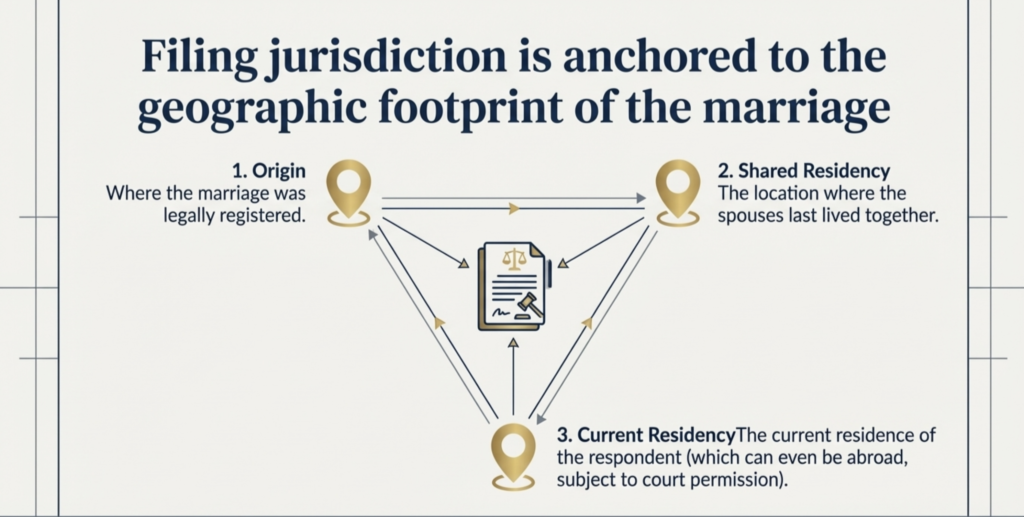
The divorce petition can be filed in India where the marriage was registered or where the spouse last lived together or the residence of the respondent (even abroad if allowed by court).
Few Example of Indian case laws on alimony:
The Honorable Supreme Court of India (in Sukhdev Singh v. Sukhbir Kaur, 2025, Civil appeal No. 2536 of 2019) held that the maintenance and permanent alimony can be granted even when marriage is declared null and void under Section 11 of the Hindu Marriage Act. The Court clarified that the term “any decree” includes nullity decrees. Even an invalid marriage does not deprive a spouse of maintenance rights.
In a significant development in matrimonial Law, the Honorable Supreme Court of India( in Anamika Jain v. Dr. Atul Jain 28 January (2026) SLP (C) no. 5220) reaffirmed that maintenance is not a matter of charity but a legal right flowing from the marital relationship. This judgement is particularly important in addressing a common defence raised by husband that an educated wife is not entitled to maintenance.
Judgement of the supreme court allowed the appeal and enhanced the maintenance from 15,000 to 30,000 per month . The court also directed that the revised amount be paid with retrospective effect. Observation of the court in this case :
- Maintenance is a right not charity – The court emphasized that maintenance is a legal right aimed at ensuring financial security and dignity, not mere subsistence.
- Education does not disqualify Maintenance: A crucial observation made by the Court was that merely because the wife is educated or capable of earning does not mean she is not entitled to maintenance.
- Standards of Living must be maintained: The Court reiterated that the wife is entitled to maintain a lifestyle similar to that enjoyed during the marriage.
- Obligation Continues after Divorce: The husband’s responsibility to provide maintenance does not end with the dissolution of marriage.
The Supreme Court of India in the case of Shamima Farooqui vs Shahid Khan Criminal appeal Nos. 564-565 of 2015 SCC 705, deals with maintenance under Section 125 CrPC. The wife sought maintenance, which was granted by the Family Court but later reduced by the High Court due to the husband’s retirement. The Supreme Court set aside the high Court’s order and restored the original maintenance. It held that maintenance is a matter of social justice and ensures a women’s right to live with dignity. The court ruled that an able bodied husband cannot avoid his responsibility by claiming financial hardship. This judgement strengthened the rights of wives, including divorced muslim women, to claim fair maintenance.
The Honorable Supreme Court of India (in Savitri vs Govind Singh Rawat Criminal appeal No. 191 of 1985 SCC 337) held that courts have the power to grant interim (temporary) maintenance even though it is not expressly mentioned in Section 125 CrPC. It emphasized that denying interim relief would defeat the purpose of providing speedy remedy to a neglected wife. The court allowed the wife to seek maintenance during the pendency of proceedings. It also recognized that applications can be supported through affidavits and summary procedure. The judgement strengthened the practical enforcement of maintenance rights.
In the case of Amit Kumar Kachhap v. Sangeeta Toppo Criminal revision No. 512 of 2023 was decided by the Jharkhand High Court. The wife had been granted maintenance by the family court under Section 125 crPC. The husband challenged this, stating that the wife left the matrimonial home without any reasonable cause. The Court examined Section 125(4) CrPC, which bars maintenance if a wife refuses to live with her husband without sufficient reason. It found that the wife failed to justify her separate residence. Accordingly, the high court held that she was not entitled to maintenance and set aside the earlier order.
Who has the responsibility to prove certain facts in a Maintenance/Alimony case?
In maintenance/alimony cases, the responsibility to prove facts generally lies on the applicant (the person seeking maintenance). Specifically, the applicant must prove to the court that the other party (the respondent) has sufficient financial means and is neglecting or refusing to maintain them. ?? However, the burden of proof depends on the specific facts and circumstances of the case. ??
For example, If the husband says his wife is already earning enough and doesn’t need maintenance, then he has to prove it. If the wife says she has no income or job, then she may need to show that she isn’t earning enough to support herself.
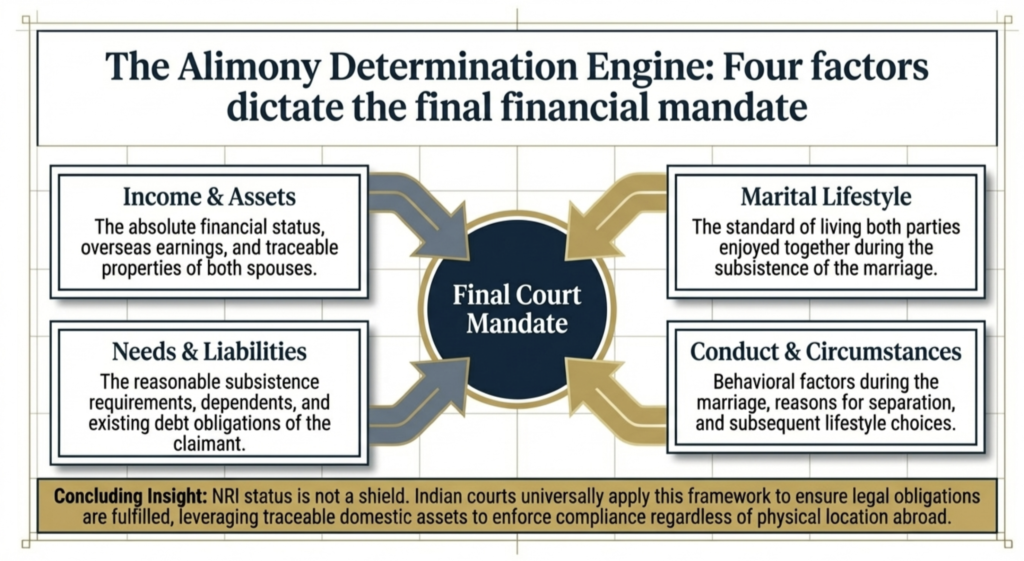
NRI spouses have the same rights and obligations regarding maintenance as individuals residing in India. Whether the marriage is governed by the Hindu marriage Act, 1955 or the special marriage Act, 1954, either the spouse’s husband or wife can claim financial support if they are unable to maintain themselves. The amount of maintenance or alimony is determined based on several factors like:
- The income and financial status of both spouses.
- Their standards of living during the marriage.
- Reasonable needs and liabilities of the claimant.
- Conduct and other relevant circumstances of the case.
Importantly, Indian courts ensure that legal obligations are not avoided merely because one spouse resides abroad. In cases involving NRIs, courts can pass appropriate orders to secure compliance, ensuring that both husbands and wives fulfill their financial responsibilities, regardless of their location.
It is recommended to seek professional legal advice about your case before taking any final decision. For more information contact NRI Legal World: info@nrilegalworld.com / +919709692096
Frequently Asked Questions
Q: Can an NRI wife file a petition to get alimony from her husband in India?
Ans: Yes, an NRI wife can claim alimony or maintenance in India if any of the given requirements is met: The marriage was solemnized under Indian law, or The husband is an Indian citizen, or The cause of action arose in India. She can file her petition under: Section 24 & 25 of the Hindu Marriage Act (interim & permanent alimony) Section 125 CrPC and 144 of BNSS for the maintenance.
Q: Can a husband seek alimony / maintenance from wife in divorce case?
Ans: Yes. Under Section 24 and Section 25 of the Hindu Marriage Act, either spouse (husband or wife) can claim maintenance, provided:
-The applicant has no independent sufficient income
-The other spouse has the financial capacity
Courts have recognized that even husbands can seek maintenance in appropriate cases.
Q: Can an NRI couple file for divorce in India ?
Ans: Yes, an NRI couple can file for divorce in India if:
Their marriage is registered or recognized under Indian law, or Either spouse is an Indian citizen or domiciled in India. The Indian courts can entertain such petitions.
Q: Where in India can an NRI couple file a divorce case in India?
Ans: A divorce petition can be filed in a Family Court/District Court where:
-The marriage was solemnized, or
-The husband and wife last resided together, or
-The wife is currently residing (in certain cases), or The respondent resides.
Q: How can an NRI know the jurisdiction of the court for filling the divorce in India?
Ans: Jurisdiction is determined under Section 19 of the Hindu Marriage Act. Key
factors:
- Place of marriage
- Last matrimonial home
- Current residence of wife (important protection for women)
- Residence of respondent
For NRIs, courts also consider:
- Whether marriage took place in India
- Whether parties have property or ties in India
Q: Are alimony and maintenance the same in divorce cases?
Ans: No, they are related but different:
- Maintenance is a financial support given during the pendency of the case. For example Section 24 HMA, Section 125 CrPC, 144 BNSS
- Alimony is financial support given after divorce (permanent). For Example: Section 25 HMA
In simple terms, Maintenance is a temporary support and Alimony is a long term or permanent support.
Q: Can an educated woman get alimony from her husband in divorce case?
Ans: Yes. Education alone does not disqualify a woman from getting alimony.
Courts consider:
- Actual income and financial independence
- Standard of living during marriage
- Husband’s income
- Responsibilities (like children)
- Even an educated woman can receive maintenance if:
- She is not earning sufficiently, or
- Her income is not enough to maintain a similar lifestyle
Comments are closed