
Non Resident Indians (NRIs) often accumulate assets across jurisdictions particularly in India in the forms of ancestral property, investments, and financial holdings. However, a significant legal complication arises when an NRI dies intestate (i.e without leaving a Will for succession of his assets). In such cases, the distribution of assets is governed strictly under the statutory succession laws in India. This situation can create uncertainty, delay and disputes, particularly affecting the legal rights and practical access of NRI children.
How the inheritance is decided if the NRI owner dies with a will
When an individual dies without executing a valid Will, their estate devolves according to the provisions of the Indian Succession Act, 1925 and applicable personal laws such as the Hindu Succession Act, 1956. The law does not consider emotional factors or informal family arrangements; it strictly follows statutory heirship rules.
If an NRI has died without leaving a valid Will, his/her property will be governed by the provisions of the Hindu Succession Act. Under the Section 10 of the Hindu Succession Act, the property is distributed equally among all Class I heirs.This means:
- Sons and daughters (married or unmarried) receive equal shares in the property of the deceased father.
- NRI children are treated equally as a legal heir with resident Indian children
- No single heir can claim exclusive ownership without the consent of others legal heirs.
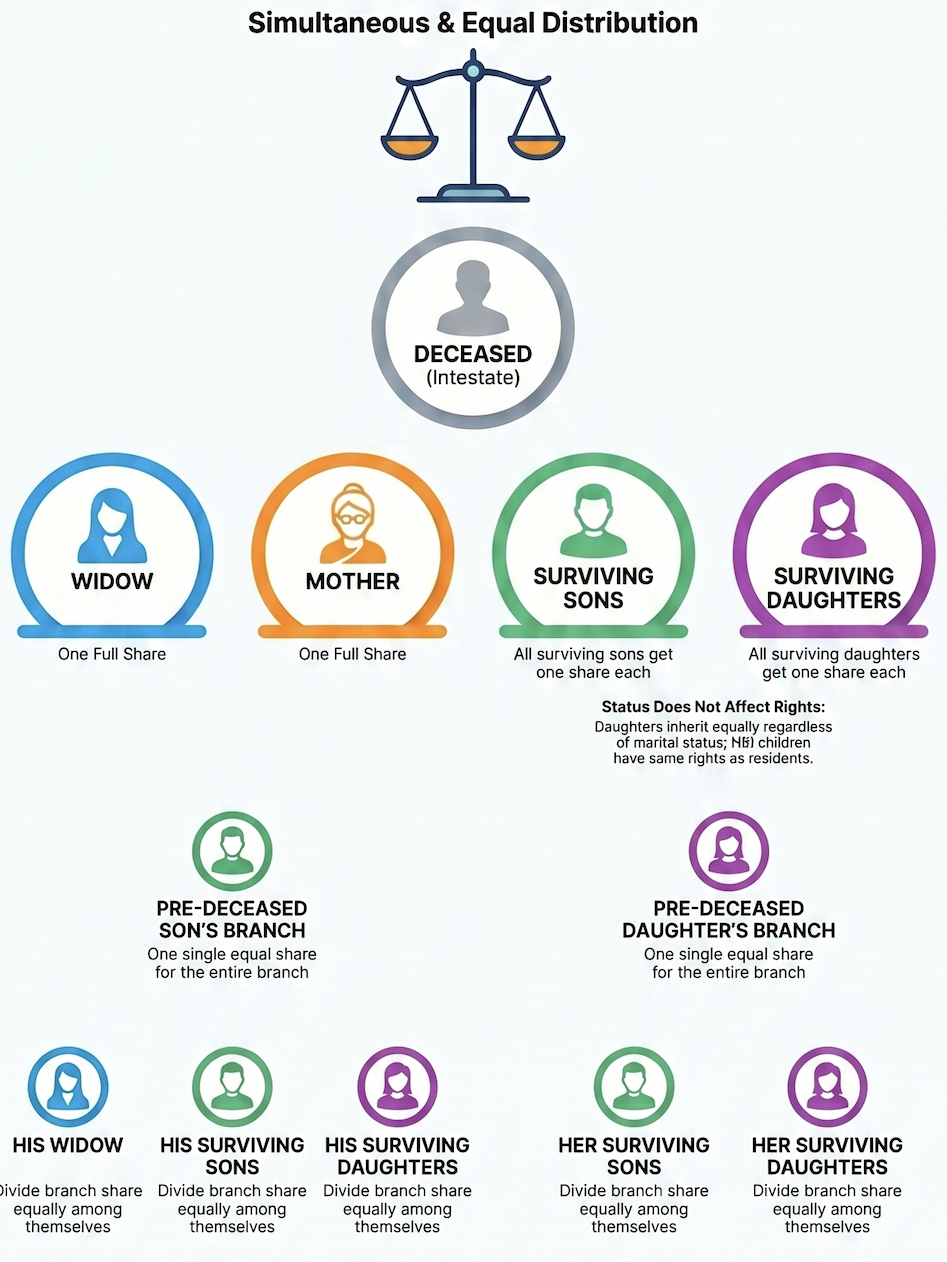
Distribution of property among heirs in class I of the Schedule Hindu Succession Act as per the law-
The property of an intestate shall be divided among the heirs in class I of the
Schedule in accordance with the following rules:―
Rule 1―The intestate’s widow
Rule 2 ―The surviving sons and daughters and the mother of the intestate shall each take one share.
Rule 3 ―The heirs in the branch of each pre-deceased son or each pre deceased daughter of the intestate shall take one share between them. Rule 4 ―The distribution of the share referred to in Rule 3—
(i) among the heirs in the branch of the pre-deceased son shall be so made that his widow and the surviving sons and daughters get equal portions; and the branch of his pre-deceased sons gets the same portion;
(ii) among the heirs in the branch of the pre-deceased daughter shall be
so made that the surviving sons and daughters get equal portions.
All class 1 heirs inherit simultaneously and in equal proportion. The entire estate is divided into equal shares among all eligible heirs.
What are the immediate Legal Consequences for NRI Children in case of no availability of a valid will:
When a person dies intestate (without a Will) the devolution of property is governed by the Hindu Succession Act, 1956. While children are Class 1 heirs. They do not get automatic operational control over assets. A structured legal process must be followed.
One of the biggest misunderstandings in inheritance matters is that legal heirs automatically become owners in practice immediately after death. Under the Hindu Succession Act, 1956, children being Class 1 heir do acquire a legal right in the property of the deceased. But this right is incomplete until it is formally recognised by authorities. This gap exists because banks, government authorities, and financial institutions do not act on assumptions or relationships; they act only on documented legal proof. Being a legal heir is not enough, you must prove it through a set procedure under the Indian law.
Some procedure for NRIs
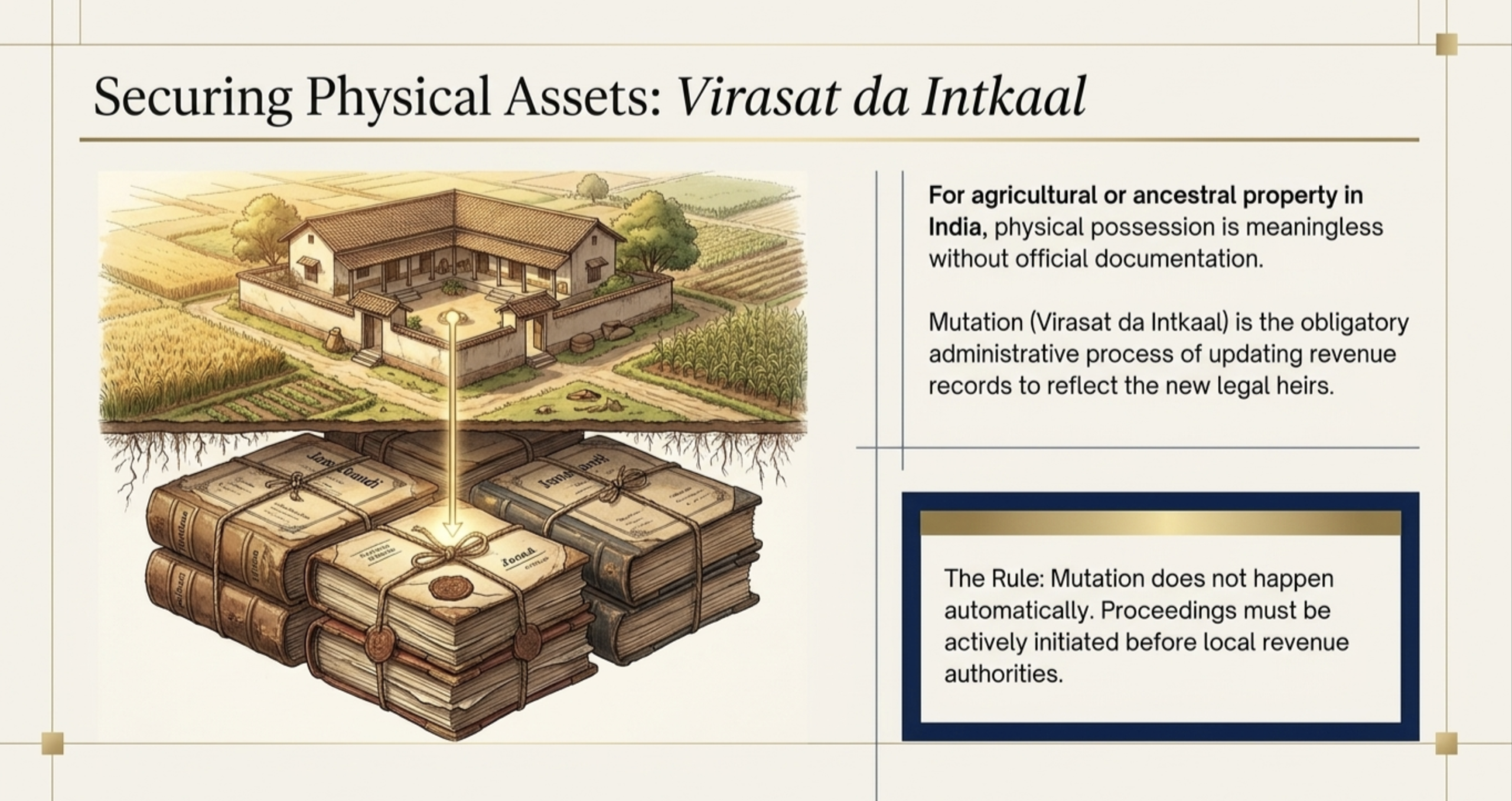
Process of inheritance based transfer of agriculture land for NRIs: Virasat da Intkaal/ Inheritance based mutation process
If an NRI dies abroad without making a will of inheritance, his legal heirs must follow the process mentioned below to secure their property right in India.
Indian authorities require a complete disclosure of all the Class I heirs in the family of the deceased. The process of succession starts after the rightful heirs moves application to the local tehsildar office (district Revenue department or local area patwari) to initiate the process of inheritance based transfer of property. The NRI must attach a copy of the family tree (Kursinama), identity proofs (Photocopy of the passport in case of NRIs) , relationship proof with the deceased person. Moreover the NRIs must have the presence of local village level Namardar or any village head while moving the application for inheritance based transfer of property.
If an NRI dies abroad without making a will of inheritance, his legal heirs must follow the process mentioned below to secure their property right in India.
Important tip for NRIs: If an NRI dies abroad without writing a proper will of inheritance the legal heirs can come to India to start the inheritance based mutation of property. Or any one of the legal heirs can come to India to start the process of inheritance based transfer of property but he/she must have the power of attorney and consent letter from other legal heirs.
NRI legal world
Mutation of Property does not happen automatically
For agricultural or ancestral property in India, mutation proceedings must be initiated before local revenue authorities.
If nobody disputes the claim of inheritance, made by the legal heirs, the mutation may be sanctioned within a few months by the revenue authorities. However in case of dispute the succession process can be shifted to Sub-Divisional Magistrate’s Court or may be to the civil court.
Immediate Requirement of Death Certificate
The first and most important legal document is the Death Certificate. The absence of a valid death certificate can give rise to unnecessary delays like the process of mutation of land can not be completed without a death certificate, thus delaying the transfer of property to rightful legal heirs The banks and insurance firms cannot process the legal claims.
The death certificate is generally issued by municipal authorities or competent local authorities where the death occurred. In case of NRIs if the NRI dies abroad the apostilled foreign death certificate needs to be provided to the Indian authorities. In some cases the Indian authorities may ask for a notarized copy of the foreign death certificate.
Note: The Foreign death certificate must be in English only.
Role of Succession Certificate
A Succession Certificate is especially important for claiming share in Immovable or movable assets. In case of any disputes between the legal heirs. The succession certificate is issued by the civil court under the Indian Succession Act, 1925. In cases where the deceased bank account holder has not nominated any one as his/her ‘nominee’ or dies without making a valid will of inheritance, the financial institutions like banks often insist on the submission of a valid succession certificate before giving the access to the bank accounts of the deceased person. This is also a mandatory requirement in case of family disputes. For NRI children, this document becomes crucial when trying to recover financial assets located in India.
Role of Legal Heir Certificate
A Legal Heir Certificate helps establish who the surviving legal heirs are.
It is generally used for the inheritance of the pension claims, employment benefits, basic inheritance verification and government authority records
However, a legal heir certificate does not itself transfer ownership title like a registered conveyance or court decree. Still, it is commonly required during mutation and administrative processes.
Legal complexities in succession of NRI properties
In many NRI families, disputes occur because some heirs remain abroad while one family member remains in India and manages the property. This often leads to allegations regarding:
- Illegal possession on the property
- Unauthorized sale of the property
- Forged documents regarding the property
- Improper mutation entries for all the legal heirs
- Fraudulent sale of NRI property by impersonation
The death of an NRI without a valid Will creates not just legal uncertainty, but also practical and emotional challenges for the children. While the law such as the Hindu Succession Act, 1956 clearly defines who the legal heirs are, the process of actually claiming and exercising those rights is far from automatic. Children may have a legal share, but without proper documentation and procedures, that right often remains only on paper.
For more information contact our experts: info@nrilegalworld.com / +919709692096
Frequently Asked Questions:
Q. Can Children directly sell the property after parent’s death?
Ans. Children can sell the property which is registered on their name not on their parents name. After the death of a parent or parents the children can sell their share from the family property only.
Q. What if there is a property dispute among siblings after the death of the father?
Ans. If a sibling’s property dispute arises after the death of parents who died without a Will. The main legal remedy is to file a partition suit under the Hindu Succession Act, 1956. The court will determine each heir’s share and either divide the property or order its sale and distribute the proceeds. If one sibling tries to sell the property unfairly, the others can seek a court injunction to stop the transaction immediately.
Q. Can banks take action against NRI children living abroad?
Ans. Banks usually proceed against the assets in India (like property, bank balances, or investments) left by the deceased. This is because the loan liability is primarily attached to the assets not to the children personally. However, if the NRI child is a co-borrower or guarantor, then the bank can take action against them personally even if they are living abroad. In such cases, recovery can be initiated under laws or through court proceedings.
Q: How can an NRI obtain a succession certificate in India ?
Ans: An NRI can obtain a succession certificate by filing a petition before the
District court which have jurisdiction where the deceased ordinarily resided or
where the property/ assets are situated. The procedure generally includes following steps:
Step 1: Court issues public notice in newspapers. The NRI may appear personally, or appoint a Power of Attorney holder in India.The succession certificate is mainly required for movable assets like bank
accounts, shares, insurance, securities etc.
step 2: Filing a petition under Section 372 of the Indian Succession Act, 1925. Then submitting a death certificate of deceased, proof of relationship, Identity and address proof, details of legal heirs and details of debts and securities/assets.
Q How can an NRI obtain a legal heir certificate in India?
Ans: The NRI can obtain the legal heir certificate from the local tehsildar, Revenue officer, Municipal Authority, depending upon the state rules in India. The NRI should keep the following documents usually ready to obtain the legal heir certificate :
- Many NRIs applies through power of attorney holder, Indian embassy
attestation, or online state portals (where available)
A legal heir certificate is generally used for mutation, pension claims,
utility transfer, government benefits, etc.
2) Death certificate of the owner/parent
3 )Aadhar/ passport copies
4) Family tree details,
5 )Passport in case of NRIs.
Q: How can NRI transfer the agricultural land in their name after the death of their father?
Ans. If the father dies intestate (without Will), the legal heirs inherit
the property according to succession laws applicable to their religion.
The NRI heir must obtain Death certificate, Obtain legal heir
certificate, Apply for mutation before revenue authorities. Submit
their identity proof, inheritance documents, land records. After
mutation, the heir’s name is entered in revenue records.
Q: How can an NRI make sure that the property is transferred to NRIs name after the death of the parent?
Ans. An NRI can ensure transfer of property after the death of the
parent by:
- Obtaining the death certificate.
- Checking whether there is a Will or not.
- Obtaining probate, legal heir certificate or succession certificate, if
required. - Applying for mutation/transfer of property records before
revenue or municipal authorities, by submitting documents like passport/OCI, property papers, identity proof, succession documents.
The NRI can appoint a Power of attorney holder in India to complete the process. Under Indian law, inheritance rights may arise automatically after death, but the property records must still be officially updated in the heir’s name.
Q: Will the agricultural land automatically be transferred to NRIs name after the death of the father who was the owner of the land?
Ans. No, Ownership does not auomatically change in revenue records
merely because of death. Although inheritance rights arise
immediately after death, the NRI heirs must still complete mutation
proceedings, succession documantation, and revenue record
updates. Without mutation, the land records may remain in the
deceased person’s name.
Q: Is there any inheritance tax in India?
Ans. India does not have any inheritance tax or estate duty.
Therefore inherited property itself is not taxed at the time of
inheritance. However rental income from inherited property is
taxable, capital gains tax may apply when the inherited property is
sold later.
Q: What documents are needed to claim the property after the death of a father in India?
Ans. Required document includes:
- Death Certificate.
- Identity proof of heirs.
- Passsport copies
- Legal Heir certificate.
- Succession certificate.
- Original property documents.
- Affadavit /NOC from other heirs.
- Power of attorney (If required).
Q: Can an NRI inherit property in India?
Ans. Yes, NRI can legally inherit property in India. Under FEMA
regulations, NRI can inheirt residential property, commercial
property, agriculture land, plantation property, farmhouse
property. Inheritance can occurs through Will, or through
succession laws.
Q: How can an NRI inherit agricultural land in India?
Ans. An NRI can inherit agriculture land in India through a
registered will or under personal succession laws after the
owner’s death. The procedure of inherit an agriculture land:
- Obtain death certificate.
- Obtain succession/ legal heir document.
- Apply for mutation before revenue department.
- Update Jamabandi/ revenue records.
- NRI can execute family settlement or partition deed according
to their choices.
Even though NRIs cannot purchase agriculture land in India
directly under FEMA, they are legally permitted to inherit it.
Comments are closed