
For many NRIs, marriage may have taken place in India while their professional and personal lives later shifted abroad. When such marriages break down, one of the biggest concerns is whether it is necessary to travel back to India repeatedly for divorce proceedings.
With the gradual modernization of the Indian legal system, the process has become more accessible for individuals residing outside the country. Courts today are more open to virtual hearings, digital documentation, and representation through Power of Attorney, making it possible in many situations to handle matrimonial proceedings from abroad.
However, the process is still legally sensitive. Questions related to the jurisdiction of courts, the validity of foreign divorce decrees, documentary evidence, and procedural compliance become extremely important in NRI matrimonial disputes. A lack of proper legal understanding at the initial stage can create complications that continue even after the divorce is granted.
Many NRIs believe that obtaining divorce abroad is easier and faster, especially in countries where matrimonial laws related to alimony, custody, and financial rights operate differently. However, if your marriage was solemnized under Indian law, obtaining a divorce only from a foreign court may not always be sufficient.
If that foreign decree is not recognized by Indian courts, it can create future legal complications related to remarriage, maintenance claims, property rights, and even your marital status in India. This is why it becomes important for NRIs to either obtain divorce in India or ensure that their foreign divorce decree is legally valid and enforceable under Indian law as well.
Jurisdiction of Indian Courts in NRI Divorce Matters
Jurisdiction is one of the most important aspects of any matrimonial proceeding. Before a court hears a divorce case, it must first have the legal authority to entertain the matter.
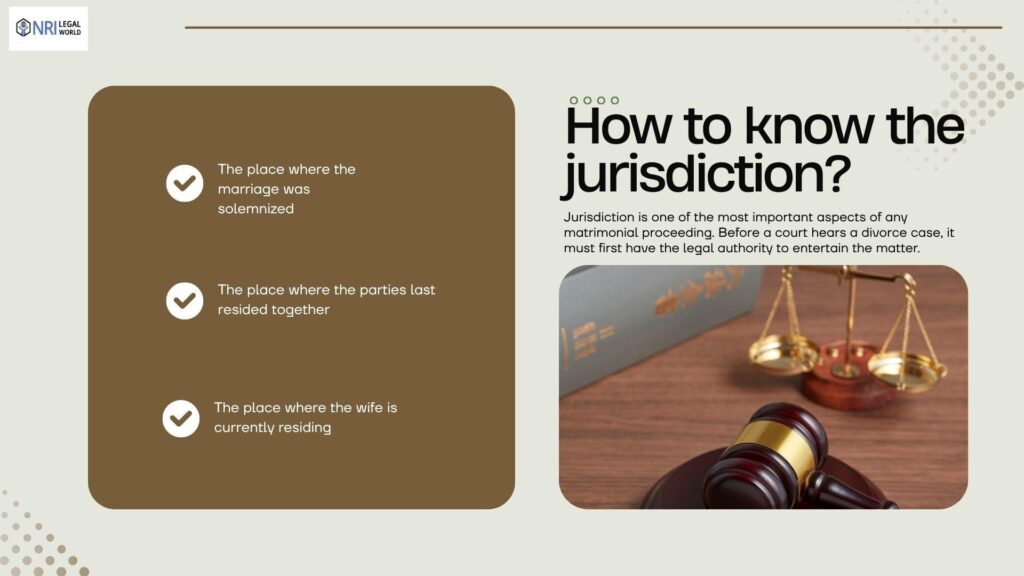
Under Indian matrimonial law, jurisdiction is generally determined based on factors such as:
- The place where the marriage was solemnized
- The place where the parties last resided together
- The place where the wife is currently residing
In NRI matters, jurisdiction often becomes more complex because both spouses may be residing abroad. Even in such situations, Indian courts may still have jurisdiction if the marriage has a sufficient connection to India.
This is particularly relevant where the marriage was performed in India under Indian personal laws or where the matrimonial home was situated in India before the parties relocated overseas.
Jurisdiction also becomes important when dealing with foreign divorce decrees. If a foreign court grants a divorce without satisfying principles recognised under Indian law, the decree may later face challenges in India.
Therefore, selecting the correct jurisdiction at the beginning of the case is not merely procedural, it has long-term legal consequences.
Role and Scope of Power of Attorney in Divorce Proceedings
For NRIs who cannot remain physically present in India during litigation, the power of attorney mechanism plays a significant role. A Power of Attorney authorizes a representative in India to perform specific legal acts on behalf of the NRI spouse. Depending on its wording, the representative may:
- File the divorce petition
- Sign pleadings and applications
- Submit documents
- Attend procedural hearings
- Coordinate with advocates and the court
To be legally valid, the power of attorney should be properly executed in the country where the NRI resides and must generally be attested before the Indian embassy, consulate, or a notary authority.
However, it is important to understand the limitations of a Power of Attorney in matrimonial disputes. Indian courts treat divorce proceedings as personal matters involving individual rights and obligations. Because of this, courts may still require direct participation of the concerned spouse at certain stages, especially during:
- Recording of evidence
- Final statements
- Verification of consent in a mutual consent divorce
- Cross-examination in contested proceedings
Therefore, while a Power of Attorney significantly reduces the need for travel, it does not completely eliminate personal involvement in every case.
Difference between Mutual Consent Divorce and Contested Divorce for NRIs
The practical difficulty of obtaining a divorce from abroad depends largely on whether the matter is contested or based on mutual consent. Under Section 13B of the Hindu Marriage Act, 1955, spouses may jointly seek dissolution of marriage after mutually resolving issues such as:
- Alimony and maintenance
- Child custody and visitation
- Division of assets and liabilities
Since there is no dispute regarding the breakdown of marriage, courts generally adopt a more flexible approach in such cases. Virtual appearances and video conferencing are more commonly permitted, making the process easier for NRIs.
On the other hand, contested divorce proceedings under section 13 of the Hindu Marriage Act, 1955, involve allegations such as cruelty, desertion, or adultery. These cases require evidence, witness examination, and detailed adjudication by the court.
As a result, contested proceedings are typically more time-consuming and may require greater personal involvement from the parties, even where technology is used. For NRIs seeking to avoid frequent travel, a mutual consent divorce is generally the more practical and efficient option.
Importance of Documentation in Overseas Matrimonial Litigation
In NRI divorce cases, documentation becomes particularly important because courts rely heavily on written records where physical participation is limited. The basic documents that are generally required include:
- Marriage certificate
- Passport copies
- Address proof
- Identity proof
- Photographs
- Immigration or visa-related records where relevant
- Birth certificate of child (in custody cases)
- Passport of child (in custody cases)
- Proof of income and assets (in alimony cases)
In mutual consent divorce matters, the settlement agreement becomes one of the most critical documents. It should clearly record the terms agreed upon by both parties regarding finances, custody, and future obligations.
In contested cases, documentary evidence supporting the allegations assumes major importance. Courts may examine communication records, financial documents, travel history, medical records or other supporting material depending on the nature of the dispute.
Properly prepared documentation often reduces procedural delays and strengthens the credibility of the case.
Recognition of foreign divorce decrees in India
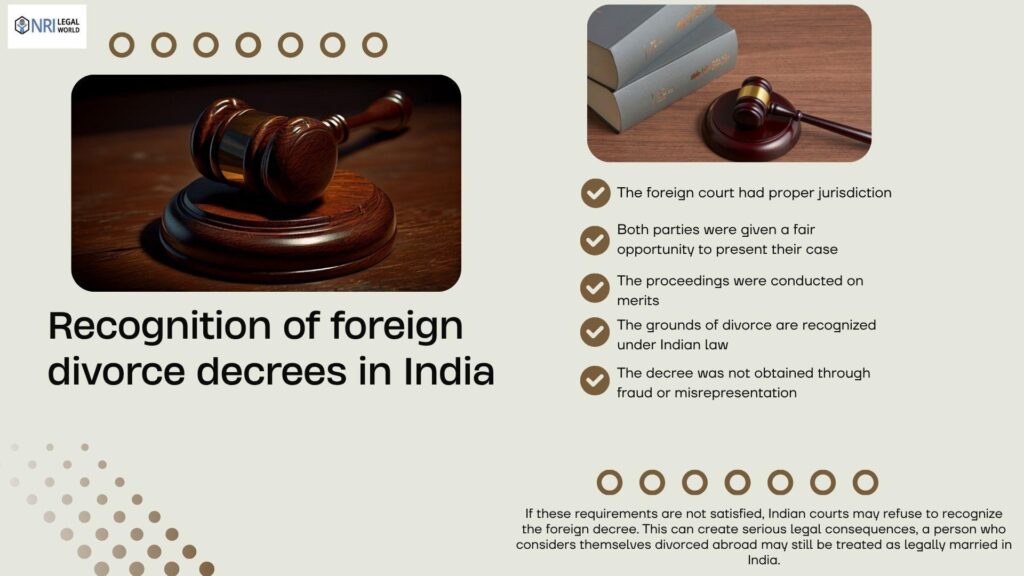
One of the most misunderstood aspects of NRI matrimonial law is the assumption that a foreign divorce decree is automatically valid in India. Indian courts do not automatically recognize every foreign judgment. The validity of a foreign divorce decree is examined under Section 13 of the Code of Civil Procedure, 1908. Indian courts evaluate whether:
- The foreign court had proper jurisdiction
- Both parties were given a fair opportunity to present their case
- The proceedings were conducted on merits
- The grounds of divorce are recognized under Indian law
- The decree was not obtained through fraud or misrepresentation
If these requirements are not satisfied, Indian courts may refuse to recognize the foreign decree. This can create serious legal consequences, a person who considers themselves divorced abroad may still be treated as legally married in India.
Such situations may affect remarriage, inheritance rights, maintenance claims, and property disputes. Therefore, NRIs should carefully examine the enforceability of foreign divorce decrees before relying upon them in India.
Use of Technology and Digital Proceedings in Indian Matrimonial Courts
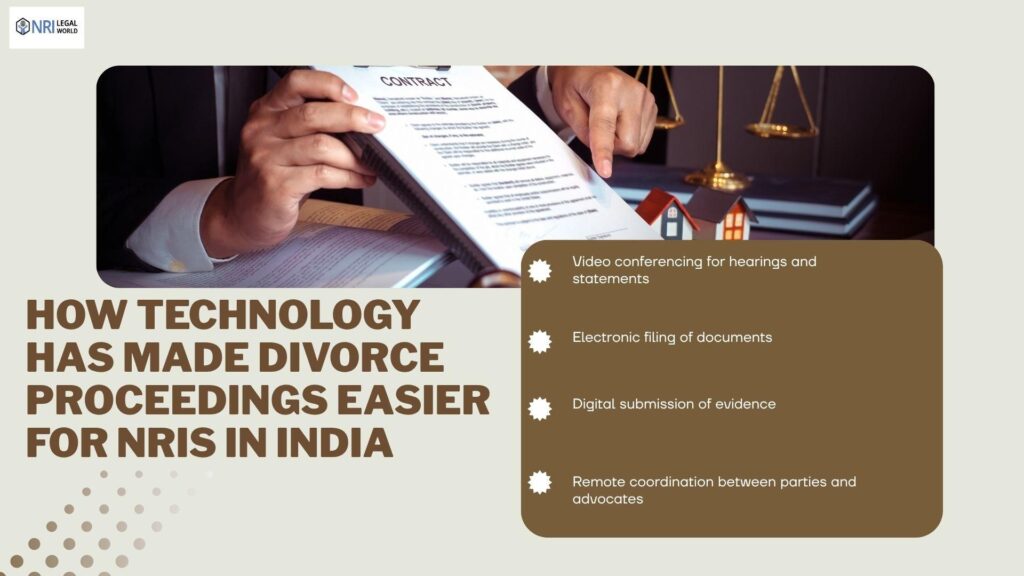
The increasing use of technology within the Indian judicial system has significantly improved access for NRIs involved in matrimonial disputes. Courts today are more willing to permit:
- Video conferencing for hearings and statements
- Electronic filing of documents
- Digital submission of evidence
- Remote coordination between parties and advocates
This shift became more prominent after courts adapted to virtual functioning in recent years. Matrimonial matters, especially mutual consent divorces, are now more capable of being managed remotely than before. At the same time, courts continue to exercise discretion depending on the facts of each case.
Technology is used to facilitate access to justice, but courts still prioritize authenticity, fairness, and procedural compliance. Even so, digital proceedings have undeniably reduced the logistical burden previously faced by NRIs in Indian matrimonial litigation.
Hence, obtaining a divorce in India without physical presence is legally possible for NRIs, but the process requires careful planning and proper legal execution. Issues relating to jurisdiction, power of attorney, documentary evidence, recognition of foreign judgments, and procedural compliance all play a crucial role in determining how smoothly the matter proceeds. While technological advancements and virtual hearings have made the system more accessible, matrimonial disputes continue to involve significant legal and personal consequences.
For this reason, the process should be approached with clarity, preparation and a proper understanding of Indian law. A well-handled case can substantially reduce the need for travel and unnecessary litigation. However, overlooking legal technicalities at the initial stage can create complications that continue long after the divorce itself is granted.
For information regarding the topic you can contact our expert team: info@nrilegalworld.com / +919709692096
Frequently Asked Questions
Q.) Which Indian court has jurisdiction in an NRI divorce case?
Ans.) Jurisdiction is usually determined based on:
- The place where marriage was solemnized
- The place where the parties last resided together
- The place where the wife is currently residing
Even if both spouses are abroad, Indian courts may still have jurisdiction if the marriage has a legal connection with India.
Q.) Can both NRI spouses living abroad still get divorced in India?
Ans.) Yes, if the marriage was performed in India or falls under Indian matrimonial laws, Indian courts can still entertain the matter despite both spouses residing overseas.
Q.) What is the role of Power of Attorney in NRI divorce cases?
Ans.) A Power of Attorney allows a trusted person in India to act on behalf of the NRI spouse for procedural matters such as filing a petition, signing documents, and attending routine hearings.
Q.) Does a power of attorney completely replace personal appearance?
Ans.) No, courts may still require direct participation of the concerned spouse at certain stages, particularly in contested matters or during final statements in a mutual consent divorce.
Q.) Can NRIs attend divorce hearings through video conferencing?
Ans.) Yes, Indian courts increasingly allow video conferencing in matrimonial matters, particularly where travelling causes hardship or practical difficulty.
Q.) Are online or virtual hearings automatically allowed in every case?
Ans.) No, permission for virtual appearance depends on the discretion of the court and the facts of the case.
Q.) What documents are usually required in NRI divorce proceedings?
Ans.) Commonly required documents include:
- Marriage certificate
- Passport copies
- Address proof
- Identity proof
- Photographs
- Settlement Agreement (in mutual consent cases)
- Evidence supporting allegations (in contested matters)
Comments are closed