
5 Things NRIs Don’t Know About Dividing Joint Family Land in Punjab, India
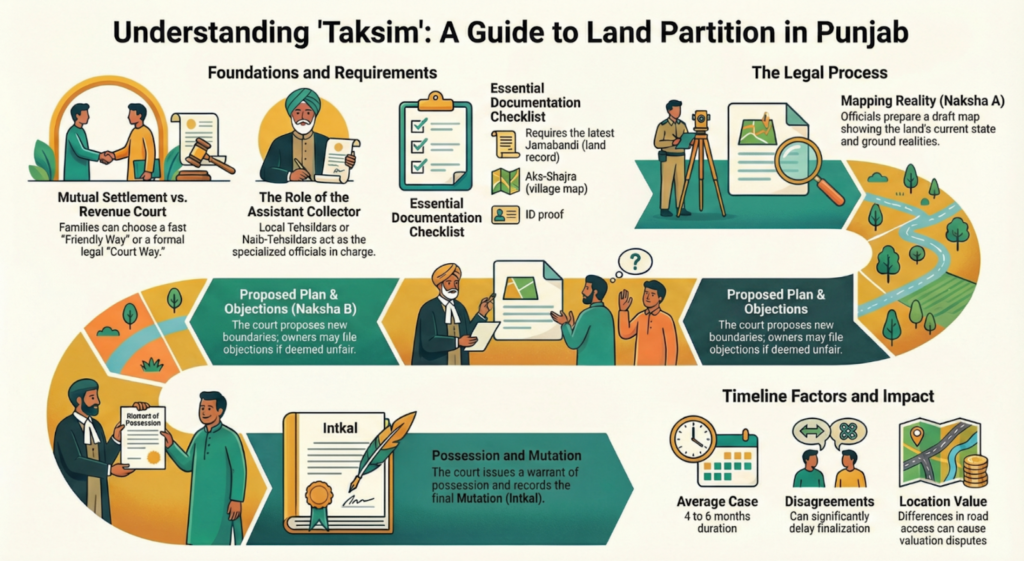
The process of partition of agricultural land is governed by the Punjab Land Revenue Act of 1887. Since land is a serious matter, specialized officials called Assistant Collectors (like your local Tehsildar or Naib-Tehsildar) handle the cases.There are generally two paths a family can take:
1. The Friendly Way (Mutual Settlement)
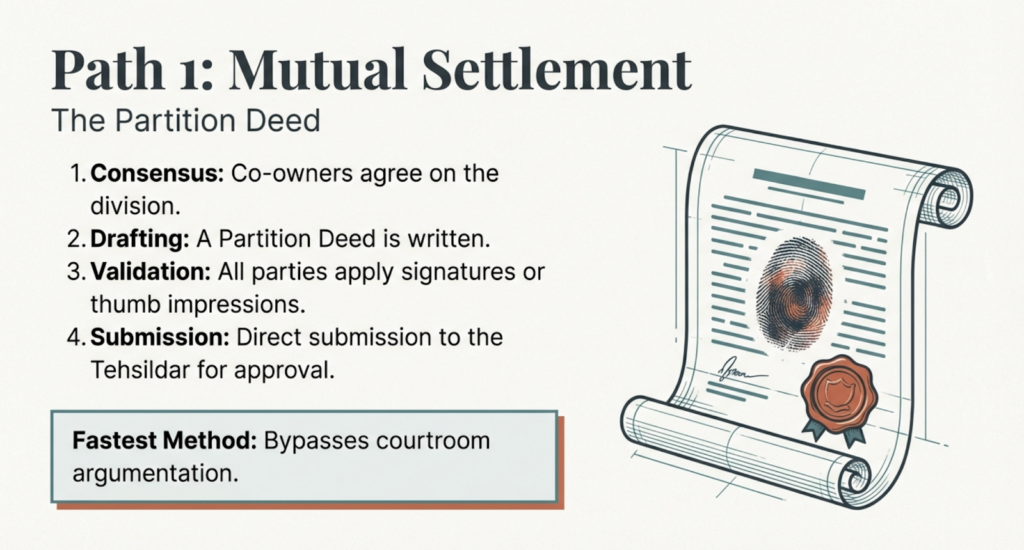
If all the shareholders are in agreement over the share of land they are getting, they can write up a Partition Deed which should be signed by every shareholder. Lastly, the partition deed must be submitted to the Tehsildar/FRO in the district. This is the fastest and easiest method of partition of joint property.
2. The Legal Way (via the Revenue Court also known as Contested Partition)
In the cases where the shareholders cannot reach a mutual agreement to divide the land and any one of the shareholders can file the partition suit at the local Revenue Court. This is called a contested partition. Any shareholder whose name is reflected in the latest Jamabandi (the official land record) can file a partition suit.
Step-by-Step Procedure for the partition of land
A step by step guide for NRIs about the whole process of partition of joint property:
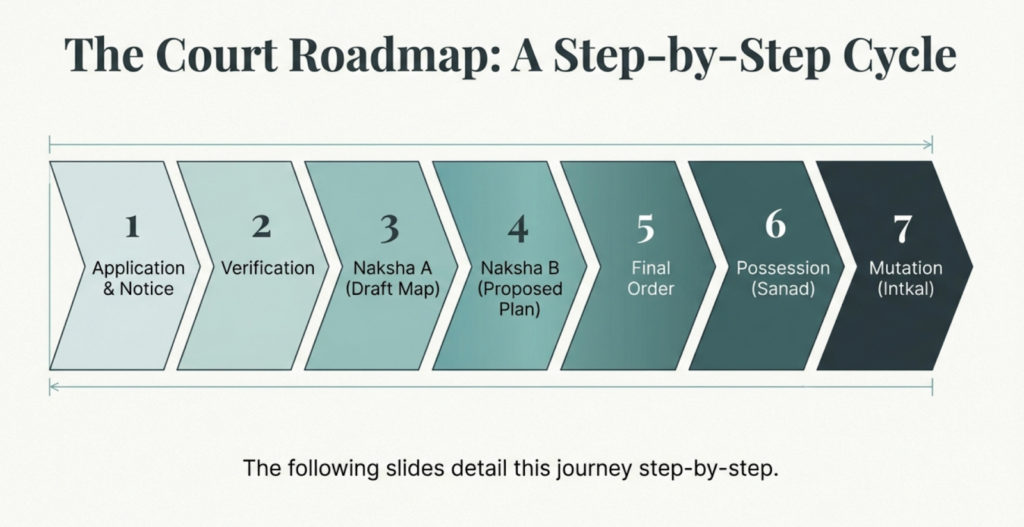
- Application & Notice: A notice is sent to all shareholders to inform them that a partition suit has been filed to divide their Joint property. The district revenue authority sends the notice on the current address of the shareholders by post, phone, massage and emails. In case a dispute is there the revenue authorities issues the notice in the newspapers and announce it publicly.
- Checking Ownership: The revenue court confirms everyone’s share. In case of a dispute of ownership of the property i.e dispute over who actually owns the land, the revenue authorities may stop the partition process and can send it to a Civil Court to decide the title of ownership first.
- Naksha A (The Draft Map): Revenue officials called the Patwari and Kanungo prepare a draft map showing the land’s current state and ground realities before the partition of land.

- Naksha B (The Proposed Plan): The revenue officials propose a new map of the land reflecting the share of all shareholders with clear boundaries. Shareholders can file objections if they think the plan is unfair to them or any of them.

- The Final Order: Once objections are settled, the court passes the final partition order.
- Taking Possession: The court issues a Warrant of Possession (Sanad Taqseem), which allows the owners to physically take over their new specific plots of shareholders.
Tip: The Sanad Taqseem, or Warrant of Possession, is the definitive legal instrument that transforms paper ownership into physical reality. It is the document that authorizes you to move fences and take physical control of your newly assigned plots.
NRi Legal World
- Mutation/Updating Records: Once the partition of the land is completed, the next and compulsory step is to file an application for the Mutation (Intkal) of the land belonging to each shareholder. By doing this the names and ownership will be clearly mentioned in the revenue records.
What Documents Are Needed for the Partition of Land?
To file a request for partition of land following documents are required:
- Jamabandi: Jamabandi is a record of rights that shows who is the possession holder of the land.
- Aks-Shajra: The official map of the village.
- ID Proof: Personal identity proof such as an Aadhaar card etc.
- Application: A formal request with the details about the land. For example Khewat/Khasra numbers of the land.
How long does the partition of land take?
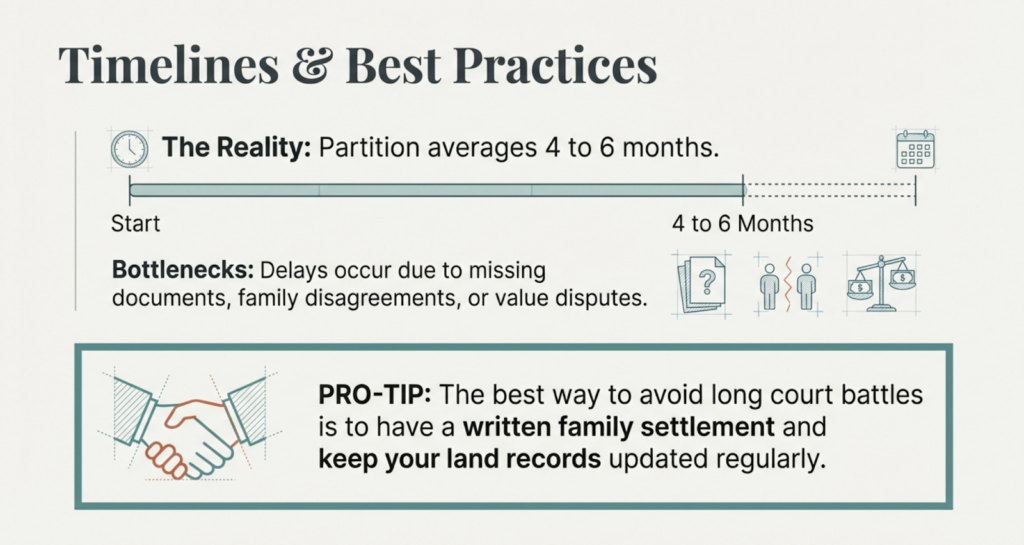
Partition of land is not always a quick process, especially in case of contested partition. In ideal cases of mutual settlement partition it takes 4 to 6 months to complete the whole process, but it can take any length of time if there are complexities in the case. Here are the few examples of the complexities:
- Dispute among shareholders of the land / dispute among family members.
- Lack of clear records like missing or old and unclear documents.
- Arguments over the value of different parts of the land (e.g., one side is near a road and more valuable).
Pro-Tip for NRIs : NRI families who prioritize speed and the preservation of healthy bonds within family members, the Mutual Settlement is the most powerful tool available for them. If all the shareholders reach a consensus on how the land should be split, they can draft a “Partition Deed.” Once all parties provide their signature and the signed deed is submitted to the Tehsildar/FRO, the Partition of land is formalized. By choosing this path of mutual settlement, you bypass the exhaustive as well as the time consuming process of the contested partition by the civil court, hence you are securing your rights through cooperation rather than civil litigation.
NRI Legal WOrld
Why does the contested partition case get delayed?
It is significant to know the grounds on which the contested partition can be delayed in Tehsildar’s court. Here are some reasons behind the delay:
- When multiple parties and heirs are involved in the partition suit which leads to complicated pleas, hearings and adds more witnesses in the case. Hence, the process becomes time-consuming.
- As many shareholders are involved in partition cases the chances of filing of Interim applications and stay orders either on actual grounds or sometimes on flimsy grounds from the civil courts increases the time for civil proceedings. Thus, each new application entered in the civil court requires separate hearings which slows down the main suit proceedings.
- Most commonly the major cause of delay in the case solvency is witness absenteeism during the proceedings of the case. Also, as more witnesses are involved in the case, the summoning of the witnesses itself is a cumbersome process. Sometimes the witnesses do not deliberately want to participate in the process to cause delay which is paramount for the NRIs.
- Sometimes if the ownership and mutation of the property is not clear. It leads to opening up of another case. In such cases the court will prefer to decide the ownership of the land before moving forward on the partition suit.
- In cases where one or more shareholders have taken the mortgage on the joint property, it adds another layer of complexity.
- Sometimes the lawyers request adjournments deliberately based on frivolous grounds.
Partition of joint land is a well structured process designed to protect your property rights, but it requires proactive management. Keep that the title of ownership clear and make sure it is reflected in the government records,
Strategic Advice: Don’t wait for a dispute to arise. Ensure your name is mentioned correctly in the current Jamabandi and maintain a written family settlement for the partition of land. Maintaining the record is the only way to avoid the typical 4-to-6-month timeline from stretching into years of land litigation.
It is always better to discuss your case with a professional team to get the best advice.
Contact Info: info@nrilegalworld.com
Phone No: +919709692096
Frequently Asked Questions
Q: Can an NRI apply for the partition of land from abroad?
Ans: Yes, NRI can manage the whole process of the partition of the land while sitting abroad. NRI can authorise a trusted friend/family member/legal advisor, by means of special Power of Attorney, to complete and manage the whole process in India on his behalf.
Q: Who handles the partition: a Civil Court or a Revenue Officer?
Ans: In the cases where the partition of the land is completed with a joint mutual settlement with the mutual consent of all the shareholders, then the revenue office is the authority to complete the whole process. On the other hand, in cases with dispute of ownership of the property involved then the civil court has the authority to decide the case.
Q: Does an NRI need to travel to Punjab to file for partition?
Ans: No, NRI does not need to travel to India to file for partition of land provided the NRI authorizes someone with a valid power of attorney to manage things on his behalf.
Q: Can an NRI file for Partition of land online?
Ans: NRI can not file a partition of land petition online. NRI can collect Jamabandi online and other services but Partition of land is not available as an online service.
Q: Can my family member file for partition of joint land without my consent ?
Ans: No, ideally it is not possible to do partition of land without the participation of all shareholders. It doesn’t matter if the shareholders are in India or living abroad. However, fraudulent mutations are a common issue in India where NRI shareholders were kept out of the loop and never received the notice. So, NRIs must regularly check their land status in the government records.
Q: How is the partition suit deliberately delayed by the parties in the NRI land case?
Ans: Specially, in the cases where land is under the illegal possession of the other parties they often use many methods to delay the finality of the civil case of partition of the land. The most common used methods are following:
- In cases where multiple parties and heirs are involved in the partition suit which leads to complicated pleas, hearings and adds more witnesses in the case. Hence, the process becomes time-consuming.
- As many shareholders are involved in partition cases the chances of filing of Interim applications and stay orders either on actual grounds or sometimes on flimsy grounds from the civil courts increases the time for civil proceedings. Thus, each new application entered in the civil court requires separate hearings which slows down the main suit proceedings.
- Most commonly the major cause of delay in the case solvency is witness absenteeism during the proceedings of the case. Also, as more witnesses are involved in the case, the summoning of the witnesses itself is a cumbersome process. Sometimes the witnesses do not deliberately want to participate in the process to cause delay which is paramount for the NRIs.
- Sometimes if the ownership and mutation of the property is not clear. It leads to opening up of another case. In such cases the court will prefer to decide the ownership of the land before moving forward on the partition suit.
- In cases where one or more shareholders have taken the mortgage on the joint property, it adds another layer of complexity.
- Sometimes the lawyers request adjournments deliberately based on frivolous grounds.
Comments are closed