

For NRIs, the Indian real estate market has been a beneficial investment destination. As we know that purchasing a property is not only a financial decision but also an emotional one for every individual which is often tied to future plans especially for NRIs such as:
- Returning home to India
- Securing diversifying family assets in India
- Building long term wealth in India
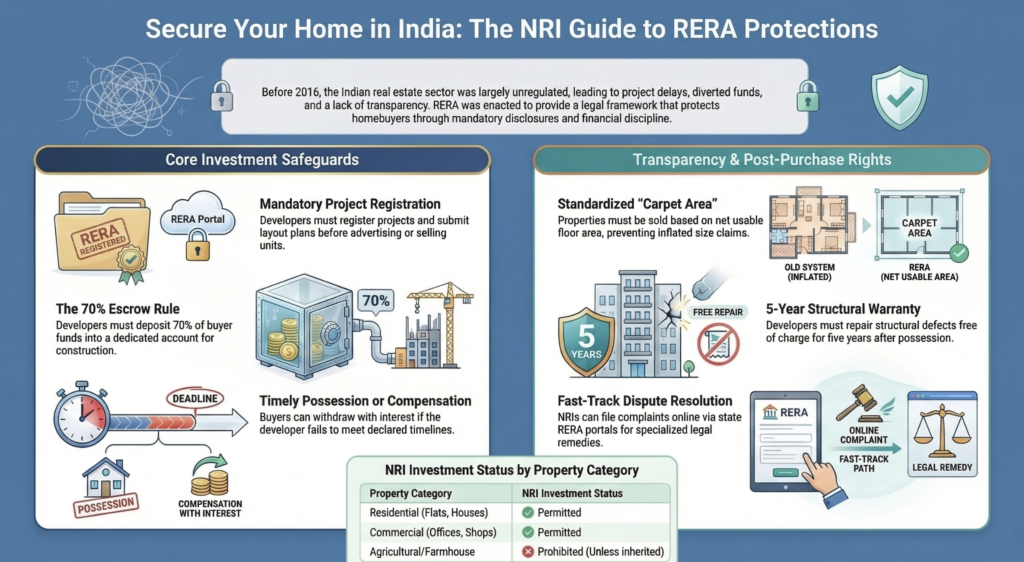
But the real estate sector has always faced many challenges like:
- Delays in completion of real estate projects
- There is lack of transparency in investments
- The funds are diverted by the developers
- Misleading advertisements by the developers
The NRIs get particularly affected by these issues, especially the ones who invest from abroad and depend totally on developers or agents for any information related to investments.
To highlight these long standing issues and bring greater accountability to the real estate sector, the government of India has enacted the Real Estate (Regulation and Development) Act, 2016 which is known as RERA worldwide. Every state has its own RERA authority and its own RERA Appellate Tribunal.
This act significantly aims at:
- Regulating the property developers
- Bringing transparency in the real estate investments and transactions
- Protecting the interest of homebuyers be it NRIs or residents of India
The purpose of RERA
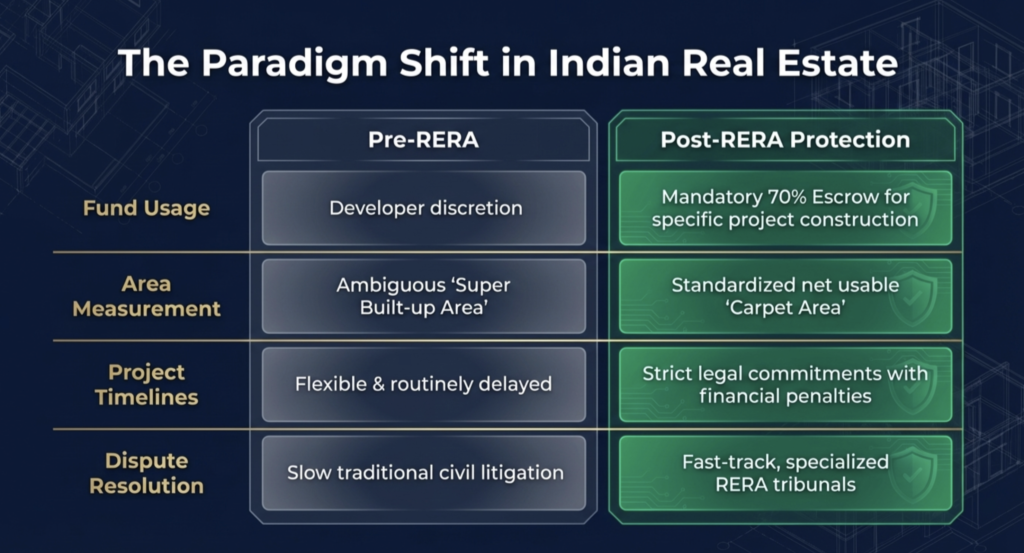
The main goal of RERA is to create a fair and transparent real estate market in India where both developers and buyers can operate within a clearly defined legal framework. Before the enactment of this act, the real estate sector used to be hugely unregulated and the developers were doing considerable discretion in the timelines of projects, the pricing structures and the terms of contacts.
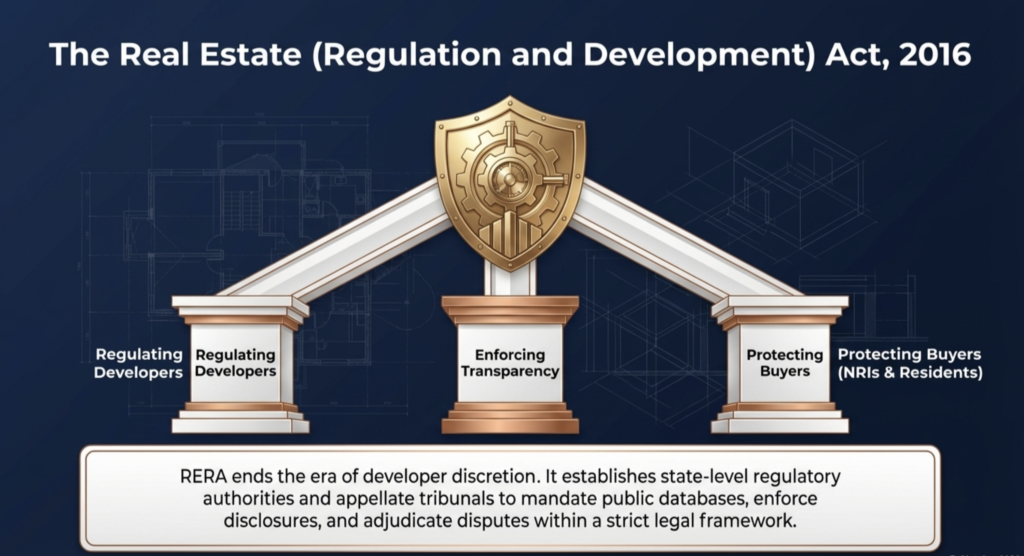
But now, RERA has introduced a system of regulatory authorities at the state level that:
- Overseas the real estate projects
- Ensures that there is complete compliance with the law
- The public databases of registered projects are now necessary to be maintained
- Enforces disclosure requirements
- Adjudicates disputes between developers and buyers which often arises
- Ensures that there is transparency and accountability in the real estate sector
RERA has enhanced the confidence of investors and made it easier for them to invest without any risk, particularly for those people who are residing outside India.
The mandatory registration of each real estate project under RERA
One of the most important factor through which RERA regulates all the property developers is that it requires all the property developers to register all the real state projects.
Developers are legally obligated to register their real estate projects with the respective state RERA authority before doing any advertisement or marketing of that project or before selling any property units to anyone.
Essential things which need to be submitted by the developer during the registration process are as follows:
Comprehensive details about the project
- Land ownership documents
- Layout plans of the project
- Approval from the government
- Timelines of the project
- The number of land units being offered
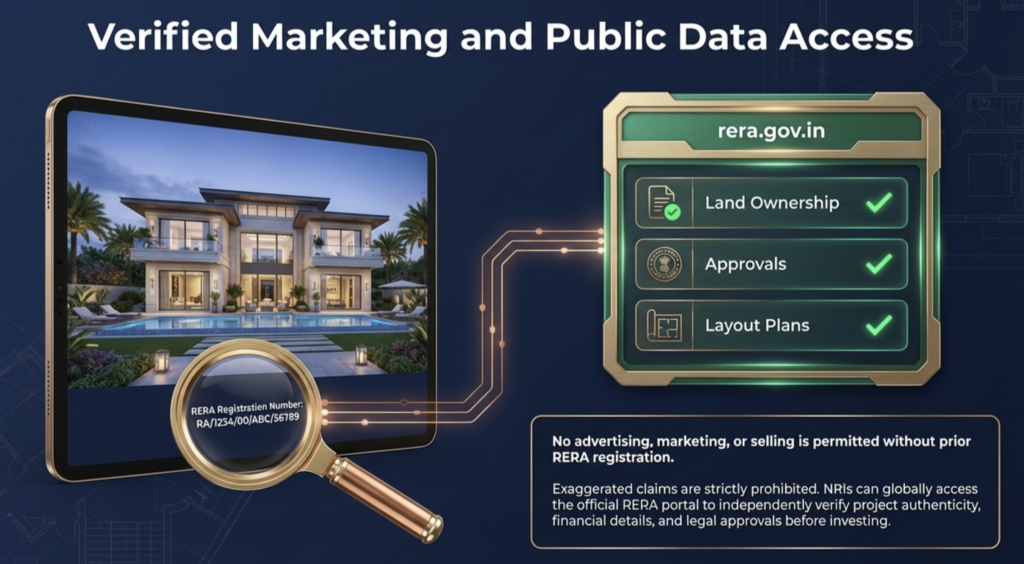
After submission, these details are made publicly accessible on the official RERA website (https://rera.gov.in), the potential buyers including NRIs can access this website to verify the authenticity and legal status of a project before making any investment.
Financial discipline through Escrow Mechanisms
Through Escrow mechanism people can keep their money safe and secure as all the money will be kept safe with a neutral third party until certain conditions are fulfilled. This acts like a safety locker for money, the money is not given to the seller until or unless the promised work or agreement is completed. The escrow mechanism is very similar to the escrow system which NRIs follow in foreign countries like the United States, United Kingdom, Australia and Canada.
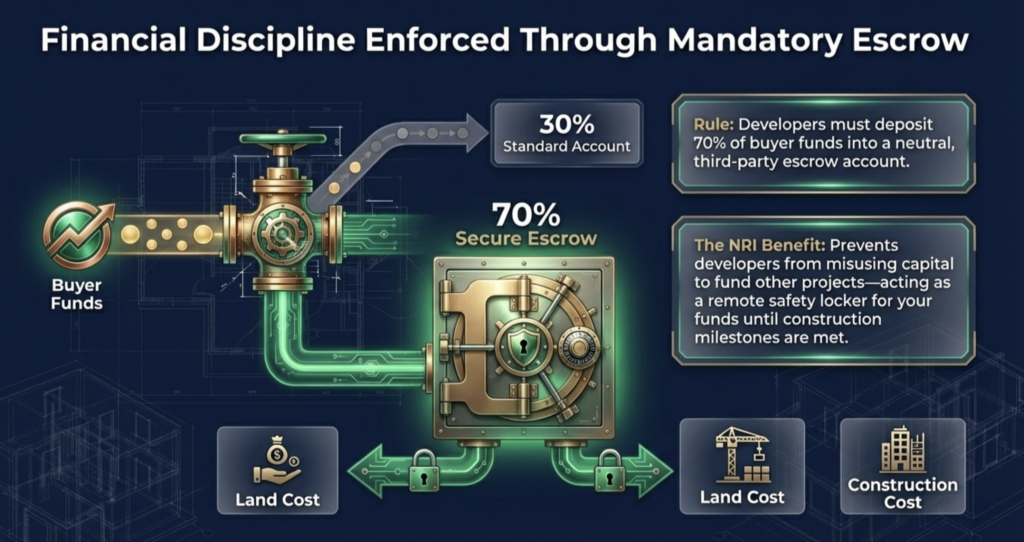
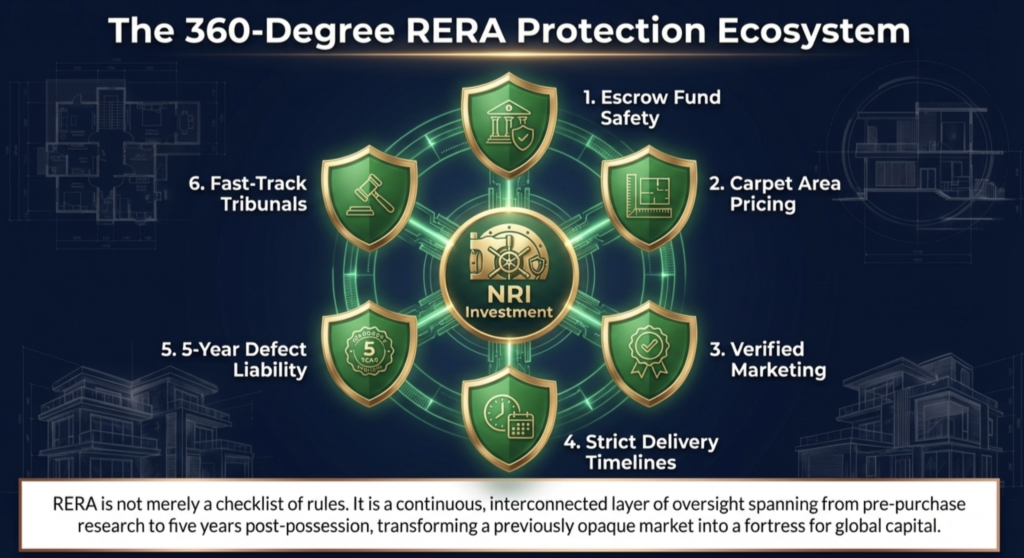
As per the Real Estate (Regulation and Development) Act, 2016, developers must deposit 70% of the money received from the buyers and then keep it into escrow account. This money can only be used for construction of the project or for the land cost of that specific project.
This rule prevents developers from misusing the money and it restricts them from funding other projects by using the money of one project which earlier used to cause delay in projects and unfinished buildings.
For NRI investors who may have not the ability to closely monitor the progress of construction, this provision offers them an important layer of financial protection.
The Timely Completion of Projects
Project delays have been one of the most frequent stress causing factors among homebuyers, developers often failed to deliver the possession of property to the buyers on promised timeline, which causes financial burden and uncertainty about the status of the investment in buyers.
Under RERA, the developers are legally bound to adhere to the completion schedule which is declared at the time of the project registration. If a developer fails to deliver possession to the buyer within the agreed timeline then:
- The buyer can withdraw anytime from the project
- The buyer can receive interest compensation for the delay
- Buyer can file a complaint before RERA authority
- The developer has to face penalties such as monetary penalties
- The buyer can appeal in RERA Appellate Tribunal
Due to this provision, the ability to bargain has strengthened for homebuyers and a strong incentive for developers to meet their commitments has been introduced.
Standardisation and transparency in property transactions
RERA has also addressed issues related to misleading measurement standards in property sales. Earlier the developers used to market properties based on “super built up area”, which included common spaces such as lobbies, staircases, amenities and parking area, which often confused the buyers about the actual usable space within the property.
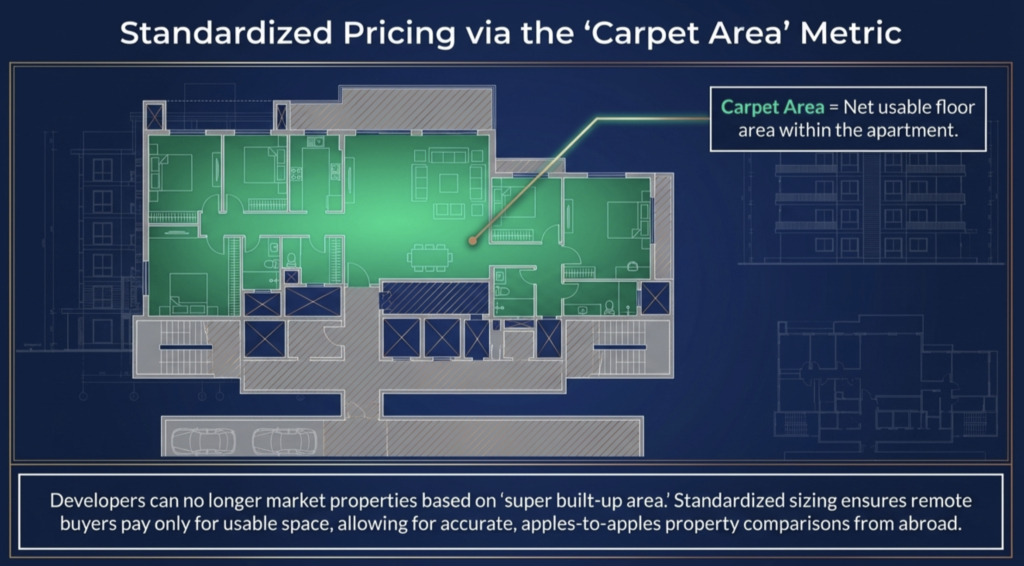
The Act now mandates that properties should be sold based on “carpet area”, which refers to the net usable floor area within apartment.
For NRI buyers who are looking for properties remotely, this standardized approach ensures:
- Greater clarity
- Prevents developers from inflating property sizes through ambiguous measurement practices
- It helps in simplifying comparisons
- Improves transparency during investments
Regulation of advertising and marketing practices
RERA plays a crucial role in controlling advertisements and promotional activities by developers, the developers are allowed to share the pictures of the properties only after registration under RERA otherwise the developers are prohibited from:
- Advertising
- Promoting real estate projects without obtaining RERA registration
- The advertisement should contain project’s official registration number
- Making exaggerated or misleading claims regarding project features, amenities, area, or delivery of possession timelines
This ensures and helps the buyers in verifying the legitimacy of a project in which they are investing or if they are thinking about investing.
Protection against structural defects
RERA also helps the homebuyers after they get the possession of the property if they face any issue related to quality of the property such as structural defects, cracks in the walls, seepage problems, poor construction quality, etc. This is valid till 5 years from the date of possession, if any such defect arises in the quality of the property within 5 years then the developer is legally obligated to rectify it without taking any additional cost from the buyer.
This ensures that the buyers are getting an acceptable standard of quality in which they are investing their hard-earned money and also reinforces the principle of developer accountability.
Legal remedies available for any dispute
RERA provides disputes resolutions and legal remedies to the homebuyers including NRIs if they face any issue or dispute related to the property, the homebuyers are entitled to make complaints before RERA and they can even appeal in RERA Appellate Tribunal if they any issues such as:
- Getting delayed possession of property
- If there is any breach of agreement by the developer
- If there has been any non-compliance with project specifications
If any such issue arises the RERA authority has the power to conduct:
- Hearings
- Investigate complaints
- Issue legally binding orders
- If either party is dissatisfied with the decision, an appeal may be filed before the real estate Appellate Tribunal
This structured dispute resolution system offers a faster and more specialized forum compared to the traditional civil litigation.
Impact of RERA in building NRI investment confidence
The introduction of RERA has improved the investor ‘s confidence in the Indian real estate sector, especially for NRIs, this law provides:
- Much needed transparency in investments
- A clear oversight to the buyers
- Legal protection in a sector that was earlier perceived as risky and opaque to invest money
- Registration of projects
- Financial accountability and safety
- Standardised property measurements
- Enforceable rights for buyers
RERA has significantly transformed the relationship between developers and investors, although there are still some challenges related to implementation and procedural delays that exist in some states but the overall framework has created a more reliable environment for property investment.
Important points to check before making any investment
- The buyer should make sure if the registration of the project is still valid or not
- The buyer should check if the developer has taken up the extension for the project or not
- It is very important to check the validity of the licence to development as the licence is only valid for 5 years after that it needs to be renewed.
- It is compulsory for the builder to buy the land before putting the land for sale and provide all the details of the land owned for the project only then the builder can allot it to the buyer
- No developer can take more than 10% of advance amount before entering the agreement to sell
- The agreement to sell should be registered at the office of sub registrar
- The RERA registration number and name of the project must be clearly mentioned on the sale deed
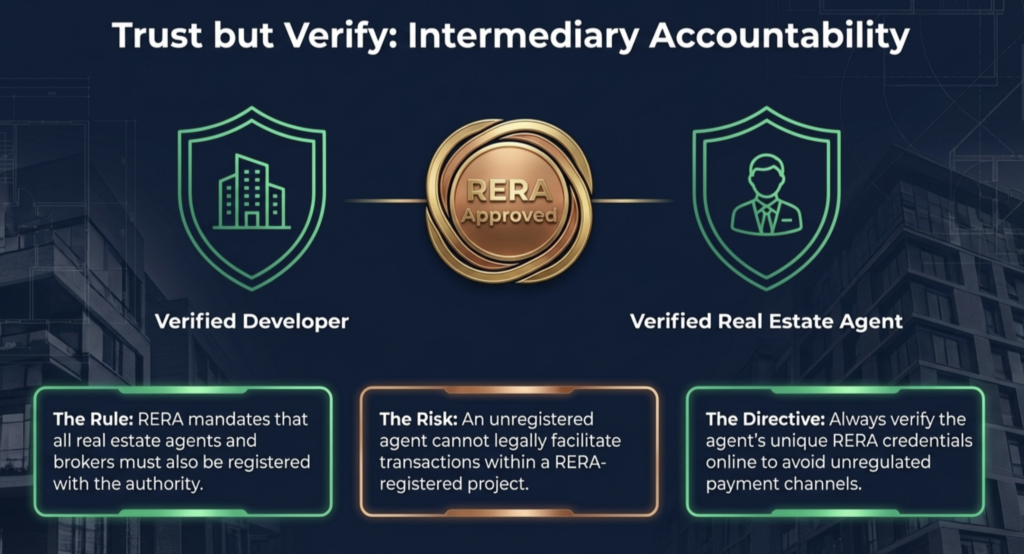
- It is highly recommended to deal with the real estate agents who are registered with RERA
- If a developer fails to deliver the possession the property to the buyer on promised timeline, the buyer can file a complaint online via the official RERA portal.
The enactment of the Real estate (Regulation and Development) Act, 2016 marks a significant step towards reforming the Indian real estate sector. This Act provides transparency, accountability, clear oversight and legal remedies to the buyers.
For NRIs who are seeking to invest in Indian real estate, this act provides a crucial layer of safety and protection which was previously absent, it empowers and builds confidence of buyers regarding financial investment with access to verified information on RERA portal (https://rera.gov.in) and for Punjab’s RERA portal the official website is https://rera.punjab.gov.in
Before investing an NRI should verify the builder’s financial health (balance sheets) and ensure that there is a valid occupancy certificate as well as a completion certificate is in place before the final registration.
This is solely for educational purpose only, before making any investment it is advised to take professional guidance. NRI Legal World can be contacted for any legal advice or at +91 9709692096 or info@nrilegalworld.com
Frequently Asked Questions
Q.) Can NRIs buy a flat/house in India?
Ans- Yes, NRIs are legally allowed to buy flats or any property in India.
Types of properties which NRIs can buy are as follows:
- Residential property such as flats, apartments, houses
- Commercial property such as offices, shops, commercial spaces
The type of properties which NRIs cannot buy are as follows:
- Agricultural land
- Plantation property
- Farmhouses
However, NRIs can get these properties through inheritance.
Q.) Can NRIs buy a showroom in India?
Ans– Yes, NRIs can legally buy a showroom in India as it is considered as a commercial property and NRIs are allowed to purchase commercial properties in India without taking permission from RBI. This is allowed under the foreign Exchange Management Act, 1999 (FEMA) and regulations issued by the Reserve Bank of India (RBI).
If the showroom is a part of commercial project or complex then it must comply with the Real Estate (Regulation and Development) Act, 2016 which regulates developers and protects buyers, including NRIs.
NRIs can also rent out the showroom and earn income in India, that income is usually credited to their NRO account and is subject to Indian taxation.
Q.) Can NRIs file a complaint before RERA if they face any quality related issue after buying property?
Ans- Yes, NRIs can file a complaint before RERA if they face any quality related issues after getting the possession of the property in India, this right is provided under the Real Estate (Regulation and Development) Act, 2016, which protects the buyers.
The act provides Right to complain for structural or quality defects under section 14 (3) of RERA, which states that if there is any structural defect or poor quality construction cracks in walls or foundation, water leakage or seepage, poor electrical wiring, etc. the buyer can file a complaint against the developer.
If the buyer complains about the quality, then the developer must rectify that defect within 30 days without taking any extra cost from the buyer and the developer is responsible for such defects for 5 years from the date when the buyer has taken possession of the property.
The NRIs can file a complaint through online state RERA portal, through a Power of Attorney holder in India, or through a Lawyer.
Q.) Can NRIs trust builders or real estate agents in India?
Ans- Yes, NRIs can trust real estate builders and agents in India only if they are registered under RERA. The NRIs should be cautious and verify legal safeguards before investing. As per the RERA act, the developer must disclose:
- Details of the project and government’s approval to it
- Timelines of construction
- Land ownership information
- Financial details of the project
This information is publicly available on the official RERA websites of each state and NRIs can verify the details and credibility of the developer through the website before investing.
RERA also requires real estate agents and brokers to register under RERA authority; an unregistered agent cannot legally facilitate property transactions in a RERA registered project.
So, the NRIs should take following precautions before making any investment:
- Verify RERA registration of the project and the agent
- Check the developers past projects and reputation
- Conduct verification through a Lawyer
- Avoid making any payments outside of the official banking channels
Comments are closed