


Indian law provides several safeguards to protect every citizen from arbitrary or illegal arrest. These protections apply equally to NRIs/OCIs. Even foreign nationals arrested in India are also entitled to several legal protections under Indian law and international convention.
If an FIR has been registered against an NRI and the investigation agency believes that arrest is necessary according to the law, the police may arrest the NRI. However, the police cannot arrest a person merely because a complaint has been filed. They must follow the procedure established by law and respect the constitutional rights of the accused.
Constitutional Protections Available To NRIs
The Constitution of India guarantees fundamental rights to every person, including NRIs who are Indian citizens. As per the Indian law, Non-Resident Indians (NRIs) hold the exact same fundamental rights and constitutional protections as resident Indians.
Article 21- Right to Life and Personal Liberty: Article 21 provides that no person shall be deprived of personal liberty except according to the procedure of law. This means that the police cannot arrest or detain someone arbitrarily and must follow the legal procedure.
Article 22- Protection Against Arrest and Detention in certain cases: Article 22 provides important safeguards after the arrest of the person, including
- Right to know the ground of arrest
- Right to consult a lawyer
- Right to be produced before a Magistrate within 24 hours
- Protection against illegal detention
These constitutional safeguards are the foundation of the rights available to every arrested person.

- Right to know the Grounds of Arrest: One of the first rights available to an arrested individual in India, is the right to know that they have been arrested. The police must clearly inform the accused about-
- The offence allegedly committed by the accused.
- The reason behind the arrest of the accused.
- The legal provisions involved in the arrest.
If the arrest is made pursuant to a warrant, the accused has the right to see the warrant. If the police refuse to inform the accused about the grounds of arrest, the detention may become illegal and can be challenged in the court of law.
- Right to Inform Family or Friends: After an arrest, the police must allow the arrested person to inform a family member, friend, relative or any trusted person about the arrest and detention. This safeguard ensures that the arrested person is not kept in illegal custody and their family is aware of their whereabouts, and helps them to arrange legal assistance immediately.
- Right to receive a copy of the FIR: If an FIR has been registered against the NRI, they have the right to obtain a copy of the FIR. With the copy of the FIR, the accused gets to know about-
- Allegations against him
- The sections invoked in the FIR
- The complainant’s version of the complaint
- The nature of the investigation
After the accused receives the copy of the FIR he can consult the lawyer for further legal actions such as regular bail, quashing of the FIR or other legal remedies.
- Right to Consult and be Represented by a Lawyer: Every arrested person has the right to consult a lawyer and be represented by an advocate of their own choice. An NRI after being arrested should immediately contact an experienced lawyer. The lawyer can meet the accused, apply for bail, challenge the illegal arrest and ensure proper periodical medical checkup.
- Right to be produced before a Magistrate within the first 24 hours of the Arrest:
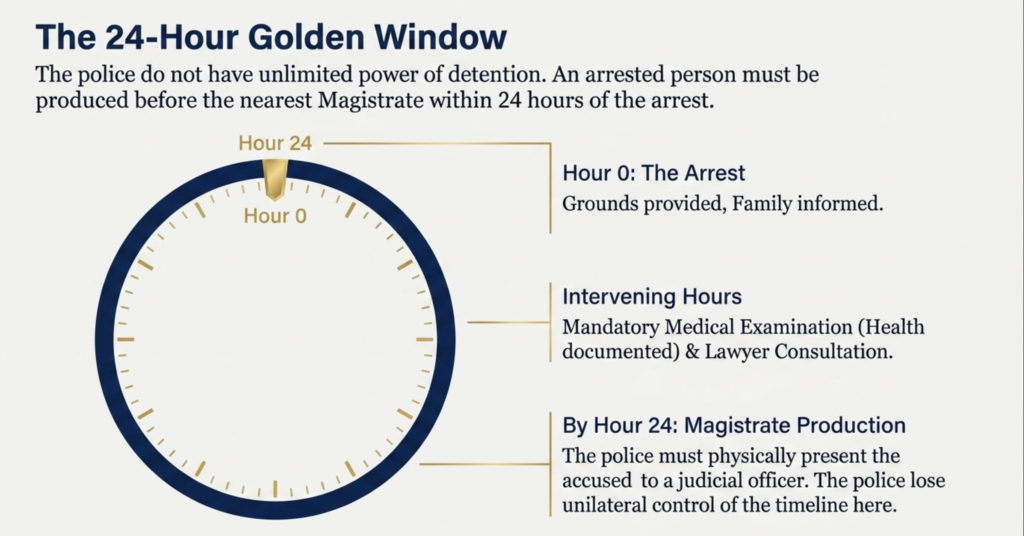
After the arrest of an accused the arrested person must be produced before the nearest Magistrate within 24 hours of the arrest for examination. The magistrate examines-
- Whether the arrest was lawful or not
- Whether the police custody is necessary in the case
- Whether the judicial custody should be granted to the accused
- Whether the bail should be considered in the case
- Right to Medical Examination: A medical examination is to be done when a person is arrested by the police. The medical examination of the accused or arrested person is done to ensure his/her physical condition in a documented form, the medical examination helps to-
- Record any injuries present at the time of arrest
- Prevent or expose custodial violence or ill treatment by the police
- Ensure the arrested person receives necessary medical care if he is sick or injured
- Provide reliable medical evidence if any dispute arises later regarding injuries sustained during custody
In simple terms, a medical examination protects both the arrested person and the police by creating an official record of the person’s health at the time of arrest and during the custody.
- Right to Fair Trial: Every accused of a crime, including NRIs, has the right to a fair and impartial trial. Every accused is considered innocent until proven guilty. During the trial, they can present evidence, question the prosecution’s witness, be represented by a lawyer, and defend themselves in Court. A court can convict the accused only if the prosecution proves his/her guilt beyond a reasonable doubt.
- Right to apply for Regular Bail: An accused including NRI, has the right to apply for bail if he/she is arrested, even if they have a fear that they might be arrested in future regarding any case, they can seek anticipatory bail before their arrest. If they are already arrested they can apply for a regular bail and in case of urgent situations, the Court may grant an interim bail to the accused until the main bail application is decided. The decision of the Court to accept or reject the bail depends on the facts and the circumstances of the case
Special Consular Rights of Foreign Nationals Arrested in India under the Vienna Convention, 1963
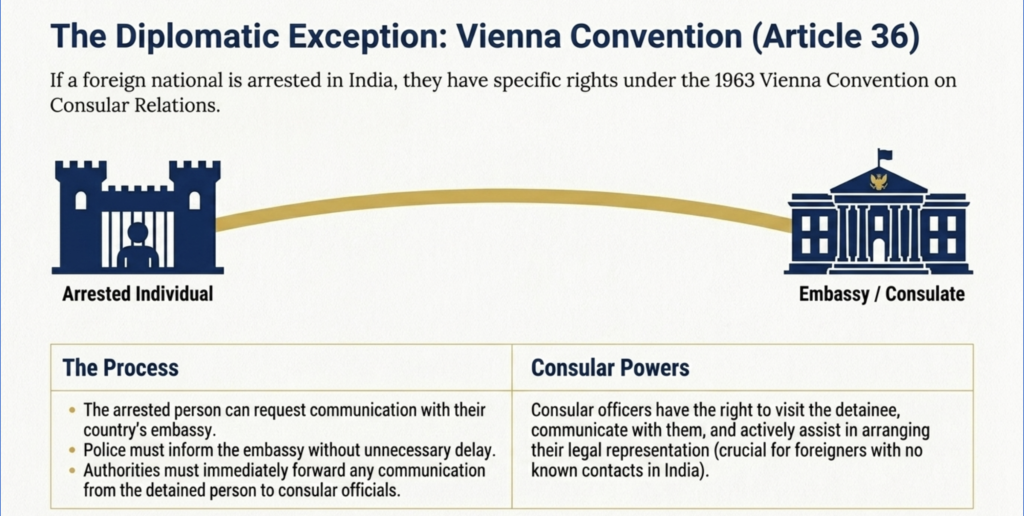
If a foreign national is arrested in India, they are entitled to certain protections under Article 36 of the Vienna Convention on Consular Relations, 1963, to which India is a party. Under this provision, the arrested person has the right to communicate with their country’s embassy or consulate. The police must inform the concerned embassy or consulate about the arrest without unnecessary delay. The authorities must also forward any communication from the detained person to the consular officials immediately.
Additionally, the consular officers also have the right to visit the detained person, communicate with them, and assist in arranging their legal representation. These rights ensure that foreign nationals receive appropriate diplomatic and legal assistance while in custody. These rights apply to Foreign citizens, including many OCI cardholders who hold Foreign nationality, therefore NRIs who are Indian citizens do not have this counselor access.
For more information contact NRI Legal World: info@nrilegalworld.com / + 919709692096