

The most familiar narrative in social life related to the domestic violence cases in India is mostly a daughter-in-law filing a complaint against her in-laws. It was due to the fact that the legal framework was narrow and the domestic violence cases were earlier filed only against men. However, the modern Indian law has moved from protecting only the “wife” to protecting “any woman” in a domestic household. It has closed the legal loopholes that previously shielded female abusers from accountability.This shift ensures that elderly women, who are often vulnerable within the domestic sphere, have the legal protection.
Defining the ‘Aggrieved Person’ and ‘Domestic Relationship’
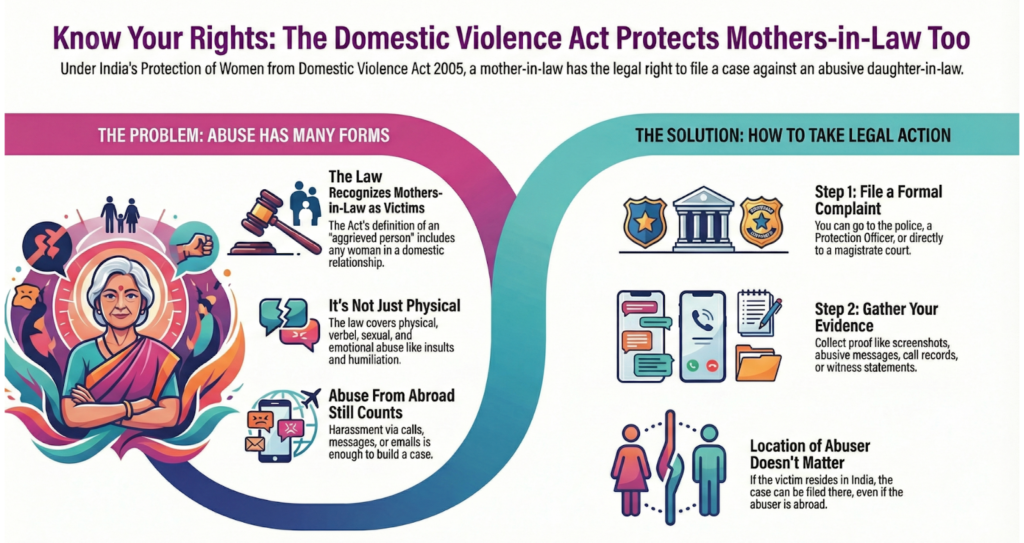
According to section 2 of the Protection of Women from Domestic Violence Act 2005 an “Aggrieved Person” is defined as any woman who is, or has been, in a domestic relationship with the respondent and who alleges to have been subjected to any act of domestic violence. This definition includes:
• Mothers-in-law, Daughters-in-law, Sisters-in-law, Widows or Any female relative living in a shared household.
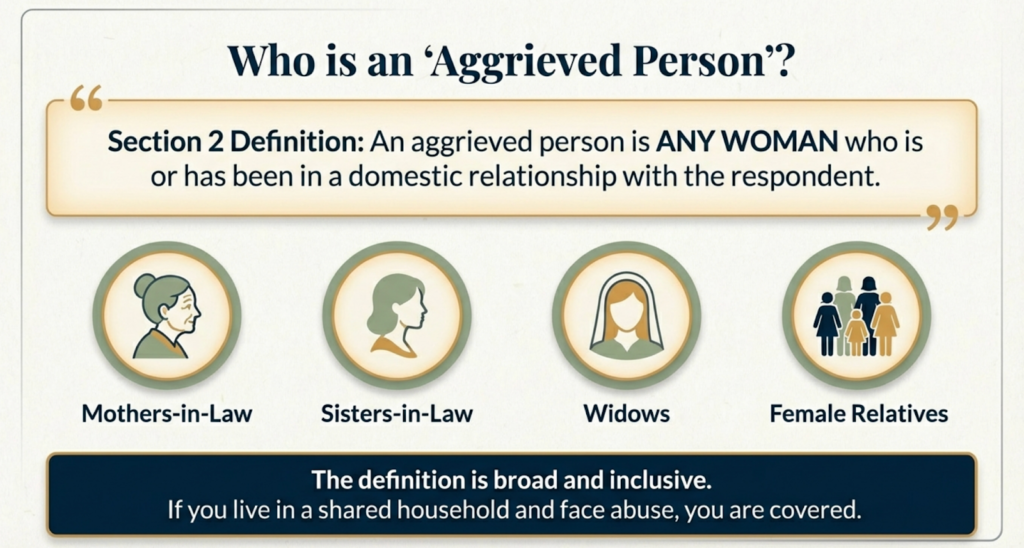
The act focuses on the nature of the living arrangement i.e shared household, rather than just the marital bond, a mother-in-law is legally empowered to file a case against a daughter-in-law. If they reside or have previously resided together in a common home and the legal criteria for a domestic relationship are met.Thus the mother-in-law can seek judicial intervention for any misconduct done by the daughter-in-law.
Understanding the types of abuse in Domestic Violence Case:
Under the PWDVA, “violence” extends far beyond physical contact; it encompasses any conduct that violates a woman’s dignity or mental well-being. Section 3 of the Act categorizes abuse into four primary domains:
| Category of Abuse | Legal Scope and Manifestation |
| Physical Abuse | Acts causing bodily pain, harm, or danger to life and health. |
| Verbal and Emotional Abuse | Insults, ridicule, humiliation, and the use of offensive language. |
| Sexual Abuse | Any unwelcome sexual behavior or conduct that is abusive or humiliates the victim’s womanhood and dignity. |
| Economic/Mental Harassment | Threats to health and well-being, including the deprivation of financial resources or harassment regarding property. |
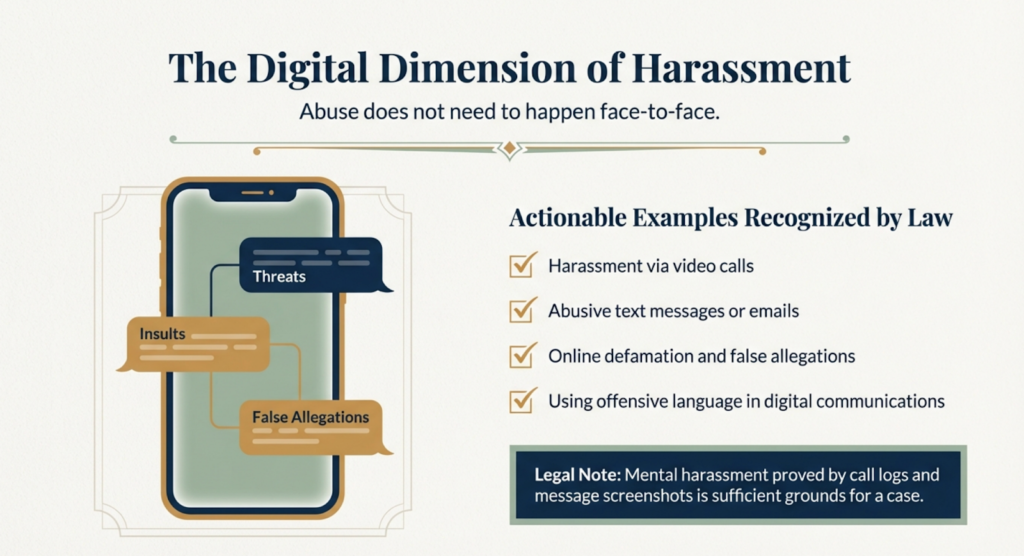
When a person uses digital platforms or devices to inflict grave mental hurt to someone in the household then it is a clear case of domestic violence. The law acknowledges that the impact of a threatening message or calls is just as damaging to any person’s dignity as an in-person insult.
NRI Scenarios and Cross-Border Enforcement
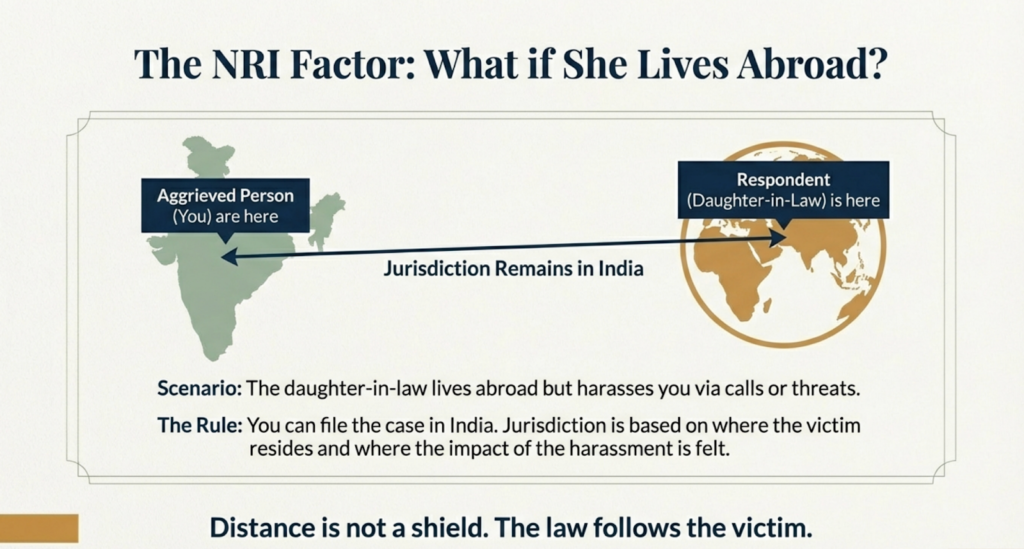
If a daughter-in-law living abroad (e.g., in the UK or USA etc) subjects her mother-in-law in India to physical and mental abuse in their house the Indian courts maintain full jurisdiction. This is based on the legal logic that the harm is felt in India. Even if a threatening call is initiated from a foreign jurisdiction, the violation of the mother-in-law’s mental peace manifests at her residence in India.
Judicial Precedence: The Case of Garima Gupta vs. State of UP
The Allahabad High Court in Garima Gupta vs. State of UP has affirmed that the Protection of Women from Domestic Violence Act is “beneficial legislation” meant to protect any woman subjected to violence, regardless of where the respondent is located. As long as the incident or its effects occurred in India, the victim has the legal right to seek protection.
Must read: https://nrilegalworld.com/blog/mutual-consent-divorce-nris/
Understanding the cross border powers of the law for NRIs
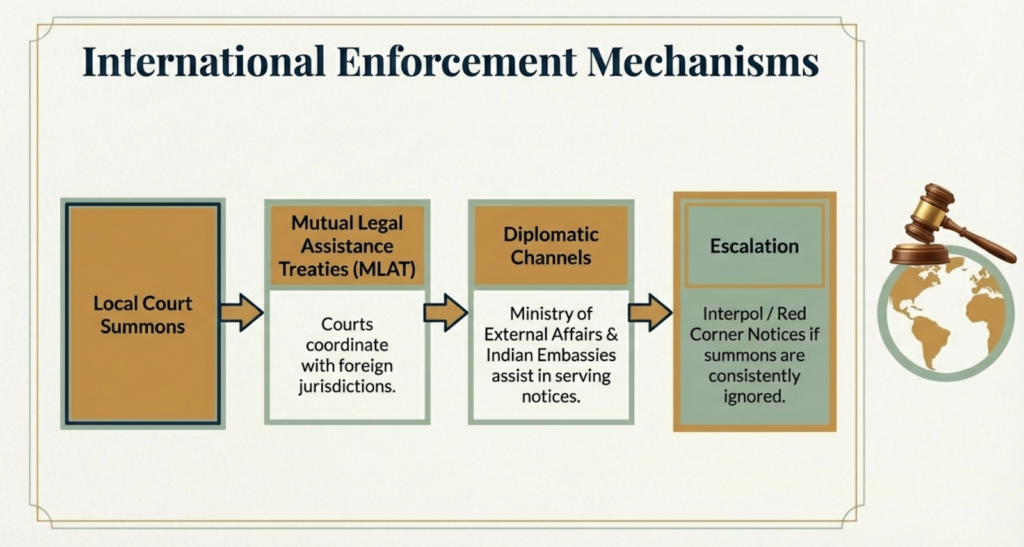
The legal provisions allow a mother-in-law who is residing in India to file a domestic violence case against a daughter-in-law who is living in another country or holds an NRI status. The legal reasoning for this is straightforward: jurisdiction is established because the “aggrieved person resides in India” and “the act of harassment was felt in India.” In an increasingly connected world, abuse can be perpetrated from thousands of miles away through video calls, messages, or emails.
Step-by-Step Guide: the Legal Procedure
The legal procedure to register a complaint in domestic violence case is given below:
1. Identify the abuse: The victim must define the type of abuse she has faced. Professional legal experts can help in setting the case on the right track.
2. Where to file the Complaint: The mother-in-law may approach the local Police Station or the Magistrate Court directly.
3. Documents: Keep the following documents ready to be produced if asked by the authorities.
- Personal ID of the mother-in-law and marriage records of the son/daughter-in-law to establish the domestic violence.
- Produce the screenshots of abusive messages, call logs, and recordings if available.
- Eye Witness Statements from neighbours, relatives or family members can be helpful.
In order to file a complaint the aggrieved person needs to submit the evidence to support the allegations. In cases involving individuals living in different countries, digital evidence becomes paramount. Digital evidence like screenshots, call records etc are admissible in such cases. It is established through the law that mental harassment delivered through calls and messages is sufficient grounds to file a complaint.
Must read: https://nrilegalworld.com/blog/child-custody-for-nris-in-india/
For expert professional advice you can contact NRI Legal World.
Contact us: info@nrilegalworld.com / +919709692096.
Frequently Asked Questions
Q: Can a Mother-in-Law file a domestic violence complaint against a Daughter-in-law?
Ans: Yes, a mother-in-law can file a domestic violence case against her daughter-in-law if they are living or once lived in a shared household.
Q: Can a Mother-in-law file a domestic violence case against an NRI Daughter-in-law?
Ans: Yes, the legal provisions allow a mother-in-law who is residing in India to file a domestic violence case against an NRI daughter-in-law. The legal reasoning for this is straightforward: jurisdiction is established because the “aggrieved person resides in India” and “the act of harassment was felt in India.” In an increasingly connected world, abuse can be perpetrated from thousands of miles away through video calls, messages, emails or any other digital tool.
Q: Where can a mother-in-law file a domestic violence complaint?
Ans: The aggrieved party can either file a complaint of domestic violence with the local police station or she can go to the Magistrate Court directly.
Q: What type of abuse constitutes domestic Violence?
Ans. Under Section 3 of the DV Act, domestic violence includes any physical abuse like assault, injury, verbal and emotional abuse, dispossession from property, denial of financial resources
sexual abuse or any conduct violating dignity or consent of any women in a shared household i.e Mothers-in-law, Daughters-in-law, Sisters-in-law, Widows or Any female relative living in a shared household.
Q: How can a domestic violence victim file a case against relatives living abroad? Ans. A Domestic Violence complaint can be filed in India, even if the respondent is living abroad. The aggrieved party can either file a complaint of domestic violence with the local police station or she can go to the Magistrate Court directly. The key here is to present evidence to support the allegations of domestic violence in order to register the complaint.
Comments are closed