
Legal issues become complicated in India, especially when you are living in a foreign country. It often happens due to missed court dates, lack of proper communication, non-delivery of summons or simply not being aware of ongoing legal proceedings against the person living abroad. Being declared a proclaimed offender is a serious matter, but it is not the end of the road on the legal side.
Indian law allows the individuals, who were declared proclaimed offenders, to return to India and voluntarily surrender to the authorities in order to participate in the legal process. In fact, courts often take a more balanced and fair approach when a person voluntarily comes forward and shows willingness to join the investigation against him by presenting himself in the court of law. This establishes that the person is a law abiding individual and has respect and faith in the judicial process.
Proclaimed offender as per the law:
Under the Bhartiya Nagarik Surksha Sanhita, 2023, a person may be declared a proclaimed offender if they fail to appear before the court despite repeated notices and warrants being served against the person.
Section 84, BNSS,2023 proclamation for absconding person.
Section 85, BNSS, 2023 Attachment of Property.
When a court believes that the person is intentionally avoiding the legal process of the courts, the court issues a proclamation requiring them to appear within a specified time. If they still fail to appear within the specified time, the person may be declared as a proclaimed offender
Decoding the proclaimed offender status for NRIs
In many cases it is seen that the NRIs are not intentionally absconding, in fact it is due to many other reasons, as mentioned below:
- The NRIs have not received any summons or notices abroad. Either due to an incorrect address or communication gaps in summoned delivery abroad.
- The NRIs lack any knowledge of fresh or pending criminal cases against them.
Under such situations the court proceedings are not halted just because of a non presence of the absconding NRI. The courts see this as contempt of the court and issue proclamations following a rigorous process of summoning the wanted NRI, and ultimately pass a proclamation order against the NRI.
NRI voluntarily surrendering in the court
An NRI can voluntarily surrender even after being declared as a proclaimed offender. Here are few tips for NRI surrendering himself in the court:
- The NRI can return to India and can surrender before the Honourable court.
- The NRI can appeal in the High Court about the self-surrender and seek an arrest stay.
- The NRI can apply for the regular bail in the court after the surrender.
- The NRI must join the investigation through the court.
Courts generally view voluntary surrender as a positive and cooperative step taken by the proclaimed offender.
Step-by-step process for voluntary surrender
- The NRI must consult a legal expert in India before taking any action, consult with a lawyer before surrendering in the court. Develop legal understanding of the FIR, review court orders, confirm proclamation status, the process that can be followed for proclamation and plan a safe legal strategy before coming to India. This step is crucial because every case is different and has its own complex legal aspects.
- NRI, through his legal counsel, can file an application in the court for voluntary surrender. NRI can also file an application to recall the proclamation order issued against him. NRI can apply for anticipatory or regular bail after consulting his legal counsel.
In some cases, limited protection from arrest may be requested to ensure safe surrender.
- NRI may have to travel to India as in most of the situations related to PO cases, physical presence of the person is required in the court. The person should formally surrender before the court. The court may take the person in custody. The bail application of the person is heard immediately after the surrender of the proclaimed person in front of the court.
- Once the NRI proclaimed offender surrenders in the court he can apply for regular bail. The court considers few general aspects before granting the regular bail:
- The nature of the offence committed by the person.
- The reason for the absence of the proclaimed person.
- Whether notice was properly served to the proclaimed person’s address.
- The willingness of a proclaimed person to cooperate in the investigation.
The court may grant bail based on the merits of the case with conditions like:
The voluntary deposit of the passport of the proclaimed person
and regular attendance of the proclaimed person before the police/court of the proclaimed person.
- The NRI must join the Investigation of the case.
- After getting the bail, the proclaimed person must:
- Appear before the police when required
- The proclaimed person should cooperate fully in the investigation
- The proclaimed person should submit documents if needed by the court/police
This shows good faith and helps the proclaimed persons in the case.
Important case laws supporting the Voluntary surrender cases:
- Siddharth v State of Uttar Pradesh (2021):
The Supreme Court of India judgement clarifies that the police are not obligated to arrest an accused when filing a chargesheet if the accused have cooperated with the investigation. The court emphasized that Section 170 of the CrPC, now Section 190 of the Bhartiya Nagarik Surksha Sanhita (BNSS), does not mandate custody, thereby reinforcing personal liberty and reducing unnecessary arrests.
- Paramjeet Singh vs State of Punjab (2024):
The Punjab and Haryana High Court addressed instances where individuals were wrongly declared proclaimed offenders in the FIRs. The SIT investigation found that the innocent people were falsely implicated and declared as Proclaimed Offender, leading to the recommendations for removing their names and potential action against the police officials for illegal custodial detention
Can the proclaimed offender’s status be cancelled?
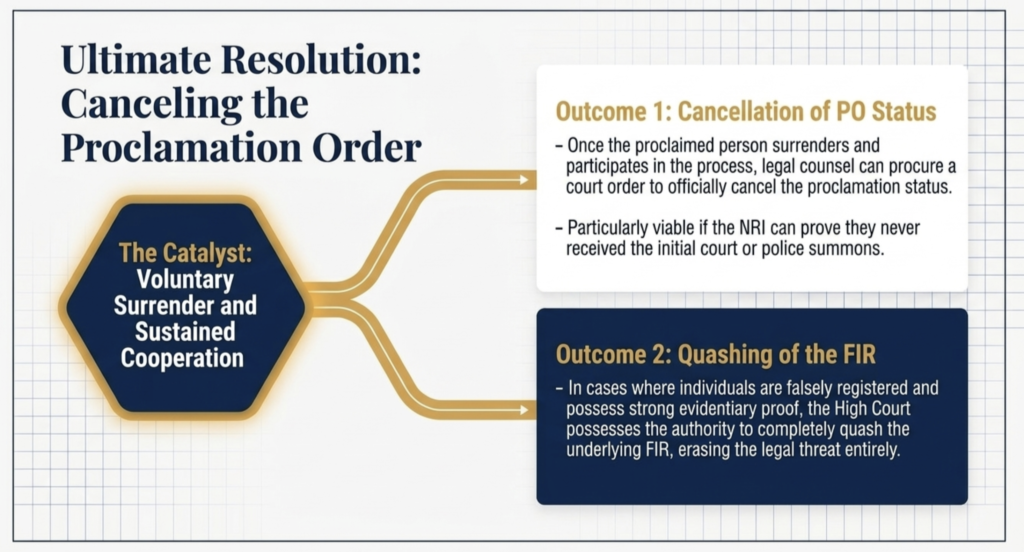
Yes, the proclaimed offender status can be cancelled if the proclaimed person surrenders before the court/police. Then the court may cancel the proclamation order
Risks of not taking action against the proclamation order against NRI
Ignoring the situation can lead to serious consequences like
- The attachment of the PO person’s property.
- The police can take action against a proclaimed person and arrest the proclaimed person.
- The harassment of the family of the proclaimed offender living in India can occur for allegations like sheltering the proclaimed offender
- The legal complications for the proclaimed person and family can occur in future, like confiscation of property
Special legal considerations for NRIs
NRIs often face unique challenges like
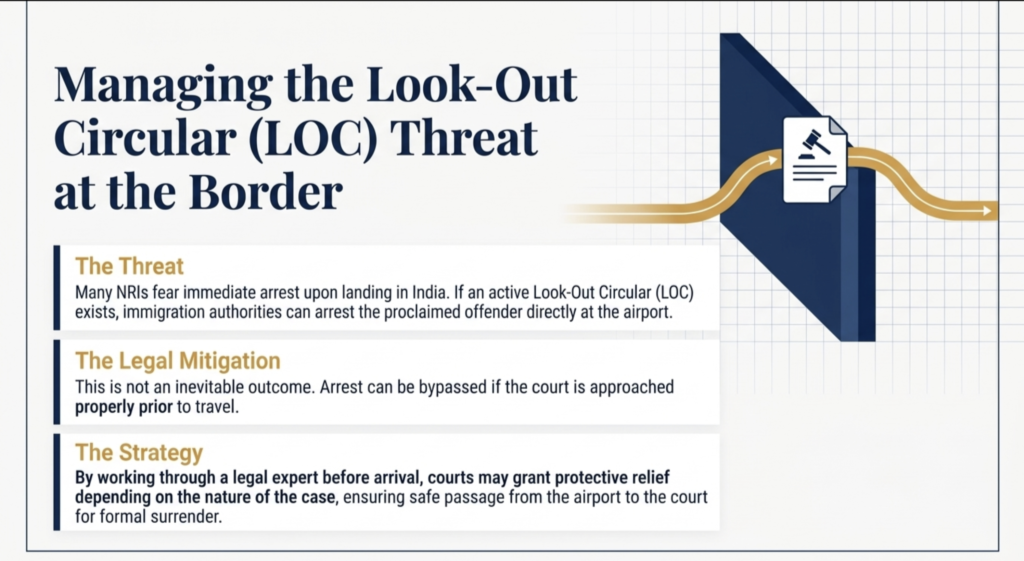
- Sometimes, proclamation notices are not properly served
- Many NRIs fear being arrested immediately upon arrival in India, especially when the look-out circulars (LOC) are issued
- Indian legal procedures can be confusing from abroad
However, courts do consider these factors when they are approached in court properly.
Practical tips for NRIs
- The NRI should always stay updated about the legal matters in India
- The NRI should maintain contact with a local legal expert in India
- The NRI should not ignore the court notices
- Act quickly if declared as a proclaimed offender
- Voluntary surrender is always the best option in proclaimed offender cases
If you are an NRI and facing such a situation, do not delay your legal action. The earlier you address the issue, the easier it becomes to manage it legally. Indian courts value fairness and intent. If you show genuine willingness to follow the law, you have a strong chance of resolving the matter smoothly.
For more information about your case you can contact NRI Legal World: info@nrilegalworld.com / +91 97096-92096
Frequently Asked Questions
Q) Can a person get bail after being declared a proclaimed offender?
Ans: Yes, the court often grants bail if you surrender voluntarily and cooperate. In some genuinely false cases, there are strong chances of anticipatory bail or even quashing of the FIR.
Q) Does the person declared as a proclaimed offender need to come to India physically?
Ans: In most cases, yes, physical appearance is required for surrender. But in falsely registered cases, if there is strong evidence to prove it false, the quashing of the FIR is sometimes possible.
Q) Will the proclaimed offender be arrested immediately upon arrival at the airport in India?
Ans: Not necessarily. The court may grant relief depending on the nature of the case if the court is approached through a legal expert. In cases where a LOC exists against the PO, then he can be arrested at the airport itself.
Q) Can the proclamation order be cancelled?
Ans) Yes, after surrender and in cases where a court order for cancellation of the proclamation order is procured through a legal expert, or sometimes the FIR gets quashed by the High Court.
Q) What if the proclaimed offender never received the court/Police summons or warrants?
Ans: This can be a strong ground for the proclaimed offender to approach the High Court for cancellation of the proclamation order through a legal expert.