
Being declared a Proclaimed Offender or having a proclamation order issued against you can be extremely stressful, especially for Non-Resident Indians (NRIs) who are living abroad and may not even be aware of the proceedings in India. However, the law provides remedies for POs.
A proclamation order is issued by a criminal court under section 82 of the Code of Criminal Procedure,1973, now known as section 84 of BNSS. When a person is absconding or deliberately avoiding court proceedings, the court publicly declares that the person must appear before the police or the court within a specific time (usually 30 days). If the person still does not appear, he may be declared a proclaimed offender.
Proclaimed offender order against NRI
Many NRIs face proclamation orders due to some of the following reasons:
- Lack of proper service of summons at the foreign address of an NRI person living abroad
- Family or property-related disputes that turn into criminal cases
- Matrimonial disputes between husband and wife such as dowry, domestic violence, or harassment cases
- Misuse of the legal provisions by the opposite party
Grounds on which proclamation order can be challenged
- Improper service of summons: If the summons or warrants were not served as per law, the proclamation order becomes invalid. Courts have repeatedly held that proper service is mandatory before declaring someone as a proclaimed offender.
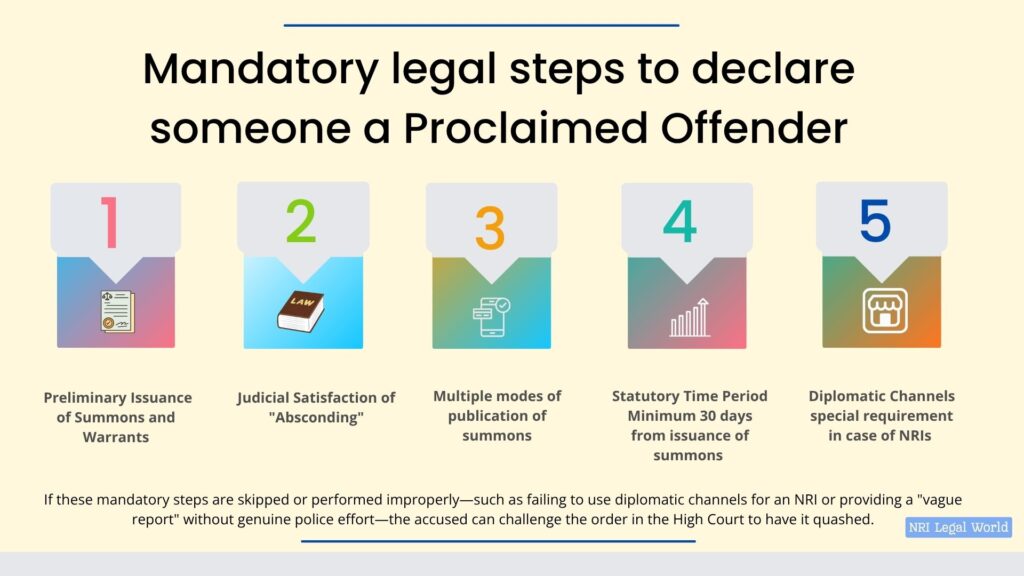
- Non-compliance with mandatory procedures: Before declaring a person a proclaimed offender, the courts need to follow a mandatory procedure under the Code of Criminal Procedure (now known as Bhartiya Nagarik Suraksha Sanhita (BNSS). This procedure includes-
- Public announcement of the proclamation order
- Affixation of the proclamation order at the residence of offender
- Affixation of the proclamation order at the court premises
- Publication of the proclamation in a newspaper
- Minimum 30 day time given to offender to appear before the trial court
- In case, the proclamation order has been issued against a person without following the steps of the above mentioned mandatory procedure, the accused can challenge the proclamation order in the High Court and get it quashed by the High Court. It is advised to take legal advice before making any legal decision.
- Mechanical or routine order by the Magistrate: A mechanical order is one where the Magistrate reproduces the language of the statute & does not examine the facts of the case, or fails to record reasons or satisfaction to issue a proclamation order as a matter of routine after the non-bailable warrants. The courts have consistently held that a proclamation order cannot be passed casually. The magistrate must be satisfied that the offender is absconding before issuing a proclamation order with valid reasons. A proclamation order passed mechanically is legally unsustainable; it can be successfully challenged and set aside before the High Court
- No proof of Absconding: A proclamation can only be issued if the court is satisfied that the accused has been absconded or is deliberately concealing himself to avoid the arrest. For NRIs, mere residence abroad does not amount to absconding. Absconding does not simply mean absence; it involves a mental element (intention) to avoid the law. If there is no proof of intentional absconding, the proclamation order issued against a person is unsustainable and liable to be set aside.
- Improper execution of warrants: A proclamation is usually preceded by the summons, bailable warrants, and non-bailable warrants. If the police or court skips these steps or does not make sincere efforts to serve them, the proclamation becomes legally weak and can be challenged.
- No genuine effort by police: Before issuing a proclamation order, the police must make genuine efforts to locate the accused, and the court must be satisfied that the person is actually absconding. If the police only give vague reports like “not found” without any real attempts, and the court relies on such reports, the proclamation becomes weak and can be challenged.
- Lack of evidence: where there is no prima facie evidence connecting an NRI to the alleged offence, issuing a proclamation order against the NRI is unjustified and becomes questionable. Courts have repeatedly held that a person cannot be compelled to appear or declared absconding in a case built on vague reports or unsupported allegations
- Failure to follow Diplomatic channels: when an accused is an NRI, the normal methods of serving summons (like local police delivery or affixation at residence in India) are often ineffective and insufficient. Since the NRI resides outside India, the authorities must use diplomatic channels, such as the Embassy/consulate, to serve the summons and warrants. Failure to use these diplomatic channels can become a strong ground to challenge a proclamation order.
Example: in the case of Rohit Kumar @ Satnam Singh v. State of Punjab, the High Court quashed a Proclamation order against an NRI, holding that authorities failed to make genuine efforts to serve him a summons at his foreign address and did not follow diplomatic channels like the Embassy or Consulate. The court emphasized that when the accused is residing abroad, strict compliance with proper service procedure is mandatory. Directly declaring him absconding without such efforts reflects a lack of due diligence and non-application of mind, rendering the proclamation order illegal and liable to set aside
Legal Remedies for NRI proclaimed offender
An NRI against whom a proclamation order has been issued has several legal remedies to challenge it, especially when due process is not followed. These remedies aim to protect the individuals from arbitrary action and ensure compliance with procedural safeguards under the Code of Criminal Procedure, 1973. The following are those remedies:
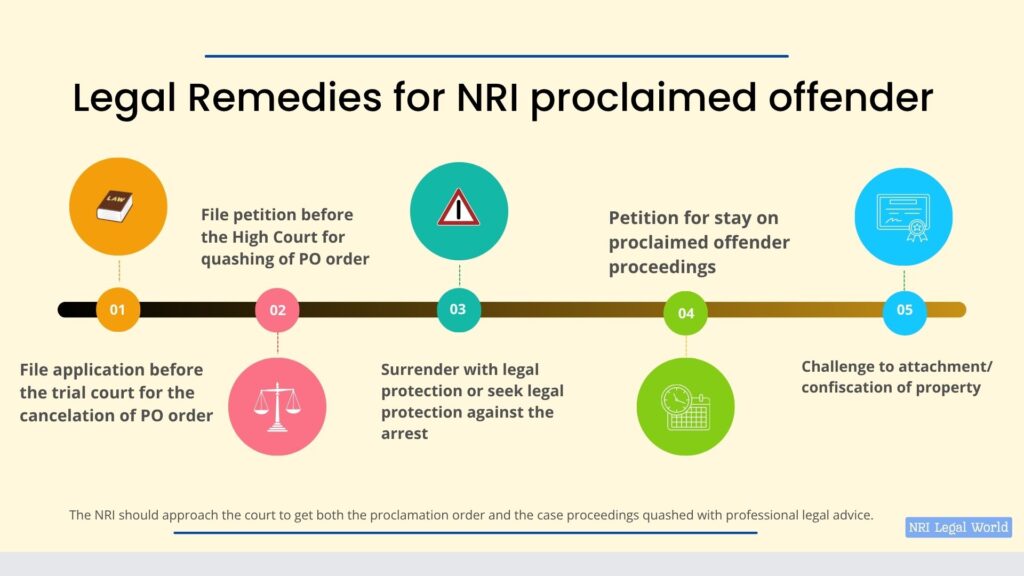
- File application before the trial court for the cancelation of PO order: An NRI can file an application before the same trial court that has issued the proclamation order, seeking its recall or cancellation after surrendering. In this application, the NRI must show bona fide reasons for non-appearance, such as living abroad, lack of knowledge of the proceedings, or improper service of the summons. Courts are generally inclined to recall such orders if the accused appears voluntarily or expresses willingness to join the investigation, as the primary objective of the law is to secure the presence, not to punish the accused person.
- File petition before the High Court: An NRI can approach the High Court by filing a petition under section 482 of the Code of Criminal Procedure (Section 528 BNSS) or under Article 226 of the Constitution of India to seek the quashing of the proclamation order. This is the most effective remedy where the order has been passed without following due process. The NRI can argue that summons were never properly served, the police did not make genuine efforts to trace him, or the Magistrate passed the orders mechanically. Courts have consistently held that such a procedural lapse makes the proclamation order invalid, especially when the accused is residing abroad and not intentionally absconding.
- Surrender with legal protection or Bail: An NRI may choose to voluntarily appear before the court and seek legal protection against the arrest. This can be done by first approaching the court through counsel and then applying for the anticipatory bail (where permissible) or regular bail on surrender. Courts often adopt a lenient approach in such cases, especially when the NRI demonstrates that the absence was not deliberate and undertakes to cooperate with the investigation. This remedy helps in regularising the proceedings and avoiding further strict action.
- Petition for stay on proclaimed offender proceedings: An NRI can also file a petition before the High Court seeking for a stay on further proceedings arising out of the proclamation order. This includes a request to stop strict actions such as arrest, attachment of property, or continuation of trial proceedings until the legality of the proclamation order is decided. This remedy provides immediate relief and prevents irreparable harm while the main petition is still pending.
- Challenge to attachment of property: If the court has ordered for the attachment of property under section 83 of the Code of Criminal Procedure, 1973, the NRI can challenge such attachment either before the trial court or the High Court. The primary ground for challenging is that if the proclamation order itself is illegal, then any subsequent attachment based on it also becomes invalid. The NRI can seek release of the property by providing procedural irregularities or the lack of proper service of notice.
Effect on the proceedings of acquittal of the main accused or the co-accused, in which an NRI is a proclaimed offender
If an NRI is made a co-accused in a criminal case, but later the main accused and the other co-accused are acquitted then the NRI gets a strong ground to challenge the Proclamation order in the court. Because if the court has already rejected the prosecution’s story and evidence, the base on which the case was filed falls or gets weak. A Proclamation order under the Code of Criminal Procedure, 1973 is only meant to ensure that the accused person must appear before the court in a valid and ongoing case. But if the case itself has become weak or unreliable due to acquittal of others co- accused on the same facts , then continuing action against NRI does not make sense.
Especially where the NRI has no specific or separate role alleged against them, in such cases continuing proceedings against them can be seen unfair and abuse of the legal process
Courts including the Supreme Court of India, have followed the principle of parity. This means that if the same evidence has already been rejected for the other accused person, it cannot be selectively used against one person unless there is clear and independent evidence against him. So, in such a situation, the NRI can approach the court to get both the proclamation order and the case proceedings quashed, as they no longer stand on solid legal ground.
For more information regarding the matter related to Proclaimed Offender status contact NRI Legal World: info@nrilegalworld.com / +919709692096
Frequently asked questions
Q) I am living abroad, and I have been declared a proclaimed offender in a case. Can I challenge the proclamation order without coming to India?
Ans: Yes, you can challenge it through a lawyer by filing a petition before the High Court based on the grounds like improper summoning, service of warrants, or the evidence proving the case to be false or civil in nature.
Q) I am living in Australia, a proclamation order has been issued against me in India in a case, but I never received any summons while living abroad. What should I do now?
Ans: If you have never received summons at your foreign address, you can challenge the proclamation order on the ground of improper service of summons
Q) I am an NRI living abroad for the last 5 years. A false case has been registered against me in India by relatives to harass me, and a proclamation order has been issued despite no evidence against me. What should I do?
Ans: You should approach the High Court through a lawyer and file a petition to quash both the false case and the proclamation order on the grounds of lack of evidence.
Q) I am an NRI, I have been declared a proclaimed offender in a matrimonial dispute. Can I settle the case and get the proclamation order cancelled?
Ans: Yes, if the dispute is settled, you can approach the High Court to quash the case and get the proclamation order cancelled
Q) I am living abroad and have been declared a proclaimed offender in a case. I have a fear of arrest if I land in India. What should I do before traveling to India?
Ans: You should first seek protection from the High Court or apply for anticipatory bail to avoid arrest on arrival
Comments are closed