
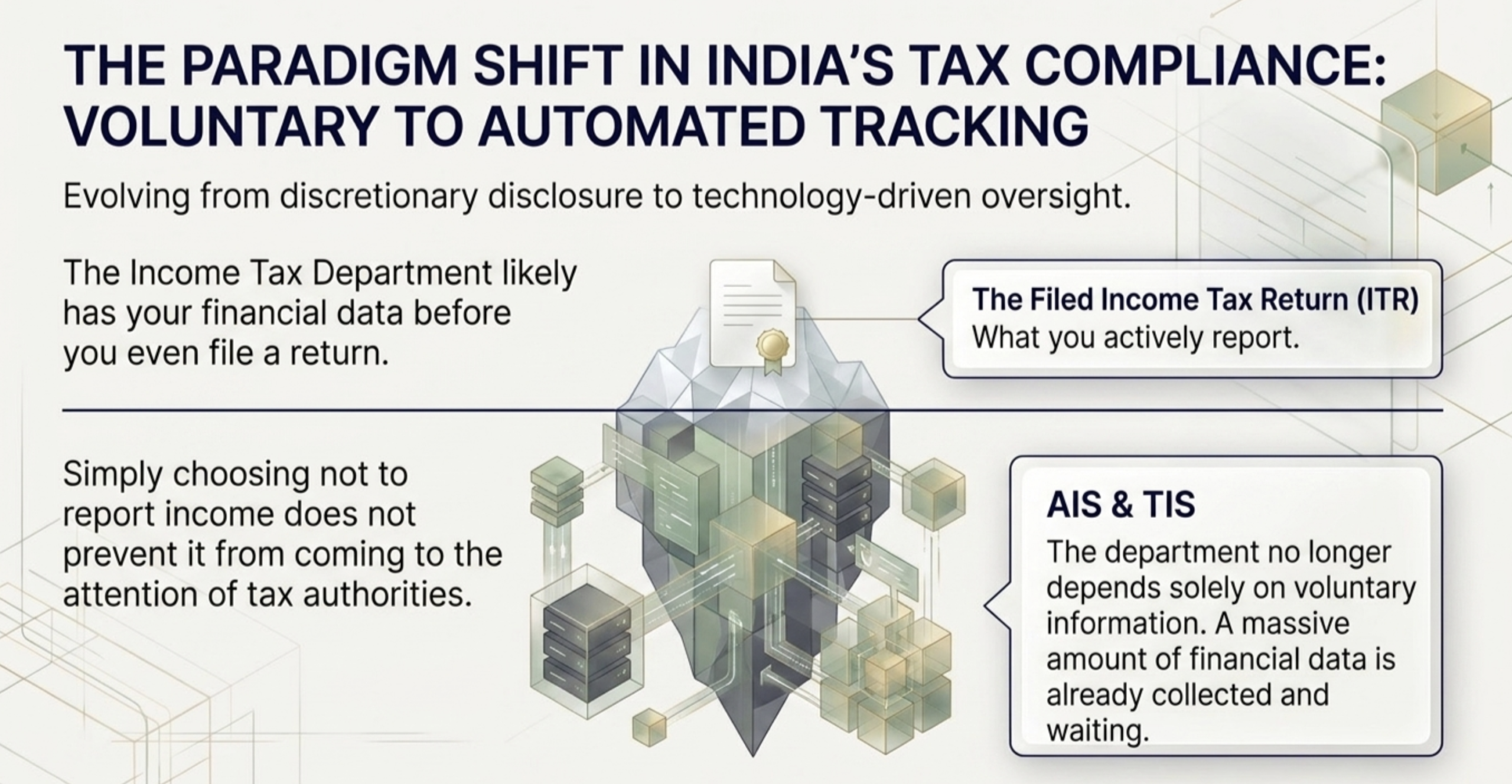
Many Non-Resident Indians (NRIs) believe that because they live outside India, the Indian Income Tax Department has limited access to information about their financial activities. Some even assume that if they do not disclose certain income or investment while filing their Income Tax Return (ITR), the department will never become aware of them. However, this assumption is incorrect. Today, the Indian tax administration relies on technology, statutory reporting requirements, data analytics, and information received from various financial institutions to verify whether taxpayers have correctly reported their income and financial transactions, for NRIs, understanding how this system works is essential because non-disclosure or incorrect reporting may result in notices, reassessment proceedings, interest, or penalties under the Income Tax Act, 1961.
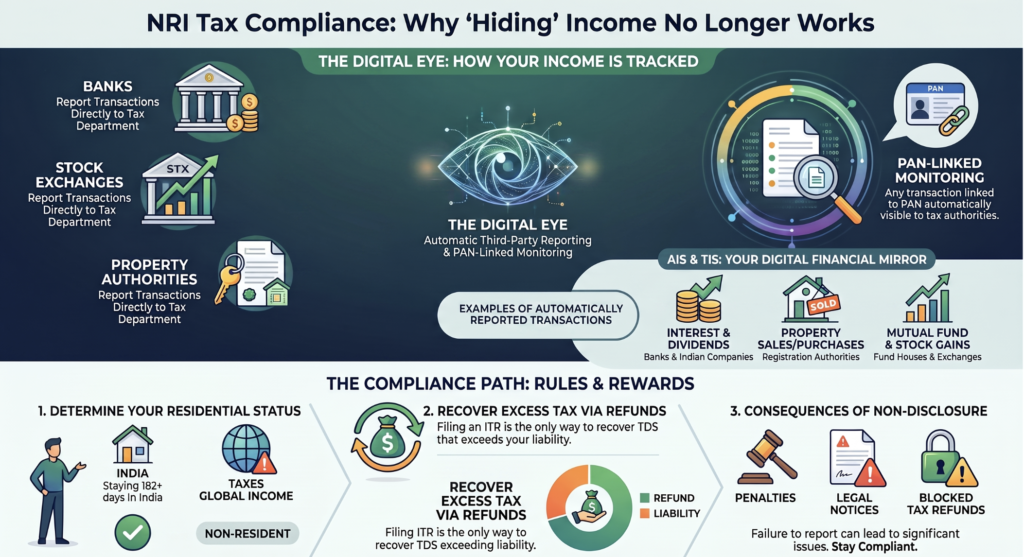
Why Does the Income Tax Department Monitor Financial Transaction?
The Income Tax Department’s objective is not to monitor every transaction made by an individual. Instead, it aims to ensure that taxpayers correctly report their taxable income and comply with the provisions of the Income Tax Act, 1961.
To achieve this, the department collects information from various authorised reporting entities and compares it with the details disclosed in the taxpayer’s Income Tax Return (ITR). If inconsistencies are found, the department may seek clarification or initiate proceedings as permitted under the law.
What is the Legal Basis for Reporting Financial Transactions?
- The reporting of specified financial transactions is governed by Section 285BA of the Income-tax Act, 1961, which requires specified persons to furnish a Statement of Financial Transaction (SFT).
- Rule 114E of the Income tax Rules, 1962, which prescribes the types of transactions that must be reported and identifies the reporting entities.
These provisions help the Income Tax Department to gather information about certain high value or specified financial transactions carried out by taxpayers.
Who Reports Financial Information to the Income Tax Department and why does it matter for NRIs?
Under the Income Tax Act 1961, certain organisations are legally required to report specified financial transactions to the Income Tax Department. Depending on the nature of the transaction, these reporting entities may include:
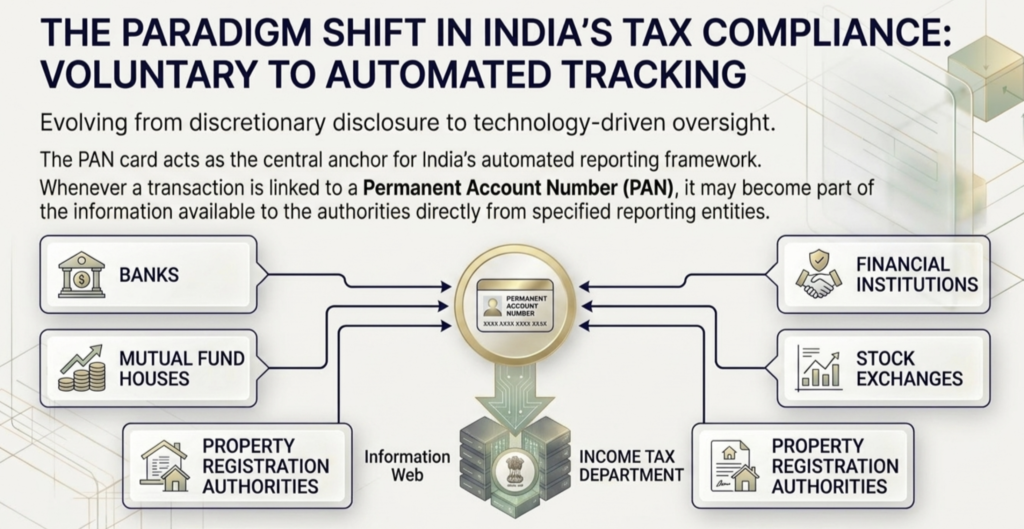
- Banks
- Mutual fund houses.
- Companies issuing shares, bonds or debentures.
- Registrars and Sub-Registrars responsible for property registration.
- Recognised stock exchanges and depositories.
- RBI-authorised entities and other prescribed institutions in India and abroad.
These entities electronically furnish details of specified financial transactions to the Income Tax Department within the prescribed timelines. If there is a mismatch between the information available with the department and the details reported in the ITR, the department may seek clarification or initiate proceedings in accordance with the provisions of the Income-Tax Act, 1961.
It is very important to note that reporting of a transaction does not mean that additional tax is automatically payable or that any wrongdoing has occurred. It is simply a compliance mechanism that helps the Income Tax Department verify the accuracy of the information reported by taxpayers.
Statement of Financial Transactions (SFT)
Many financial transactions are reported through the Statement of Financial Transaction (SFT) Under the Income tax-Act, specified reporting entities are required to furnish details of certain high value financial transactions to the Income Tax Department within the prescribed time.
The information received through SFT is generally linked with the taxpayer’s PAN and may subsequently appear in the Annual Information Statement (AIS). This enables the department to compare the information available with the details disclosed in the taxpayer’s Income Tax Return.
Role of PAN card in the Income Tax Department
A Permanent Account Number (PAN) serves as the primary identifier for most financial transactions in India. Whenever a taxpayer opens certain financial accounts, purchases property, invests in securities, receives taxable income, or undertakes specified reportable transactions, the PAN is generally quoted and linked with that activity.
Because of this linkage, information reported by different organisations can be consolidated against a single PAN. This allows the Income Tax Department to build a comprehensive financial profile of the taxpayer and compare the reported transactions with the information disclosed in the Income Tax Return.
Whenever a transaction is linked to a Permanent Account Number (PAN), it may become part of the information available to the Income Tax Department. Consequently, many taxpayers are often unaware that the department already possesses details of their financial activities before the Income Tax Return is even filed.
Role of Financial Intelligence Units (FIU-IND)
Apart from the Income Tax Department, financial information may also be reported to the Financial Intelligence Unit India (FIU-IND), which functions under the Department of Revenue, Ministry of Finance. FIU-IND primarily analyses information relating to suspicious financial transactions reported under the prevention of Money Laundering Act, 2002 (PMLA).
These reports may include:
- Suspicious Financial transactions.
- Large cash transactions.
- Certain Cross border wire transactions.
- Transactions involving high-risk customers.
Although FIU-IND and the Income Tax Department perform different functions, information may be shared between competent authorities wherever permitted by law.
Form 26AS, AIS and TIS: Transparency Tools
Before filing an Income Tax Return, every NRI should review three important tax documents available on the Income Tax e-filing portal.
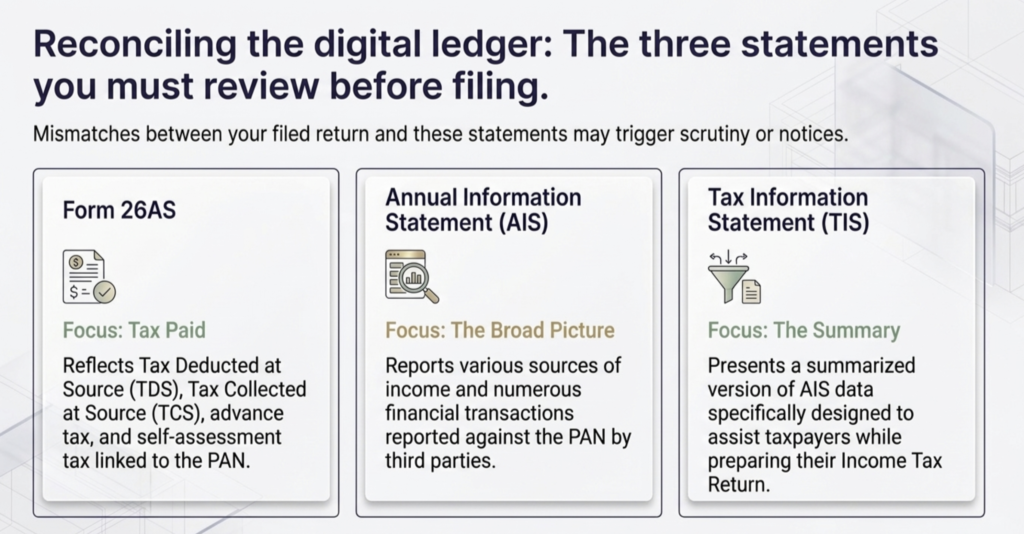
Form 26AS contains details relating to Tax Deducted at Source (TDS), Tax Collected at Source (TCS), Advance Tax, Self-assessment tax, and certain other tax related information.
The Annual Information Statement (AIS) provides a much more comprehensive picture of a taxpayer’s financial activities. It may contain details relating to Interest income, Dividend income, Property transactions, Securities transactions, Mutual funds investments, foreign remittances, or other financial information reported against the PAN.
Tax Information Statement (TIS) provides a summarized version of the information available in AIS and assists taxpayers while preparing their Income Tax Return.
Reviewing these documents before filing an ITR helps to ensure that the information reported by various institutions matches the details disclosed in the return.
How Can NRIs Access Their AIS?
NRIs can access their Annual Information Statement (AIS) through the official Income Tax e-Filing Portal.
The process is simple:
- Log in using your PAN and password.
- Select the services menu.
- Click on Annual information Statement (AIS).
- Open AIS.
- View or download both AIS and TIS.
- Carefully verify all reported transactions before filing your Income Tax Return.
If any incorrect information appears in AIS, the portal also allows taxpayers to submit feedback.
These documents are available online in the official tax website. Link given: https://share.google/RbBggENhoL35VUXOj
What Happens if Income or Transactions are not properly Reported?
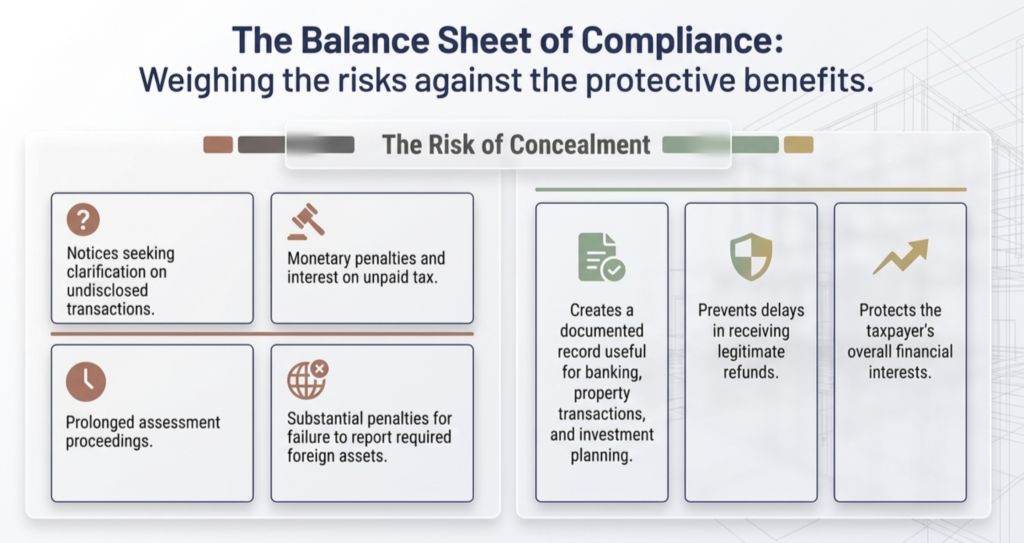
If the Income Tax Department finds a mismatch between the information available in its records and the Income Tax Return filed by the taxpayer, it may issue a notice seeking clarification. Depending on the facts of the case, the taxpayer may also become liable for Additional Tax, Interest, Penalties, Reassessment proceedings, or other legal consequences under the applicable provisions of the Income Tax Act.
Compliance Tips for NRIs:
To reduce the risk of tax disputes, NRIs should obtain a PAN if required for taxable or reportable transactions. Keep PAN, KYC, and contract details updated. Maintain records of investments properly, transactions, and bank statements. Review Form 26AS, AIS, and TIS before filing the ITR. Correct any errors through the prescribed mechanisms, Report taxable residential status under the Income-tax Act. Consult a tax professional if they have income or assets in multiple countries.
Contact: info@nrilegalworld.com / +919709692096 for more details.
Frequently Asked Questions
Q.) Can I avoid filing an Income Tax Return by not disclosing my income?
Ans.) No, many financial transactions are reported to the Income Tax Department by banks, financial institutions, stock exchanges, mutual fund houses, and other reporting entities. Hiding income or investments may lead to notices, penalties, or other legal consequences.
Q.) Do NRIs have to pay tax in India on all their income?
Ans.) No, NRIs are required to pay tax only on income that is taxable in India. However, the exact tax liability depends on the individual’s residential status and the nature of the income.
Q.) Why should I check Form 26AS, AIS and TIS before filing my return?
Ans.) These statements contain details of taxes deducted, income, and specified financial transactions linked to your PAN. Reviewing them helps ensure that your Income Tax Return matches the information already available toNRI’sthe the Income Tax Department.
Q.) If TDS has already been deducted, do I still need to file an Income Tax Return?
Ans.) In some cases, yes. Filing an Income Tax Return may be necessary to report your income correctly and claim a refund if excess tax has been deducted.
Q.) Can the Income Tax Department know about my investments in India?
Ans.) Yes, certain investments and high-value financial transactions, such as property purchases, investments in shares or mutual funds, and interest earned on bank deposits, may be reported to the Income Tax Department by the relevant reporting entities.
Q.) Do NRIs need to report their foreign income in India?
Ans.) Generally, if you qualify as a non-resident under the Income Tax Act, only income taxable in India is required to be reported. However, if your residential status changes and you become a resident, your reporting obligations may also change.