
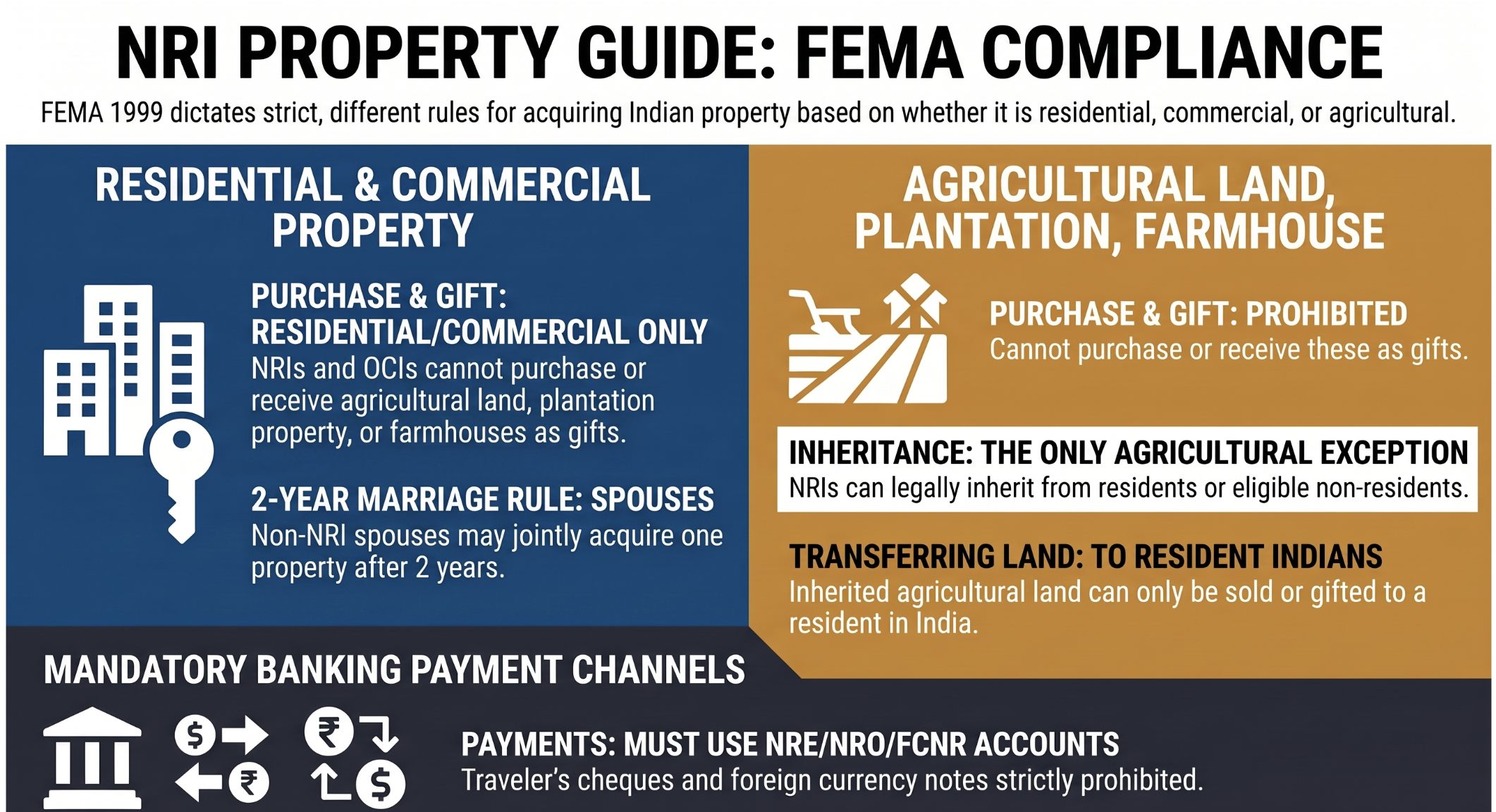
The Foreign Exchange Management Act, 1999 (FEMA), (Non-Debt Instruments) Rules 2019, prescribes specific conditions regarding the purchase, gift, inheritance and transfer of immovable property in India by persons resident outside India. The most important point for NRIs and OCIs is that the rules are different depending upon how the property is acquired or transferred. There are also special restrictions concerning agricultural land, plantation property and farm houses, payment through banking channels, acquisition by the spouse of an NRI/OCI, business premises, and citizens or entities connected with certain specified countries.
Acquisition and transfer of property in India by a NRI or an OCI
NRI or OCI may acquire immovable property in India by way of purchase, subject to the applicable FEMA rules. There is an important restriction for NRIs and OCIs, an NRI and OCI can Purchase immovable property in India other than agriculture land, plantation property and farmhouse.
Therefore, an NRI or OCI can generally purchase residential or commercial property in India, but the automatic route does not extend to agricultural land, plantation property or a farmhouse. This distinction is extremely important because the fact that an NRI or OCI is legally entitled to purchase residential property in India does not mean that the person can automatically purchase agricultural land in India.
Gift of Property for NRIs
An NRI or OCI may acquire immovable property in India by way of gift, but there are important restrictions regarding the nature of the property and the person giving the gift. An NRI or OCI may receive any type of immovable property in India by way of gift deed except agricultural land, plantation property or a farmhouse land in India. The gift can be received from a person resident in India, or an NRI or OCI who is a relative of the recipient.
For determining who is treated as a “relative” for this purpose, reference is made to Section 2(77) of the Companies Act, 2013 and Rule 4 of the Companies (Specification of definitions details) Rules 2014.
- They are members of a Hindu Undivided Family.
- They are husband and wife or.
- One person is related to the other in such a manner as may be prescribed.
Prescribed List under Rule 4 of the Companies (Specification of definitions details) Rule 2014 A person is deemed relative if they are, Father (includes step-father), Mother (includes step-mother), Son (includes step-son), Son’s wife, Daughter, Daughter’s husband, Brother (includes step-brother), Sister (includes step-sister).
Inheritance of property for NRIs/ OCIs:
An NRI or OCI may acquire immovable property in India by way of inheritance from a person resident in India. An NRI or OCI can also inherit immovable property in India from a person who was resident outside India, provided that the person from whom the property is inherited had acquired that property in accordance with the foreign exchange law applicable at the time of acquisition. This is an important distinction. Therefore, where an NRI inherits property from a deceased parent or another person resident in India, the inheritance route is available. Similarly, property inherited from a person resident outside India can also be inherited where the deceased had lawfully acquired the property under the foreign exchange rules applicable at that time. Unlike purchases or gifts—where agricultural land, plantation land, and farmhouses are completely barred—inheritance carries no such restriction regarding the type of land. An NRI/OCI can legally have agricultural acres, farmhouses, or plantation estates transferred into their name through a legal will, succession, or inheritance laws in India.
Can NRI/OCI transfer property to a resident Indian?
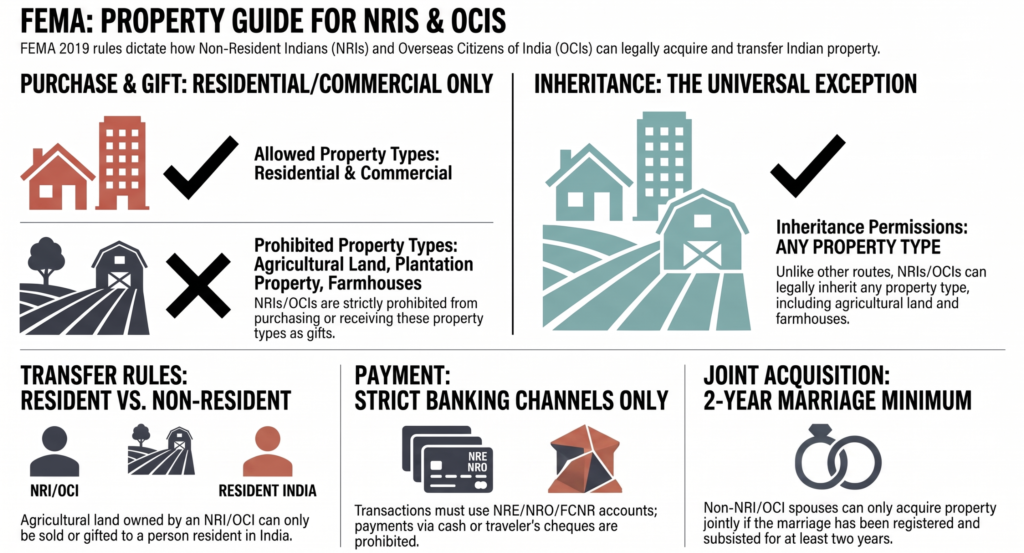
An NRI or OCI may transfer any immovable property in India to a person resident in India, subject to the applicable FEMA requirements and other laws. This is important because the restriction on agricultural land, plantation property and farmhouses that applies to certain acquisition and transfers between persons resident outside India should not be incorrectly extended to every transfer to a resident Indian. The RBI framework has specifically recognised the ability of an NRI to transfer immovable property to a person resident in India.
Can NRI/OCI transfer property to another NRI or OCI?
An NRI or OCI may transfer immovable property in India to another NRI or OCI, provided that the property is not agricultural land, plantation property or a farm house. Therefore, while an NRI can transfer property to a resident Indian, a transfer from one NRI/OCI to another NRI/OCI is subject to the specific restriction concerning these categories of property.
Hence, if an NRI decides to sell or transfer that inherited agricultural land in the future, NRI cannot sell it to another NRI or OCI. By law, any agricultural land, plantation property, or farmhouse can only be sold or transferred to a person resident in India.
This distinction should be carefully considered before executing a sale deed, gift deed or other transfer document.
Joint Acquisition of property by the spouse of a NRI or an OCI:
A person who is resident outside India but is neither an NRI nor an OCI, and is married to an NRI or OCI, may acquire one immovable property jointly with his or her NRI/OCI spouse. However, this property cannot be agricultural land, plantation property or a farmhouse. Thus, any resident Indian married to NRI/OCI/Foreign Citizen can not jointly acquire or purchase agricultural land in India.
The joint acquisition is subject to certain conditions under FEMA:
- Payment must be made through permitted banking channels. The consideration or purchase payment for the property must be made either from funds received in India through banking channels by way of inward remittance from a place outside India or by debit to their NRE/FCNR (B)/ NRO account. This means that the payment for the property must come through the permitted banking channels or from an eligible non-resident account.
- Payment cannot be made through traveller’s cheques or foreign currency notes: The rules specifically provide that payment for the transfer of the immovable property cannot be made either by traveller’s cheques or by foreign currency notes, or any other mode that is not specifically permitted under these provisions. Therefore, the parties must ensure that the consideration is paid only through the modes permitted under the applicable FEMA provisions.
- Marriage must have been registered and must have continued for at least two years.
There is also an important condition relating to marriage. The marriage between the NRI/OCI and the non-resident spouse must be registered and have subsisted continuously for at least two years immediately before the acquisition of the property. Thus, the joint acquisition cannot be made under this provision unless the marriage has been registered and has continued for the required continuous period of two years immediately preceding the acquisition.
- The NRI/OCI spouse must not otherwise be prohibited from acquiring the property:
The provision also makes it clear that the NRI or OCI spouse must not be otherwise prohibited from acquiring joint property in India. Also, satisfying the conditions relating to the marriage and payment is not, by itself, sufficient if the NRI or OCI spouse is otherwise prohibited under the applicable law from acquiring the property.
Prohibition on acquisition or transfer of immovable property in India by citizens of certain countries.
- Citizens of Pakistan, Bangladesh, Sri Lanka, Afghanistan, China, Iran, Nepal, Bhutan, Macau, Hong Kong and democratic people’s Republic of Korea cannot without prior permission of the Reserve Bank, acquire or transfer immovable property in India, other than on lease, not exceeding five years.
- This restriction does not apply to an Overseas Citizen of India (OCI).
For NRIs and OCIs, investing in or transferring immovable property in India is permitted under the FEMA framework, but specific conditions apply depending on the types of property and the manner in which it is acquired or transferred. Residential and commercial properties are generally treated differently from agricultural land, plantation property and farmhouses. Before entering into any sale, purchase, gift, inheritance or transfer transaction, an NRI or OCI should verify their residential status, the nature of the property, the source and mode of payment, the relationship between the parties and the applicable FEMA and respective state laws.
Contact NRI Legal World for more information: info@nrilegalworld.com / +919709692096
FAQs:
Q1. Can an NRI or OCI purchase immovable property in India?
Ans. Yes, an NRI or OCI can purchase immovable property in India, except agricultural land, plantation property and farmhouse, subject to FEMA restrictions.
Q2. Can an NRI or OCI receive property in India as a gift?
Ans. Yes, an NRI or OCI can receive an immovable property by way of gift from a person resident in India or from an NRI/OCI who is a relative as defined under Section 2(77) of the companies Act, 2013. The property cannot be agricultural land, plantation property or a farmhouse under this route.
Q3. Can an NRI or OCI inherit immovable property in India?
Ans. Yes, an NRI or OCI can inherit immovable property in India from a person resident in India. An NRI/OCI can also inherit property from a person resident outside India where the property was acquired in accordance with the foreign exchange law applicable at the time of acquisition. Unlike purchases or gifts—where agricultural land, plantation land, and farmhouses are completely barred—inheritance carries no such restriction regarding the type of land. An NRI/OCI can legally have agricultural acres, farmhouses, or plantation estates transferred into their name through a legal will, succession, or inheritance laws in India.
Q4. Can an NRI or OCI transfer property to another NRI or OCI?
Ans. Yes, an NRI or OCI transfers immovable property other than agricultural land, plantation property or farmhouse to another NRI/OCI. Where the transfer is by way of gift, the recipient must be a qualifying relative according to Indian law.
Q:5. Can NRIs take agricultural land as a gift?
Ans: No, NRI/OCI cannot take agricultural land as a gift. NRI/OCI cannot receive agricultural land as a gift even from their parents. An NRI/OCI can legally have agricultural acres, farmhouses, or plantation estates transferred into their name through a legal will, succession, or inheritance laws in India.