
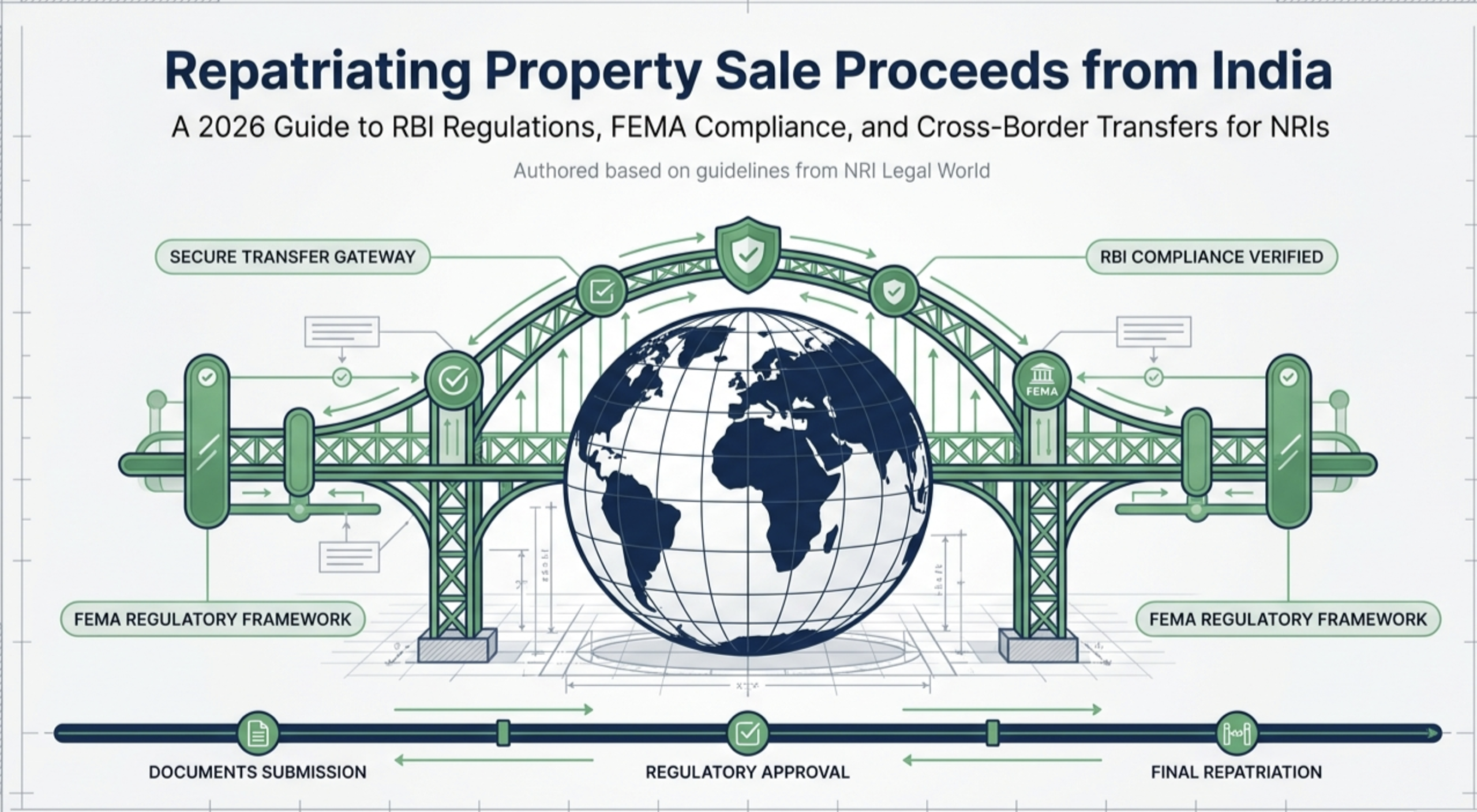
In 2026, one of the most common problems faced by NRIs is not merely taxation or property ownership disputes but difficulties in complying with RBI documentation requirements while transferring funds. Many NRIs are surprised to learn that selling a property does not automatically mean they can immediately transfer the entire sale proceeds abroad. Banks require extensive documentation to verify the source of funds, tax compliance, and FEMA eligibility before approving any remittance out of India.
The Reserve Bank of India regulates foreign exchange transactions through FEMA. Every authorized bank in India is required to ensure that money being transferred into or out of India complies with legal and regulatory requirements.
Before processing a remittance, banks generally verify the identity of the account holder, the source of the funds, the purpose of the remittance, payment of applicable taxes, ownership of the underlying assets, etc. As a result, documentation has become one of the most important aspects of NRI banking and financial planning for NRIs.
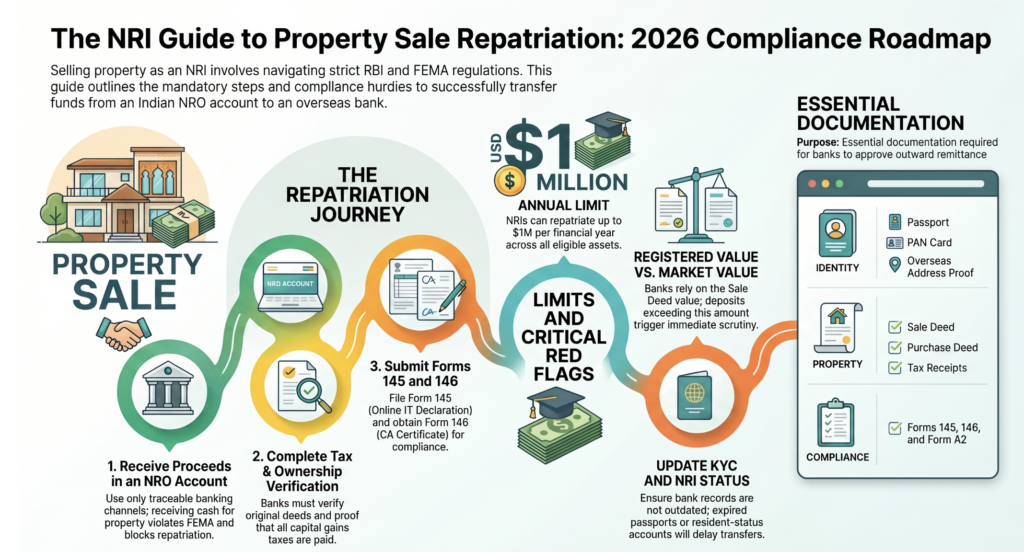
Common banking challenges faced by NRIs after selling their property in India
Apart from the documentation and tax compliance, NRIs often face several practical banking and RBI-related challenges after selling their property in India. These issues frequently delay the transfer of funds abroad and may even result in additional scrutiny by banks.
- Sale proceeds through the Cash Transaction: One of the biggest mistakes made in property transactions is accepting a portion of the sale consideration in cash and most of the times such cash transactions are mentioned in the agreements for sale of the property. Under the FEMA and banking regulations, NRIs should ideally receive the entire sale amount through the proper banking channels like the NRO accounts (certainly not in the savings account).
- Mismatch Between Market value and Registered sale value: In many cases, the actual market value of the property is substantially higher than the value recorded in the Sale Deed. This creates practical difficulties because banks generally rely on the registered transaction value. Large deposits exceeding the registered value may trigger scrutiny because it will amount to clear FEMA violations and therefore the complete process of approvals for the repatriation of funds can get delayed and also invite penal actions under FEMA.
- Issues faced while transferring the money from NRO to NRE: Many NRIs are unaware that before transferring money abroad, the sale proceeds are generally credited to the NRO account. Common issues include failure to submit form 145 and Form 146, lack of tax payment proof, incomplete source of funds documentation, delays in obtaining CA certificates. As a result, NRO to NRE transfers often become one of the most time consuming parts of the process.
- Outdated KYC and NRI status records: Many NRIs maintain accounts that were originally opened way back in the past when NRI used to be a resident in India. Using the bank account after a long gap might not be smooth for an NRI account owner as the KYC (know your customer process) records were outdated due to many missing documents such as residential status was not updated in the bank account, the passport details were expired and overseas address records were incomplete. This may result in temporary delay on the fund transfers.
Preparing for repatriation after the sale of land:
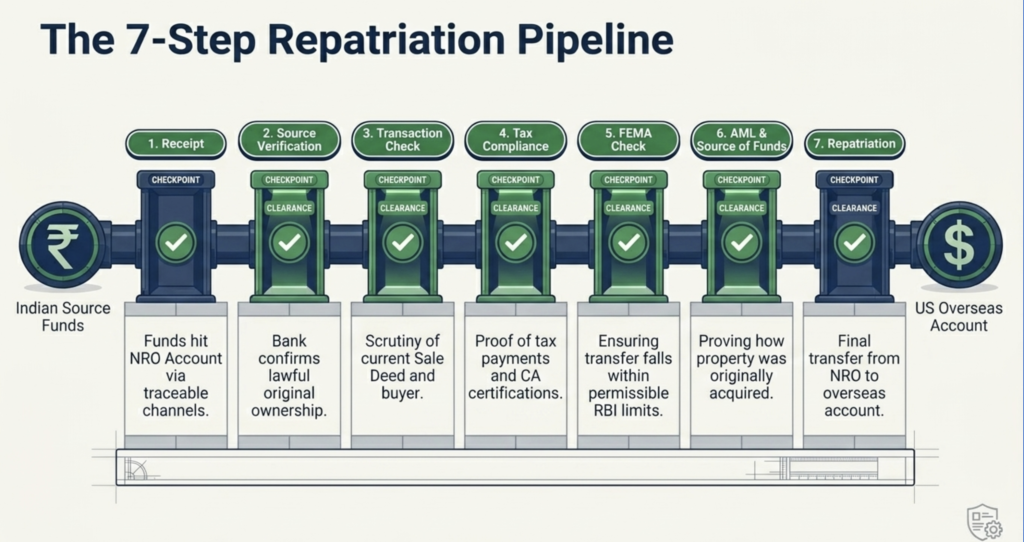
Step 1. Receipt of Sale Proceed: When an NRI sells a property in India, the sale consideration should ideally be received through proper banking channels such as bank transfer, cheque, demand draft, or other traceable payment methods into their NRO accounts only. Receiving sale consideration in cash may create significant compliance issues and can make future repatriation difficult. In most cases, the sale proceeds are credited to the NRO (Non Resident Ordinary) account belonging to the NRI. This account serves as the primary account through which sale proceeds, rental income, and other Indian-source income are received.
Step 2. Verification of source of income: Before allowing any remittance abroad, the banks verify that the seller was the lawful owner of the property. The bank may examine original purchase deed, sale deed, title documents, mutation records, inheritance documents (if applicable), previous ownership records etc. This verification ensures that the proceeds arise from a genuine and legally valid transaction.
Step 3. Examination of the Sale Transaction: Banks are required to review the transaction itself. They may verify the sale value mentioned in the Sale Deed, the identity of the buyer, the mode of payment, whether the transaction was completed through proper banking channels, whether there is any unusual discrepancy between the market value and the registered value. If substantial cash components or unexplained deposits are identified, the bank may seek additional clarification before processing the remittance request.
Step 4. Tax Compliance Verification: One of the most important stages is tax verification. Before funds can be transferred abroad, banks generally require proof that all applicable taxes have been paid. This may include TDS certificates, capital gains tax calculations, Income tax returns, Form 145,Form 146 issued by a Chartered Accountant. The objective is to ensure that no outstanding tax liability exists on the sale proceeds being remitted outside India.
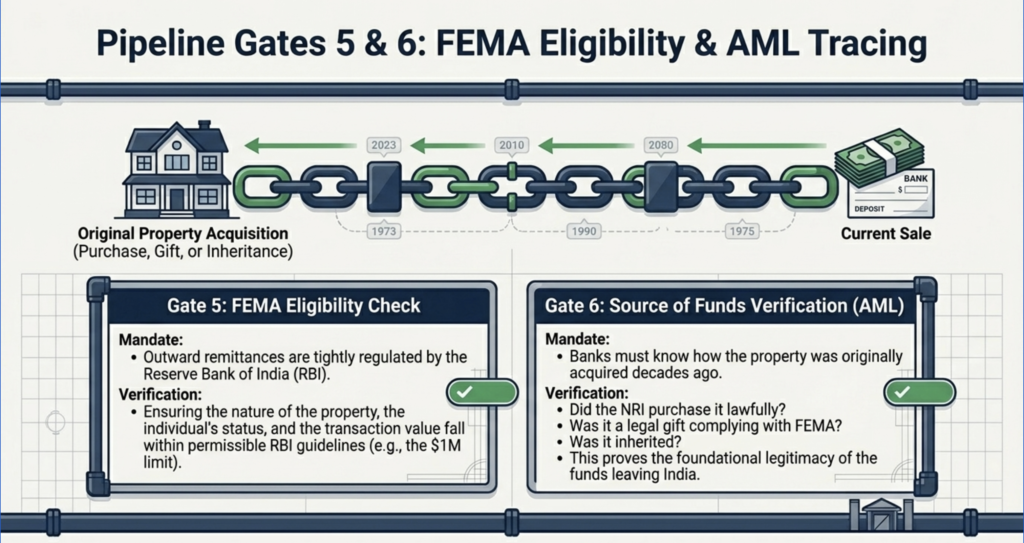
Step 5: FEMA Eligibility Check: Since outward remittances are regulated under FEMA, banks must ensure that the proposed transfer complies with applicable RBI regulations. The bank may verify the nature of the property sold, whether the remittance falls within permissible FEMA limits, whether the transaction qualifies for repatriation, and compliance with RBI guidelines governing NRO account remittances. This stage becomes particularly important in high-value transactions and inherited property cases.
Step 6: Source of funds verification: Banks must be satisfied regarding the source of funds before allowing any overseas transfer. The NRI may be required to demonstrate how the property was acquired.Whether it was purchased, gifted lawfully complying with FEMA regulations, inherited, or received through a family settlement, the original source of investment and the legitimacy of the funds being remitted. This requirement forms a part of anti-money laundering and financial compliance regulations.
Step 7: Repatriation of funds Abroad: Once all the documentation has been reviewed and verified, the repatriation process can begin. The NRI may then apply to transfer the funds from the NRO account to an overseas bank account, subject to FEMA regulations, RBI guidelines, and completion of all banking formalities. In practice, the legal sale of the property is often the easiest part of the process. The more challenging aspect is satisfying the bank’s compliance requirements relating to ownership verification, tax clearance, source of funds documentation, and FEMA eligibility. For this reason, NRI should maintain complete records of property ownership, tax payments, banking transactions, and inheritance documents well before initiating a remittance request. Proper planning can significantly reduce delays and ensure a smooth transfer of funds outside India.
How much money can an NRI Transfer Abroad
Under FEMA regulations, an NRI can generally repatriate up to USD 1 million per financial year from funds held in the NRO account. This limit applies to property sale proceeds, inheritance assets, gifts received in India, Bank balances, and other eligible assets. Importantly, the USD 1 million limit applies per individual and not per property. For example: If an NRI sells a property and receives the equivalent of USD 1.5 million after taxes, only USD 1 million can ordinarily be remitted during that financial year. The balance may need to be transferred in a subsequent financial year, subject to applicable regulations.
Documents required for the repatriation of funds abroad
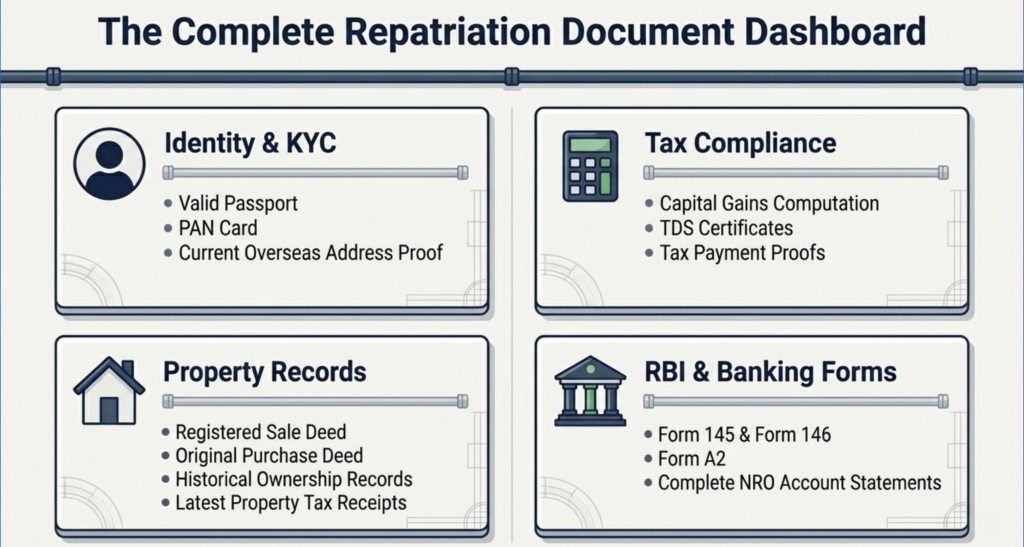
1) Identity Documents:
- Passport.
- PAN card.
- Overseas Address Proof.
2) Property Documents:
- Sale Deed.
- Purchase Deed.
- Ownership records.
- Property Tax receipts.
3) Tax Documents:
- Capital gains computation.
- Tax Payment proof.
- TDS certificates.
4) FEMA and RBI documents:
- Form 145.
- Form 146.
- Form A2.
- NRO Account statements.
Role of Form 145 in repatriation of funds abroad: Form 145 is an online declaration filed through the income tax Portal before making certain foreign remittances from India to non-resident or a foreign company. It is submitted by the person sending the money abroad. The purpose of form 145 is to inform the income tax Department about the foreign remittance. To disclose the purpose of the remittance. It also ensures that the applicable taxes have been deducted and paid before the money leaves India.
Role of Form 146 in repatriation of funds abroad: Form 146 is issued by a Chartered Accountant. The certificate confirms applicable tax provisions. Tax compliance. Deduction of taxes where required and legality of the remittance. Most banks insist on these forms before processing significant outward remittance.
Repatriation of funds after the sale of inherited property in India:
Once the inherited property is sold, the sale proceeds are generally credited to the NRI’s NRO (Non-Resident Ordinary) account. Before permitting the remittance of funds abroad, the bank may require additional documents to establish the chain of ownership and succession. The documents, which are required: - Death Certificate: The Death Certificate of the deceased land owner serves as proof that the original property owner has passed away. Banks and authorities use this document as the starting point for verifying inheritance claims and the repatriation of the funds.
- Legal Heir Certificate: A legal heir certificate identifies the surviving legal heirs of the deceased and helps the bank in establishing that the transaction is in the favour of a legitimate heir. NRI can use the Succession certificate as well.
- Probate of Will: If the deceased left a Will, the bank may require probate, which is a court issued certificate confirming that the Will is genuine and legally valid. Probate is particularly important in certain jurisdictions and for high-value properties.
- Family Settlement Agreement: In many families, legal heirs mutually agree on the division of inherited property through a Family settlement Agreement. Banks may request this document to verify how ownership was distributed among family members.
In order to comply with the FEMA guidelines the banks, before allowing the remittance of inherited funds outside India, must ensure that the sale proceeds originated from a genuine sale of the land via genuine inheritance of the property in favour of the NRI.
By understanding RBI requirements in advance and maintaining proper records, NRIs can avoid unnecessary delays, reduce compliance risks, and manage their finances efficiently across borders.
For more information contact NRI Legal World: info@nrilegalworld.com / +919709692096
Read more blogs: https://nrilegalworld.com/a-guide-for-nri-voters-rights-registration-and-revisions-under-sir-2026/
Frequently Asked Questions:
Q1. I have been living in California, USA for the last three decades. I have recently sold my agricultural land in India and received the sale amount in my NRO account. Can I immediately transfer the entire amount to my foreign bank account?
Ans. Not necessarily, before permitting the remittance, the bank will verify the source of funds, ownership documents, tax compliance, Form 145, Form 146, and FEMA eligibility. Only after completion of these formalities can the repatriation process proceed.
Q2. I am am NRIs living abroad for a long time. After selling my land in India, can I receive a part of the sale proceeds in cash and the remaining amount through the bank transfer?
Ans. Although cash transactions may occur in practice, they can create significant difficulties during repatriation. Banks generally prefer that the entire sale consideration be received through proper banking channels to establish a clear source of funds and ensure regulatory compliance.
Q3. I am an NRI, the market value of my property was higher than the amount mentioned in the Sale Deed. Will this create any issue while transferring funds abroad to Canada?
Ans. Yes, it can create a problem. If the amount deposited in the bank account substantially exceeds the value reflected in the registered Sale Deed, banks may ask for additional explanations and supporting documents before approving the remittance.
Q4. Which account should receive the sale proceeds of property sold by an NRI?
Ans. The sale proceeds are credited to the NRO (Non-Resident Ordinary) Account. Thereafter, eligible funds may be repatriated abroad subject to RBI and FEMA regulations.
Q5. Can an NRI directly receive property sale proceeds in an NRE Account?
Ans. Property sale proceeds are credited to the NRO Account first and are subsequently transferred abroad after completion of documentation and compliance requirements.
Q6. Do NRIs have to pay tax on the money received after the sale of land?
Ans. Yes an NRI has to pay tax in India on the sale of land or property situated in India. The tax liability depends on the nature of the property and the period for which it was held.
Q7. I inherited property from my parents in India and sold it. How can I transfer the money abroad to the USA?
Ans. Banks may require additional documents such as the Death Certificate, Will, Probate, Legal Heir Certificate, Succession Certificate, or family Settlement Agreement to establish lawful inheritance.
Q8. What happens if NRI cannot produce the original purchase documents of my property?
Ans. Banks may delay or refuse the remittance request until satisfactory evidence of ownership and source of funds is provided because sometimes the NRIs purchase property without disclosing their NRI status or sometimes they purchase agriculture, farmhouse, plantation lands in violation of FEMA/RBI guidelines. Maintaining historical property records is therefore extremely important for NRIs.