
Under the Foreign Exchange Management Act, 1999 (FEMA) and the Foreign Exchange Management (Non-Debt Instrument) Rule 2019 an NRI or OCI is permitted to acquire immovable property in India other than agricultural land, Farmhouse or plantation property.
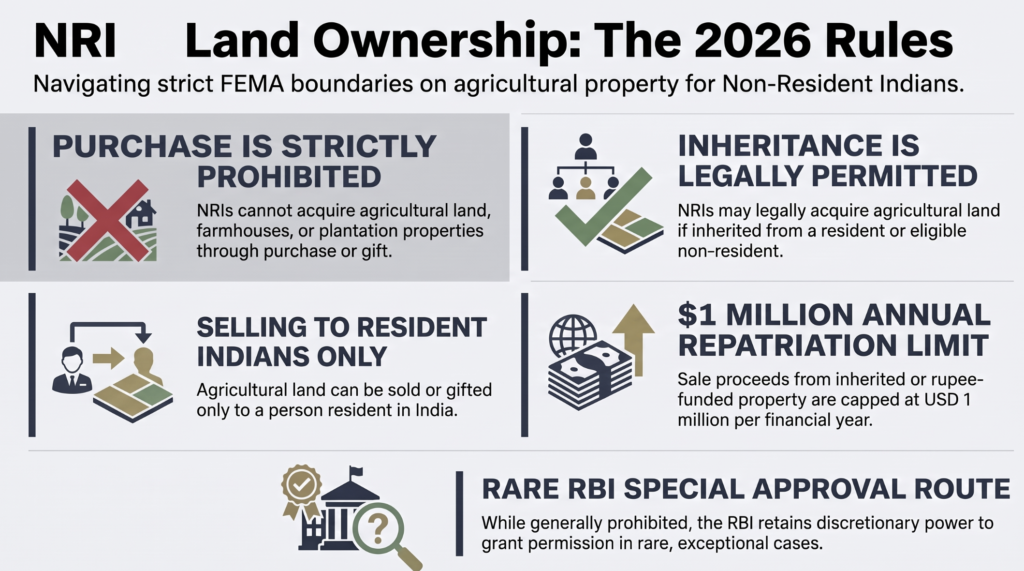
Under Rule 24(a), the Foreign Exchange Management (Non-Debt Instrument) Rule 2019 states that an NRI or OCI may acquire immovable property in India by purchase, other than agricultural land, Farmhouse or plantation property. Therefore, the general permission available to an NRI for purchasing immovable property does not cover agricultural land.
Can an NRI or OCI receive property as a gift?
Yes, Rule 24(b) permits an NRI or OCI to acquire immovable property in India by way of gift, subject to important restrictions. The gifted property cannot be agricultural land, farmhouse or plantation property. Further, the donor must be either.
- A person resident in India or
- An NRI or OCI who is a relative of the recipient within the meaning of (Section 2(77) of the Companies Act 2013.
This means that an NRI cannot assume that any person living abroad can freely give any Indian property to him or her. The relationship between the donor and recipient must be examined where the donor is an NRI or OCI. NRI can not receive agricultural land as a Gift from any of the relatives or even parents.
Can an NRI or OCI Inherit Agricultural land in India?
Yes, inheritance is treated differently from purchase. Under Rule 24 (c), an NRI or OCI may acquire immovable property in India by Inheritance from a person resident in India; or person resident outside India who had acquired the property in accordance with the foreign- exchange law applicable at the time of acquisition or under the applicable FEMA provisions. Therefore, the fact that an NRI cannot purchase agricultural land does not mean that the NRI cannot inherit agricultural land.
For example: If an NRI inherits agricultural land from a parent who was resident in India, the inheritance is governed by Rule 24 (c) subject to the applicable legal requirements.
Can an NRI transfer agricultural land to a resident Indian?
Under Rule 24(d) permit that an NRI or OCI can transfer immovable property to a resident in India, also they can sell or gift their agricultural land to a resident Indian. Under Rule 24(ze) “Transfer” includes sale, purchase, exchange, mortgage, pledge, gift, loan or any other form of transfer of right, title, possession or lien
Can an NRI sell property to another NRI or OCI?
Yes an NRI may sell property to another NRI but there are some important restrictions Under Rule 24 (e), an NRI or OCI may transfer immovable property other than agricultural land, farm house or plantation property to another NRI or OCI. Therefore an NRI/OCI may transfer eligible residential commercial property to another NRI/OCI, subject to the FEMA conditions.
Sale of property by an NRI, FEMA compliance does not end with registration of property
An NRI selling property in India must consider more than merely executing a sale deed. There may be separate issues relating to income tax, TDS, capital gains, registration, stamp duty, repatriation of sale proceeds, NRO/NRE account requirements, source of original purchase funds and FEMA compliance.
RBI specifically states that repatriation of sale proceeds is subject to separate conditions. For example, where an NRI/ PIO seeks to remit sale proceeds of certain immovable property outside India, the property must have been acquired in accordance with the applicable in accordance with the applicable foreign exchange law and the prescribed conditions relating to the source of acquisition funds and residential properties must be satisfied. Therefore, permission to sell property and permission to freely repatriate the sale proceeds are two different questions.
Repatriation of Sale proceeds of Immovable Property by an NRI
Repatriation means transferring eligible funds from India to a place outside India through permitted banking channels. The FEMA/RBI framework does not provide one single repatriation rule for every property sale. The applicable route depends, among other things, on how the property was acquired and the source of funds used for its acquisition.
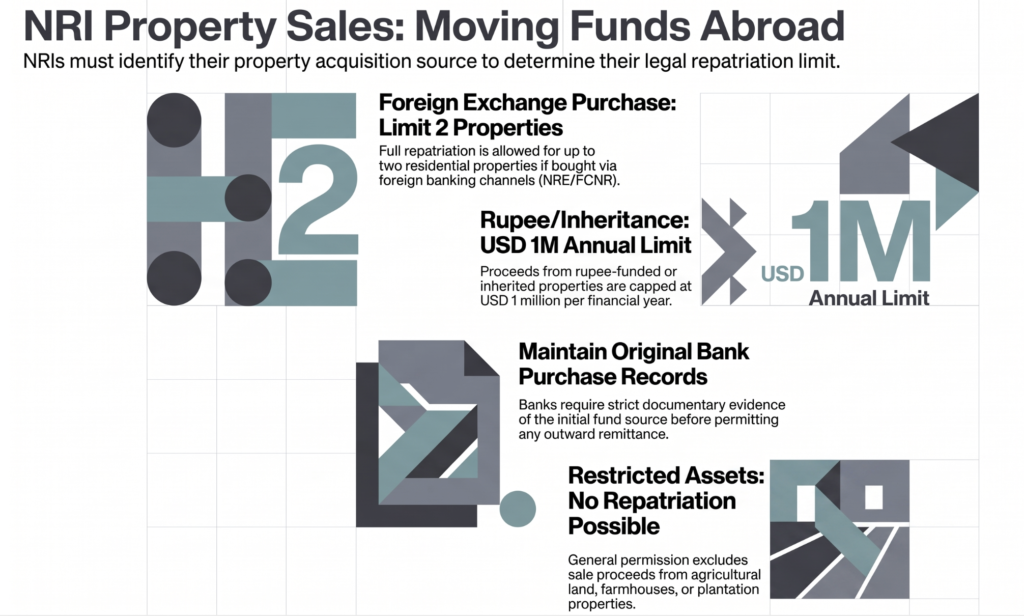
1) Property Purchased with foreign exchange: An NRI/OCI can generally repatriate the sale proceeds of an eligible immovable property other than agricultural land, farmhouse, or plantation property, where the property was legally acquired under FEMA.
An authorised Dealer (AD) bank can permit repatriation if
- The property was acquired in accordance with the applicable foreign exchange law.
- The original acquisition payment was made from foreign exchange received through normal banking channels or From an FCNR (B) account or From an NRE account.
- For residential property, the repatriation facility is restricted to not more than such properties.
- The important point is that the AD bank examines the source of the original purchase funds. Therefore, an NRI should preserve the bank records showing how the property was originally purchased.
2) If Property was purchased from NRO/rupee Funds?
When an NRI purchased the property out of rupee funds, including funds permitted to be maintained in an NRO account, the sale proceeds can be remitted under the USD 1 million per financial year facility, subject to the applicable conditions and tax compliance. RBI’s remittance permits an NRI/PIO to remit up to USD 1 million per financial year from NRO account balances, sale proceeds of assets and assets acquired by inheritance/ legacy. USD 1million is a financial year limit, not a lifetime limit.
For example, if an NRI has eligible sale proceeds of USD 1.8 million, the entire amount cannot ordinarily be remitted under the USD 1 million facility in the same financial year. The balance may require a different permissible route or, where applicable, RBI permission.
3) If property Inherited by an NRI:
An NRI may inherit immovable property in India, subject to FEMA and the applicable succession/property laws. When the inherited property is subsequently sold, the repatriation rules are different from the normal repatriation of property purchased with foreign exchange. The USD 1 million per financial year remittance facility can cover eligible sale proceeds/ assets acquired by inheritance or legacy, subject to documentary evidence and applicable tax requirements.
- Lock-in period: For an NRI/PIO who purchased immovable property out of rupees funds, RBI’s framework allows remittance of sale proceeds under the USD1 million facility without a lock-in period.
Note: The ordinary NRI property-purchase framework does not permit an NRI/OCI to purchase agricultural land, farmhouse or plantation property under the general permission.
Prohibition on transfer of immovable property in India:
As a general rule, a person resident outside India cannot transfer immovable property situated in India.
Provided that
- The Reserve Bank may, for sufficient reasons, permit the transfer, subject to such conditions as may be considered necessary.
- A bank which is an authorised dealer may, subject to the directions issued by the Reserve Bank in this behalf, permit a person resident in India or on behalf of such person to create charge on his immovable property in India in favour an overseas lender or security trustee, to secure an external commercial borrowing availed under the provisions of the Foreign Exchange Management (Borrowing or Lending in Foreign Exchange) Regulations, 2000, as amended from time to time.
- An Authorized Dealer in India being the Indian correspondent of an overseas lender may, subject to the directions issued by the Reserve Bank in this regard, create a mortgage on an immovable property in India owned by an NRI or an OCI, being a director of a company outside India, for a loan to be availed by the company from the said overseas lender. Provided
- the funds shall be used by the borrowing company only for its core business purposes overseas;
- in case of invocation of charge, the Indian bank shall sell the immovable property to an eligible acquirer and remit the sale proceeds to the overseas lender.
- A person resident outside India who has acquired any immovable property in India in accordance with foreign exchange laws in force at the time of such acquisition or with the general or specific permission of the Reserve Bank may transfer such property to a person resident in India provided the transaction takes place through banking channels in India and provided that the resident is not otherwise prohibited from such acquisition.
Reference: Foreign Exchange Management (Acquisition and Transfer of Immovable Property in India) Regulations, 2018
Can NRIs appeal to the Reserve Bank of India (RBI) for permission to purchase agricultural land?
Yes, but it is not an assured right. RBI can give permission to an NRI to purchase agricultural land in India but only in some cases, depending on the discretion of RBI. An NRI must file a formal application with the RBI (typically through an Authorized dealer Bank) under a Prior Approval route. As per the FEMA rules, an NRI cannot purchase agricultural land, plantation property, or farmhouse in India. Any permission, if at all, comes only through a special approval from the RBI, only in exceptional cases, and after government approval. While FEMA and RBI guidelines generally prohibit NRIs from purchasing agricultural land, the Reserve Bank of India (RBI) does have the legal authority to grant special permission. However, such approvals are granted on a case-by-case basis and are historically very rare. (as per rules under FEMA, purchase is prohibited but RBI has residual discretionary power. Section 6(3)(i) of FEMA, 1999 read with Rule 7 of the FEMA (Non Debt Instruments) Rules 2019. Section 6(3) (i) of FEMA, 1999 allows transactions “ subject to such conditions as may be specified by the Reserve Bank Rule 7 of FEM (Non-Debt Instruments) Rules, 2019 except with the prior permission of the Reserve Bank).
For more information contact NRI Legal World: info@nrilegalworld.com/+919709692096
FAQs:
Q1. Can an NRI repatriate the sale proceeds of property sold in India?
Ans. Yes, an NRI can repatriate eligible sale proceeds, but the applicable conditions depend on how the property was acquired, the source of the original purchase funds, and the type of property. The remittance is generally processed through an Authorised dealer (AD) bank.
Q2. Can an NRI repatriate sale proceeds if the property was purchased using rupee funds?
Ans. Yes, subject to the applicable FEMA conditions. Sale proceeds of property acquired out of rupee funds may generally be remitted under the USD 1 million per financial year facility, subject to the required documentation and payment of applicable taxes in India.
Q3. Can an NRI send the sale proceeds directly from the buyer’s account to their foreign bank account?
Ans. The Transaction should be structured through the appropriate Indian banking channels and in accordance with the AD bank’s requirements. The bank will verify the sale, source of funds, tax compliance and FEMA eligibility before processing the outward remittance.
Q4. Can an NRI sell property and keep the sale proceeds in India instead of repatriating them?
Ans. Yes, Repatriation is a facility, not an obligation to immediately transfer the proceeds overseas. The proceeds can be maintained in India in the appropriate account, subject to FEMA and banking rules.
Q5. Can an NRI repatriate proceeds from a property received through a gift?
Ans. This requires examination of the FEMA rules applicable to the acquisition and subsequent sale, including the relationship/source of the gift and the manner in which the property was acquired. The USD 1 million facility may become relevant depending on the circumstances.