
For an NRI, the practical importance of a succession certificate usually arises when the deceased has left financial assets in India, and the institution holding those assets requires formal proof of authority before releasing them. For example, a deceased parent’s bank may be unwilling to release a substantial fixed deposit merely on the basis of a death certificate and an NRI child’s assertion that he or she is the legal heir. The bank may require a succession certificate or another legally recognized document before making payment.
The same issue can arise with securities and other financial assets where there are several heirs or uncertainty about the person entitled to collect them. A succession certificate can therefore be particularly relevant where the deceased has substantial financial assets, the heirs are living in different countries, there is no clear nomination, or the nomination does not resolve the underlying succession issue, several heirs are involved, or the financial institution specifically requires a court-issued certificate.
It is not, however, necessary in every inheritance case. Whether an NRI needs a succession certificate depends upon the nature of the asset, the documents available, the applicable succession law and the requirements of the institution holding the asset.
Purpose of Succession Certificate
A succession certificate should not be treated as a title document for immovable property. If an NRI’s parent dies leaving a house, agricultural land, flat or commercial property in India, the succession certificate does not itself transfer that property into the name of the NRI or any other legal heir. The heir’s rights in the immovable property have to be determined under the applicable succession law, and the appropriate mutation, registration or other property-related formalities have to be completed separately.
This distinction becomes particularly important in families where the deceased owned both financial assets and immovable property. The succession certificate may help in collecting the eligible financial assets, while the property will require a separate inheritance and title process.
The Supreme Court’s decision in Banarsi Dass v. Teeku Dutta, (2005) 4 SCC 449 is particularly important. The court expressly held that the grant of a succession certificate does not establish the title of the certificate holder as the heir of the deceased; it primarily gives authority to collect the debts covered by the certificate.
Legal Heir Certificate and Succession Certificate
A Legal Heir Certificate and a Succession Certificate are not the same document, and they serve different purposes. A Legal Heir Certificate is primarily used to identify the surviving legal heirs of a deceased person. It establishes the relationship of the persons claiming to be the legal heirs with the deceased, and may be used for purposes such as mutation of property records, family pension, transfer of certain service benefits or other administrative purposes, depending on the requirements of the concerned authority.
A Succession Certificate, on the other hand, is issued by a competent court under the Indian Succession Act, 1925, mainly for enabling a person to collect the deceased person’s debts and securities covered by the certificate. This can include certain bank amounts, shares, bonds, securities and other qualifying financial assets. The certificate specifies the debts and securities for which it has been granted and does not automatically give ownership of all the deceased person’s property to the certificate holder.
Another important difference is that a Legal Heir Certificate does not itself give a person authority to collect debts or securities where the bank or financial institution requires a court-issued succession certificate. Similarly, a Succession Certificate does not by itself establish ownership or title over the deceased’s immovable property. The Supreme Court in Banarsi Dass v. Teeku Dutta, (2005) 4 SCC 449, clarified that a succession certificate does not establish the title of the certificate holder as the heir; its primary purpose is to provide authority to collect the debts covered by the certificate.
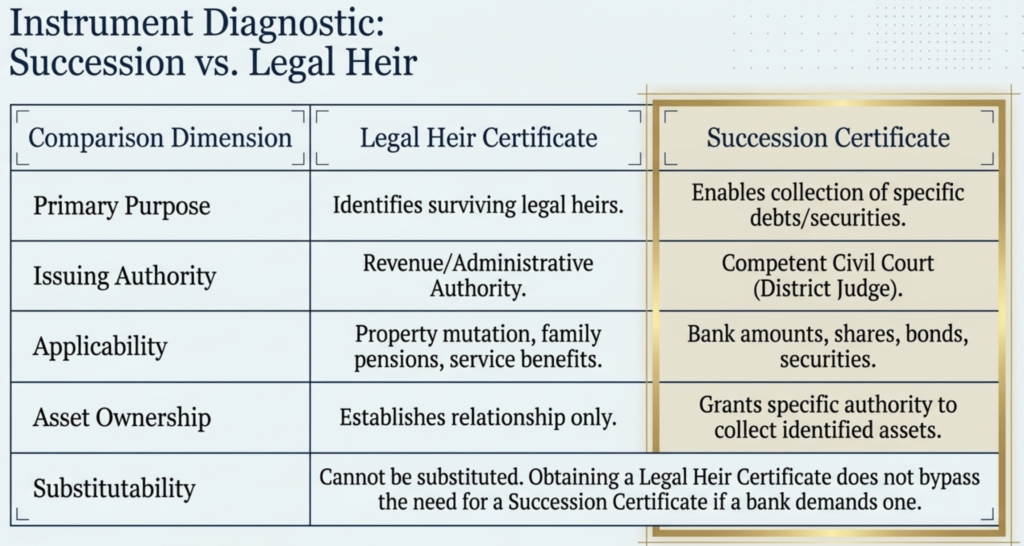
Therefore, an NRI should not assume that obtaining a Legal Heir Certificate automatically removes the need for a Succession Certificate. The appropriate document depends upon the nature of the asset, the purpose for which the document is required and the requirements of the authority or financial institution dealing with the deceased person’s assets.
Financial Assets Covered by the Succession Certificate
The expression “debts and securities” is important because a succession certificate is not intended to cover every asset belonging to the deceased. The Act specifically defines securities for the purposes of Part X. Depending upon the nature of the asset, the certificate may be relevant to government securities, certain bonds and debentures, shares and other securities, as well as debts owed to the deceased.
In practical cases, banks and financial institutions may also require a succession certificate for amounts standing in deposits or accounts, depending upon their internal requirements and the circumstances of the estate. The exact asset should therefore be identified before filing the petition. The certificate specifies the debts and securities in respect of which it has been granted, rather than giving the holder an unrestricted authority over all assets of the deceased.
For an NRI with several types of assets, this distinction is important. A bank fixed deposit, shares in a company and a house owned by the deceased do not all fall into one category merely because they are part of the same estate. The legal procedure for dealing with each asset must be determined separately.
Procedure to apply for Succession Certificate in India
A large number of succession certificate applications arise after a person dies intestate, meaning without leaving a valid will. In such cases, the heirs may have to establish their relationship with the deceased and obtain the necessary documentation to collect financial assets.
Suppose an NRI’s father dies without a Will and leaves behind two sons and two daughters, all living abroad, together with bank deposits and a commercial property in India. The succession rights of the children will have to be determined under the personal law applicable to the deceased. For the bank deposits or other qualifying financial assets, a succession certificate may be required depending on the circumstances and the institution’s requirements.
The commercial property, however, is not transferred merely because a succession certificate has been obtained. Thus, inheritance rights and the procedure for collecting a particular asset are related but not identical questions. The legal heirs may have rights in the estate even though a succession certificate is required to enable one of them to collect a particular debt or security.
Jurisdiction and Filing of the Petition for Succession Certificate in India
Under Section 371 of the Indian Succession Act, the application is generally made before the District Judge within whose jurisdiction the deceased ordinarily resided at the time of death. If the deceased had no fixed place of residence, jurisdiction can arise where any part of the deceased’s property is found.
Section 372 of the Indian Succession Act requires the application to be made by petition and to contain particulars such as the date of death, the deceased’s ordinary residence, details of the family or near relatives, the applicant’s right to the certificate and the debts and securities for which the certificate is sought.
This is particularly relevant for NRIs because the fact that the heirs themselves are living abroad does not ordinarily determine the jurisdiction of the succession certificate proceeding. The deceased’s residence and the location of the relevant property are important for determining the appropriate court.
Procedure Followed by the Court in Succession Certificate Petition
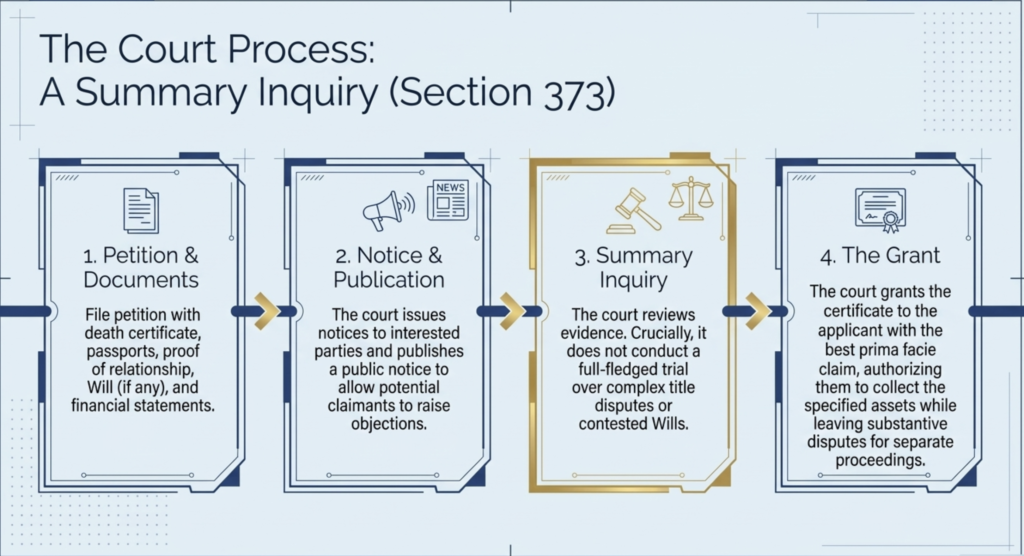
The process begins with filing the petition along with the necessary supporting documents. The court examines the petition and, where appropriate, issues notice to persons who may have an interest in the estate. Notice or publication gives other potential claimants an opportunity to appear and raise objections. The court then considers the evidence placed by the applicant and any person opposing the application. Section 373 provides for a summary inquiry. Where the court is satisfied about the applicant’s claim, it may grant the certificate in respect of the specified debts and securities.
Where there are competing applicants, the court considers the material available before deciding whom the certificate should be granted to. The summary nature of the proceedings is significant. The court is not expected to turn every succession certificate application into a full-fledged trial concerning every possible dispute about the deceased’s estate.
The purpose is to provide a person who appears to have the better prima facie claim with authority to collect the relevant debts and securities, while leaving complicated substantive disputes to appropriate proceedings where necessary.
Documents Required from an NRI Applicant to Obtain Succession Certificate in India
The documents depend upon the facts of the estate and the requirements of the particular court, but an NRI applicant will ordinarily need documents establishing the death of the deceased, the applicant’s identity and relationship with the deceased, details of the other legal heirs or near relatives, and documentary evidence concerning the debts and securities for which the certificate is sought.
Documents such as the death certificate, passport, proof of relationship, details of bank accounts or fixed deposits, share or investment statements and other documents issued by financial institutions may be required. If the deceased left a Will, that document should also be disclosed because it can materially affect the legal route to be followed.
An NRI should also be careful about documents executed outside India. Depending on the document and the country where it is executed, notarization, apostille, legislation, stamping, or other formalities may be required before the document can be relied upon in India.
How NRI can get Succession Certificate While Sitting Abroad
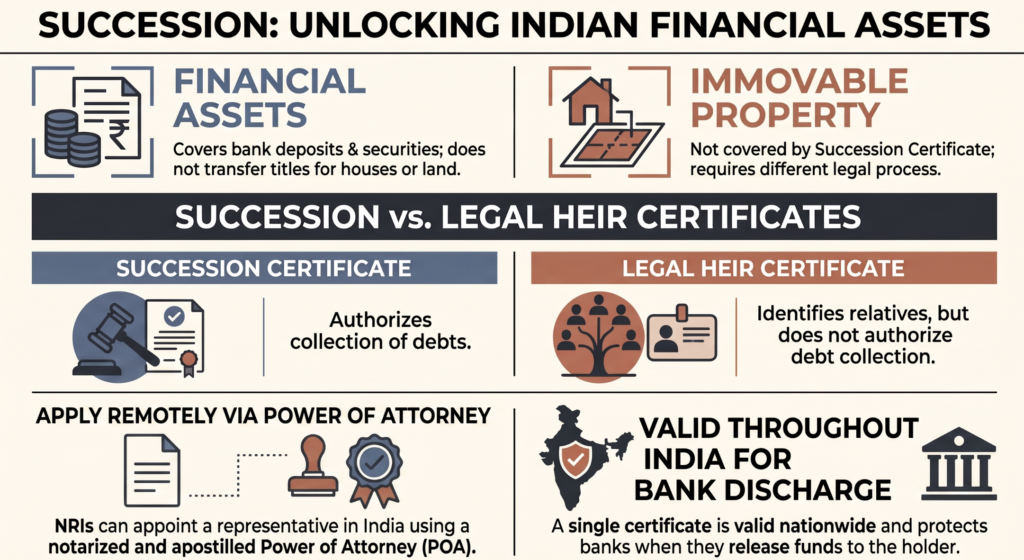
An NRI cannot get a Succession Certificate entirely online in India, because it is issued exclusively by a District or Civil Court through a formal legal petition process under the Indian Succession Act. However, you can file e-petitions through the e-Courts India Services portal or state-specific district court websites to initiate the proceedings, though physical verification and hearings are still mandatory. Depending upon the circumstances, the NRI can execute a Power of Attorney (POA) in favour of a person in India, such as a family member or authorized representative, to act on the NRI’s behalf in connection with the court proceedings. However, a Power of Attorney executed outside India cannot simply be signed and sent to India for use. It has to comply with the applicable requirements for execution, authentication and stamping.
If the NRI is executing the Power of Attorney abroad, it should generally be executed before an appropriate Notary Public (A legally authorized person in the foreign country who notarizes the NRI’s signature/ document) or the Indian Consular authority (The Indian Embassy or Consulate in that country), as permitted by the applicable law. Where the country in which the NRI is executing the POA is a member of the Hague Apostille Convention, the document may generally be apostilled by the competent authority in that country so that it can be presented for use in India. The exact authentication route should be checked according to the country where the POA is executed and the requirements of the authority before which it will be used.
Apostille and stamping are two different requirements. An apostille authenticates the origin of the document, particularly the signature, seal or capacity of the person who authenticated it. It does not, by itself, mean that the document has been duly stamped under Indian stamp law. Therefore, after the POA reaches India, the applicable Indian stamp duty/ adjudication requirements must also be complied with before the document is relied upon, where such duty is payable. The applicable stamp duty depends upon the nature and purpose of the Power of Attorney and the State in which it is being used. The Indian Stamp Act contains provisions concerning Power of Attorney, but State amendments and State stamp laws can alter the applicable duty.
The POA should also be drafted specifically enough to authorize the representative to take the required steps in the succession certificate proceedings, including engaging an advocate, signing or filing documents where legally permissible, appearing before the concerned court or authority, receiving notices and taking other procedural steps. Even after a valid POA has been executed, the court may require particular evidence or the personal appearance of the NRI in a specific situation. A POA is therefore a means of representation and convenience; it does not automatically remove every procedural requirement imposed by the court.
Role of Other Legal Heirs and Objections
A succession certificate proceeding can involve all persons who may have an interest in the deceased’s debts and securities. If another legal heir disputes the applicant’s claim, challenges the relationship with the deceased or claims a competing right, that person can raise an objection before the court. This is particularly important in NRI families because heirs may be living in different countries and may have different views about who should collect the deceased’s assets.
The court is not expected to simply accept the applicant’s statement without considering the material placed before it. Where the dispute involves complicated questions of title, validity of a contested Will or other substantial inheritance issues, those questions may require appropriate proceedings beyond the limited scope of a succession certificate application.
Validity and Effect of the Succession Certificate
A succession certificate issued under the Indian Succession Act, 1925 has effect throughout India. This means an NRI does not ordinarily need to obtain a separate succession certificate merely because the deceased had qualifying debts or securities with institutions located in different States. The certificate also provides protection to a person or institution that makes payment to, or deals with, the person named in the certificate in good faith. Under section 381, such payment is treated as a valid discharge of the debtor’s obligation to the extent covered by the certificate.
This is practically important because banks and other institutions can rely on the certificate when releasing the specified amounts instead of requiring them to independently resolve every question concerning the deceased’s estate. A certificate can also be extended to additional debts or securities under Section 376 if they were not included when the original certificate was issued. An NRI who later discovers another qualifying bank deposit, security or debt of the deceased therefore does not necessarily have to start an entirely new succession certificate proceeding.
FEMA and RBI Rules After Receiving Inherited Money
Once an NRI becomes entitled to receive inherited money in India, a separate question arises: can that money be transferred outside India, and through what route? This is governed by FEMA and RBI rules and is separate from the succession proceedings. For an NRI, inherited money will commonly be credited or maintained in an NRO account, depending on the nature and source of the funds. The fact that money has been received as inheritance does not automatically make it freely repatriable to a foreign bank account.
Under the RBI’s remittance-of-assets framework, an NRI/OCI can generally remit up to USD 1 million per financial year out of specified eligible assets and balances, including certain inherited assets and eligible NRO balances, subject to the prescribed conditions. Where the proposed remittance exceeds the permitted limit, the applicable RBI approval requirements have to be considered. The practical issue for an NRI is documentation. The Authorised Dealer (AD) bank processing the remittance may require documents establishing the source and inheritance of the funds, such as the death certificate, succession certificate or other succession document, bank or investment records, proof of relationship where relevant, and documents relating to payment of applicable taxes. The Exact documents depend on the nature of the inherited asset and the proposed transaction. Apart from this, consultation with a Chartered Accountant is necessary, particularly when an NRI subsequently wants to remit inherited money outside India.
An NRI should therefore speak to an AD bank before transferring or selling the inherited asset if the intention is to remit the proceeds abroad. The bank can confirm the documents required, the applicable remittance route and whether any tax or other compliance has to be completed first. The same principle applies where an NRI inherits immovable property and later sells it. The succession process and the sale of the property are separate stages, and repatriation of the sale proceeds is subject to the FEMA/RBI rules applicable to inherited property and the particular transaction.
For more information contact NRI Legal World: info@nrilegalworld.com / +9197096920906/ nrilegalworld@gmail.com
Frequently Asked Questions
Q.) Can an NRI obtain a succession certificate while sitting abroad?
Ans.) Yes, an NRI does not necessarily have to travel to India personally for every step of the succession certificate proceedings. The NRI can, where appropriate, execute a Power of Attorney in favour of a person in India, such as a family member or authorized representative, to handle the proceedings on their behalf. The POA must be properly executed, authenticated and stamped as required before it can be used in India. However, the court may require the NRI’s personal appearance or additional evidence in particular circumstances, so obtaining a POA does not automatically remove every procedural requirement.
Q.) What documents should an NRI keep ready before starting the case?
Ans.) The exact documents depend on the case, but an NRI should generally keep the deceased’s death certificate, details and proof of the deceased’s ordinary residence, information regarding surviving legal heirs, documents identifying the debts or securities involved, the applicant’s identity and address documents, and the properly executed Power of Attorney where a representative will act in India. If a Will, previous court proceedings, or a dispute exists, those documents should also be disclosed to the advocate at the beginning.
Q.) What is the purpose of a succession certificate for NRIs?
Ans.) For an NRI, a succession certificate can provide legal authority to collect specified debts and securities belonging to a deceased person when the concerned bank, financial institution or other authority requires a court-issued document. It can be particularly relevant where the deceased ha d financial assets in India, several heirs are involved, there is no clear nomination, or the institution requires formal proof before releasing the assets. It does not, however, transfer ownership of the deceased’s house, land or other immovable property.
Q.) Can I use the same succession certificate in different States of India?
Ans.) Yes, under Section 380 of the Indian Succession Act, a succession certificate granted by the competent court has effect throughout India. Therefore, an NRI does not ordinarily need to obtain a separate certificate merely because the deceased’s qualifying debts or securities are held by institutions in different States.
Q.) What if the deceased left a Will? Do I still need a succession certificate?
Ans.) It depends on the nature of the assets, the terms of the Will and the legal procedure applicable to that estate. A Will and a succession certificate serve different purposes, and in some situations probate or letters of administration may be relevant instead. An NRI should therefore not assume that a succession certificate is automatically required merely because the deceased had money or investments in India.
Q.) What is the difference between a Succession Certificate and a Legal Heir Certificate?
Ans.) A Legal Heir Certificate primarily identifies the surviving legal heirs of a deceased person and may be used for various administrative and inheritance-related purposes. A Succession Certificate is issued by a competent court mainly to enable the certificate holder to collect specified debts and securities of the deceased, such as qualifying bank amounts, shares or other financial assets. A succession certificate is therefore not a replacement for a Legal Heir Certificate in every situation, and a Legal Heir Certificate does not automatically give authority to collect financial assets where a court-issued succession certificate is required.