
For generations, families in Punjab have owned houses, plots, shops and other properties situated within the Lal Lakir, commonly referred to as Lal Dora. These properties are often ancestral and may have remained in the same family for decades. However, unlike agricultural land, properties situated within the inhabited portion of a village were historically not recorded and mapped in the same systematic manner in the revenue records because the government was not generating any revenue from the properties of Lal Dora.
This has created particular difficulties for Non- Resident Indians (NRIs). An NRI may own or inherit a house in his or her native village, have old documents, electricity bills and other evidence of possession, and yet face difficulty in establishing the precise boundaries, area and recorded ownership of the property. The problem becomes more complicated when the NRI wants to sell, mortgage, inherit, transfer or otherwise deal with the property while living abroad.
Punjab has now created a statutory framework for addressing these issues through the Punjab Abadi Deh (Record of Rights) Act, 2021 and the Punjab Abadi Deh (Records of Rights) Rules, 2021. The process is being implemented through the Mera Ghar Mere Naam (MGMN) scheme, under which Abadi Deh properties are surveyed, mapped, and brought into a formal Record of Rights. The State’s digital system is designed to capture survey data, verify ownership information and generate Property Cards from the verified Record of Rights.
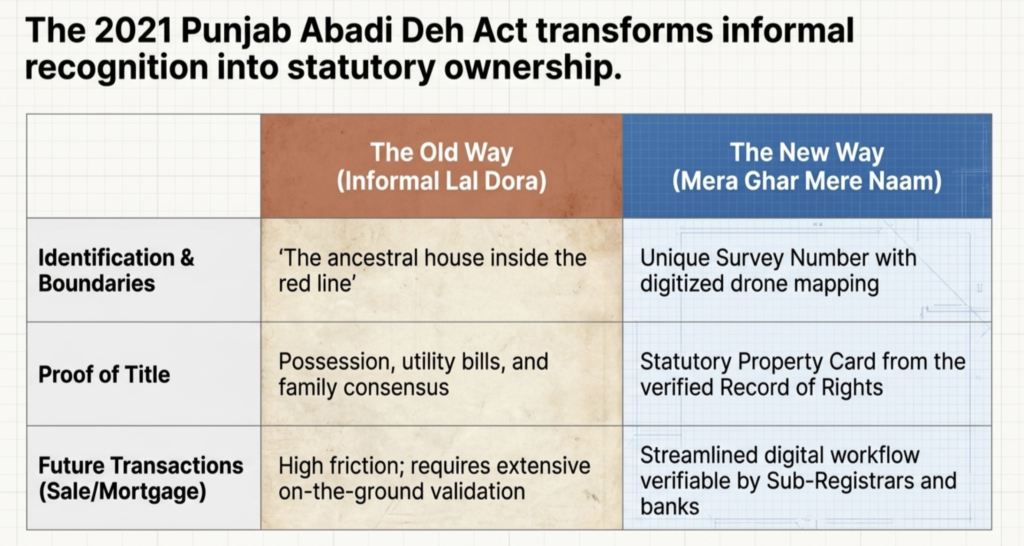
For an NRI, therefore, Lal Lakir property is no longer simply a matter of relying on an old village description such as “the ancestral house inside the red line”. There is now a statutory process through which the property can be surveyed, assigned a unique survey number, its boundaries and area can be recorded, and the person entitled to the proprietary right can be entered in the Record of Rights.
Understanding Lal Lakir and Abadi Deh Properties
The expression Lal Lakir or Lal Dora traditionally refers to the red line shown on village maps to distinguish the inhabited portion of the village from the surrounding agricultural area. The inhabited area is commonly known as Abadi Deh. The term “Lal Dora property” is widely used in ordinary conversation, but the statutory framework in Punjab is based on the concept of Abadi Deh. The Punjab Abadi Deh (Record of Rights) Act, 2021 provides for identification, survey, mapping and recording of proprietary rights in such areas.
Legal Background of Lal Lakir Properties registration The Punjabi Abadi Deh (Record of Rights) Act, 2021 & the Mera Ghar Mere Naam Scheme
The Punjab Abadi Deh (Record of Rights) Act, 2021 provides the statutory foundation for creating a formal Record of Rights in Abadi Deh areas. The government may notify an Abadi Deh area for the purpose of identifying, recording and resolving rights in individual survey units. A Survey Officer, generally a revenue department official, is then appointed, and the area is surveyed and mapped so that its boundaries, dimensions and individual survey units can be identified and assigned unique survey numbers.
The Mera Ghar Mere Naam (MGMN) scheme is the implementation framework through which this process is being carried out. The government’s stated objective is to provide property rights to lawful owners/occupants of properties within Lal Dora areas. The system involves survey and mapping, preparation of survey-unit data, verification by revenue officials, creation of the Record of Rights and generation of Property Cards.
The significance of this development is that the government is not merely issuing a document describing a person’s possession. The process creates a structured record of the property itself and the proprietary right recorded against that property. For NRIs, this can be particularly valuable where an ancestral property has historically been identified only through its location, neighbouring houses or family possession rather than through a clearly surveyed and digitised property record.
Process of Lal Lakir Property Registration: Survey, Drone Mapping and Identification of Individual Properties
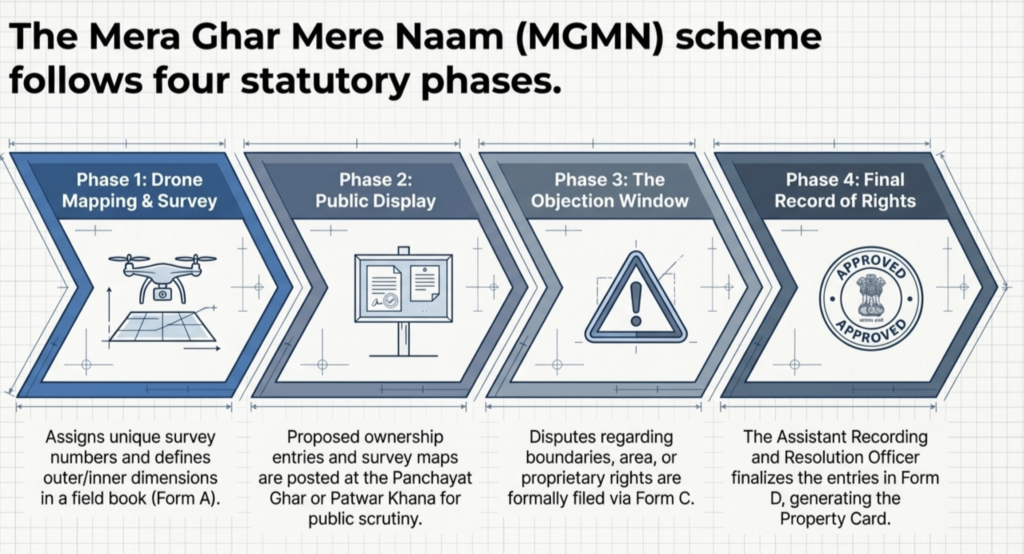
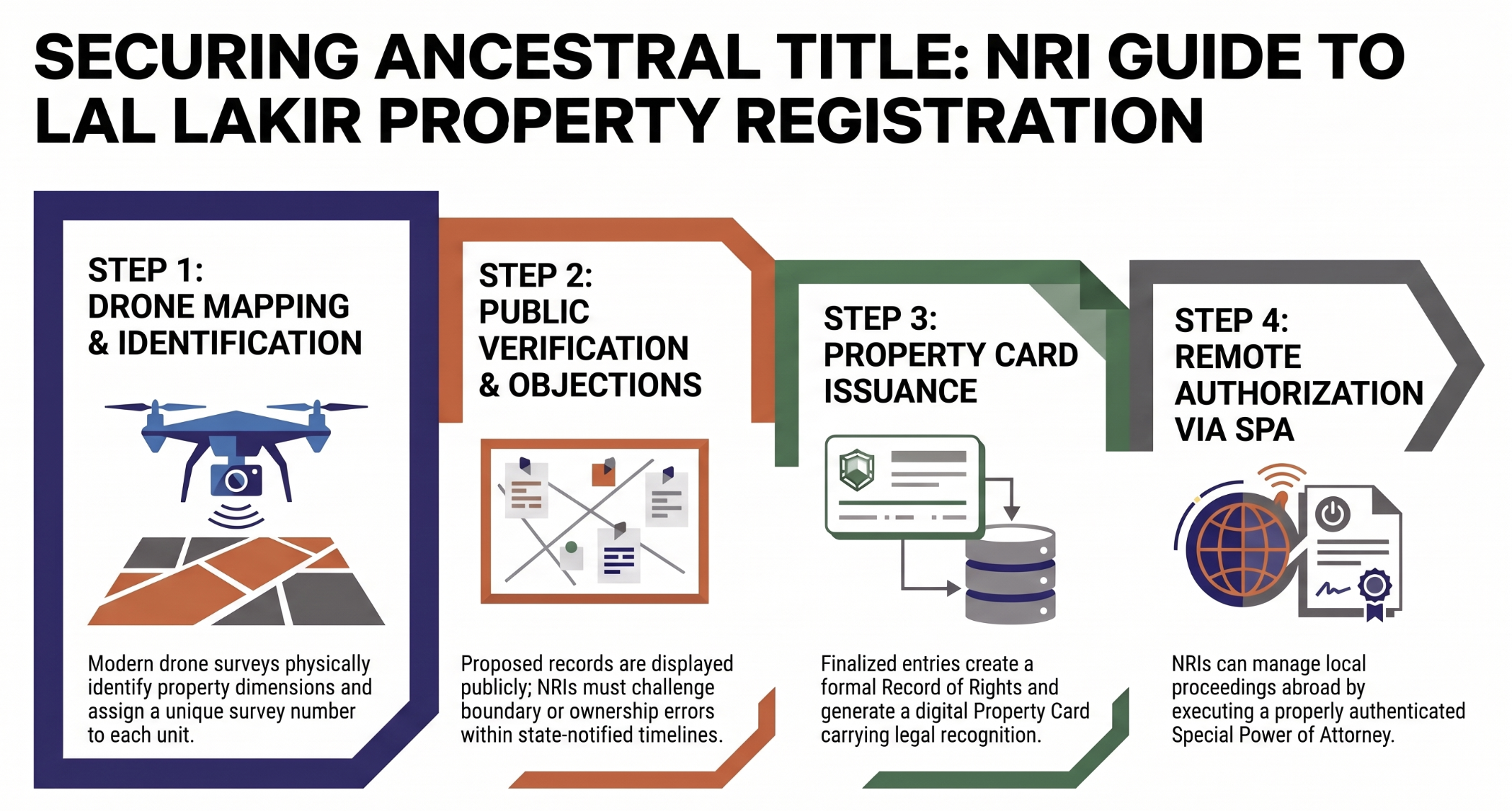
The process begins with the identification and survey of the Abadi Deh area. The Punjab framework provides for the area to be surveyed and mapped to determine the outer boundary of the Abadi Deh and to define the area and dimensions of each individual survey unit. A unique survey number is assigned to each unit. Under the Mera Ghar Mere Naam process, modern technology, including drone-based aerial surveying and digital mapping, is used for this purpose. The survey data is then processed by the revenue authorities for preparing the formal property record. Punjab’s Mera Ghar Mere Naam (MGMN) system specifically provides for village maps, unit maps, survey-unit information, ownership data, verification by revenue officials and generation of Property Cards.
The field-level revenue machinery remains important even though the initial mapping may be technology-driven. The survey information has to correspond with the actual property on the ground. Dimensions, boundaries, area and the nature of the survey unit are recorded in the field book. The Punjab Abadi Deh Rules contemplate a detailed field record in Form A, containing the survey-unit number, dimensions, boundaries, area, type of property and subsequent corrections.
This means that the drone survey should not be understood as the final determination of ownership. It primarily establishes the physical identity of the property. The question of who should be recorded as the proprietor is dealt with through the subsequent ownership-verification process.
Correction of Errors in Lal Lakir property documents and Public Verification
Once the survey map and proposed ownership entries have been prepared, they are made available for public scrutiny. The Punjab Abadi Deh Rules require the survey map and proposed entries to be displayed at conspicuous places in the village, including places such as the Panchayat Ghar, Patwar Khana, Dharamshala, community centre or other appropriate public locations. This stage is particularly important for NRIs because an NRI may be living thousands of kilometres away from the village and may not know that the survey has taken place.
Suppose an NRI owns an ancestral house in Punjab, but another family member is currently occupying it. During the survey, the physical house may be correctly identified, but the ownership entry may be incorrectly shown in the occupant’s name. In another case, the owner’s name may be correct, but the boundaries or area may have been incorrectly recorded. These are precisely the kinds of issues for which the objection mechanism becomes important.
The Punjab Rules specifically contemplate objections concerning dimensions, measurement, boundary or area, objections concerning ownership/proprietary rights, or objections concerning both. Such objections are to be filed before the Assistant Recording and Resolution Officer in Form C (Objection Form; this is the form through which a person can formally object to the proposed survey or ownership record). An NRI should therefore treat public display as an important legal stage and not as a mere administrative formality.
The 2026 Amendment and the Current Position on Objections
The original Punjab Abadi Deh Act prescribed a fixed period of 90 days from the display of the record for filing objections and a further 60-day period for the Assistant Recording and Resolution Officer to decide the objections. The Act also contained a fixed period in relation to appeals. However, this position changed in January 2026. The Punjab Abadi Deh (Record of Rights) Amendment Act, 2025, published in the Punjab Government Gazette on 13th January 2026 as Punjab Act No.3 of 2026, amended Section 11. The earlier reference to objections being filed ‘within ninety days’ was replaced with “within such time as may be notified by the Government.” The corresponding 60-day period for deciding objections was also replaced by a period to be notified by the Government. Section 12(4) was similarly amended in relation to the appeal period.
This is an important update for NRIs because several older articles and online explanations still reproduce the original 90-day and 60-day periods as though they remain the current statutory timelines. They should not be relied upon without checking the applicable notification. For a particular village, the NRI should therefore examine the notice and the currently notified period applicable to that proceeding. If the proposed record contains an incorrect ownership entry, boundary, measurement or area, the objection should be filed within the applicable period and supported by the relevant documents.
Recording of Proprietary Rights and the Final Record
The Assistant Recording and Resolution Officer, with the assistance of the village committee and after hearing interested persons, considers relevant documents submitted in support of the claim and prepares the proposed entries of proprietors and their proprietary rights. The Act specifically provides that, in the case of a privately owned built-up dwelling or residential area, including its open or enclosed courtyard and other vacant land or plots belonging to the owner and not being common areas, the proprietary right is recorded in the name of the owner.
The Act separately deals with common areas and land belonging to the Panchayat, municipal body, Government or other entities. This is why documentary evidence can be important even though the property is being surveyed physically. An NRI may be able to support the claim through an old sale deed, allotment document, inheritance papers, family partition, Will, court decree, previous revenue record or other relevant documents. The Punjab Rules expressly permit the authority to take into consideration relevant and material documents or writings submitted by a proprietor or interested person in support of the claim.
After objections are considered and the necessary corrections are made, the Record of Rights is prepared. The Rules provide for the final record in Form D (this contains the final entries after objections), containing details such as the proprietor, survey unit, dimensions, boundaries, area, type of property and remarks.
Lal Lakir Property Card and Its Legal Significance
The Mera Ghar Mere Naam (MGMN) system is designed to generate a Property Card from the verified Record of Rights. Punjab’s digital implementation provides for verification of survey and ownership information by the concerned revenue authorities and generation of Property Cards by the SDM. The citizen interface also allows the property owner to search for the property and download the Property Card through the system where the record is available.
The Property Card is important because it provides a formal government record connecting an identified property with the person whose proprietary right has been recorded. However, an important distinction should be maintained between a Property Card/ Record of Rights and registration of a transfer document. The Record of Rights records the proprietary right under the Abadi Deh statutory framework. It does not mean that every subsequent sale, gift, mortgage or other transaction can be completed without complying with the laws applicable to that particular transaction.
At the same time, it would also be incorrect to describe the Property Card as a mere “possession certificate” having no legal significance. The Act gives the Record of Rights statutory recognition, and the recorded proprietary right carries a legal presumption subject to the remedies provided by the Act and the rights determined by a competent court. The practical effect is that the NRI’s property can move from an informally identified village holding towards a formally surveyed and recorded property, while any subsequent transaction must comply with the relevant registration, stamp, succession, FEMA and other applicable requirements.
How NRIs can prove their ownership of Lal Lakir properties
Documents such as electricity bills, water bills, telephone bills and other records can help NRIs in establishing their ownership of Lal Lakir properties. They may be useful particularly when the property is being verified during the survey.
However, such documents should not automatically be treated as conclusive proof of ownership. The strongest case will generally be one supported by a coherent chain of documents explaining how the property was acquired or inherited and why the present claimant is entitled to have the proprietary right recorded. For an NRI, it is therefore advisable to collect the documents before the survey or objection stage rather than attempting to reconstruct the property’s history after a dispute has already arisen.
Power of Attorney for NRIs
An NRI does not necessarily have to return to Punjab personally for every stage of the Lal Lakir property-recording process. Where representation is permitted, the NRI can authorize a trusted parent, sibling, relative, friend or legal representative in India through a valid Special Power of Attorney (SPA). An SPA is generally preferable to a broad General Power of Attorney when the authority is limited to a particular property and specific revenue formalities. The POA should clearly identify the NRI and the attorney holder, provide the property details such as village, tehsil, district and survey/property number wherever available, and specifically authorize the representative to appear before revenue authorities, submit ownership documents, receive notices, file objections, obtain survey maps and Record of Rights, receive the Property Card and complete the specified revenue formalities.
If the NRI does not intend to authorize the attorney to sell or transfer the property, such powers should not be unnecessarily included. The manner of executing the POA abroad depends on the country of residence and the method used for authentication. It may be executed through the applicable Indian Embassy/Consulate route or through notarization and authentication/apostille, as applicable. The document must also comply with the applicable Indian stamping requirements before it is used in India. The Registration Act, 1908 recognizes certain Powers of Attorney executed outside India when authenticated before specified authorities. Therefore, an NRI should not assume that merely getting the POA notarized abroad is sufficient. The applicable requirements for authentication, stamping and, where required, registration or adjudication should be completed before the POA is used for the property-recording process in Punjab.
NRI can contact local Revenue Authorities to inform them about NRI’s Ownership in Lal Lakir
An NRI who knows that a village property is in his or her name should not depend entirely upon relatives to monitor the Mera Ghar Mere Naam process. Where there is a risk that the NRI may not receive information about the survey, it can be useful to communicate the ownership details and contact information to the concerned revenue authorities, particularly where the survey process has commenced or is expected to commence.
The NRI can submit the available ownership documents and details of the property to the concerned revenue authority and maintain proof of having submitted them. Depending upon the stage and local procedure, the relevant authority may be the concerned Tehsildar, SDM or other officer handling the Abadi Deh proceedings.
This is not a substitute for the statutory objection procedure, but it can help ensure that the authorities are aware that the property has an absentee owner who is residing abroad and that the owner has an interest in the recording process. For an NRI, this can also reduce the practical risk of discovering an incorrect ownership entry only after the record has already been finalized.
What an NRI Should Do During the Survey and Verification Process
An NRI should first find out whether the concerned village has been covered under the Mera Ghar Mere Naam process and at what stage the process currently stands. If the survey has not started, the NRI should keep the ownership documents ready and identify a reliable person in India who can monitor the process. If the drone survey has already taken place, the NRI should ensure that the physical property has been correctly identified and that the survey number, boundaries and area correspond with the actual property.
When the proposed record is displayed, the NRI should verify both the physical description of the property and the ownership entry. These are separate issues, and both can be challenged where incorrect. If an objection is required, it should be filed in the prescribed manner within the applicable notified period. The NRI should keep copies of the objection, supporting documents and acknowledgement.
Once the final Record of Rights and Property Card are generated, the NRI should again verify the name, share, survey number, area and boundaries. A mistake should be addressed promptly through the available statutory mechanism rather than being ignored for years.
Purpose of Lal Lakir property registration in Punjab: Sale, Mortgage and Future Transactions
The formal recording of Lal Lakir properties is intended to make these properties more usable for future economic and legal transactions. The Punjab Government’s MGMN digital framework specifically contemplates subsequent functions relating to mortgage, sale deeds, and mutations after the creation and verification of the Record of Rights. NIC’s (National Informatics Centre) description of the Punjab system identifies Property Cards, mortgage, sale and mutation as components of the broader digital workflow.
Therefore, once an NRI’s proprietary right has been formally recorded, the property can have a much clearer foundation for future dealings. However, the NRI should not assume that obtaining the Property Card automatically completes a sale or mortgage. Before entering into a transaction, the owner should verify the final Record of Rights, title history, co-ownership, pending litigation, encumbrances and the requirements of the concerned Sub-Registrar, bank or other authority.
For a sale or gift, the appropriate instrument must be executed and registered wherever the law requires registration, along with the payment of applicable stamp duty and compliance with other relevant laws. For an NRI, FEMA and tax considerations may also arise depending upon the nature of the property, the NRI’s status, the manner in which the property was acquired and the proposed transaction. These issues should be examined separately before the transaction is completed.
Preventing Fraud in Lal Lakir Properties
The digitization of Lal Lakir properties is intended to create greater clarity, but NRIs should still take practical precautions because absentee ownership can make village properties vulnerable to unauthorized dealings. An NRI should maintain updated copies of the Property Card, survey map, ownership documents and Power of Attorney. If a representative is appointed, the NRI should keep the authority narrowly drafted and should not give unnecessary powers.
The NRI should also periodically check the available revenue records and registered transaction information and remain alert to any unexpected mutation, sale deed, mortgage or other entry relating to the property. If the NRI discovers an unauthorized transaction, the appropriate remedy will depend upon the facts. It may involve revenue proceedings, civil proceedings for declaration or cancellation, injunction proceedings, or criminal proceedings where fraud, forgery or another offence is involved.
Contact for more details: info@nrilegalworld.com / +919709692096
Frequently Asked Questions
Q.) Can an NRI get his or her Lal Lakir property recorded in Punjab?
Ans.) Yes, an NRI residing outside India does not, by itself, prevent the NRI from claiming proprietary rights in an eligible Abadi Deh property. The NRI must establish the basis of the claim and participate in the statutory recording process, either personally or through an authorized representative where permitted.
Q.) Can an NRI participate in the survey without travelling to Punjab?
Ans.) Where the concerned process permits representation, an NRI can appoint a representative through a properly executed Power of Attorney. The representative can then undertake the specified acts before the revenue authorities. The exact authority required should be stated in the Power of Attorney.
Q.) Can an NRI sell a Lal Lakir property after getting the Property Card?
Ans.) The Property Card provides a formal record of the property and the recorded proprietary right, and the MGMN framework contemplates subsequent sale and other transactions. However, the particular sale must comply with the applicable registration, stamp duty, succession, FEMA, tax and other requirements. The title and encumbrance position should also be checked before the transaction.
Q.) What happens if the NRI’s father owned the Lal Lakir property and has died?
Ans.) The heirs must establish their succession rights and have the relevant ownership record updated through the applicable procedure. If there are multiple heirs, the rights of all the heirs must be considered. The NRI should not assume that possession by one family member gives that person exclusive ownership.
Q.) Can an NRI check the Lal Lakir property record online?
Ans.) Punjab has developed the Mera Ghar Mere Naam (MGMN) digital system for survey data, Record of Rights and Property Cards, and the Punjab land-record infrastructure provides various online land-record services. The availability of a particular property online depends upon the stage reached by the concerned village and property in the survey and record-preparation process.
Q.) If a house in the Lal Lakir was built by the parents or jointly by the siblings, does one sibling living there for many years become the sole owner?
Ans.) Not automatically, if the house or the underlying property belongs jointly to the parents or siblings, the fact that one sibling has been living there for a long period does not, by itself, make that sibling the exclusive owner. The rights of all legal owners or successors will depend on the title documents, inheritance, any family settlement or relinquishment, and the entries made during the Record of Rights process. Living abroad does not by itself cause a sibling to lose their share. If there is a dispute regarding ownership, the revenue record or Property Card alone may not finally determine the parties title, and the matter may require appropriate legal proceedings.
Q.) Can a person who has been occupying and running shops on Lal Lakir property for around 30 years claim ownership merely because the shops are in their possession and they have electricity bills and tax records?
Ans.) Long-term possession, electricity bills and payment of property taxes can support a person’s claim of possession or occupation, but they do not automatically establish ownership. If the shops were originally constructed by your family and given to the person on rent, the nature of that original arrangement and the documents supporting it would be important. A tenant or occupant cannot ordinarily convert a tenancy into ownership merely because they have remained in possession for many years. The proposed Record of Rights process also provides an opportunity to object if an incorrect ownership claim is recorded. The family should preserve documents showing ownership and the original tenancy or occupation arrangement and raise an objection before the competent revenue authority if the occupant’s name is wrongly proposed as the proprietor.