
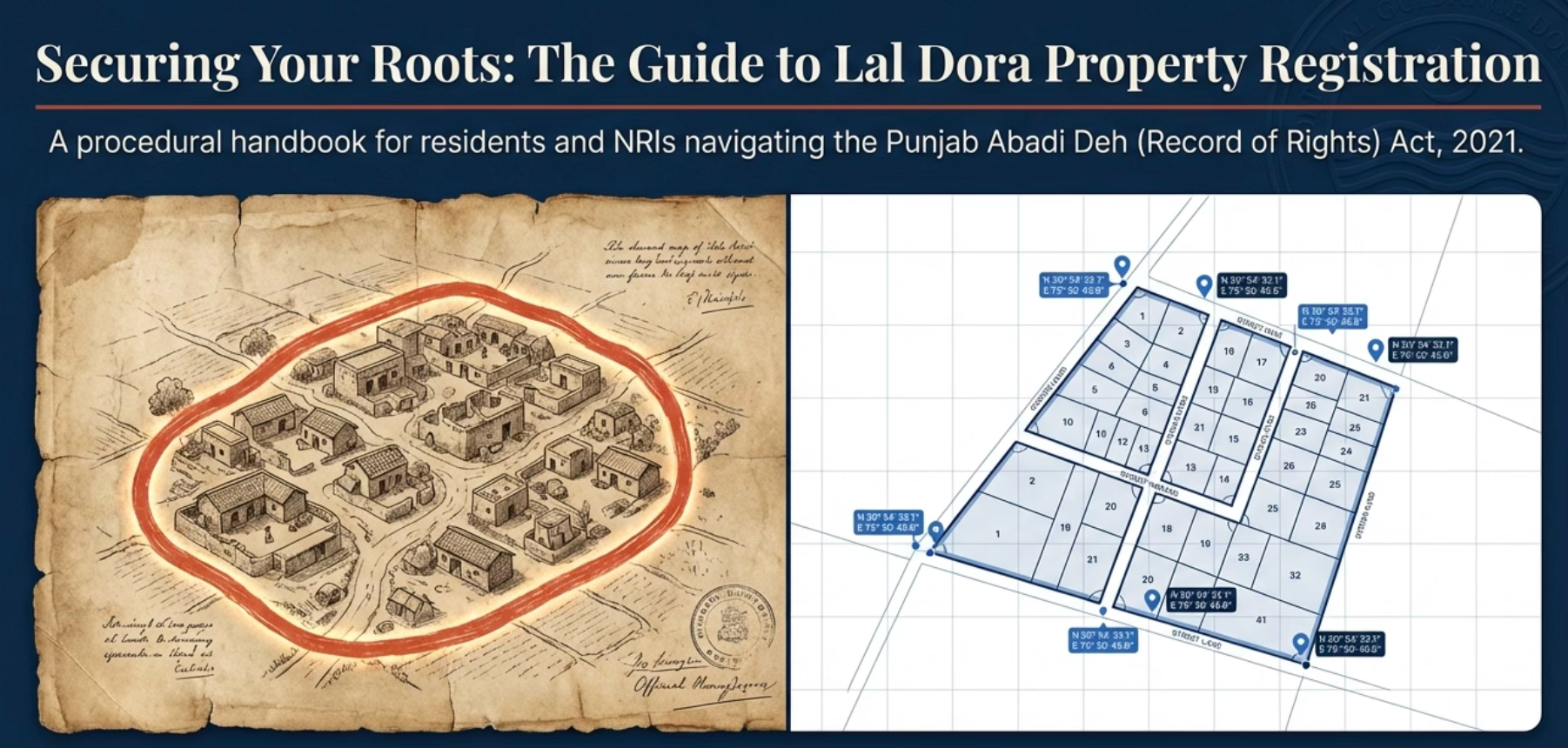
Definition of Lal Dora properties
The ‘Lal Dora’ refers to the ‘land or properties’ of villages which are separated by ‘red line’ in traditional land revenue maps of India since the British-era. This red line on the map was to separate the ‘Habitation area of a Village’, also referred to as Abadi area of a village, from the revenue earning agricultural area of a village in Punjab.
In Punjab, the ‘Lal Lakir’ Act -Punjab Abadi Deh (Record of Rights) Act,2021, gives legal ‘Property Rights’ to the ‘Residents of the villages in Punjab. With the introduction of the Punjab Abadi Deh (Record of Rights) Act, 2021, the government of Punjab has finally provided a statutory backbone for “Property Rights” within Lal Lakir areas by moving these properties from “possession only” to a modernized legal framework within the revenue department. This transition is a seismic shift.
Can an NRI register his ‘Lal Dora’ Properties?
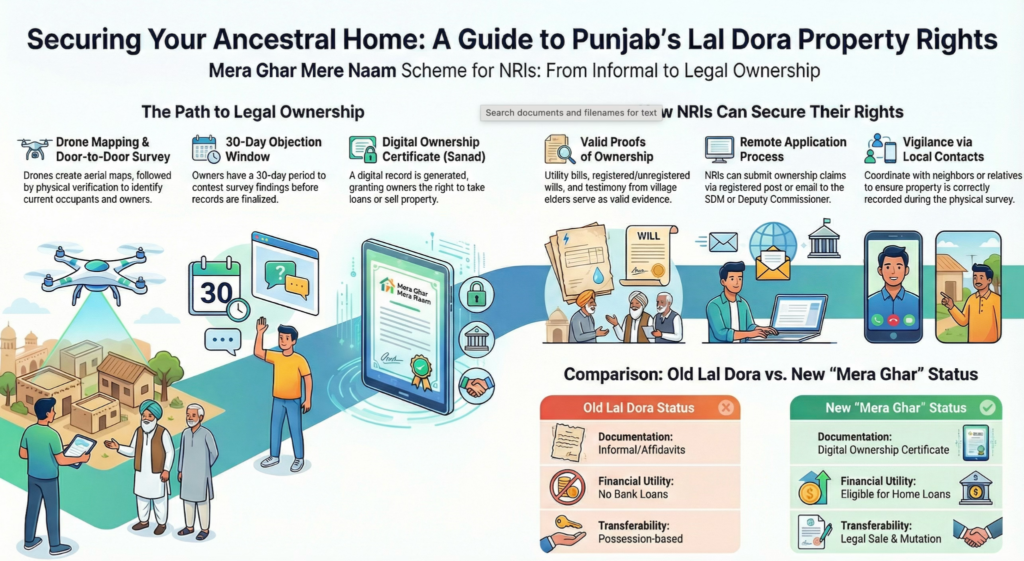
Yes, the Lal Dora properties can now be registered under the new scheme. Initially a certificate of ownership is being provided to the owners. Lal Dora lands were not registered earlier because they were out of the ambit of land revenue. Now under the newly launched ‘Mera Gahr Mere Naam’ scheme, initiated by the Indian government, the authorities have started making a Legal digital record of the villages.
HOW to get a Lal Dora ownership certificate?
This scheme is in the initial stage and is being done from village to village. It is recommended to contact the local revenue authorities to make sure your property ownership is clearly mentioned in the certificate. Once the process is completed and your property is free from any objections the authorities will issue the certificate of ownership.
Uses of the LAL Dora certificate
Certificate of ownership of lal dora property ensures the legal right on the property. This will make the ownership titles clear in the village houses/plots/ properties by making it part of the formal revenue record.
How property/land is measured by the revenue field staff
1) The patwari/kanungo are the field revenue staff. They verify the land using modern technology like Drone/ETS (Electronic total station) to capture a high resolution imagery for 3D mapping of the village.
2) The Public Verification: This is the most critical stage for NRIs. After the drone mapping the Survey team will conduct a door-to-door verification to match the digital draft with the physical possession holders of the plots and houses and seek confirmation about their ownership claims. Both the digital draft and physical verifications are marked and then published as a tentative map for public scrutiny.
The public is given a total of 30 days of the time to raise their objections to the title ownership of the property, after the map is published for scrutiny. Once the objections are raised the district level land revenue authorities must clear the case of ownership within the next 30 days.
3) Final land record: The authorities release the final digitised map of the village land record by assigning a particular number to each and every house or plot. This serves as the definitive digital record forming the basis for your legal Certificate of Ownership.
NRI can authorise a trusted friend/relative/or legal adviser with a valid power of attorney(POA) to complete the process of Lal dora certificate. NRI Legal World recommends a special power of attorney for a specific purpose instead of a general power of attorney giving away all the authorities to the sale and register the property. NRIs can cancel the Power of Attorney in any doubtful situation.
How to make a Power of Attorney from abroad?
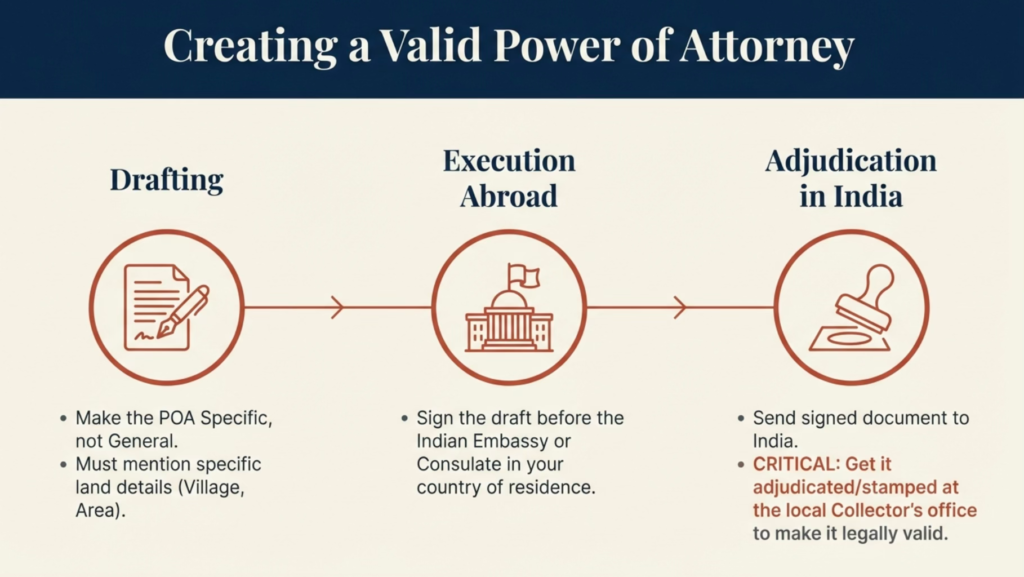
- Draft a precise and specific power of attorney mentioning the specific purpose and property details.
- Get the PoA notarised and embossed from local Indian embassy/Consulate
- Send to PoA to India
- The authorised person should get it registered/ adjudicated/stamped at the local district collector’s office in India.
Important judgements related to Lal Dora Cases:
1. Nachattar Singh & Anr vs. Gurdev Singh, Punjab and Haryana High Court, 2023
In this case, the plaintiff (Nachattar Singh) claimed ownership of a plot of land situated within the lal lakir of village Lehra Khana (Bathinda). The dispute was over a 9-marla plot that the plaintiff said was originally jointly allotted to Chet Singh and Tota Singh in 1964. Later, Chet Singh allegedly relinquished his share to Tota Singh, and the defendant claimed this made them the owners of the entire plot.
COURT FINDINGS
- The court examined documentary evidence related to the allotment and possession of the plot within Lal Lakir
- Continuous possession and inheritance from the original allotment played a central role
- The case illustrates that when land is shown in Lal Lakir, clear historical evidence and possession are essential to succeed in a civil suit for ownership
2. Harjinder Singh vs State of Punjab and others, Punjab and Haryana High Court, 2012
In this writ petition the petitioner challenged a revenue/gram
panchayat over a land that was claimed to be within the Lal Lakir and a part of the abadi area in a village. The dispute was centred on whether the land was common village property (Shamilat deh).
Court’s final decision was:
The high court remitted the matter to the authority to decide if the land actually falls within the Lal Lakir or Abadi Deh or if it is genuinely common village land under the statutory definition.
The case shows that:
- Land within Lal Lakir is not automatically common village land
- The village or panchayat must prove actual common use or statutory status, not just rely on things like police reports
- The court won’t accept casual evidence like police reports to decide ownership in Lal Lakir.
Important tips for NRIs
- NRI should make sure the power of attorney is specific, not general.
- The wording in the draft of power of attorney must clearly specify the powers given to the attorney holder while dealing with the property. Property details must be clearly mentioned.
- Present the documentary evidence to prove your claim to ownership. NRI can also provide utility bills of the house like telephone bill, Electricity bill, etc.
- The Lal Dora certificate does not convey full ownership; you have to register later in the sub-register office
- The NRI should get information on what stage the Lal Lakir property registration scheme (MERA GHAR MERA NAAM) has reached from their neighbors in the village or from other sources.
- The NRI can see the map of the land (LAL DORA) on the official website of the survey of India. ( if available)
- The NRI can send the application to the concerned authority (Deputy Commissioner, SDM, Tehsildar) to make the authorities aware about NRIs ownership right on the property with all the possible details, via a registered post or email. This step makes authorities aware that the absentee owner has a clear ownership title of the property thus it minimises possibility of error or fraud related to the property.
- NRI can apply online for Lal Dora certificate in some states (Delhi, etc.), but online does not mean fully automatic; you need an Authorised POA agent for some steps (Field/Land verification)
- NRI can seek more information on the matter by reaching us on info@nrilegaloworld.com / +919709692096