

“In today’s globally connected era”, Non-Resident Indians (NRIs) often own property in India, foreign bank accounts, investments, and business interests in more than one country. However, managing these assets after death can become legally complex if proper estate planning is not done. One of the most crucial legal tools for NRIs is a Will. Legally, a will is a testamentary document made by a person, expressing how their property and assets are to be distributed after their death. It is a revocable document, meaning it can be changed or cancelled by the person at any time during their lifetime, as long as they are of sound mind. Under the Indian Succession Act, 1925, a Will takes effect only after the death of the person making it (known as the testator). It must be executed voluntarily and in accordance with legal requirements such as proper signing and attestation.
Drafting will of inheritance NRIs
In the era of artificial intelligence, it has become important to understand the various legal aspects of the ‘will’ and the law governing inheritance of property in India, especially for Non Resident Indians.
Registration of Foreign Will in India
Even though the law does not mandate registration of ‘will’ in India, but legally it is recommended to NRIs to get their foreign will registered in India as it reduces the risk of future litigation regarding the properties mentioned in the Will and also increases the authenticity of the Will. For NRIs, those who hold assets in India, registration or proper attestation of the ‘will’ bridges the gap between foreign ‘will’ and its execution in Indian.
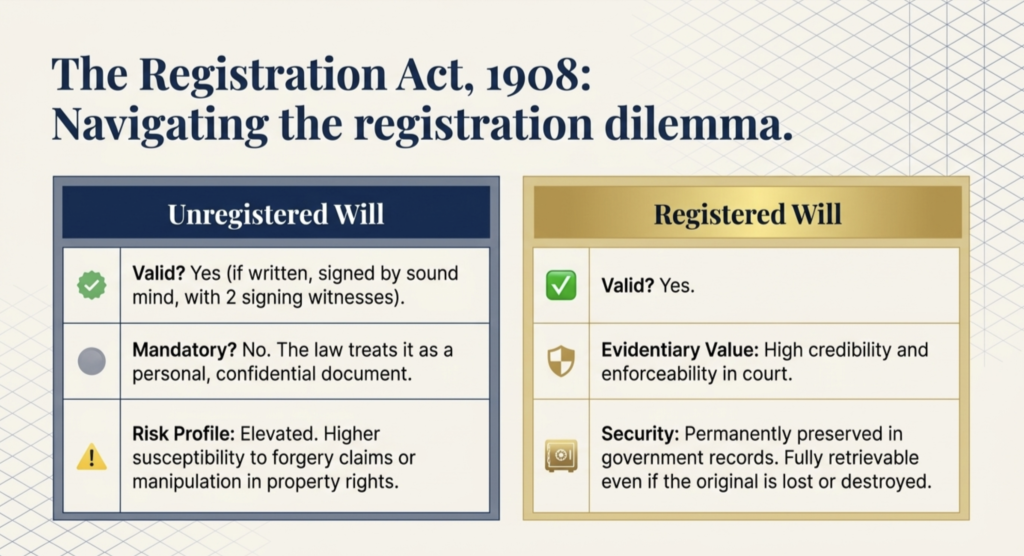
Under the Registration Act, 1908, registration of a Will is not mandatory. A Will can be valid even if it is not registered, provided it fulfils the essential legal requirements such as, it is written as well as signed by a person of sound mind in the presence of two witnesses. The will must have the sign of these witnesses.
The law recognises that a Will is a personal and confidential document, and therefore, it gives individuals the flexibility to choose whether or not to register it. But the practical reality is that the registration plays a significant role in strengthening the credibility and enforceability of a Will. It reduces risk of forgery and manipulation in property rights. It enhances the evidentiary value in court. The registration ensures that the Will is preserved in the government records and it can be retrieved even if the original copy is lost or destroyed. At the same time, it is important to understand that the registration alone does not make the ‘Will’ valid, and similarly, non-registration of the will does not make it invalid. An unregistered will can still be fully enforceable, if the will is properly executed and its authenticity can be proved through the witnesses.
On the other hand, in some cases even a registered Will is challenged in the Indian courts and the petitioners are sometimes able to successfully establish that the will was made with force, coercion or any other external pressure. Here are a few legal examples that were established in the courts when the ‘will’ was challenged like the will was forged, the testator was forced to sign, the testator was not of sound mind etc.
Hence, the NRI property owner must seek professional, legal advice before or during the process of estate planning.
Tips for NRIs writing their Will of inheritance
NRIs can make a Will while living abroad and this is where practical planning becomes important. An NRI can draft and sign the Will outside India. After writing the draft of the will NRI can get it notarized or attested under the local laws of the country of residence. However, if the Will deals with the immovable property in India, it may still require probate in India. Courts may examine whether execution complied with Indian legal standards. Therefore, many legal experts recommend either executing the Will before Indian witnesses, or ensuring proper attestation through the Indian consulate.
Understanding the necessity of Probate in foreign will
Probate is a legal certification granted by the court that confirms the validity of a Will. It enables the lawful distribution of assets. It is governed primarily under the Indian Succession Act, 1925. Probate becomes compulsory in certain cases, when the Will relates to immovable property situated in Mumbai, Chennai or Kolkata and it is mandatory when there is a dispute among legal heirs. The intention behind probate is not just procedure but it is a way to provide the legal protection and clarity to the ‘will’. Probate ensures that no fake or manipulated Will is used to grab the property, hence reduces the chances of fraud. It gives all heirs an equal chance to raise objections and ensures fairness in the execution of the ‘will’.
Ingredients of a good Will Especially for NRIs

A well-drafted Will is not just about distributing assets it is about ensuring clarity, enforceability, and minimising disputes in future. The following are a few essential elements:
1. The Will must clearly mention the Full name of the testator passport details, permanent and overseas address.
2. The Testator must be of sound mind and not be under coercion or undue influence.
3. All assets should be clearly mentioned including Immovable property with details like Khasra Number for land, location, area, Bank accounts, investments.
4. The beneficiaries must be clearly identified with full name, relationship to the testator, and share in property.
5. An executor should be appointed to administer the Will to ensure proper distribution of assets.
6. As per the law a Will must be signed by the testator and attested by at least two witnesses.
Frequently Asked Questions
Q1. What happens if an NRIs Will is challenged as forged in India?
Ans. In such cases, the burden of proof lies on the person relying on the Will. They must produce witnesses and prove the signature and execution. If the Will is registered, it carries stronger evidentiary value and reduces suspicion, though it can still be challenged.
Q2. What if the Original Will is lost after the testator’s death?
Ans. If a family lost an original Will but they have a photocopy of the Will, courts are generally reluctant to accept photocopies unless supported by strong evidence. Beneficiaries have to prove. The Will was validly executed, the loss was genuine, and Contents of the will are accurate. A registered Will can be retrieved from official records, which avoids the issue.
Q3. If a Will has been made abroad by an NRI is it valid in India.
Ans. If Will is executed in a foreign country but used for Indian assets. Then yes, it can be valid if it is properly executed as per local laws. However, Indian authorities may require apostille or consular attestation. Proof of authenticity to avoid complications, it should align with the Indian Succession Act, 1925.
Q4. Can I challenge a registered will in the court?
Ans. Yes, registration does not make a Will immune from challenge. It can still be contested on grounds like fraud, Undue influence, Lack of mental capacity. However, registered Wills are harder for dispute.
Q5. What if witnesses are not available after the testator’s death?
Ans. If Witnesses are not available after the death of the testator. This creates serious difficulty in proving the Will. Courts rely heavily on witness testimony. In such cases, other evidence must be produced.
Q6. Can an NRI change or revoke their Will later?
Ans. Yes, a Will can be changed anytime during the lifetime of the testator. The latest Will overrides all previous ones.