
Understanding summons and its purpose
A summons is a legal document that is issued by a court or any other competent authority directing a person to appear before the court or authority on a specific date regarding a particular case. It informs the receiver that a legal proceeding has been initiated and their presence or response is required. In India, summons are mainly governed by procedural laws such as the Code of Civil Procedure 1908 (CPC) and the Code of Criminal Procedure 1973(CrPC).
Purpose of Summons
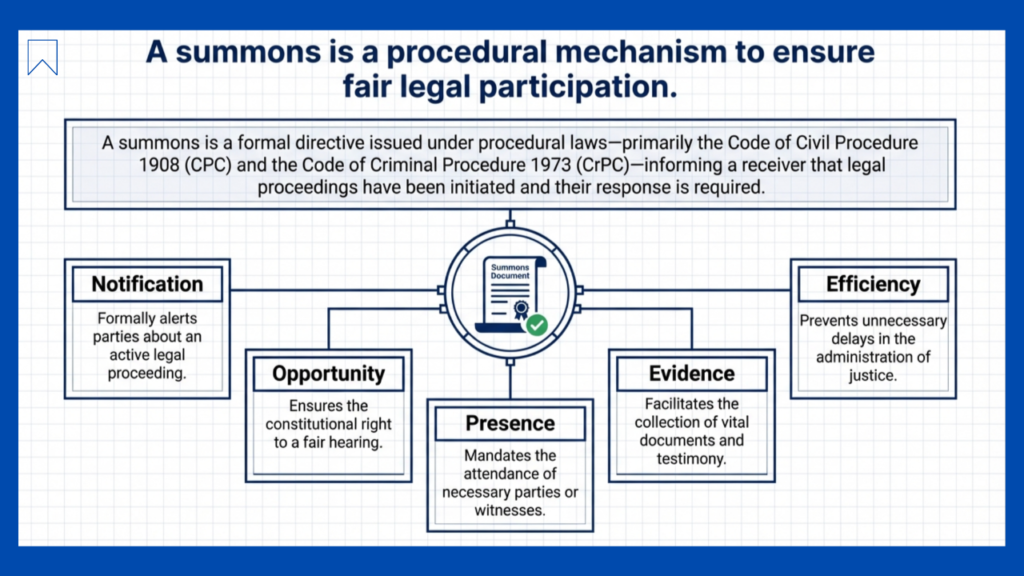
A summons is one of the most important procedural tools in the legal system. It ensures that individuals involved in a legal matter are properly informed about the proceedings and given the opportunity to appear before the authority or court.
Summons helps to:
- Ensure fair opportunity to be heard during a legal process.
- Notify parties about the legal proceeding involving them.
- Ensure the presence of parties and/or witnesses in the legal process to deliver justice.
Who can issue summons?
- Courts: Courts are the primary authorities that can issue summons in both criminal and civil cases
- Civil courts: civil courts issue a summons to inform the defendant that a case has been filed against them and to require them to appear in court. The civil court has the power to send a summons under (the Order V of) the Code of Civil Procedure, 1908.
- Criminal courts: criminal courts issue summons in criminal proceedings where the presence of an accused or witness is required.
- Police Authorities: Police authorities have the power to issue a summons under the section 160, of the Criminal Procedure, 1973. A police officer investigating a case may require the attendance of any person who may have knowledge of the facts and circumstances of the case.
- Income Tax Authorities: Income tax authorities have power similar to civil courts for investigation and assessment. Under section 131 of the Income Tax Act 1961, income tax authorities can issue a summons
- Enforcement Directorate (ED): The Enforcement Directorate investigates the offences related to money laundering. Under section 50 of the Prevention of Money Laundering Act, 2002, the Enforcement Director office has the power to summon any person whose attendance is necessary during an investigation.
- Custom Authorities: A customs officer can issue a summons during investigations related to smuggling or customs duty violations. Under section 108, of the Customs Act 1962, a Customs officer may summon any person to give evidence or produce documents during an inquiry.
- Human Rights commissions: National Human Rights Commission of India (NHRC) and State Human Rights Commissions protect people’s fundamental rights. Under section 13, of the Protection of Human Rights Act, 1993, the Human Rights Commission has the power similar to a civil court; therefore, they can summon any person, call for documents or records, examine witnesses etc.
Service of the summons to the NRIs
For NRIs, receiving summons can be challenging because they live outside India. However, Indian law provides certain procedures to ensure proper service of summons.
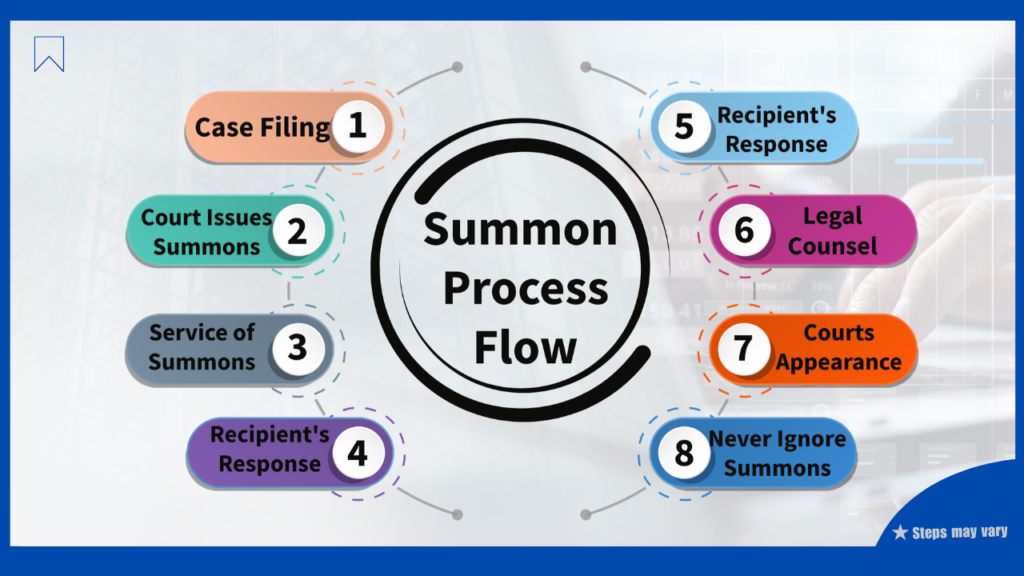
Under the Code of Civil Procedures, 1908 summons to NRIs can be served through several methods, such as:
- Through Embassy/consulates: Indian embassies or consulates can serve summons to NRIs abroad. This method is often used when other methods aren’t feasible.
- It is a more official and reliable method of service of summons and it adds more legal credibility in the court.
- It is helpful in the circumstance where the exact address or the direct contact to the person is difficult.
- Through registered international post or courier: The court sends the summons along with copies of the case document to the person’s foreign address . It is the most commonly used method for the service of summons. It is an easy and cost effective method and provides a delivery proof and tracking receipt.
However on the disadvantageous side this method fails if the address is wrong/ person refuses to accept the delivery.
- Through email or electronic forms: The court allows service of summons through email and electronic forms when the person involved resides outside India. This approach helps ensure that legal notices reach parties quickly and reduces delay caused by international postal procedures. However, a person may ignore or deny receiving the email and can have doubts about the authenticity of the summons.
- Hague service convention: If the NRI’s country is a signatory country like the US, UK, Australia, India can request service of summons through the country’s central authority.
In case of NRIs it is the most effective method legally and is recognized and accepted by the foreign courts. However this process can take months of time as it is a more formal and complex procedure.
Note: This is not applicable if the country is not a part of the Hague convention.
Benefit of Hague service convention for NRIs
The Hague service convention is an international agreement between countries that explains how legal documents, such as court summons and notices, should be delivered to people who are living in other countries. In simple terms, it is a system that helps the courts to send legal papers from one country to another in a proper and recognised way.
The main purpose of the Hague Convention is to make the process of serving legal documents abroad simple, secure and internationally recognized. Before this convention existed, serving court documents across borders often required complicated diplomatic procedures. The convention created a uniform system so that courts in one country can send documents to another country through an official authority.
India officially ratified the Hague service convention on 23, November 2006, and it came into force in India from 1, August 2007.
Note: More than 70 countries are part of Hague service convention, including Japan, the United States, Canada, Brazil, Australia, New Zealand, Germany, the United Kingdom, etc.
Procedure for summoning through Hague Service commission
- Court prepare summons:
The Indian court prepares summons along with the copy of the case and the Necessary documents. The court officials properly ensure that every document must be complete and signed properly.
- Application is made for foreign service:
The party that is filing the case requests the court to send summons abroad under this convention. This request is usually made under the provisions of the Code of Civil Procedure, 1908 (order 5 Rules 25-26A).
- Documents sent to central Authority:
Every country under this convention has a central Authority, India sends the documents to the Central Authority of that foreign country in which summons are to be sent. This is done through official legal channels.
- Central Authority serves the summons:
The central authority of the foreign country receives the summons, and after checking if everything is correct, it arranges the service of the summons to the person (NRI) as per their local laws, such as through a court officer, through the local post service or through authorised agents etc.
- Proof of summons is created:
After the delivery of the summons, the Central Authority prepares a certificate of service that includes details such as when the summons was delivered and how the summons was delivered.
- Certificate sent back to India:
The certificate of service of summons is sent back to the Indian court. It acts as proof or official evidence that the summons was served properly.
NRIs response to summons:
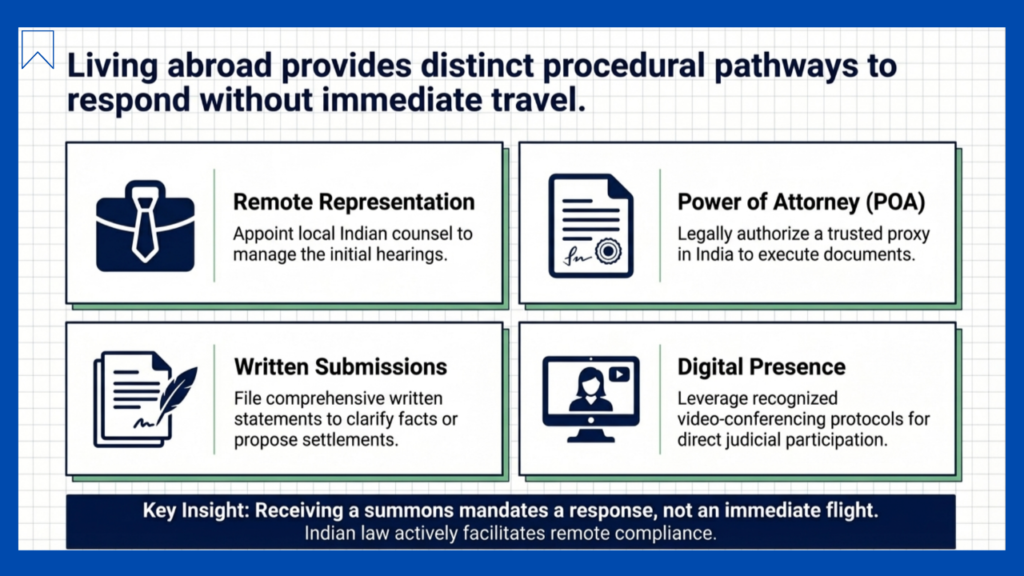
When an NRI receives a court summons from India, it does not mean that they must immediately travel to India. Indian law provides several practical ways to respond and participate in the case while living abroad.
Below are the main methods through which NRIs can respond to court summons:
- Appointing a lawyer in India: The most common and practical step is to appoint a lawyer in India. A lawyer can represent the NRI before the court and handle the legal proceedings on their behalf. In many civil cases, the personal presence of an NRI is not required if a lawyer is representing them.
- Granting the power of attorney: NRIs can authorize trusted persons in India, such as a family member or close relative, through a power of attorney. This person can sign legal documents, communicate with a lawyer, and attend court proceedings when necessary. Usually, the POA must be signed abroad and attested by the Embassy of India or a consulate in that country.
- Filling a written reply or written statement: After receiving the summons, the NRI must file a written reply to the court through their lawyer. The reply can clarify facts, deny allegations or propose settlement options.
- Seeking exemption from personal appearance: NRIs can request the court to excuse them from personally appearing if travelling to India is difficult. The lawyer can file an application requesting exemption, explaining valid reasons such as living permanently abroad, work commitments, health or travel difficulties.
In Bhaskar Industries Ltd. V. Bhiwani Denim & Apparels Ltd. (2001), the Supreme Court of India stated that courts may allow the accused to appear through a lawyer and grant exemption from personal appearance when justified.
- Participation through video conferencing:
Indian courts allow participation in legal proceedings through video conference in many situations. This facility helps NRIs to attend hearings, give statements or record evidence without physically appearing in court.
How NRI can attend court hearing online:
Step 1: Application through a lawyer -The NRI’s lawyer files an application before the court requesting permission for video conferencing. The application must mention reasons such as residing abroad, travel difficulty, cost, etc.
Step 2: Court permission-The court considers the nature of the case, the stage of the proceeding, the genuineness of the request, etc. If the court is satisfied, then the court grants permission to attend the court through video conference.
Step 3: The NRI must provide details such as Email ID, contact details, and identity proof, like a passport, etc. The court verifies identity before hearing
Step 4: The court staff schedules a fixed date and time for the video conferencing and generates the link for the video
Step 5: The NRI has to join the video with a laptop/mobile with a proper camera and internet with a stable connection, clear audio and visuals.
The legality of video conferencing in court proceedings was firmly established by the Supreme Court of India in the landmark case State of Maharashtra v. Praful B. Desai (2003). In this case, the court held that recording evidence through video conferencing is legally valid and falls within the meaning of presence in court under the Code of Criminal Procedure 1973. The court observed that modern technology can be used to make the justice system more efficient and accessible. The judgment opened the door for witnesses and parties living abroad to participate in Indian court proceedings remotely.
What happens if NRIs ignore Summons?
If NRIs ignore a court summons, the court may take serious action such as:
- The court may proceed Ex-parte; meaning the case is decided without hearing the NRIs argument.
- A bailable or non-bailable warrant may be issued against the NRI in criminal cases.
- NRIs can be declared as a PO (proclaimed offender) if they ignore the summons.
- The court may pass an order affecting property or financial rights in India like confiscation of the property.
- In extreme situations, the court may initiate further legal action for non-compliance.
Can police arrest a person after summoning ?
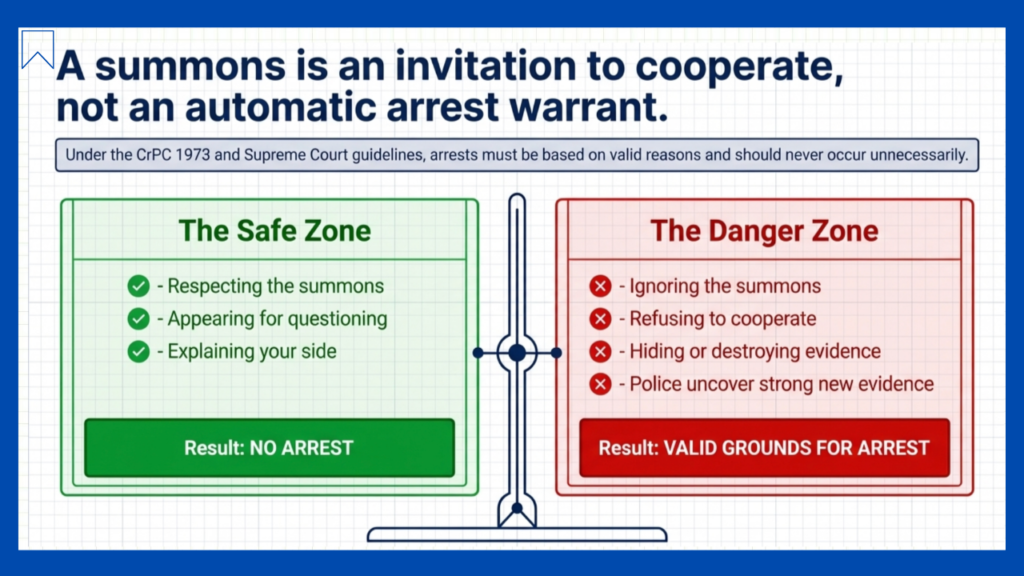
Yes, police can arrest a person even after sending summons, but it is not the first step and does not happen automatically. A summon is usually given to give a chance to cooperate without being arrested.
If you respect the summons and appear before the police, then you will be questioned, you can explain your side, therefore, no arrest is made in this situation. However, the arrest can be made in situations such as
- If you ignore the summons or don’t appear
- If you refuse to cooperate during questioning
- If you try to hide evidence or mislead the investigation
- If police find strong evidence that makes arrest necessary
The law under the code of criminal procedures 1973 and guidelines of supreme court of India clearly says:
- Police should not arrest unnecessarily
- Arrest must be based on valid reasons
Legal remedy for NRIs in case of improper service of the summons
NRIs have the right to challenge court proceedings, if the summons were not served correctly, following the legal procedure set by Hague service convention. In such cases, the NRI can prove that he/she never received any summons and can apply to set aside an Ex-parte order under the Code of Civil Procedure, 1908.
In the landmark judgement Yallawwa v. Shantavva (1997), the Supreme Court of India held that if the summons was not duly served, the Ex-parte decree must be set aside under (Order IX, Rule 13 of ) the Code of Civil Procedure, 1908.
For more legal information contact info@nrilegalworld.com
Comments are closed