
With the increase in cross-border marriages involving non-resident Indians (NRIs), disputes related to foreign divorce decrees have become frequent before Indian courts. Many spouses obtain a divorce from foreign courts, assuming that the decree will automatically be valid in India. However, under Indian law, a foreign divorce decree must satisfy legal requirements before it can be recognized or enforced in India.
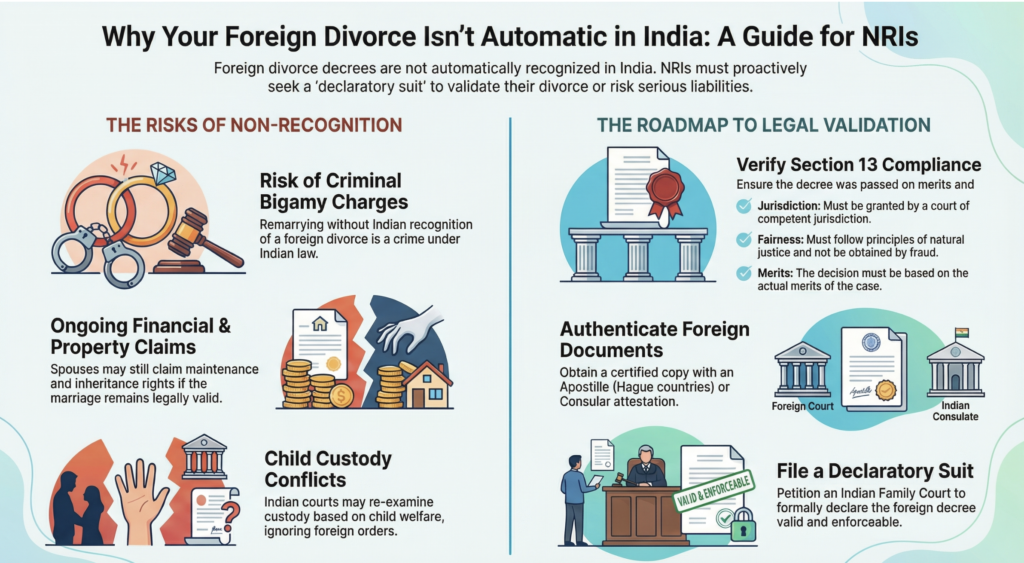
India does not have a separate statute dealing exclusively with foreign divorce. The validity of such decrees is determined primarily under Section 13 of the Code of Civil Procedure. A foreign judgment is not conclusive if:
- It is not given by a court of competent jurisdiction
- It is not given on the merits of the case
- It is based on an incorrect view of international law
- It violates principles of natural justice
- It is obtained by fraud
- It is contrary to Indian law or public policy
Therefore, registration of a foreign divorce decree in India depends on whether the decree satisfies these conditions or not.
A Foreign Divorce Decree Is Not Automatically Valid in India
Indian courts have repeatedly held that a foreign divorce decree is not automatically enforceable in India. The Supreme Court of India in Y Narasimha Rao vs. Y. Venkata Lakshmi (1991) held that:
- The foreign court must have proper jurisdiction
- Both parties must have participated in the proceedings
- The divorce must be granted on grounds recognized under Indian matrimonial law.
- The decree must be passed on merits
- It should not be an ex-parte decision
If these conditions are not fulfilled, the marriage may still be considered valid in India even though a divorce was granted abroad. This creates serious legal problems, such as:
- In case the NRI have remarried without recognising their foreign divorce decree in India, the second marriage can be challenged as bigamy is a crime in India.
- Maintenance can be claimed by the spouse in Indian courts as well.
- Property and inheritance disputes may arise in Indian jurisdiction.
- Child custody conflicts may arise.
What is meant by “Registration” of a foreign divorce decree?
In India, there is no formal registration mechanism, like in a government office set up by the authorities, to register the foreign divorce decrees in India. Many NRIs think that registering a foreign divorce in India is the same procedure as in registration of marriage. Foreign divorce decree must be recognised in Indian courts to make the decree legally effective in India. For this NRI couple or spouse should file a petition in Indian court. Indian courts pass the final ruling recognising the foreign divorce in accordance with Indian law.
The parties usually file a declaratory suit in India for registration of a foreign divorce decree to seek:
- Declaration that the foreign divorce decree is valid
- Execution of the foreign judgment
- Fresh divorce in India if the decree is found invalid in India
Complications when a foreign divorce decree is found Invalid in India
If a foreign decree is found invalid in India, the marriage may still be considered legally valid in India. It will lead to several legal and practical complications for NRIs, such as:
- Risk of Bigamy – The most serious consequence is that the NRI may remarry abroad, believing that the divorce is valid, but in India, the first marriage may still be considered valid. The Supreme Court of India in Y. Narasimha Rao vs. Y. Venkata Lakshmi case held that a foreign divorce decree not satisfying Indian law will not dissolve the marriage in India.
This may lead to:
- Criminal case for bigamy under the Indian Penal Code (IPC)
- Second marriage is void in India
- Issues in inheritance and succession
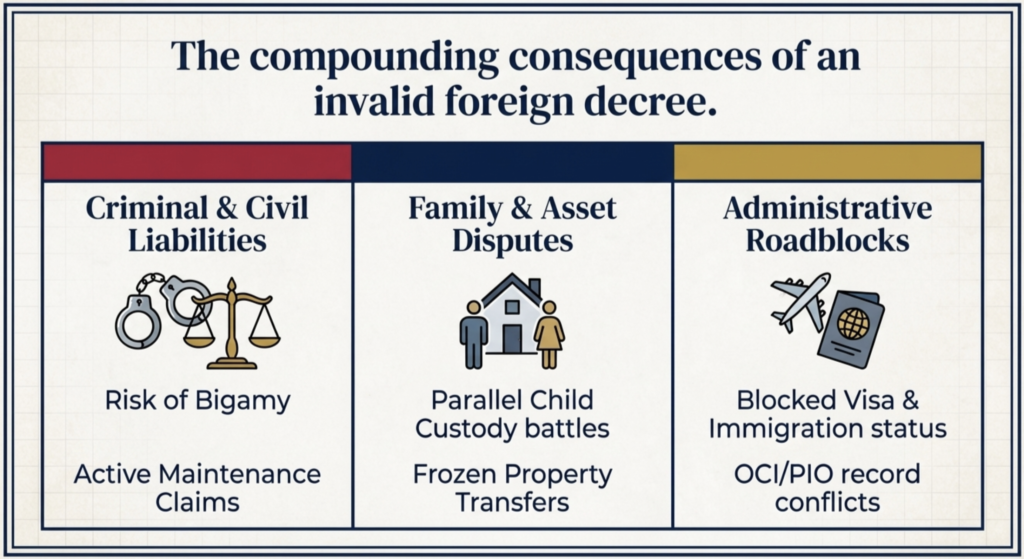
Thus, an NRI who remarries after an invalid foreign divorce may face both civil and criminal proceedings in India.
- Maintenance and alimony claims can continue in India – Even after obtaining a divorce abroad, the spouse in India may file or continue maintenance and alimony proceedings under the Hindu Marriage Act, Special Marriage Act, Section 125 of the CrPC (now section 144 of the BNSS), Domestic Violence Act, or Indian Divorce Act.
- Child custody and Guardianship disputes – Foreign courts often decide child custody along with divorce, but Indian courts may not accept such orders if the divorce itself is invalid. This can result in:
- Parallel custody proceedings
- Conflicting orders from two countries
- Difficulty in bringing the child to India
- Passport and visa complications may arise
Indian courts may re- examine the custody of the child based on the welfare of the child, even if a foreign court has already passed an order.
- Property and inheritance disputes – In many NRI cases, property located in India becomes subject to litigation because marital status is unclear, if a foreign divorce is not recognized in India:
- The wife/husband may still be treated as legally married in India
- Husband/wife cannot transfer a property freely
- Succession rights of the spouse may remain active
- Family disputes may arise
This is common when a divorce is granted abroad without the participation of the spouse living in India.
- Immigration and documentation problems – An invalid foreign divorce may cause issues in:
- Sponsoring a new spouse
- Visa applications
- Overseas Citizen of India (OCI)/ Person of Indian origin (PIO) records
- Passport marital status (Indian authorities may refuse to update the spouse details)
- Emotional and financial burden on NRIs – Apart from legal complications, NRIs also face emotional and financial burden, such as:
- Long-distance litigation
- High legal expenses in two countries
- Repeated travel to India
- Delay in remarriage or settlement
- Stress due to multiple proceedings
In the case of Neeraja Saraph v. Jayant Saraph, the Supreme Court of India has recognized the difficulties faced in NRI marriages and emphasized the need to protect spouses from unfair foreign divorce decrees.
Procedure for Recognition and Registration of a Foreign Divorce Decree in India
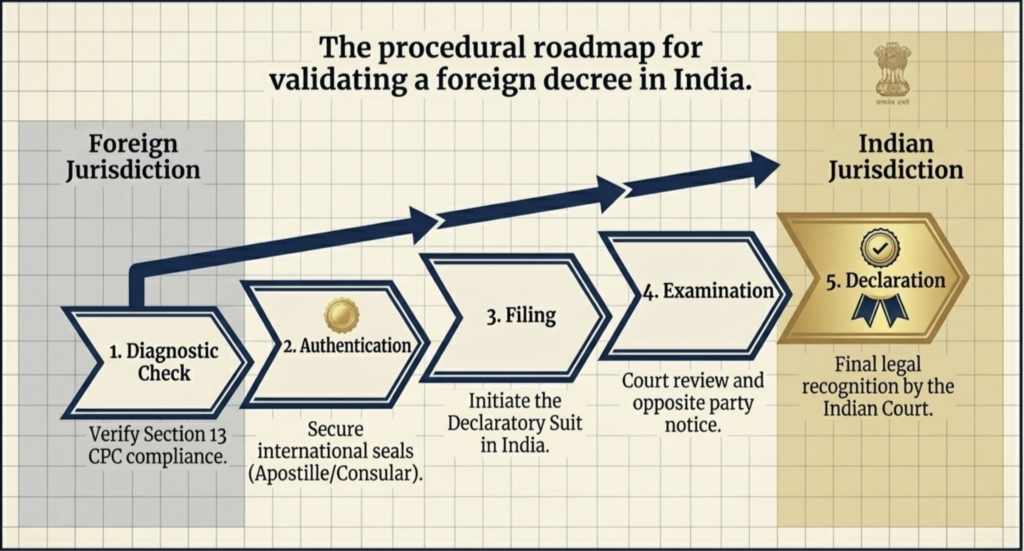
In India, there is no direct registration mechanism for foreign divorce decree. But the decree must be recognized by an Indian court before it can have legal effect in India (for example for remarriage, property disputes, maintenance claims, and child custody). The recognition mainly depends on section 13 of the Code of Civil Procedure, 1908.
To get the foreign divorce decree recognized and registered in India, following steps should be followed:
- Check validity – Before filing anything, it is important to verify whether the foreign decree satisfies the conditions of Section 13 of the Code of Civil Procedure (CPC). A foreign divorce will be valid in India only if:
- The foreign court had competent jurisdiction
- Decree was given on merits
- Both parties were given fair opportunity (principle of natural justice)
- Grounds of divorce are recognized under Indian law
- Decree was not obtained by fraud
- Decree is not against Indian public policy
- Obtain a Certified Copy of the Foreign Divorce decree – the spouse must obtain the:
- Certified copy of the divorce decree/judgment from the foreign court
- Apostille or consular attestation of that copy
- If the country is a member of the Hague Convention, then only an apostille stamp is needed, it is a simplified form of authentication accepted internationally
- If the country is not a member of the Hague Convention, then a consular attestation of documents is needed from the foreign country’s authorities and the Indian embassy of that foreign country
- Proof that the decree is final and valid in that foreign country
These documents are required to prove authenticity before an Indian court.
- File a petition/ declaratory suit in an Indian court – There is no direct registration for foreign divorce, the parties must file a case in the family court or district court seeking:
- Declaration that the foreign divorce decree is valid
- Recognition or enforcement of the decree
- Submit required documents – The following documents are generally required:
- Certified copy of foreign divorce decree
- Copy of pleadings (petition, written statements, evidence if available)
- Proof of service of notice to the other spouse
- Copy of Marriage certificate
- Identity and address proof of parties
- Proof that the decree is final (appeal is not pending)
Documents must be apostilled (if from a Hague Convention country) or notarised (if not).
- Court examination – The Indian court will examine:
- Whether the foreign decree satisfies the conditions of section 13 of CPC
- Whether both parties participated
- Whether the grounds for divorce match with Indian law or not
- Whether it violates the Indian matrimonial law or not
- Whether the divorce was mutual or contested
- Notice to the opposite party – court issues notice to the other spouse, they can either:
- Accept the decree or
- Challenge its validity
- Evidence and hearing – Parties may need to submit the evidence, such as foreign court records, proof of consent or participation of the other spouse, proof of residence, etc., in the Indian court. An Indian court may conduct detailed hearings in the case of a contested divorce.
- Declaration by the Indian court – If satisfied, the court will declare the foreign divorce decree valid and enforceable in India. Only after this, the foreign divorce decree will be legally recognized in India for remarriage, property rights, maintenance issues, etc.
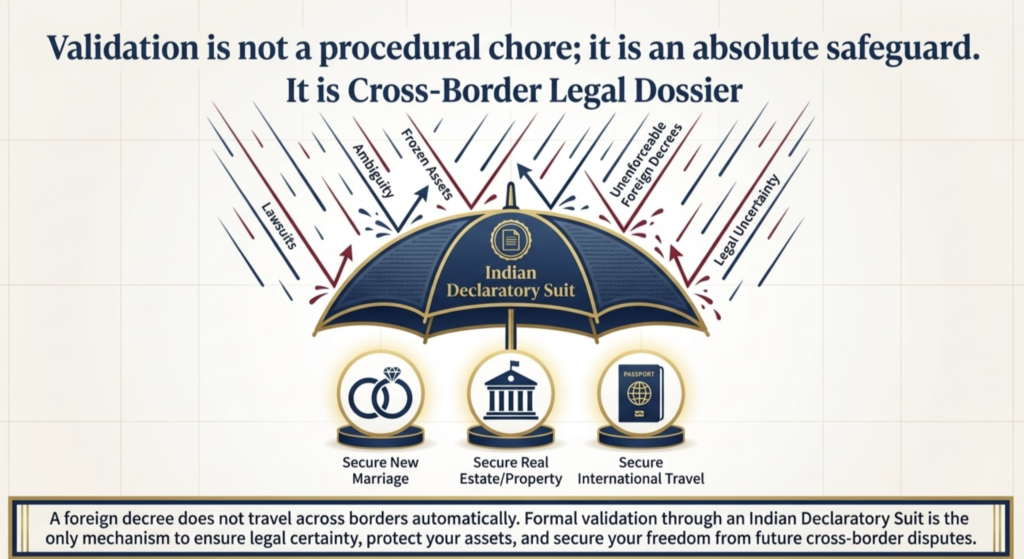
A foreign divorce decree, though valid in another country, does not automatically hold legal value in India. Its recognition depends on compliance with Indian legal principles, especially fairness, jurisdiction and alignment with domestic matrimonial laws. In the absence of proper recognition, parties may face serious legal, financial, and personal consequences. Therefore, seeking validation of a foreign divorce decree through Indian courts is not merely a procedural step, but a necessary safeguard to ensure legal certainty, protect rights and avoid future disputes.
This blog is for information purposes only. It is advised to seek professional legal guidance regarding your case before making any decision. For more information contact us : info@nrilegalworld.com / +91 9709692096
Frequently asked questions
Q.) How long does it take to get a foreign divorce decree recognized in India?
Ans.) The time varies, depending on whether the matter is contested or mutual. It is easier to get a foreign divorce decree recognized in mutual consent divorces but it may take longer in disputed or contested divorce cases.
Q.) What happens if a foreign divorce decree is not recognized in India?
Ans.) If a foreign divorce decree is not recognized in India or found invalid in India, the marriage will be considered still legally valid in India. This can lead to issues such as bigamy (if remarried), the spouse can claim maintenance, property disputes and child custody conflicts may arise.
Q.) Is a foreign divorce automatically valid in India?
Ans.) No, a foreign divorce is not automatically valid in India. It must satisfy the conditions laid down under Indian law, especially under section 13 of the Code of Civil Procedure. If the foreign divorce does not satisfy the conditions laid down under section 13 of CPC, the divorce will be considered invalid in India and the marriage will be considered still legally valid in India.
Q.) Is there a formal registration process for foreign divorce decrees in India?
Ans.) No, India does not have a direct registration mechanism for the registration of foreign divorce decrees in India but the decree must be recognized or declared valid by a competent Indian court through legal proceedings. It is necessary to get the foreign divorce decree recognized in India to avoid any legal disputes in future.
Q.) Can a spouse claim maintenance in India after a foreign divorce?
Ans.) Yes, a spouse can claim maintenance in India even after a foreign divorce, but it depends on whether the divorce is recognized under Indian law.
- If the foreign divorce is not recognized in India: The marriage is still considered legally valid in India and the spouse has a full right to claim maintenance under Indian laws.
- If the foreign divorce is valid and recognized in India: Even then, maintenance can still be claimed if –
- No maintenance was granted to the spouse by the foreign court
- The amount granted is inadequate or unfair
- The spouse is unable to maintain themselves
However, if the foreign court has already provided fair and reasonable, Indian courts may take that into account and adjust or deny further claims to avoid duplication.
Q.) Will Indian courts accept child custody orders passed by foreign courts?
Ans.) Indian courts may consider child custody orders passed by foreign courts, but they are not bound to accept them automatically. If the order violates principles of natural justice or Indian law, it may be rejected. The paramount consideration for Indian courts is always the welfare and best interests of the child. Even if a foreign court has already decided custody, an Indian court can:
- Re-examine the entire matter
- Pass a different order if it feels the child’s welfare requires it.