
For many Non-Resident Indians (NRIs), dealing with a legal dispute in India can be far more challenging than the dispute itself. Living overseas often means balancing employment commitments, immigration obligations, family responsibilities, and financial considerations, making it impractical to travel to India for every court hearing.
Fortunately, Indian law provides several mechanisms that allow NRIs to effectively manage civil and criminal proceedings without requiring their physical presence at every hearing. However, these relaxations are subject to legal provisions and the discretion of the court, and failure to comply with court directions can have serious consequences.
Understanding your rights and obligations while litigation is pending is essential to ensuring that your case progresses smoothly without exposing you to unnecessary legal complications.
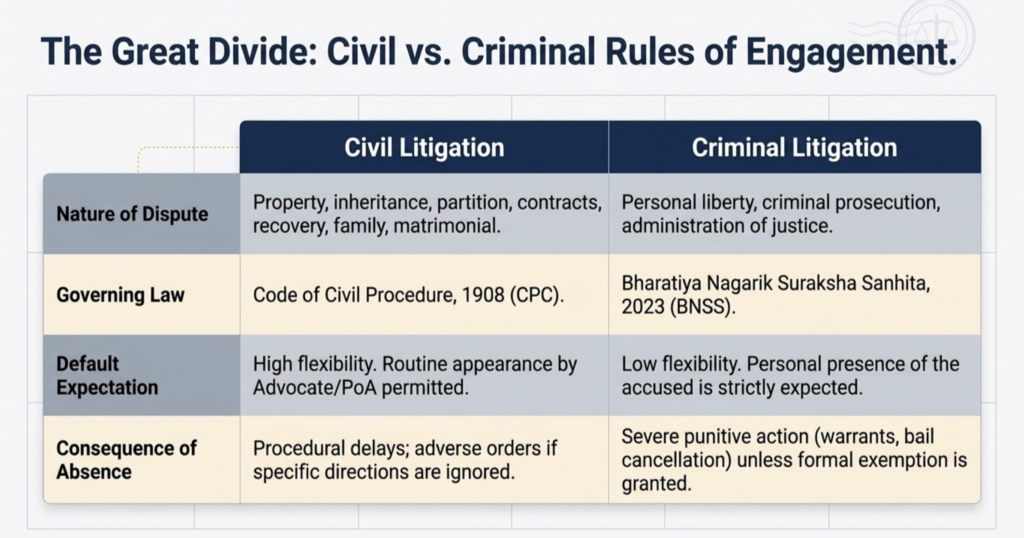
Civil disputes generally involve matters such as property disputes, inheritance claims, partition suits, contractual disputes, recovery of money, family settlements, specific performance of agreements, and matrimonial proceedings. Unlike criminal cases, civil litigation generally offers greater flexibility to parties residing outside India.
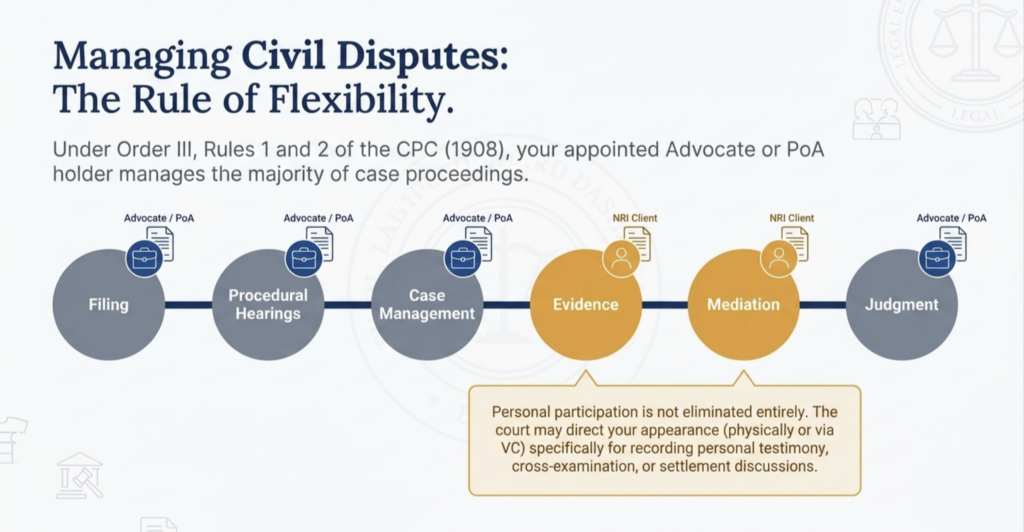
Under Order III, Rules 1 and 2 of the Code of Civil Procedure, 1908 (CPC), a party may authorize a recognized agent or a duly appointed Power of Attorney holder to act on their behalf in legal proceedings. For NRIs, this is the most practical way to manage litigation while continuing to reside overseas. A validly executed Power of Attorney enables the authorized representative to coordinate with advocates, file pleadings where legally permissible, submit documents, obtain certified copies, receive court notices, and perform several procedural acts necessary for conducting the case.
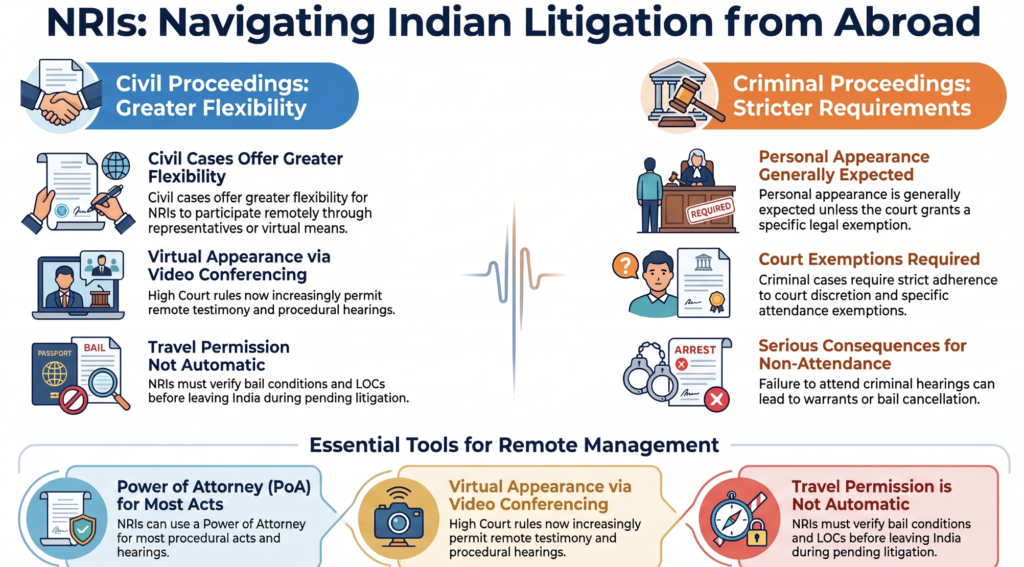
However, appointing a Power of Attorney does not completely eliminate the need for personal participation. Where the court considers personal testimony necessary, or where the party is required to appear for evidence, cross-examination, mediation, settlement discussions or any other stage where personal appearance is specifically directed, the court may require the individual to appear. Depending upon the nature of the proceedings and the applicable court rules, such an appearance may sometimes be permitted through video conferencing.
Managing Criminal Proceedings While Living Overseas
Criminal cases require a different approach because they directly involve the administration of criminal justice and, in many cases, the personal liberty of the accused. If an NRI is facing criminal prosecution in India, the court generally expects the accused to remain available throughout the proceedings.
However, Indian criminal procedure also recognises that insisting upon physical appearance on every hearing may cause unnecessary hardship, particularly where the accused resides permanently outside India and is cooperating with the judicial process. The Bharatiya Nagarik Suraksha Sanhita, 2023 (BNSS), provides the court with the discretion to exempt an accused from personal appearance in appropriate cases.
Under Section 205 of the BNSS, the magistrate may dispense with the personal attendance of the accused and permit appearance through an advocate where the circumstances justify such relief. Similarly, Section 355 of the BNSS empowers the court to proceed with certain stages of the trial in the absence of the accused where the court considers it appropriate, and the interests of justice are not prejudiced.
These provisions do not create an automatic right to remain absent. The court exercises its discretion after considering factors such as the seriousness of the allegations, the conduct of the accused, the stage of the proceedings, whether identity is disputed, and whether personal appearance is genuinely necessary.
Personal Appearance During Court Proceedings
One of the most common misconceptions among NRIs is that appointing an advocate allows them to remain absent throughout the case. In reality, the requirement of personal appearance depends upon the nature of the proceedings and the specific directions issued by the court. In civil litigation, advocates routinely appear on behalf of their clients during procedural hearings, case management hearings, and adjournments. Personal appearance is generally required only when the court specifically directs it or when the party’s evidence is to be recorded.
In civil litigation, advocates routinely appear on behalf of their clients during procedural hearings, case management hearings, and adjournments. Personal appearance is generally required only when the court specifically directs it or when the party’s evidence is to be recorded.
In criminal proceedings, the accused should never assume that attendance is optional. Unless the court has granted an exemption from personal appearance or permitted representation through counsel, failure to attend scheduled hearings may result in adverse legal consequences. Whenever attendance becomes difficult due to residence abroad or unavoidable circumstances, an appropriate application seeking exemption should be filed before the concerned court instead of simply remaining absent.
Foreign Travel During Pending Court Proceedings
The mere pendency of a civil or criminal case does not automatically prevent an individual from travelling outside India. There is no general rule prohibiting international travel simply because litigation is pending. However, travel restrictions may arise where the court has imposed specific conditions.
This commonly occurs in criminal proceedings where an accused has been granted bail, subject to conditions that restrict foreign travel. In some cases, the court may require prior permission before the accused leaves India, direct the deposit of the passport, or impose other conditions to ensure the accused’s presence during trial.
Similarly, if a Look Out Circular (LOC) has been issued or any judicial order specifically restrains international travel, the individual must comply with those directions before leaving the country. Accordingly, every NRI involved in litigation should carefully review the orders passed by the court and obtain appropriate legal advice before making travel arrangements.
Tip: NRI can take the permission of the court to travel abroad.
Consequences of Leaving India Without the Court’s Permission
Leaving India without obtaining the court’s permission, where such permission is legally required, can have serious consequences. The nature of the consequences depends upon the facts of the case, the conditions imposed by the court, and the conduct of the individual. In criminal matters, violation of bail conditions may result in cancellation of bail, issuance of bailable or non-bailable warrants, forfeiture of bail bonds, and initiation of further coercive proceedings to secure the accused’s presence.
In appropriate cases, the court may also initiate proceedings for declaring the accused a proclaimed offender in accordance with the applicable legal provisions. Where an individual repeatedly ignores court directions or deliberately avoids the proceedings, the court may draw an adverse inference regarding the person’s conduct, making it significantly more difficult to obtain favourable discretionary relief in future applications.
If a Look Out Circular has been issued, travelling internationally without resolving the underlying legal restrictions may also lead to difficulties upon arrival or departure from India.
Participation in court hearings through the Video Conferencing
The increasing use of technology in Indian courts has significantly improved access to justice for NRIs. Following the expansion of virtual court proceedings, many courts now permit hearings through video conferencing for appropriate matters, subject to the applicable High Court Rules and the discretion of the concerned judge.
Video conferencing can be particularly useful for procedural hearings, case management conferences, certain interlocutory applications, and, in appropriate circumstances, recording evidence. However, virtual appearance is not available in every matter. The court may still require physical presence where the nature of the proceedings, recording of evidence, identification of parties, or the interests of justice make personal attendance necessary.
NRIs should therefore consult their legal counsel regarding the availability of virtual appearance in their particular case rather than assuming that every hearing can be attended remotely.
Role of a Power of Attorney in Litigation
A properly executed Power of Attorney is one of the most valuable legal instruments available to NRIs managing litigation from abroad. It enables an authorized representative in India to handle numerous procedural and administrative aspects of the case without requiring the NRI to travel frequently.
The scope of authority depends upon the terms of the Power of Attorney and may include engaging advocates, signing pleadings where legally permissible, filing applications, obtaining certified copies of court records, receiving notices, producing documents, coordinating with government authorities, and managing day-to-day litigation requirements.
Where the Power of Attorney is executed outside India, it should be duly notarized or authenticated in accordance with the applicable legal requirements and, where necessary, adjudicated or stamped in India before being relied upon in legal proceedings.
It is important to understand that a Power of Attorney cannot substitute personal appearance where the law specifically requires the party or accused to be present before the court.
Practical Considerations for NRIs Managing Litigation from Abroad
Successfully managing litigation from abroad requires proactive legal planning rather than responding only when problems arise. NRIs should ensure that they appoint competent legal counsel at the earliest opportunity, execute a properly drafted Power of Attorney wherever appropriate, remain informed about every hearing date, preserve regular communication with their advocate, and immediately comply with all court directions.
Before travelling outside India during the pendency of criminal proceedings, it is essential to verify whether any bail condition, judicial direction, or travel restriction applies. Any necessary permission should be obtained well in advance rather than after travel arrangements have been made.
Timely compliance with procedural requirements not only reduces the risk of adverse orders but also demonstrates good faith before the court, which often becomes relevant while considering applications seeking exemption or other discretionary relief.
For more information contact NRI Legal World: info@nrilegalworld.com / +919709692096
Frequently Asked Questions
Q.) Can an NRI attend court hearings through a lawyer instead of appearing personally?
Ans.) Yes, in civil matters, advocates routinely represent their clients, and a Power of Attorney holder may also perform certain authorized acts. In criminal matters, personal appearance may be exempted by the court in appropriate cases, but this is subject to judicial discretion and the facts of the case.
Q.) Is it necessary for an NRI to travel to India for every hearing?
Ans.) No, a routine hearing can often be attended by your advocate. However, if the court specifically directs your personal appearance, records your evidence, or requires your presence at a particular stage of the proceedings, you must comply unless the court grants an exemption.
Q.) Can an NRI leave India while a court case is pending?
Ans.) Yes, provided there is no court order or bail condition restricting foreign travel. If the court has directed that prior permission is required before leaving India, you must obtain such permission before travelling.
Q.) What happens if an NRI misses a court hearing?
Ans.) The consequences depend on the nature of the case and the reason for absence. In civil cases, the court may proceed in your absence or pass other procedural orders. In criminal cases, repeated or unexplained absence may lead to warrants, cancellation of bail, or other legal consequences.
Q.) Can a criminal case in India be handled entirely without coming to India?
Ans.) Not always, while courts may exempt personal appearance for certain hearings, there may be stages of the proceedings where the accused is required to appear personally. Whether such an exemption is granted depends on the facts of the case and the court’s discretion.
Q.) What should an NRI do before travelling abroad during the pendency of a criminal case?
Ans.) Before leaving India, the individual should verify whether any bail condition, court order, or travel restriction requires prior permission. Consulting an advocate and obtaining the necessary approval in advance can help avoid legal complications in future.