
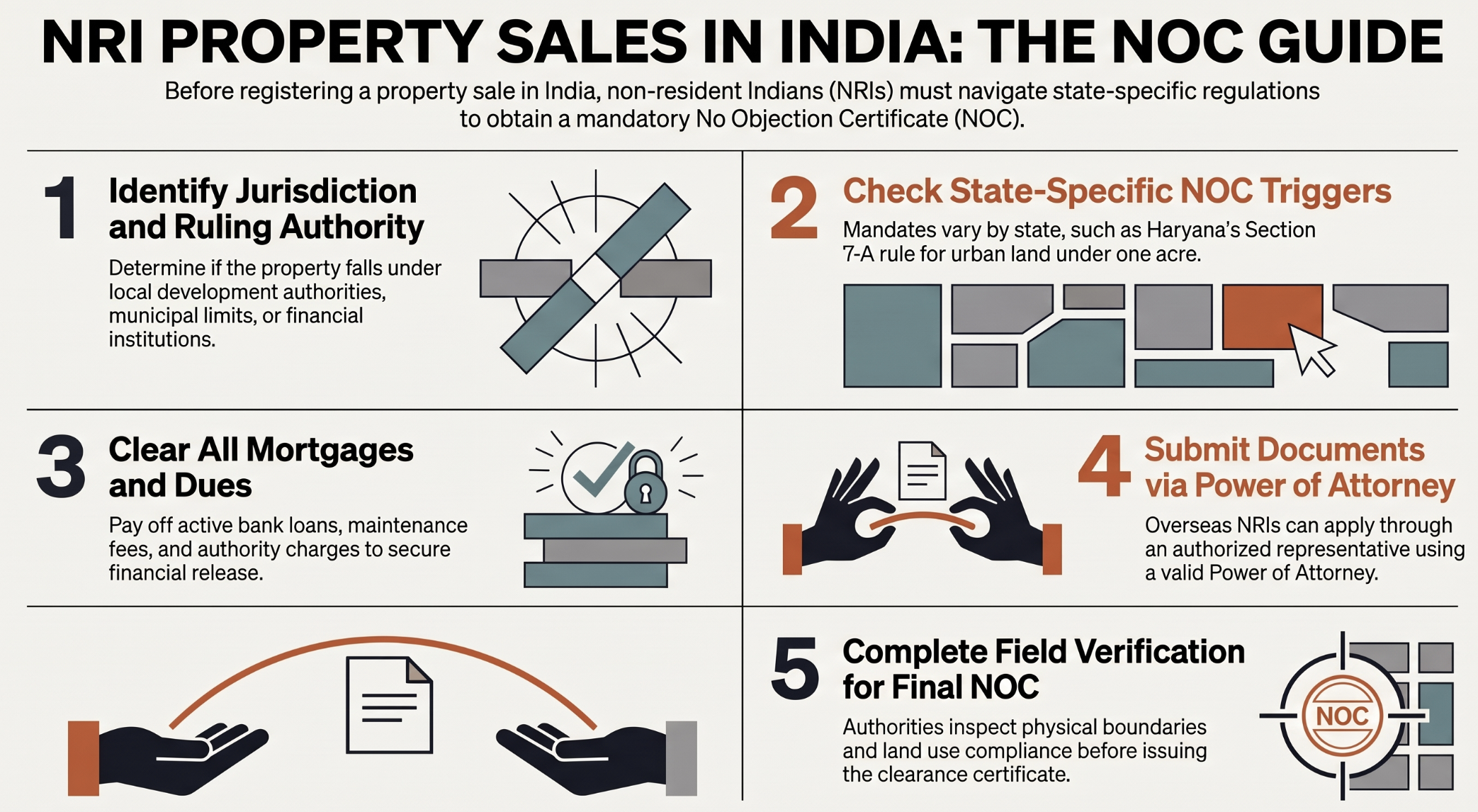
Buying and selling immovable property in Punjab, Haryana or Chandigarh is not merely of executing a sale deed and presenting it before the Sub Registrar. Depending upon the location and legal status of the property, the transaction may also require a few approval, permission, clearance or a No Objection Certificate (NOC) from the competent planning development or estate authority before selling it. No-objection certificate is mandatorily required in relation to urban properties, properties situated in controlled or notified areas, agricultural land falling within urban areas plots in colonies, leasehold properties and properties governed by development authorities. However, an important point must be kept in mind that there is no blanket rule for NOC for each state in India. Thus each state may have their own set of rules for NOC requirements for owners while selling the property. The applicable requirement must be determined by examining the property and the law applicable to that particular property.
NOC (No Objection Certificate) is a permission issued by the competent government authority confirming that subject to the applicable conditions, it has no objection to the proposed transfer/ registration of the property. An NOC may be required for different reasons.
For example, an NOC requirement is usually related to urban planning, unauthorised colonies, land use restrictions, controlled areas, agricultural land restrictions, development authority requirements, municipal requirements, conversion/change of land use, restricted tenure, and other state specific restrictions. In many cases, the NOC is required because of the property and its location, while the seller happens to be an NRI.
When is an NOC Actually Required for an NRI to sell property in India?
a) When the property is mortgaged to a bank:
One of the most common situations in which an NRI seller may need a clearance from another party is where the property is subject to a home loan, mortgage, charge or other security interest. A bank or financial institution having a mortgage over the property has an interest that must be dealt with before the property can be transferred free from that charge. Depending upon the circumstances, the bank may issue documents such as:
- No Objection Certificate
- Loan closure letter.
- Release letter,
- Discharge of mortgage
- Other documents confirming that the lender’s interest has been satisfied or released.
b) When the Property is leasehold or subject to Transfer Restrictions:
An NRI may own property that was allotted or granted on a leasehold basis by a development authority, housing authority or another governmental/statutory body. The original lease deed, allotment letter or applicable regulations may contain conditions relating to transfer or sale. In such circumstances, the concerned authority may require prior permission, transfer permission NOC, or compliance with specified transfer conditions.
c) When the property is subject to a court order or Attachment: If a property is affected by a court order, attachment injunction or other legal restriction, the seller cannot assume that the property can be freely transferred merely because he or she is the registered owner. Depending upon the nature of the order, permission or appropriate relief from the concerned court or authority may be necessary before the transaction can proceed.
d) When state governments have issued notification to make it NOC mandatory for selling the property located in urban areas. For instance, Haryana has made it mandatory to obtain NOC from local District Town planner authority in case the property is less than one acre and is classified as urban area properties. In the same manner Punjab and Chandigarh have their own set of rules for NOC requirement for selling the property falling under urban jurisdiction. The main objective behind the mandatory NOC condition, as given by the authorities, is to snub the possibility of unauthorised urban growth i.e illegal colonies.
NOC requirement in Punjab: GMADA, Municipal Limits and Property status.
The abbreviation/short form for Greater Mohali Area Development Authority is GMADA.
In Punjab, the requirement of a No Objection Certificate (NOC) for sale or registration of property depends upon the authority and planning framework under which the property falls.
Properties falling under the applicable GMADA framework, jurisdiction, the applicable rules require the permission for sale or transfer of property, the owner may be required to obtain the No-objection Certificate from GMADA before registration of the sale deed. GMADA provides a specific service for obtaining permission for sale, gift or transfer of property.
Where the property is situated within the Municipal Corporation rather than the applicable GMADA property/colony framework, a GMADA NOC is not required merely for the sale of that property. The NOC requirements are different for each and every state in India, Urban development authorities of States and Municipal Authorities in cities. Hence, it is advised to NRIs to seek professional help before deciding on NOC requirements.
Process of obtaining NOC for selling the property in India
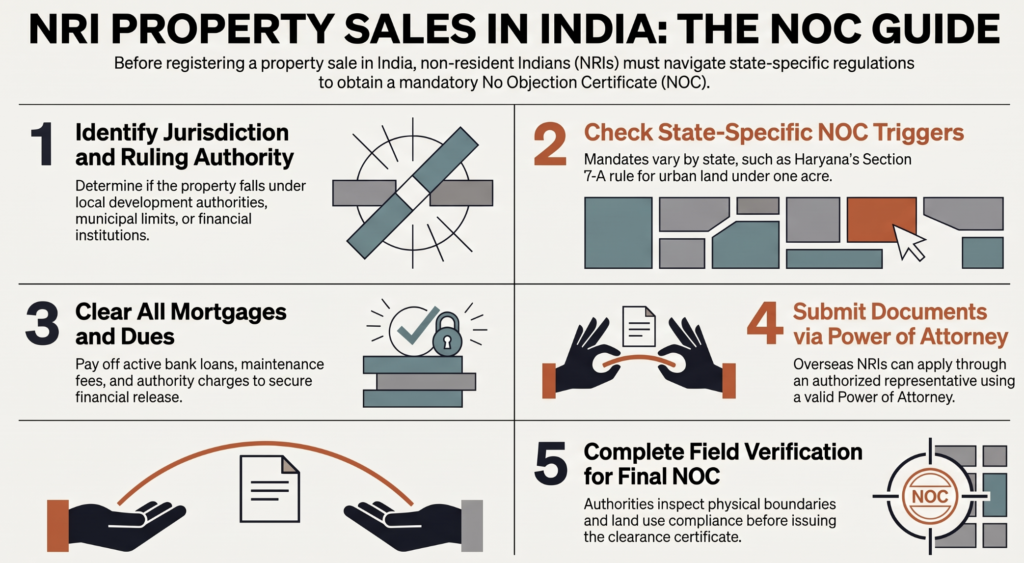
- Identify the authority having Jurisdiction: The first step is to identify who controls or administers the property depending upon the property, the concerned authority GMADA or another development authority, PUDA/ concerned estate office, Municipal authority, Cooperative housing society, Bank or financial institution, where the property is mortgaged or another competent authority under the applicable law.
- Prepare the Application: For a development authority property, the seller normally has to submit the prescribed application for sale/transfer permission or NOC.
- Clear outstanding dues or Encumbrances: Before the NOC or sale permission is issued; the authority may require outstanding dues to be cleared. These may include authority dues, maintenance charges, extension fees, transfer fees, property related dues, mortgage/loan dues or other charges applicable to the property. Whether the Property is mortgaged, the bank’s Loan/mortgage clearance may be required. GMADA’s published checklist expressly refers to clearance against loan/mortgage where applicable.
- Submit the Application to the concerned Authority: The completed application and supporting documents are submitted to the relevant authority in the manner prescribed for that property. For properties falling under the Punjab Housing and Urban Development framework, the published right to service information identifies the Superintendent of the concerned authority as the designated officer at the first level for NOC/transfer services, with escalation to the estate officer and Additional Chief Administrator at subsequent levels.
- Field Verification/Site Inspection: After submission of the application, the concerned authority may conduct field verification/site Inspection of the property before granting the NOC or permission for sale/transfer. During the Verification, the concerned officials may check the actual location and area of the property, dimensions/boundaries, land use existing construction or development, possession, encroachment and other relevant particulars and compare them with the records and documents submitted by the applicant. Any discrepancy in the actual area or physical status of the property may be required to be clarified or rectified before the NOC/permission is issued.
- Payment of applicable Fees: The seller may have to pay applicable processing fee, transfer fee, extension fee, other authority charges and applicable statutory charges depending on the state and authority requirements.
NOC for selling the property in Haryana- Section 7A is particularly important to know
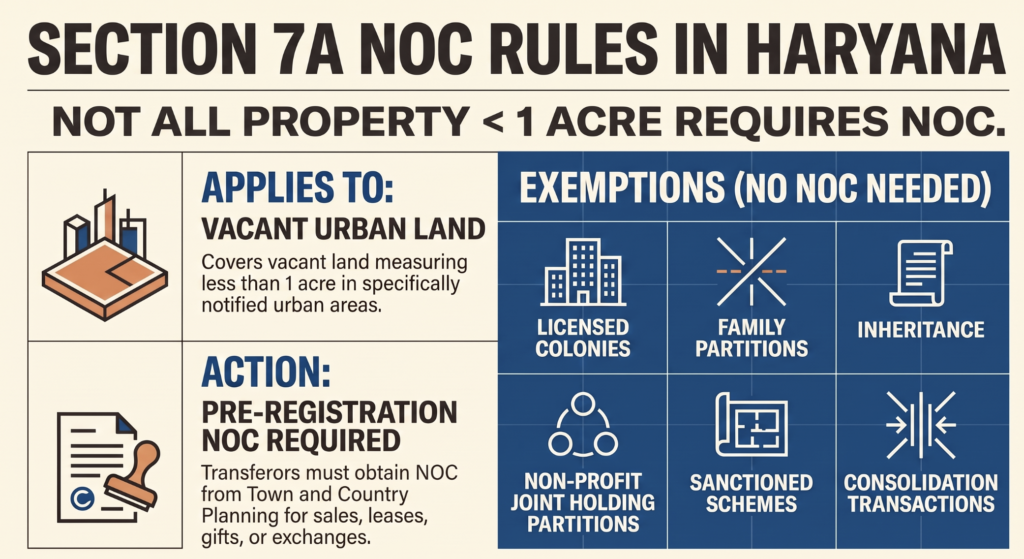
In Haryana the requirement of an NOC before registration is governed particularly by Section 7-A of the Haryana Development and Regulation of Urban Areas Act, 1975. The provision applies to certain transactions involving vacant land measuring less than One acre situated in an urban area specifically notified by the Haryana government for the purposes of Section 7-A. The provision requires the transferor to produce an NOC issued by the Director, Town and Country planning, or an authorised officer, before the Registration Officer can register the document. The present framework covers sale, lease and gift transactions and has been expanded to address exchange transactions. However, Section 7-A itself contains important exemptions, including licensed colonies, family partition, inheritance, succession, partition of joint holdings without a profit motive, sanctioned schemes and specifies consolidation transactions. Therefore, it is incorrect to state that every property below one acre in Haryana requires an NOC. The exact requirement depends upon the nature of the land, its location in a notified urban area, the nature of the proposed transaction and the applicable exemption.
Other blog: https://nrilegalworld.com/a-legal-guide-on-suit-of-specific-performance-of-contracts-in-india-by-nris/
NOC requirement for Property in Chandigarh
In Chandigarh, the requirement of a No Objection Certificate depends upon the authority under which the property was originally allotted or registered. Properties may, for example, fall under the Changigarh Estate Office, Chandigarh Housing Board or a private developer, and the applicable transfer requirements can therefore differ. For a property falling under the Chandigarh Estate Office, an NOC is typically required for transfer of the property. In the case of properties originally allotted by the Chandigarh Estate Office, the material specifically states that the NOC from the Chandigarh Estate office is required before the sale deed can be registered.
The NOC process involves verification by the Estate Office. According to the material, the authority verifies matters such as outstanding dues, encumbrances and compliance with the applicable lease conditions before issuing the NOC. Therefore, for an Estate Office property, a seller should not wait until the last stage of the transaction to check the NOC requirement. The NOC should be considered as part of the transfer process before registration of the sale deed.
Process for obtaining NOC or required clearances for NRIs selling their property in India
- Identify the correct state and authority: First thing for NRIs is to identify the state as well as the city where the property is located. Once the requirement is identified, the NRI should approach the authority or institution that has imposed the restriction. For Example: Bank/ Financial Institution where the property is mortgaged, the seller should contact the lender and request the applicable NOC, loan closure document or release/ discharge of mortgage. NRI can always refer to the official masterplan of the city to know the development zone of the area where the property is located.
- Prepare the documents: The exact documents vary according to the authority. An NRI seller may be asked to provide documents such as Passport, Proof of NRI/OCI status, where applicable, PAN, Proof of address, Title deed/sale deed previous title documents or chain of ownership, allotment letter or lease deed, where applicable, any additional document prescribed by the concerned authority.
- Submit the Application: The NRI or the authorised representative may submit the application to the concerned authority in the manner prescribed by that authority. NRI can obtain NOC for selling their land while sitting abroad by using the Power of Attorney to a reliable and trustworthy relative, friend or legal counsellor.
- Verification by the Authorities: The concerned authority may verify ownership, identity of the applicant, title documents, outstanding dues, mortgage or charge, compliance with allotment /lease conditions. and other statutory requirements.
- Field Verification of the Property: Where required, the concerned authority may carry out a field inspection of the property to verify the particulars provided in the application and supporting documents. During such verification, the authority may check the location, total area, measurements and boundaries of the property, as well as its existing condition, construction, land use and possession. The physical details may be crosschecked with the relevant official records. If any variation or discrepancy is found, the applicant may be required to provide clarification or additional documents before the NOC or clearance is issued.
- Payment of Outstanding Dues if applicable: If there are outstanding loan amounts, property taxes, maintenance charges, lease charges, transfer fees, development authority dues or other statutory or contractual amounts. The concerned authority may require these to be cleared before issuing the relevant NOC or permission.
- Obtain the NOC/Permission/Release Document: If the authority is satisfied that the requirements have been fulfilled, it may issue the appropriate document. The document could be called NOC, transfer permission, permission to sell, release letter, discharge certificate, mortgage release, no dues certificate or another form of clearance.
- Proceed with the Sale and Registration: Once all necessary permission and clearance have been obtained, the parties can proceed with the sale documentation and registration in accordance with the applicable law.
It is an important administrative step for NRI/ OCI or resident property owners to obtain NOC before selling their property situated in urban areas. If you need more information on the subject you can contact NRI Legal World: info@nrilegalworld.com / +919709692096 /https://nrilegalworld.com/contact-us/
Read more Blogs: https://nrilegalworld.com/blog/
FAQs:
Q1. Does FEMA specifically mention NOC for an NRI selling property?
Ans. No FEMA does not specifically require every NRI to obtain an NOC before selling property in India. The FEMA framework regulates the acquisition and transfer of immovable property by persons resident outside India and identifies circumstances in which a transfer is permitted or requires prior RBI permission. An NOC is not a blanket FEMA requirement; it may arise from a separate source, such as a bank mortgage, any note from the investigating agency, development-authority rules, lease conditions, society regulations or applicable state law. Therefore, an NRI property sale should not be described as requiring an “RBI NOC unless a specific FEMA provision or applicable RBI direction actually requires prior RBI permission.
Q2. Is an NOC required before selling the property if the property is mortgaged?
Ans. A bank or financial institution’s clearance may be required if the property is mortgaged. The lender may require repayment/closure of the loan and may issue a release, discharge, NOC or other document confirming that its charge has been dealt with. This is a bank related requirement, not an RBI NOC.
Q3. Does sale of agricultural land also require NOC from any authority?
Ans. Yes, sometimes there is a requirement of NOC depending upon the state revenue department regulations/ instructions. Sometimes, there is a bar to register agricultural land less than a specified minimum area, which is to avoid illegal development of residential colonies. In addition to this sometimes the land to be sold is already under supervision of some investigative agency like Enforcement Directorate for violation of FEMA regulations or some Court litigation.
Q4: Is there any requirement for NOC before selling land in Haryana?
Ans. An NOC is not required for every sale of land in haryana. The requirement depends on the location, nature and size of the property and the applicable planning laws. For example, under Section 7-A of the Haryana Development and Regulation of Urban Areas Act, 1975, an NOC may be required for registration of certain transfers of agricultural land measuring less than One acre situated in a notified urban area. The law also provides exemptions including where the land is situated in a licensed colony and the approved layout plan is submitted, or in cases such as inheritance, succession and certain family partitions.
Therefore, before selling a property, the owner should verify whether the particular property falls within the urban area or category for which an NOC or other planning approval is required.
Q5: How can an NRI obtain NOC for selling their property in Haryana?
Ans. An NRI can apply for the required NOC through the competent authority having jurisdiction over the property. In case of Haryana District Town Planner has the powers to issue NOC. If the NRI is unable to visit India, they may authorise a person in India through a properly executed Power of Attorney to complete the application and related formalities on their behalf.
Q6: Is there any requirement for NOC before selling land in Punjab, India?
Ans. In Punjab, the owner is required to obtain the No-objection Certificate from GMADA before registration of the sale deed. GMADA provides a specific service for obtaining permission for sale, gift or transfer of property, only if the property falls under the jurisdictional powers of PUDA. There are no area-wise or acre-wise conditions or notifications passed by PUDA so far, as like in Haryana. Along with this if the property is under the jurisdiction of local Municipal Authorities then District level Office ADC (Assistant Development Officer) will issue the NOC.
Q7: How to obtain NOC for selling the property in Punjab?
Ans. To obtain NOC the owner should approach the competent development authority or local authority having jurisdiction over that property, such as GMADA/PUDA or the concerned local urban body like Muncipality, depending on the location and nature of the property.
Q8. How can NRI obtain NOC for selling their property in India?
Ans. NOC requirement depends upon the state law, location, type of property and the authority controlling the property. An NRI should identify the relevant authority and confirm whether any NOC, permission or clearance is required. If physical presence in India is not convenient, the NRI can appoint a trusted person in India through a properly executed Power of Attorney to complete the relevant formalities.