
NRIs often enter into agreements related to property, investments, business transactions, or other contractual arrangements in India. Problems arise when the other party fails to honour the agreement. For example, when a seller refuses to execute a sale deed after receiving an advance, a developer fails to complete an agreed transaction, or a contractual party refuses to perform an obligation they specifically undertook.
In such situations, an NRI may be able to seek specific performance of the contract before an Indian court. Specific performance is a remedy under the Specific Relief Act, 1963, through which a court can direct the defaulting party to perform the contractual obligation, subject to the requirements of law.
For an NRI, this remedy can be particularly important because living outside India does not prevent the person from enforcing contractual rights in India. However, the NRI must carefully consider limitations, jurisdiction, the validity and terms of the agreement, readiness and willingness to perform their own obligations, FEMA and RBI regulations where applicable, and the procedural requirements for conducting litigation from abroad.
What is the Specific Performance of a Contract?
Specific performance is a legal remedy through which a court directs a party to perform the obligations that it agreed to perform under a valid contract. For example, suppose an NRI living in Canada enters into an agreement to purchase a house in Punjab for Rs.80 lakhs and pays Rs.10 lakhs as advance payment. The agreement requires the seller to execute the sale deed after receiving the remaining consideration. The seller later refuses to complete the transaction because another buyer is offering a higher price.
Instead of merely asking for return of the advance or monetary compensation, the NRI may, where legally permissible, seek specific performance and ask the court to direct the seller to complete the transaction in accordance with the agreement. The remedy is therefore concerned with requiring the defaulting party to perform the contract, rather than treating payment of money as the only possible remedy. So, in simple words, specific performance means enforcement of the contractual promise itself.
What Changed in the Law on Specific Performance in 2018?
One important change for anyone dealing with specific performance is the Specific Relief (Amendment) Act, 2018. This was a legislative amendment made by Parliament. The amendment substantially changed the earlier approach under the Specific Relief Act. Before the 2018 amendment, specific performance was generally treated as a discretionary remedy. Section 10 stated that specific performance could be enforced at the discretion of the court, while Section 20 in the act, specifically gave courts discretion to refuse specific performance in certain circumstances, even where the contract was otherwise legally enforceable.
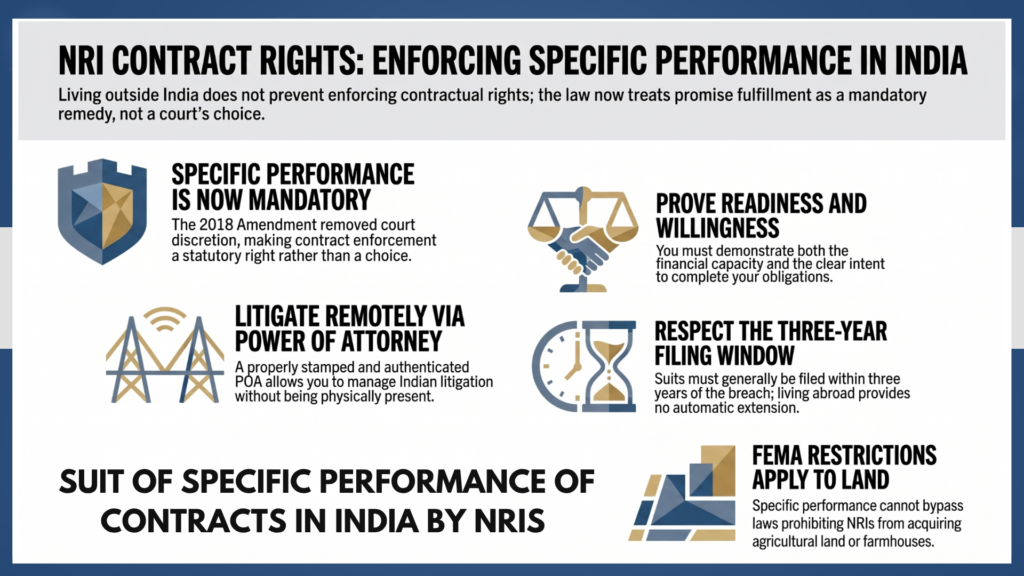
The Specific Relief (Amendment) Act, 2018 changed this framework by substituting Sections 10 and 20. The amended Section 10 made specific performance a statutory remedy, rather than a generally discretionary remedy. At the same time, the amended Section 20 removed the earlier broad discretion to refuse specific performance on grounds such as unfair advantage or hardship. Specific performance is now subject to the statutory exceptions and requirements contained in provisions such as Sections 11(2), 14 and 16 of the Act.
When Can an NRI seek Specific Performance?
An NRI can consider seeking specific performance when there is a legally enforceable contractual obligation, and the other party has failed or refused to perform it. Common situations include:
- An NRI enters into an agreement to purchase a residential property in India and pays an advance, but the seller refuses to execute the sale deed.
- A seller enters into an agreement with an NRI and subsequently attempts to sell the same property to another purchaser
- A developer fails to perform obligations specifically agreed with the NRI
- A contractual party refuses to complete the transaction despite repeated requests
- A party attempts to cancel or withdraw from a binding agreement without a legally valid basis.
- A party attempts to create third-party rights in property that is already the subject of a contractual obligation.
The actual relief will depend upon the terms of the agreement, the conduct of both parties, the nature of the property or transaction, applicable laws and the evidence available.
Does Living Abroad Prevent an NRI from Filing a Law Suit in India?
No, an NRI does not lose the right to enforce a contractual obligation in India merely because he or she lives abroad. If the transaction concerns property situated in India or is otherwise governed by Indian law and the Indian courts have jurisdiction, the NRI may institute appropriate proceedings in India.
An NRI also does not necessarily have to remain physically present in India throughout the litigation. Depending upon the circumstances and the requirements of the particular court, the NRI can conduct substantial parts of the litigation through an advocate and an appropriately authorized representative.
A properly drafted Power of Attorney (POA) can therefore be extremely useful for an NRI who cannot travel to India for every stage of the proceedings.
Execution of Power of Attorney from Abroad
The exact procedure depends upon the country where the NRI is residing and the applicable Indian requirements and state requirements. Generally, where a Power of Attorney is executed outside India, the document may need to be:
- Properly executed by the NRI in accordance with the applicable requirements of the country of execution.
- Notarized or otherwise authenticated where required.
- Apostilled where the country is a party to the Hague Apostille Convention, and apostille is applicable.
- Where apostille is not applicable, the document may instead require authentication/attestation through the appropriate Indian Embassy or Consulate.
- Once brought into India, the Power of Attorney must comply with applicable Indian stamp-duty requirements. Section 18 of the Indian Stamp Act, 1899 provides that an instrument executed outside India, where chargeable with duty, may generally be stamped within three months after it is first received in India. State-specific stamp laws and procedures must also be checked.
Failure to comply with stamping requirements does not mean that the Power of Attorney is automatically and permanently “inadmissible” in every circumstance. An insufficiently stamped instrument may be liable to be impounded and dealt with under the applicable stamp law, including payment of the requisite duty and penalty where permitted.
The Power of Attorney should clearly specify the authority being granted, for example, authority to engage an advocate, sign pleadings where legally permissible, appear before authorities, receive notices, pursue the litigation and take other specified steps. The Power of Attorney holder does not automatically become the owner of the NRI’s property merely because the Power of Attorney authorizes him or her to act on the NRI’s behalf.
Readiness and Willingness Are Extremely Important in suit of Specific Performance of Contracts in India
One of the most important requirements in a suit for specific performance is readiness and willingness under Section 16(C) of the Specific Relief Act. The NRI seeking specific performance must establish that he or she has performed, or has always been ready and willing to perform, the essential obligations required of them under the contract.
For example, if an NRI agreed to purchase a property for Rs.1 crore and paid Rs.20 lakhs as advance, the NRI should be able to demonstrate that they were financially capable and genuinely willing to pay the remaining Rs.80 lakhs and complete the transaction. There is an important distinction between readiness and willingness.
Readiness generally concerns the person’s capacity to perform the contract, including financial capacity where payment is involved.
Willingness concerns the person’s intention and conduct. The court may examine what the NRI actually did after entering into the agreement, rather than relying only on a statement that the NRI was willing to complete the transaction.
The Supreme Court has repeatedly explained this distinction. In C. Haridasan, the Court reiterated that readiness and willingness remain important even after the 2018 amendment. In this case, the purchaser had entered into an agreement to sell property, paid an advance and later sought specific performance after the sellers refused to complete the transaction. The Supreme Court examined whether the purchaser had actually demonstrated readiness and willingness to perform his own obligations. It shows that even after the 2018 amendment made specific performance a statutory remedy, a purchaser still has to establish readiness and willingness through the facts and conduct of the case.
Evidence that an NRI Can Use to Prove Readiness and Willingness
An NRI should preserve documents showing both financial capacity and genuine efforts to complete the transaction. Depending on the case, this may include:
- Bank statements
- Proof of availability of funds
- NRE/NRO/FCNR account records, where relevant
- Correspondence with the seller or other contracting party
- Emails and messages
- Legal notices and replies
- Receipts for advance or earnest money
- The original agreement and related documents
- Bank transfer records
- Evidence of attempts to arrange the balance consideration
- Communications requesting execution of the sale deed
- Documents showing continued efforts to complete the transaction
An NRI should not simply wait until the end of the limitation period and then approach the court. Conduct and unexplained inaction can become relevant when the court examines readiness and willingness. In Rajesh Kumar v. Anand Kumar & Others, 2024 INSC 444, the Supreme Court dealt directly with this issue. The plaintiff had entered into an agreement to purchase a large parcel of land and had paid earnest money. The time for completing the sale was extended more than once. The seller’s side ultimately executed a sale deed in favour of third parties despite the earlier agreement. The plaintiff then issued a notice and filed a suit for specific performance, but the suit was instituted after a prolonged period and very close to the expiry of the limitation period.
The plaintiff argued that the suit was filed within the three-year limitation period. However, the Supreme Court explained that merely filing a suit within the limitation period does not mean that the plaintiff can ignore the time stipulated in the agreement or remain inactive for a long period after the breach. The court referred to the plaintiff’s conduct and the delay in approaching the court while considering whether the requirements for specific performance had been satisfied. The court also dealt with readiness and willingness and held that where the plaintiff’s personal state of mind and conduct are in issue, a Power of Attorney holder who does not have personal knowledge cannot simply give evidence in place of the plaintiff about the plaintiff’s readiness and willingness.
The judgment makes it clear that limitation and readiness and willingness are separate considerations. An NRI should therefore act promptly after a breach or refusal and preserve evidence showing continuous efforts to complete the transaction.
Limitation Period for Filing a Suit for Specific Performance
Under Article 54 of the Limitation Act, 1963, a suit for specific performance generally has a limitation period of three years. The three years are calculated from the date fixed for performance, or, where no such date is fixed, from the date when the plaintiff has notice that performance is refused. An NRI living abroad does not get an automatic extension merely because they are outside India.
For example, if an agreement requires the sale deed to be executed on 30 June 2026, that date may become important for calculating limitations. If no specific date is fixed, the date on which the NRI becomes aware of the other party’s refusal may become relevant. The exact calculation must be made from the agreement, correspondence, notices, refusal and other facts of the particular case.
Significance of Registered and Unregistered Agreements to Sell
Registration can make an important practical difference, but an unregistered agreement to sell is not automatically a bar to filing a suit for specific performance. An agreement to sell does not by itself transfer ownership of the property. Ownership in an immovable property is ordinarily transferred through a registered sale deed. The agreement to sell records the contractual obligation of the seller to execute the sale deed in favour of the buyer.
For an NRI, the first question is therefore not simply whether the agreement is registered or unregistered, but whether the particular agreement was required to be registered under the applicable law. Certain agreements are compulsorily registrable depending upon their nature, terms and the rights they create. Section 17(1A) of the Registration Act, 1908 also specifically deals with certain contracts relied upon for the purpose of Section 53A of the Transfer of Property Act.
However, an unregistered agreement to sell is not automatically useless in a specific performance case. Section 49 of the Registration Act generally restricts an unregistered document that is required to be registered from affecting immovable property or being received as evidence of a transaction affecting that property. At the same time, its proviso creates an important exception: such an unregistered document may be received as evidence of the contract in a suit for specific performance. The Supreme Court has reaffirmed that an unregistered agreement to sell can therefore be relied upon in a specific performance suit, subject to the requirements of the law and the facts of the case.
This means that an NRI does not automatically lose the right to seek specific performance merely because the agreement to sell was not registered. However, registration can still be important from an evidentiary and practical perspective. A registered document provides a stronger formal record of the transaction and can make it easier to establish the execution and contents of the agreement. An unregistered agreement may still be admitted for the limited purpose permitted by Section 49, but the buyer may have to establish the execution, genuineness, terms of the agreement and other requirements necessary for obtaining specific performance.
The NRI should also distinguish registration from stamp duty. An agreement may be admissible under the Registration Act’s specific performance exception, but if it is insufficiently stamped, the applicable stamp law can create a separate problem regarding its admission in evidence. The Supreme Court has treated stamping and registration as separate legal requirements.
Protecting the Property During Litigation
If an NRI files a specific-performance suit and there is a risk that the seller may sell, mortgage or otherwise create third-party rights in the property, the NRI can seek an interim injunction from the court under Order XXXIX Rules 1 and 2 of the Code of Civil Procedure. An interim injunction is a temporary court order restraining the seller from dealing with the property while the suit is pending.
This is different from Section 52 of the Transfer of Property Act, 1882, known as the doctrine of lis pendens. Section 52 deals with the effect of a transfer made during pending litigation: a person who acquires the property during the litigation remains subject to the result of the pending suit. It does not itself operate as a court order restraining the seller from transferring the property.
Therefore, where there is a genuine risk of the property being transferred during the case, seeking an interim injunction can be important because it aims to prevent the transfer in the first place, while Section 52 protects the pending litigation if a transfer nevertheless takes place. The Supreme Court has recognized that Section 52 does not always provide complete protection to the plaintiff’s interests and that an injunction restraining alienation may still be appropriate in a suitable case.
What if the Contract Relates to Commercial Property or a Business Transaction?
An NRI dealing with commercial real estate, business agreements, or other commercial transactions should not automatically assume that the matter will follow the ordinary civil-suit procedure. The Commercial Courts Act, 2015 applies to specified categories of commercial disputes and includes, among other matters, certain agreements relating to commercial transactions and disputes involving immovable property where the dispute qualifies as a commercial dispute.
For a commercial suit to fall within the Commercial Courts Act, it must satisfy the specified-value requirement. Under the amended law, the specified value is generally Rs.3 Lakh or more, subject to the applicable statutory and State framework. Therefore, where an NRI’s commercial dispute meets the definition of a commercial dispute and the applicable value requirement, it may be dealt with by a Commercial Court.
Another important requirement is pre-litigation mediation under Section 12A of the Commercial Courts Act. Where a commercial suit does not contemplate urgent interim relief, pre-litigation mediation is generally required before instituting the suit. The Supreme Court in Patil Automation Pvt. Ltd. v. Rakheja Engineers Pvt. Ltd. held Section 12A to be mandatory. The Supreme Court has subsequently reiterated that the requirement applies prospectively to suits instituted from 20 August 2022, while suits genuinely contemplating urgent interim relief can be instituted without first completing the mediation process.
In Patil Automation, the dispute was a commercial money-recovery dispute. The plaintiff had filed the commercial suit without first going through the pre-institution mediation process under Section 12A, and the defendant challenged the maintainability of the suit on that ground. The Supreme Court held that pre-institution mediation under Section 12A is mandatory where the suit does not contemplate urgent interim relief. The case is relevant to NRIs because an NRI involved in a qualifying commercial dispute may have to complete this statutory pre-litigation process before approaching the Commercial Court.
Therefore, if an NRI’s commercial dispute requires immediate protection against sale, transfer or another urgent act, the question of urgent interim relief becomes particularly important when determining the pre-litigation procedure. If the agreement contains an arbitration clause, the dispute-resolution mechanism must also be examined before filing proceedings. Depending upon the wording of the arbitration agreement, the nature of the dispute and the applicable law, arbitration may affect the appropriate forum and procedure.
FEMA and RBI Regulations: An Important Legal point for NRIs
Under the FEMA framework, an NRI or OCI may acquire immovable property in India subject to the applicable regulations, but agricultural land, farmhouse and plantation property are excluded from the general permission to purchase. The RBI’s current regulatory framework specifically provides that an NRI or OCI may acquire immovable property other than agricultural land, farmhouse or plantation property, subject to the prescribed conditions.
For permitted acquisitions, the consideration must also be paid through permitted channels, such as funds received through banking channels or funds held in an eligible non-resident account, as prescribed by the regulations. Therefore, an NRI should not enter into an agreement to purchase agricultural land in India on the assumption that being an Indian citizen is sufficient to make the purchase permissible under FEMA. State land laws can create additional restrictions as well. The classifications of land and the law of the particular State must therefore be checked separately.
What if an NRI has already entered into an agreement to purchase agricultural land?
This situation requires particular caution. If an NRI has entered into an agreement to purchase agricultural land and has already paid an advance, the existence of the agreement does not by itself guarantee that a court will decree specific performance. The court would have to consider whether the proposed transaction itself is legally capable of being completed. A civil court cannot use a decree for specific performance to authorize a transaction that would be prohibited by applicable law.
Therefore, if the proposed transfer would result in an acquisition prohibited by FEMA or applicable State land laws, the NRI cannot assume that filing a civil suit will overcome that prohibition. Depending on the facts, the NRI may have to examine alternative remedies such as recovery of money, compensation or other legally available reliefs. Section 21 of the Specific Relief Act permits compensation to be claimed in appropriate cases, while Section 22 deals with additional reliefs such as possession and refund of earnest money in suits concerning transfer of immovable property.
The precise outcome will depend on the nature of the restriction, the stage of the transaction, whether any permission or exemption is available, the State’s land laws and the pleadings in the case. In other words, a decree for specific performance cannot be treated as a mechanism for bypassing FEMA or State restrictions on acquisition of property.
Contracts that Cannot Be Specifically Enforced
Specific performance is not available for every contract. Section 14 of the Specific Relief Act identifies categories of contracts that cannot be specifically enforced. For an NRI, the practical meaning of these categories is more important than memorizing the statutory language.
Where substituted performance has already been obtained
Suppose an NRI hires a contractor to construct a property in India. The contractor breaches the agreement, and the NRI, after complying with the legal requirements for substituted performance, gets the work completed through another contractor and seeks the applicable expenses. The NRI generally cannot then ask the court to force the original contractor to perform the same work that has already been completed by somebody else.
Where the contract requires continuous supervision by the court
Some contracts require continuous performance over a long period, and proper performance may require the court to supervise numerous activities on an ongoing basis. For example, if an agreement requires continuous services or maintenance for several years in a manner that cannot realistically be supervised by a court, specific performance may not be appropriate. The concern is practical: a court cannot effectively monitor every aspect of a continuing obligation indefinitely.
Where performance depends on the personal qualifications or skills of a particular person
A court generally cannot force a person to personally provide unique artistic, professional or personal services against their will. For example, if an NRI enters into a contract with a particular artist to create a unique painting, or with a person whose specialized personal skill is central to the contract, a court cannot realistically compel that individual to provide their personal skill.
Determinable contracts
Some contracts contain terms under which either party can legally terminate the arrangement. For example, if a contract expressly permits either party to terminate it by giving the required notice, the court may not specifically enforce continuation of the contractual relationship after a valid termination.
For an NRI, the important point is not to memorize these categories. Before filing a suit, the agreement should be examined by a lawyer to determine whether the contract is legally capable of specific enforcement or not.
Contact for more information: info@nrilegalworld.com/+919709692096
Frequently Asked Questions
Q.) Can an NRI living in Canada file a suit in India if a seller refuses to honour an agreement to sell?
Ans.) Yes, if the agreement is legally enforceable and the Indian court has jurisdiction, the NRI can seek appropriate relief in India. Living in Canada or another country does not by itself prevent the NRI from enforcing contractual rights in India.
Q.) I paid Rs.20 lakhs as advance money for an Indian property, but the seller is now refusing to execute the sale deed. What can I do?
Ans.) The available remedies depend upon the agreement and the facts. The NRI may consider a suit for specific performance and may also consider other reliefs such as refund, compensation or interim protection where legally appropriate. The agreement, payment records, correspondence and evidence showing readiness and willingness should be examined immediately.
Q.) The seller has sold the property to someone else after taking my advance. Have I lost my property?
Ans.) Not necessarily, if the seller entered into a subsequent transaction with another person, the legal consequences will depend upon the timing of the transactions, the knowledge and status of the subsequent purchaser, the terms of the original agreement and other facts. An NRI should obtain the subsequent sale documents and seek immediate legal advice rather than assuming that the original agreement has become meaningless.
Q.) Can I stop the seller from selling the property while my specific-performance case is pending?
Ans.) An NRI may seek temporary or interim injunctive relief where the facts justify it. Section 52 of the Transfer of Property Act operates through the doctrine of lis pendens, but it does not mean that an injunction is automatically granted merely because a suit has been filed. A separate application for interim protection may be necessary.
Q.) Is an unregistered agreement to sell useless in a specific-performance case?
Ans.) No, an unregistered agreement is not automatically incapable of being relied upon in a suit for specific performance. Section 49 of the Registration Act contains a provision permitting an unregistered document, where otherwise required to be registered, to be received as evidence of a contract in a suit for specific performance. However, the precise registration and stamp duty consequences depend upon the nature of the document and the applicable law.