
A gift deed allows the owner to transfer property voluntarily without receiving monetary consideration. Gifting property in Haryana involves compliance with the Transfer of Property Act, 1882, the Foreign Exchange Management Act, 1999 (FEMA), applicable income tax provisions and Haryana’s property registration and stamp duty rules. This blog explains the legal framework for gifting property in Haryana by an NRI, including conditional gifts, agricultural land transfer, registration requirements, tax exemptions, and the practical steps involved.
Definition of Gift Deed
A Gift Deed is a Legal Document through which a person voluntarily transfers ownership of their existing property to another person without receiving any money or other consideration in return. Sections 122 and 123 of the Transfer of Property Act, 1882 governs a gift deed.
For Example: An NRI living in Canada owns a house in Haryana. He wants to transfer the house to his daughter living in India without selling it. He can execute a gift deed in favour of his daughter, subject to applicable legal requirements.
There are two main parties involved in this Deed:
- Donor: The person giving the property.
- Donee: The person receiving the property.
Type of Gift deed
There are two types of gift deeds: Unconditional and Conditional gift deed.
Unconditional Gift Deed
An Unconditional gift deed is a legal document through which a person (the donor) voluntarily transfers ownership of their property to another person (the donee) without imposing any conditions or expecting anything in return.
Conditional Gift Deed
A conditional gift deed transfers property subject to specific, lawful conditions agreed upon by the donor and the recipient. These conditions must be clearly mentioned in the deed. The Transfer of Property Act, 1882, Section 126, governs when a gift may be suspended or revoked. It is up to the donor which condition he/she wants to add in the Gift Deed.
Can an NRI Gift Agricultural Land in Haryana?
Yes, FEMA permits an NRI or OCI to transfer agricultural land, plantation property, or a farmhouse in India to a person resident in India. However, the transaction must also comply with the applicable land laws.
Can an NRI Gift an Urban Property in Haryana ?
Yes, An NRI can gift urban immovable property, such as a residential house, flat, commercial shop or plot to a person resident in India. The rules also permit the transfer of properties situated within the Lal Lakir of the village boundary.
Can NRI gift property to blood relatives or other relatives in India?
Yes, an NRI can gift property to blood relatives or other relatives in India. The recipient may be a son, daughter, Father, Mother, Husband or wife, Bother or sister Grandfather or Grandmother, Grandson or Granddaughter who is resident in India. NRI cannot gift his agricultural land, plantation, farmhouse in India to another NRI or OCI under FEMA regulations.
What are the stamp duty rules in Haryana when an NRI gifts his agricultural land to his blood relatives or other relatives?
In Haryana, an NRI gifting agricultural land to eligible blood relatives can claim 100% stamp duty remission for a lifetime transfer to parents, children, grandchildren, brothers, sisters or a spouse. He notification issued by the Haryana Government clarified that the exemption also covers grandchildren through daughters.
However, if the recipient is a relative other than blood relative, such as a nephew, niece, uncle, aunt or cousin, the exemption does not apply. The general stamp duty on the gift deed transfer will be 3% in case of rural property and 5% for urban property as per the 2026 rules.
Relevant Judgement:
Kishan Singh v. State of Haryana and others, decided by the Punjab and Haryana High Court held that the stamp duty remission under the 2014 notification did not extend to transfer between an uncle and his nephews merely because they were blood relatives.
Tax implication for Gift Deed transfer in India
Under Section 56 (2)(x) of the Income Tax Act, 1961, certain gifts received by an individual are exempt from tax if they are received from a person who qualifies as a relative under the statutory definition.
| For the purposes of this clause, “relative” means— |
| (i) | spouse of the individual; | |
| (ii) | brother or sister of the individual; | |
| (iii) | brother or sister of the spouse of the individual; | |
| (iv) | brother or sister of either of the parents of the individual; | |
| (v) | any lineal ascendant or descendant of the individual; | |
| (vi) | any lineal ascendant or descendant of the spouse of the individual; | |
| (vii) | spouse of the person referred to in clauses (ii) to (vi); |
If an NRI gifts an Indian property to a person who qualifies as a relative under Section 56(2)(x), the recipient is not liable to pay income tax on the value of the gifted property, even if the property has a high market value.
Example: An NRI living in Canada gifts a house in Haryana, valued at ₹ 80 lakh, to his sister who lives in India. If the transfer is a genuine gift and the statutory conditions are satisfied, the sister generally does not have to pay income tax on the ₹ 80 lakh, value merely because she received the property as a gift. However, this income tax exemption does not automatically exempt the transaction from stamp duty, registration fees, or other applicable property law requirements.
Income tax rules for Gift transfer of property out of family
If a person receives immovable property without consideration from someone who does not qualify as a relative, under Section 56(2)(x) may have to pay the tax as per the stamp duty value of the property as income from other sources.
| (x) | where any person receives, in any previous year, from any person or persons on or after the 1st day of April, 2017,— |
| (a) | any sum of money, without consideration, the aggregate value of which exceeds fifty thousand rupees (50,000 rupees), the whole of the aggregate value of such sum; | |
| (b) | any immovable property,— |
| (A) | without consideration, the stamp duty value of which exceeds fifty thousand rupees, the stamp duty value of such property; | |
| (B) | for a consideration, the stamp duty value of such property as exceeds such consideration, if the amount of such excess is more than the higher of the following amounts, namely:— |
| (i) | the amount of fifty thousand rupees; and | ||
| (ii) | the amount equal to ten per cent of the consideration: | ||
Procedure for Gift Deed between blood relatives or other relatives in Haryana
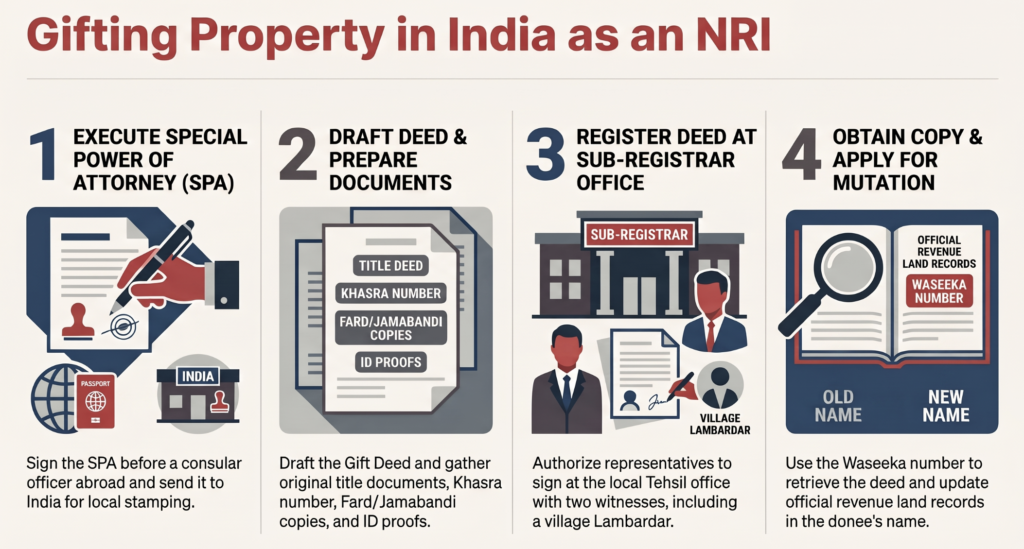
When an NRI wants to gift a house, plot or agricultural land to a blood relative without receiving any money, the usual procedure is to execute and register a Gift Deed at the local Sub Registrar/ tehsildar. If the NRI donor cannot visit India, they can generally handle the process through a Special Power of Attorney (SPA).
1) Prepare the Special Power of Attorney:
Draft a Special Power of Attorney authorizing a trusted person in India to execute and register the Gift Deed on the donor’s behalf. The donor must execute it before the appropriate Indian consular officer or Notary Public, following the authentication requirements.The authorized representative receives the original document . The authorized representative can stamp or emboss the SPA at the local DC office in Punjab.
2) Drafting a Gift Deed:
A well drafted Gift Deed will include all the details regarding the property, name and address of the donee’s and donor’ and any condition attached to the gifting. NRI can also take professional help for drafting the deed.
3) Documentation:
Attach the necessary documents with the gift deed, such as original title documents of the land, Kasra number, Fard / Jamabandi copy, relevant mutation records, identity proofs like Aadhar cards, PAN details, passport ( in case of NRI), of both the parties.
4) Local Sub registrar office:
Visit the local Tehsil/Sub-Registrar office where the land is situated. Both parties are required to be present at the sub-registrar office, where a picture and signatures of both parties will be captured by the authorities in the presence of 2 witnesses. The Gift Deed is signed by both the parties in the presence of two witnesses at the Sub-Tehsildar office. One of the witnesses must be a Lambardar of the village.
5) Waseeka Number:
After the execution of the gift deed the parties should use the Waseeka number of the deed to obtain a copy of the executed Gift Deed.
6) Mutation of Property:
Lastly, the recipient party can apply for mutation so that the revenue authority can update the land records in the donee’s name. Both parties should check the Fard/Jamabandi regularly to make sure the right legal owner is reflected in the owner column of the fard/Jamabandi.
However it is to be noted that NRI cannot gift the agricultural land to another NRI or OCI card holder because it is prohibited as per the FEMA regulations.
For more information contact NRI Legal World: info@nrilegalworld.com/ +919709692096 / https://nrilegalworld.com/contact-us
FAQs:
Q1. Can an NRI gift property his nephew in India?
Ans. Yes, an NRI can gift Indian immovable property to a person resident in India. The NRI can start the gifting of property while sitting abroad. The NRI can gift property to his nephew/niece or any person or relative he wants. In Punjab / Haryana the transfer of land to immediate family and blood relatives is exempted from stamp duty.
Q2. Where can an NRI register the Gift Deed in Haryana?
Ans. There is a fully described procedure for executing the transfer of land / property to another person at local district level tesildar office or sub-tehsildar office. The NRI must also take other supporting documents like Fard of land, Aadhar card, passport copy, a private witness, Lambardar of the village as a witness, and embossed copy of POA if any. Most importantly the name and address of the recipient must be stated carefully. It is mandatory for both parties or their Power of Attorney holders to be present at the sub-tehsildar office.
Q3. Is mutation compulsory after registration of a gift deed?
Ans. Mutation should be applied for to update relevant revenue or property records. Registration and mutation are separate processes; mutation does not replace a valid registered gift deed.
Q4. Can a gift deed include conditions?
Ans. Yes, lawful conditions can be included, such as reserving a clearly defined right of residence for the donor. Conditions should be drafted carefully because an invalid condition may not be enforceable.
Q5. Does the recipient need to be physically present when the gift deed is registered?
Ans. The recipient’s acceptance of the gift is essential. Whether personal appearance is required depends on the registration procedure and applicable rules. Any authorised representative must have legally acceptable authority.
Q6. Can an NRI gift his agriculture land in India to another NRI under FEMA regulations?
Ans. No, an NRI cannot gift his agricultural land, plantation, farmhouse in India to another NRI under FEMA regulations. Under Rule 24 of the Foreign Exchange Management (Non-Debt Instrument) Rules, 2019 an NRI may transfer immovable property, including agricultural land, to a person resident in India. However, the permitted transfer to another NRI under Rule 24(e) excludes agricultural land, plantation property any farmhouses.