
Whether you are looking to transfer a family home to your children, settle ancestral land, or streamline your estate planning, understanding the legal framework is crucial to protecting your assets.
Transferring Property Within Blood Relations
Transfer Deed is one of the most cost-effective ways for an NRI to transfer self-acquired property to immediate family members during their lifetime.
Key Points:
- Eligible Relatives for Transfer of property in Blood relatives: Under the Hindu Succession Act, this includes children, grandchildren, spouses, and siblings.
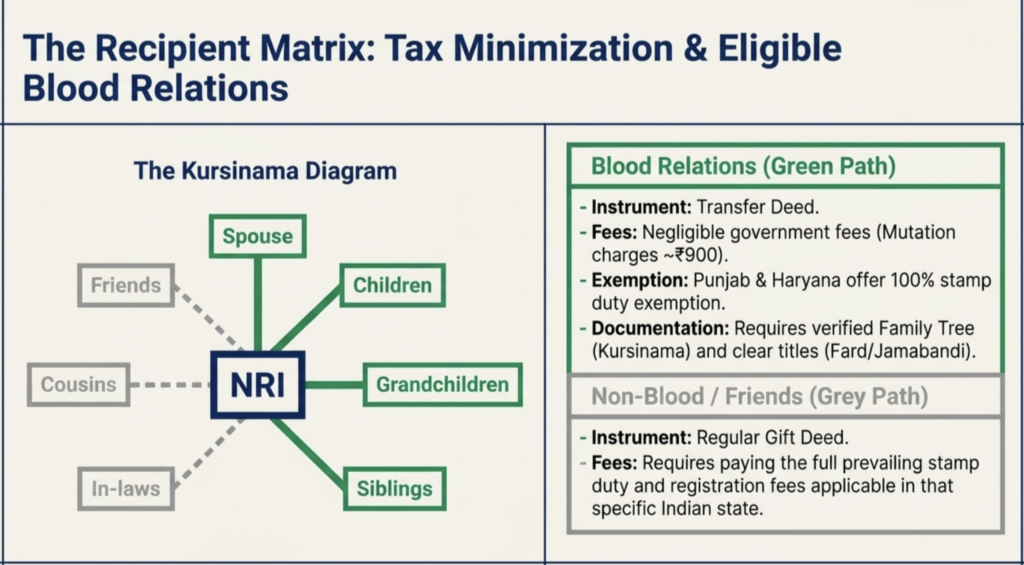
- Stamp Duty and Registration Costs on Transfer of Property to Blood relatives: Unlike standard property sales or gifts transfer of property to the third parties, transferring property within immediate blood relations incurs negligible government fees—often just nominal documentation or mutation charges plus registration fees ( depending on state regulations). The state governments in Punjab and Haryana have exempted the stamp duty on the transfer of property to blood relatives. The key document required is a verified family tree (Kursinama) to prove the relationship between the parties, alongside clear ownership title documents like Fard/Jamabandi.
Pro Tip: Always have the transfer deed drafted by a legal professional specializing in NRI property law. Ambiguous wording can lead to unnecessary title disputes or rejection at the Registrar’s office.
FEMA Guidelines: Which property NRIs Can and Cannot Transfer in India
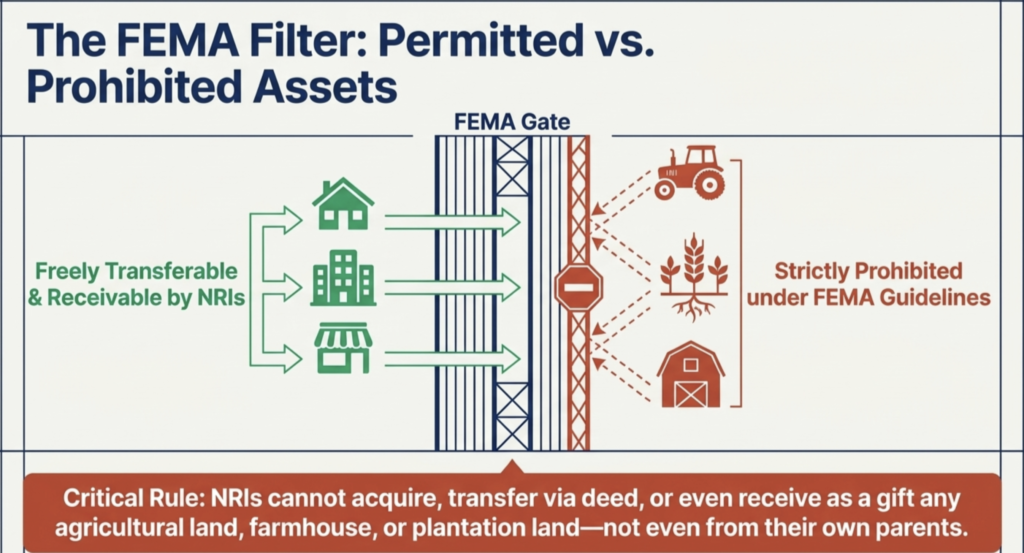
Residential and commercial properties are easier to transfer but when it comes to NRI parties making any change in the ownership involving agriculture land or farmland in India, should be considered seriously as sale and purchase of agricultural land, farm house and plantation land is banned under the Foreign Exchange Management Act (FEMA).
- Which Property NRIs are Allowed to Transfer in India: Residential houses, apartments, plots, and commercial units can be freely transferred to eligible family members via a Transfer Deed.
- Restricted Property transfer for NRIs: NRIs can transfer agriculture land to any resident Indian but are not allowed to transfer agricultural land, plantation property, or farmhouses via a transfer deed to another NRI.
If your Indian holdings include agricultural property, farm house and plantation land, consult a legal expert specialized in FEMA regulations to evaluate your options for inheritance or any other lawful transfer of agricultural land.
To know more on the subject you can contact NRI Legal World: info@nrilegalworld.com/ +919709692096
Transfer of Property for NRIs Settled Abroad
NRIs do not always need to travel to India to execute a property transfer. NRIs can complete the process remotely using a valid Power of Attorney (POA).
How Power of Attorney Works:
- Drafting & Execution Abroad: Draft the POA document , get it notarized and sign it in the presence of an authorized officer at the Indian Embassy or Consulate in your country of residence.
- Embossing of Power of Attorney in India: Send the document to your representative in India, who must get it embossed or registered at the local Deputy Commissioner (if the property is situated in one district only) Financial Commissioner’s office ( in case the property is situated in one or more district) within the stipulated legal timeframe.
- Registration: Once embossed, the POA holder can sign the transfer deed at the local Tehsil/Sub-Registrar office on NRI’s behalf.
Separate rules for Self-Acquired and Ancestral Property in India
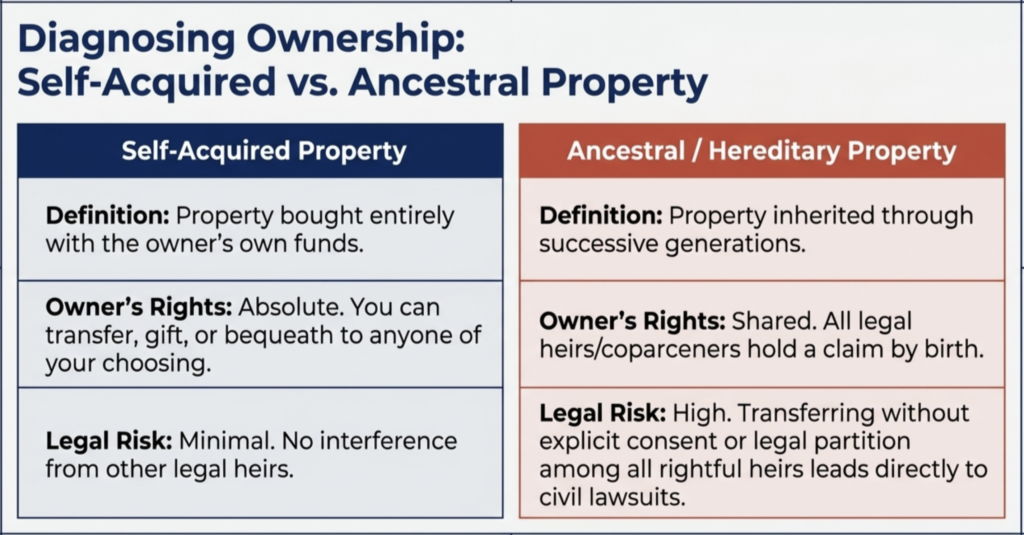
Understanding the origin of your property is critical before initiating any transfer in India.
- Self-Acquired Property: If an owner bought the property with his own funds, the owner holds absolute rights to transfer, gift, or bequeath it to anyone he chooses without interference from other legal heirs.
- Important: NRIs can transfer agriculture land to any resident Indian but are not allowed to transfer agricultural land, plantation property, or farmhouses via a transfer deed to another NRI.
- Ancestral/Hereditary Property: If the property was inherited through generations then all legal coparceners/heirs hold a claim. The legal heirs have right on the ancestral property by birth, hence transferring ancestral property without the explicit consent or partition among all rightful heirs can lead to civil lawsuits.

Transfer of Property Ownership in India: An Essential Guide for NRIs
Transferring Outside Blood Relations: Regular Gift Deeds
If an NRI wishes to transfer property to someone outside immediate blood relation (e.g., a friend, distant relative, or trust), a standard Gift Deed is required.
Unlike transfers within a close family, a regular Gift Deed requires paying the full prevailing stamp duty and registration fees applicable in that specific Indian state. The stamp duty is exempted only in transfer deeds within the blood relatives. However there will be no requirement to pay the cost of property as par the district collector rate.
Disclaimer: Property laws in India vary by state, and FEMA guidelines are subject to periodic updates. Always consult a qualified legal advisor or property specialist before initiating real estate transactions in India.
NRI, who is either gifting or transferring his property or receiving property as gift or transfer deed, should separately consider the capital Gaines issue, Stamp Duty, Registration feels based on the collector rate of the property.
To know more on the subject you can contact NRI Legal World: info@nrilegalworld.com/ +919709692096
Frequently Asked Questions:
Q) Can parents take back the property once transferred to their children?
Ans: Under the Maintenance and Welfare of Parents and Senior Citizens Act, if parents transfer property to their children on the condition that they will be cared for, and the children subsequently fail to fulfil that duty, the parents can apply to revoke the transfer deed through the Maintenance Tribunal.
Q) Can NRI transfer property to his friend?
Ans: Yes, an NRI can transfer property to his friend or relative. NRI can make a gift deed transfer to his friend. Unlike transfers within a close family, a regular Gift Deed requires paying the full prevailing stamp duty and registration fees applicable in that specific Indian state. The stamp duty is exempted only in transfer deeds within the blood relatives.
Q) Can an NRI take property as a Gift in India?
Ans: NRI can take any kind of residential or commercial property as a gift deed transfer. While there is a strict prohibition for NRIs on agriculture land, farmhouse and plantation land transfer to NRIs as per the FEMA guidelines. NRIs can not receive agricultural land, farmhouses or any kind of plantation land as a gift, not even from their parents.