
NRI cannot simply assume that sending money from abroad through informal channels or letting things go unnoticed will fly under the radar. In the past, things were handled very differently, transactions carried out by NRIs 20-25 years ago happened freely without intense scrutiny by the Indian tax department. Back then, NRIs relied on what they heard from elders and moved forward without worrying about modern regulatory frameworks.
However, today’s digital era completely changes the landscape. With computerization, automated data sharing, and international treaties, everything is transparent.
Data Sharing and Automated Tracking by Tax Department
In the past, tracking of financial transactions relied on physical records or manual data submission by the revenue departments. For example, the revenue department used to manually report the registries above certain monetary thresholds and the data were sent on CDs. Today, modern regulatory software links everything automatically. Property registrations, Aadhaar, PAN cards, and tax filings are instantly cross-referenced.
If an NRI sells land or makes an investment, the income tax department matches local transactions with foreign disclosures. As Indian and foreign tax authorities share information across borders, hidden capital gains, undeclared funds, or unrecorded cash transactions can trigger serious legal notices at any time.
Benami Properties and the Dangers of Proxy Ownership
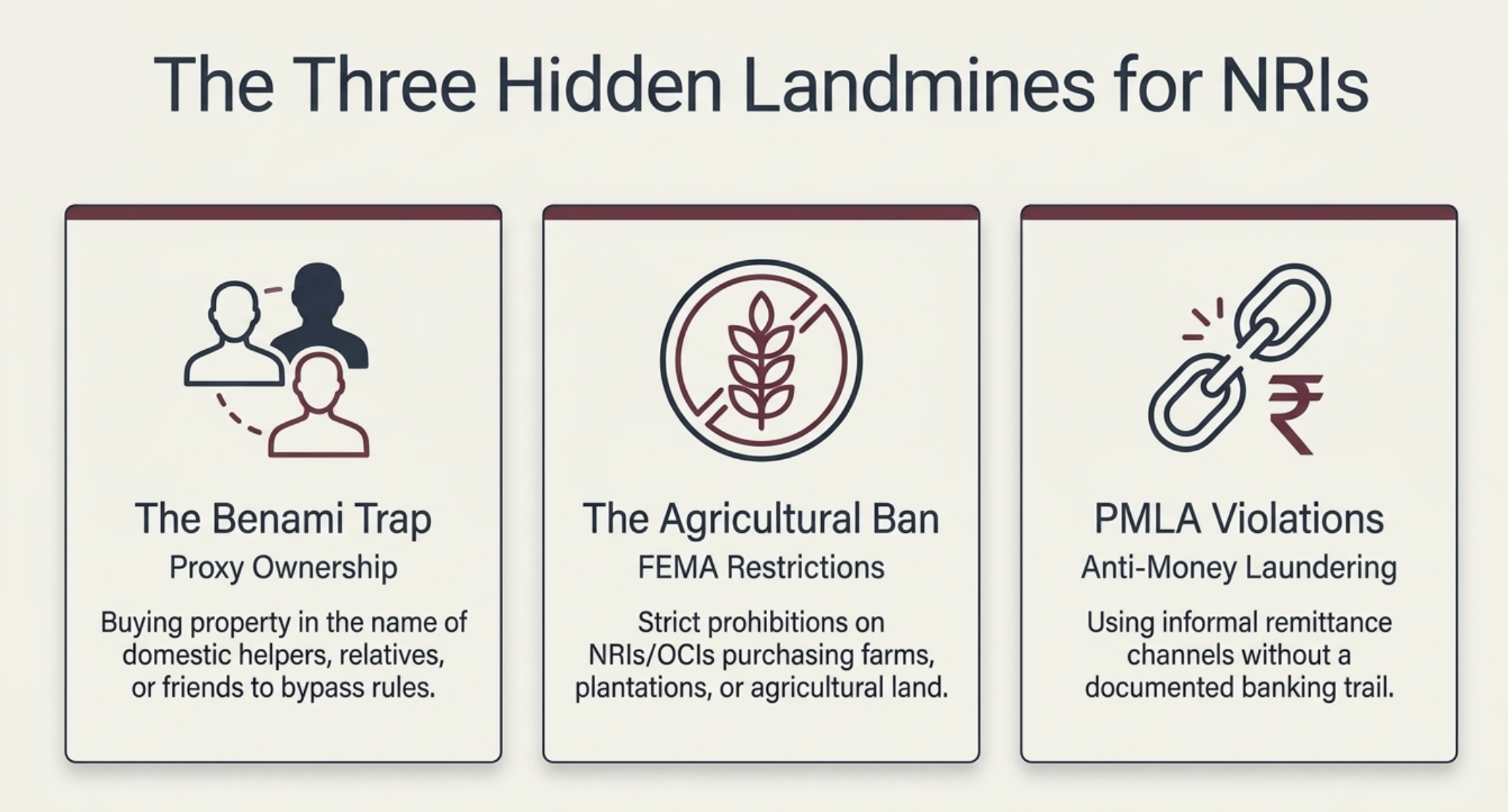
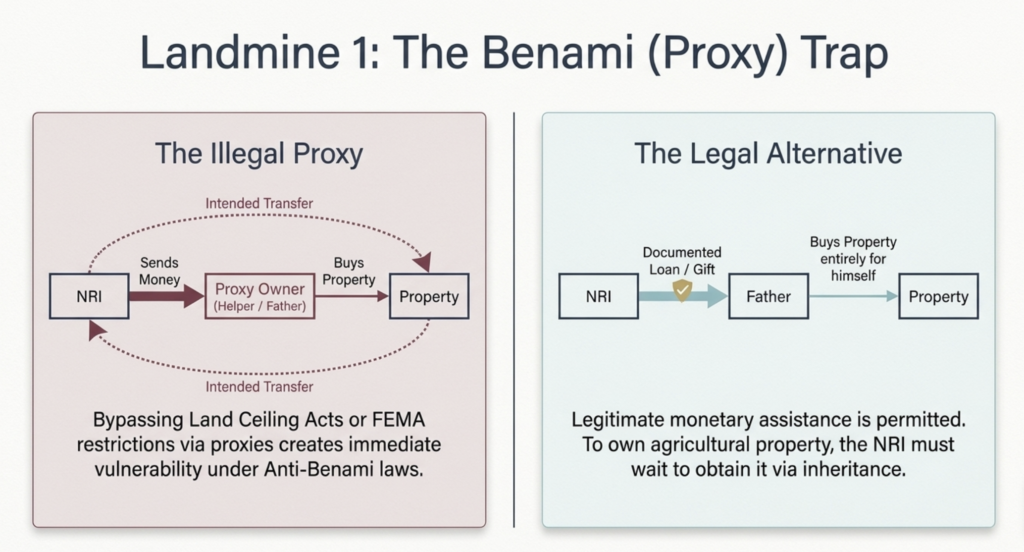
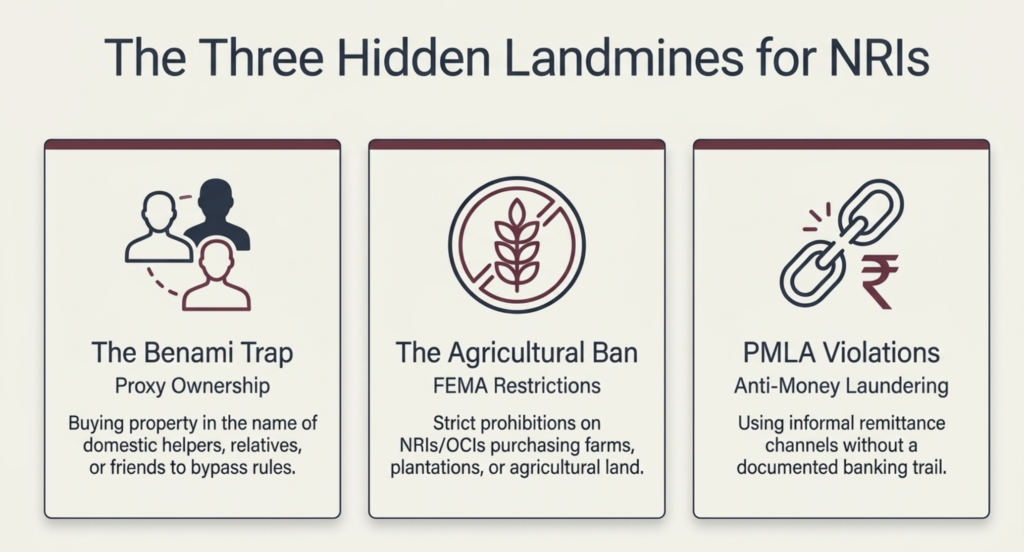
Most critical issues covered under the PMLA act are benami (proxy) properties and land acquisitions under other person’s names. For example, in order to avoid the Land Ceiling Act restrictions, people registered their properties on the names of their cooks or other domestic helpers (without their knowledge) as proxy owners. Such types of proxy registrations create immediate vulnerability under anti-benami and PMLA regulations.
NRI buying Agriculture land in India and PMLA violation
An NRI/OCI who resides outside India is not legally permitted to purchase agricultural land or any type of farmhouse or plantation land in India.
If an NRI has bought agricultural land out of innocence or lack of awareness regarding the law is a violation of law and simply ignoring it creates compounding risks. While authorities evaluate cases based on intent and whether the funds were legitimate (other than proceeds of crime or black money), failing to properly declare or regularize such transactions can lead to long-term complications for NRI and their descendants who may inherit property.
Understanding the Prevention of Money Laundering Act (PMLA) for NRIs
The Prevention of Money Laundering Act is ultimately designed to track and deter black money. However, ordinary laymen and well-meaning NRIs can inadvertently find themselves entangled if they fail to maintain proper financial transparency while purchasing any property in India.
Key Points about PMLA for NRIs
- Unlike traditional investigating procedures in any other civil and criminal procedures where investigative processes are conducted openly, PMLA inquiries often proceed silently until notices are served to NRIs abroad.
- Legal liabilities under PMLA statutes are severe, and securing bail or resolving notices requires rigorous documentation, legal as well as CA expertise to establish facts in regard to the source of funds. PMLA proceedings are lengthy as well as exhaustive for NRIs.
- Under PMLA, if an NRI remits large sums of money to India or buys property without a clear banking trail of money used in the deal, such as sending money via unofficial channels/ hawala or undocumented cash transfer, the burden of proof falls on the individual to establish the legitimate source or sources of funds.
NRI Legal World experts recommend to all the NRIs/ OCI families that consulting qualified legal and financial experts is the quintessential step to follow before executing any cross-border transactions.
Practical Checklist for NRIs to encourage Safe Property & Financial Transactions
To protect your assets and family in India from tax notices, benami proceedings, or PMLA action, NRIs can follow these essential compliance steps:
- Buy Strictly in Your Own Name: NRI should never register property in the name of friends, caretakers, or relatives in order to either avoid paying taxes or bypassing the other rules laid by Indian Law.
- Use Proper Banking Channels: NRI must route all of their funds exclusively through NRE/NRO accounts with additional documentation provided by the Chartered Accountant.The source of the fund must be in accordance with Indian tax laws. The Involvement of Cash elements in the property transactions must be avoided.
- Respect FEMA & RBI Limits: According to FEMA rules, NRIs or OCIs are not eligible to purchase agricultural land in India. NRIs should consult professional legal advisors before making any property transaction in India.
- File Accurate and timely ITRs in India: NRI should declare their property sales, rental income, capital gains or any other transactions accurately to ensure your Indian and foreign tax filings align. NRIs should not try to hide any income or expenditure from Indian or foreign tax agencies.

Practical Checklist for NRIs to encourage Safe Property & Financial Transactions
At NRI Legal World, our team of experienced advocates, retired civil servants, and financial experts provide transparent, end-to-end assistance tailored to the NRIs. For more information you may contact NRI Legal World: +919709692096 / info@nrilegalwolrd.com
Disclaimer: This article is for general informational purposes only and does not constitute formal legal or tax advice. Please consult a qualified legal professional regarding your specific circumstances before executing any property or financial transaction.
Frequently Asked Question
Q.1 – What If an NRI has already bought agricultural land by mistake by violating FEMA guidelines?
Ans: If an NRI purchased agricultural land out of genuine unawareness about the restrictions given in FEMA, the NRI family should consult the expert legal team before taking any further step. Ignoring the issue will only compound the risk and can also create the problem for the descendants who will inherit the property in the future.
Q.2 – How does the PMLA Act apply to NRI transactions in India?
Ans: The Prevention of Money Laundering Act is primarily aimed at tracking and deterring black money and proceeds of crime in India. It is seen that well-meaning NRIs and their families frequently get caught in its net due to procedural ignorance or informal money transfers.
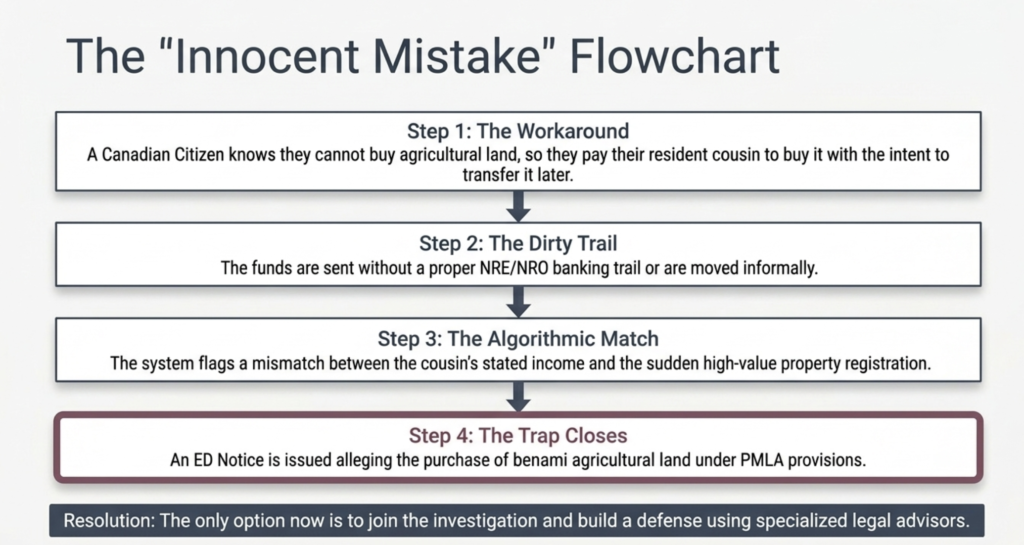
Q.3 – I am a Canadian Citizen, knowing that I can’t buy agricultural land, I had paid my cousin to buy that piece of land, which I wanted to buy and get it transferred to me later on. Now I have received a notice from ED for violating PMLA provisions alleging me of buying benami agriculture land. What should I do?
Ans: In this case the NRI should join the investigation. NRI can build up his case with the help of their legal advisers.
Q.4 – As I live in the UK as a citizen of India. Can I buy a piece of land on which a brick kiln factory was earlier working but now it is lying defunct?
Ans: If the brick kiln is established by changing the use in revenue and industrial authorities, from agriculture to industrial purposes then NRI ( Indian citizens) can buy the land. However it is recommended to ascertain the CLU (change of land use) status from Land revenue authorities and industrial authorities while making the purchase.
Q.5 – I am an NRI and citizen of India, I have been living in India for the last 18 months. Can I buy agricultural land?
Ans: NRI living in India for 18 months makes 548 days in India hence, you are eligible to buy agricultural land.
Q.6 – I am an Australian citizen but a Person of Indian Origin (PIO). Can I exchange my land with another landowner in a different village? I want to take 20 Acres by giving 16 Acres in this exchange. Can I do this without violating any Indian law?
Ans: No, the exchange of agricultural land is not allowed for NRIs. Under Rule 24 of the FEM (Non-debt Instruments) Rules, 2019, an Overseas Citizen of India (OCI)—which encompasses former PIO cardholders—is strictly prohibited from acquiring agricultural land, plantation property, or a farmhouse in India by way of purchase, gift, or exchange.
Q.7 – Can I send my money from Germany to my father in India who is an Indian resident to buy agricultural land in his name?
Ans: If your father is buying the land with only intention to transfer to you later and using your money to buy the land then it can be considered as a benami property as FEMA has restricted NRIs/OCIs from purchasing agricultural land in India. If your father is buying the property and needs monetary help from the NRI son then NRI can transfer the money as Loan or Gift. NRI can obtain agriculture property only via inheritance.
Q.8 – Can RBI grant permission to NRIs to buy agricultural land in India?
Ans: Yes, NRI can try to seek permission from RBI to buy agricultural land as the provision is there. However, RBI rarely gives permission to allow NRIs to buy agricultural land.
Q.9 – What are the penalties if an NRI has purchased agricultural land in violation of the FEMA provision?
Ans: In FEMA violation cases the authority can confiscate the property and can also add a penalty which could be three times the value of the land. FEMA can also add other daily penalties for NRIs in this matter. Along with this if the NRI fails to explain the source of money or the exact money trial is missing then PMLA proceedings can also start.