
How can an NRI get a divorce in India while sitting abroad?
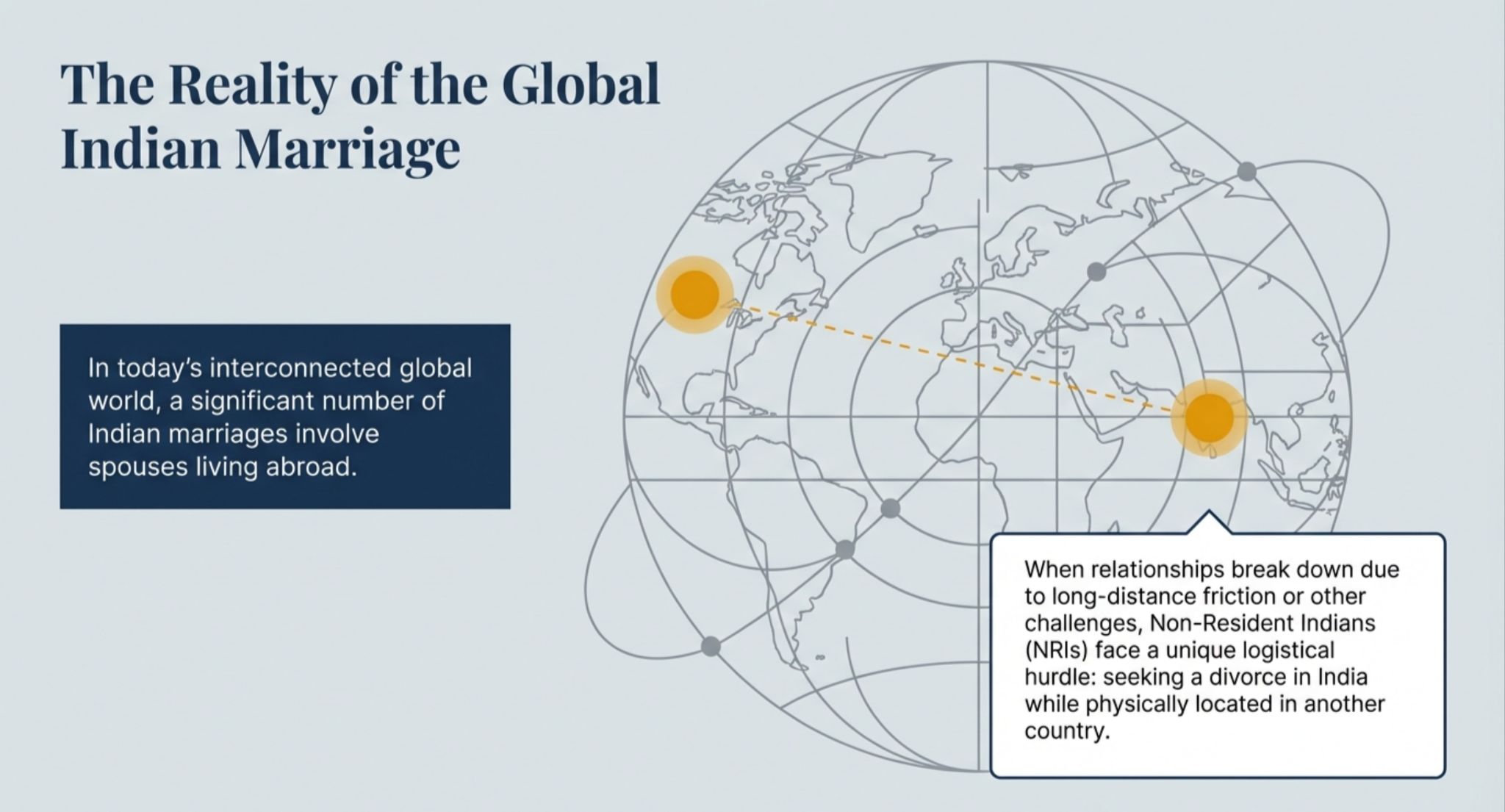
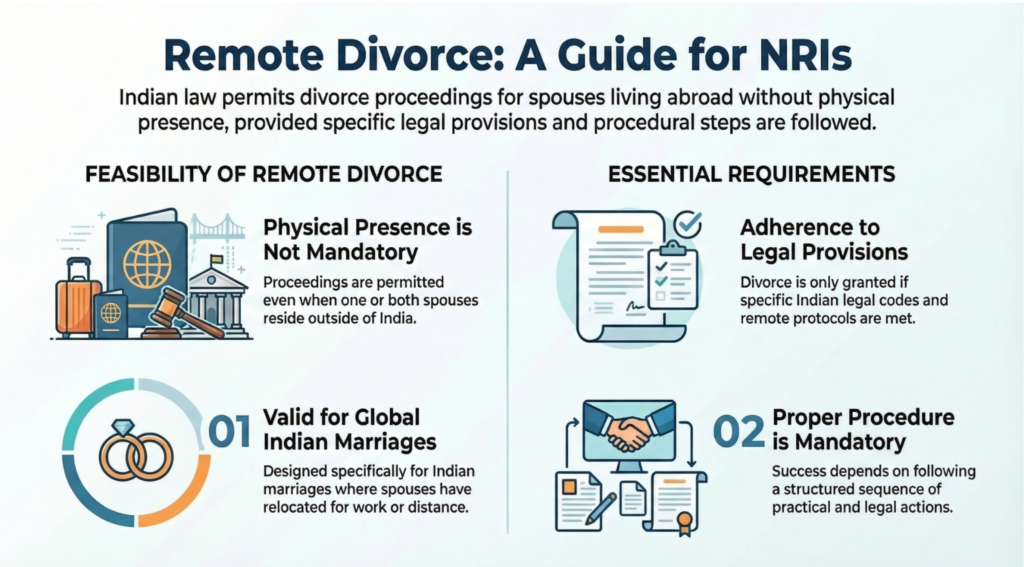
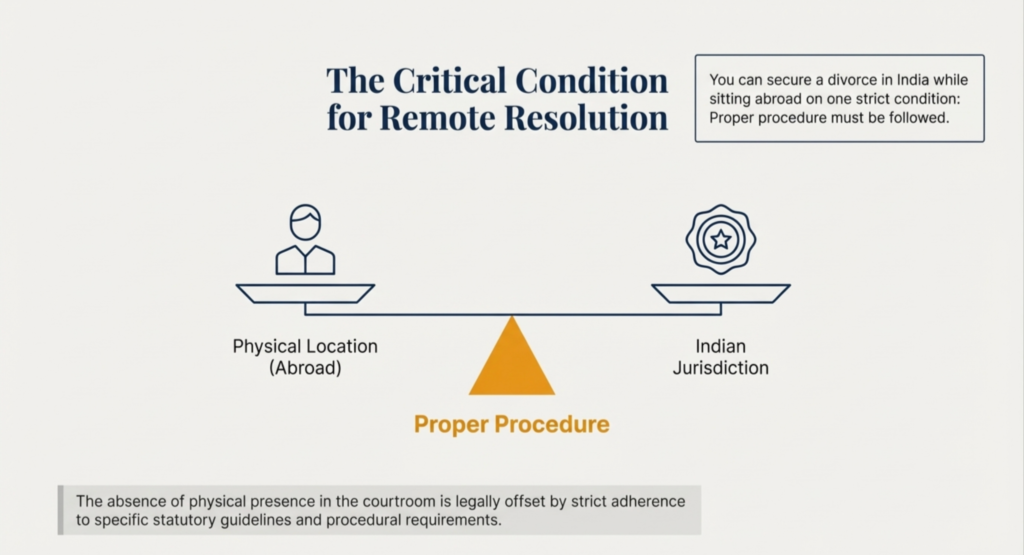
In today’s global world there are many Indian marriages that involve spouses who are living abroad. Sometimes the relationships do not work due to long distance or some other reasons and an NRI woman/man may want to consider getting a divorce from their spouse in India while they are living abroad. The good news is that Indian law allows divorce proceedings even if one spouse or both husband and wife are not physically present in India, but the condition is that proper procedure should be followed. This blog explains how an NRI woman/man can get divorce in India while staying abroad, the legal provisions which are involved in the process of taking divorce and the possible practical steps which they need to take for that.
Legal framework that governs divorce in India
Divorce involving NRIs is governed by Indian matrimonial laws, jurisdiction rules of courts and provisions related to recognition of foreign judgements. Even if any one of the spouses lives abroad or both live abroad, Indian courts have the jurisdiction to grant a divorce if there is a legal connection with India. Divorce is governed in India by different personal laws depending on the religion and these personal laws are applicable on NRIs also, if they are Indian citizens or if the marriage is connected with India.
Following are the main laws through which divorce is governed in India:
- Hindu Marriage Act, 1955, which applies to Hindus, Sikhs, Jains, Buddhists, including NRIs.
- Special Marriage Act, 1954, which applies to civil marriages, inter-religion marriages and marriages registered in India.
- Indian Divorce Act, 1869, which applies to Christians.
- Muslim Personal Law, which applies to Muslims.
The first step is to check whether Indian court has jurisdiction:
The most important step for NRIs before filing a divorce in India, is to check if the Indian court has authority to hear the case or not. As per the Hindu Marriage Act, divorce can be filed in India if:
- The marriage has taken place in India
- The husband/wife lives in India or has Indian citizenship
- The couple has last lived together in India
- The marriage was solemnized by Hindu marriage rituals even if it was solemnized abroad.
The Indian courts do not have the jurisdiction in cases, such as, if:
- The marriage was solemnized abroad under the foreign laws, then the NRIs have to take divorce in the foreign courts.
- Both spouses are foreign citizens and have foreign citizenship.
- The couple never lived in India.
- The couple has no connection with India.
Divorce can be filed through Power of Attorney in India
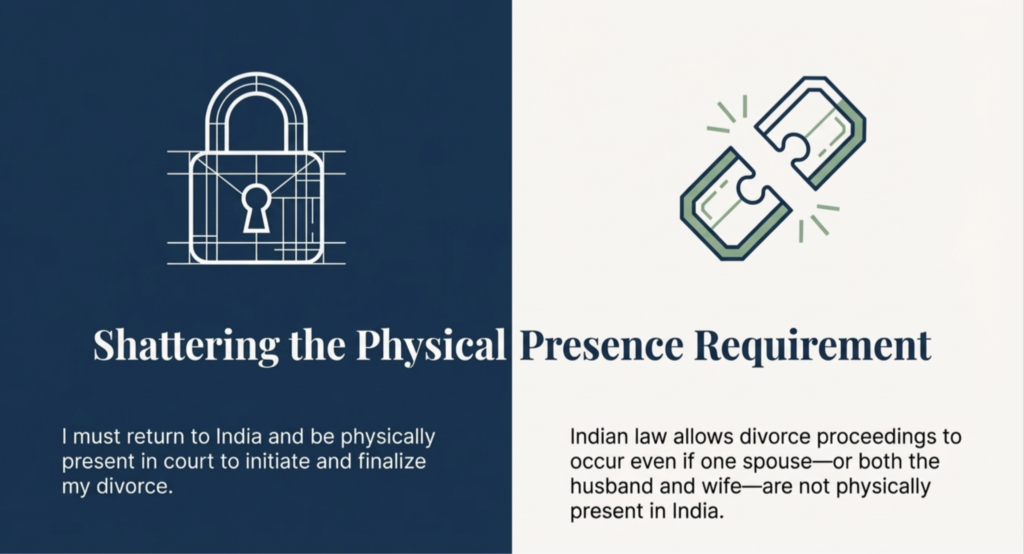
One of the most important legal tools for NRIs, is the Power of Attorney (POA). If any of the spouses is living abroad, he/she does not need to come to India for filing a divorce or to be present in every court hearing. They can authorize a lawyer or trusted person in India to represent their case.
Here are a few steps that need to be followed when filing a divorce case through the Power of Attorney:
- The NRIs should take professional legal help in India to confirm the jurisdiction of the court. NRIs should ascertain what type of divorce they are filing, like if it is a contested divorce or a mutual consent divorce. For this, the NRIs should provide details such as:
- Place of marriage
- Spouse’s address
- The current address of the NRIs
- Marriage certificate
- Copy of passport
- Whether both spouses have a mutual consent for divorce or it is a contested divorce.
- The NRIs should prepare a Special Power of Attorney abroad not a General Power of Attorney. The NRIs must get the Special Power of Attorney notarized and attested from the local Indian Embassy or the Consulate.
- The NRIs should send the original copy of the Special Power of Attorney (embossed and notarized) to the authorised person in India. The Indian attorney holder must get the POA registered at the local deputy commissioner office to make it valid in India.
Mutual Consent divorce – the easiest option
If both husband and wife agree to get separated, then the simplest and easiest way is to file for a mutual consent divorce under Section 13B of the Hindu Marriage Act.
A divorce is a mutual consent divorce, if :
- Both parties agree to end their marriage.
- They must have lived separately for at least one year (according to Sec 13B of the Hindu Marriage Act,1955).
- A joint petition for divorce should be filed in the court.
- Statements are recorded by the court before the court grants divorce.
In many cases, the statements of NRIs are recorded through video conferencing or affidavit so that the NRIs may not need to come to India.
Cooling – off period in a divorce case
Under section 13B of the Hindu Marriage Act, 1955, after filing the first motion for divorce, the parties were required to wait for six months before filing the second motion. This period is known as the cooling – off period and it was introduced to give time to the husband and wife to reconsider their decision and to see if reconciliation is possible.
However, the Supreme Court of India in Amardeep Singh v. Harveen Kaur clarified that the six month cooling period is not mandatory in every case. The court held that if the marriage has completely broken down and there is no possibility of reunion then the family court may waive the waiting period to avoid unnecessary delay and hardship to the parties.
Contested divorce
If one of the spouses or both the spouses do not agree for the divorce through mutual understanding, they can file for a contested divorce in India. Under the Hindu Marriage Act, divorce can be filed on grounds such as:
- Cruelty
- Desertion
- Adultery
- Mental harassment
- Fraud
Even in the case of contested divorce, an NRI woman/man can remain abroad and file for a divorce from there by authorizing a trusted person with a specific power of attorney to initiate and attend the legal proceedings on the behalf of the NRI. Courts may permit the recording of the statement through video conferencing or via written affidavit, especially when someone is living outside India.
Although contested divorce takes more time, it is still possible to complete the case without staying in India permanently.
Practical difficulties faced by an NRI during divorce
NRIs often face emotional as well as legal difficulties during divorce. There are many difficulties, such as living in another country, managing work, family pressure and court procedures, all of these at the same time can feel overwhelming. Many NRIs also worry that they may have to travel to India repeatedly to attend the legal proceedings, or the case might take many years to conclude.
Fortunately, Indian courts today understand the challenges faced by NRIs or the spouses who live abroad for work or any other reason, the courts now grant flexible options such as:
- Representation through a lawyer or power of attorney holder.
- Virtual presentation in the court via video conferencing with the permission of the court.
- Written affidavit evidence
With proper legal guidance, the legal process of the divorce cases can become manageable for NRIs even from abroad.
Important precautions for NRI spouses
It is very important to keep the following documents ready before filing for a divorce in India:
- Marriage certificate
- Copy of passport
- Proof of the address
- Proof of separation or cruelty (if any)
- Details of the spouse’s address
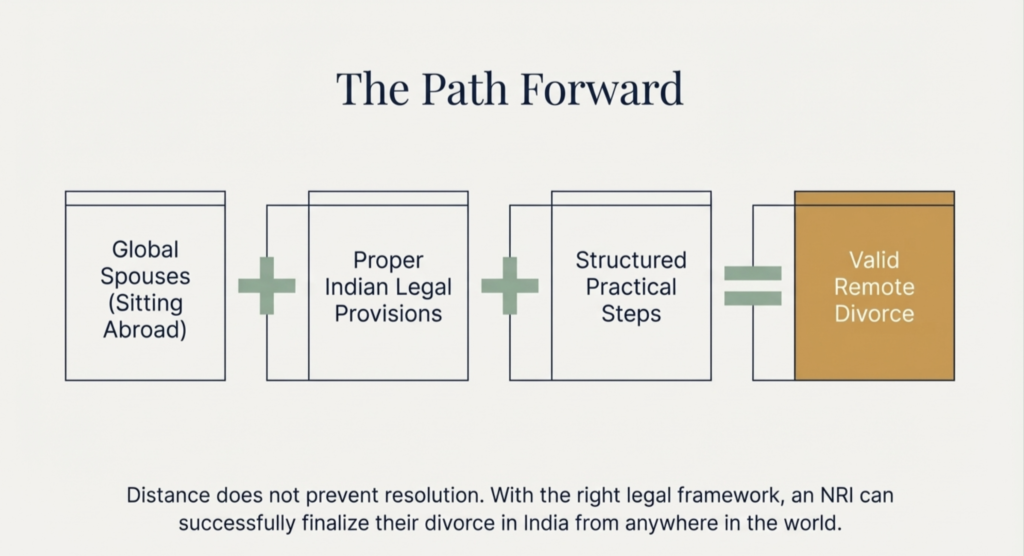
An NRI can legally obtain a divorce in India while staying abroad, and they do not need to travel to India for every court hearing. By confirming the jurisdiction of the court, appointing a lawyer through a special power of attorney and following the legal procedure under the Hindu Marriage Act, 1955, the divorce process can be completed smoothly. Although the situation may feel stressful and complicated, the Indian Law provides enough flexibility to ensure that distance does not prevent a person from seeking justice and moving forward in life.
This blog is for informational purposes only, it is advised to seek professional help for any legal advice.
NRI Legal world can be contacted for any legal advice at info@nrilegalworld.com or +91 9709692096
Frequently asked questions
Q.) Can an NRI woman/man get divorce if the marriage took place abroad?
Ans.) Yes, an NRI can get divorce in India even if the marriage was solemnized abroad, but only if the Indian courts have jurisdiction over the marriage. The place of marriage alone does not decide the matter. Indian courts look at factors like citizenship, residence, matrimonial home and connection with India before allowing divorce under Indian law. The Indian court may accept the case in following scenarios:
- If the marriage is registered in India
- One of the spouses is Indian citizen
- Husband/wife lives in India
- Last matrimonial home was in India
- Marriage was governed by Indian law
- Parties follow Hindu law
The Indian courts may not accept the case if:
- Both spouses are foreign citizens and have foreign citizenship
- The couple never lived in India
- Marriage is not governed by Indian law
- No connection with India
Q.) Do the NRIs have to take divorce in India if they have already taken divorce in abroad?
Ans.) NRIs do not always have to take divorce in India if they have already taken divorce abroad, but it is important to check whether that foreign divorce is valid in India or not. If the foreign divorce is not valid in India, then the parties may have to take divorce in India as well to avoid legal problems later. The validity of foreign divorce in India is decided under section 13 of the Code of Civil Procedure, 1908.
A foreign divorce will be recognized in India in the following cases:
- If the foreign court had proper jurisdiction
- Both husband and wife participated in the case
- Divorce was given under the grounds recognized under Indian law
- Decision was not obtained by fraud
- Judgement is not against Indian public policy
Q.) Why the recognition of foreign divorce is important in India?
Ans.) Even if divorce is taken abroad, there might be chances that the divorce might not be recognized valid in India and problems may arise in India in future such as:
- Remarriage in India
- Property disputes may arise
- Inheritance matters may occur
- Criminal complaints
- Matrimonial cases
If the foreign divorce is not recognized in India, the person may legally still be considered as married in India. Therefore, it is essential to take a divorce in India as well if the foreign divorce is not recognized as valid in India.
Q.) Is it necessary for an NRI to come to India for every court hearing?
Ans.) No, it is not necessary for an NRI to come to India in every case. Indian courts may allow NRIs to be represented through a lawyer or a Special Power of Attorney. In many situations, the Indian courts may also allow the appearance or statement recording through video conferencing, especially in mutual consent divorce cases.
Q.) How can an NRI file for divorce if the spouse does not agree for divorce?
Ans.) If the spouse does not agree for divorce, then the NRI can file a contested divorce in India on legal grounds such as cruelty, desertion, fraud, harassment, etc. The case may take more time, but the divorce can still be filed even if the spouse is living in abroad.
Comments are closed