
A key legal question is if an NRI daughter-in-law has any rights in her husband’s parental property in India. This is particularly relevant when determining the property rights in case of the husband’s death, widow’s remarriage, and the inheritance of the property.
The answer depends on understanding the inheritance laws under Indian legislation, which is primarily the Hindu Succession Act, 1956 in case the person belongs to Hindu, Sikh, Jain and Buddhist religion. This act clearly defines who will inherit the property and under different circumstances arises after the death of the owner in the absence of any will of inheritance. Judicial interpretations over time have clarified these rights, creating a more structured and predictable legal landscape for inheritance of property.
Nature of a Daughter-in-law’s Right
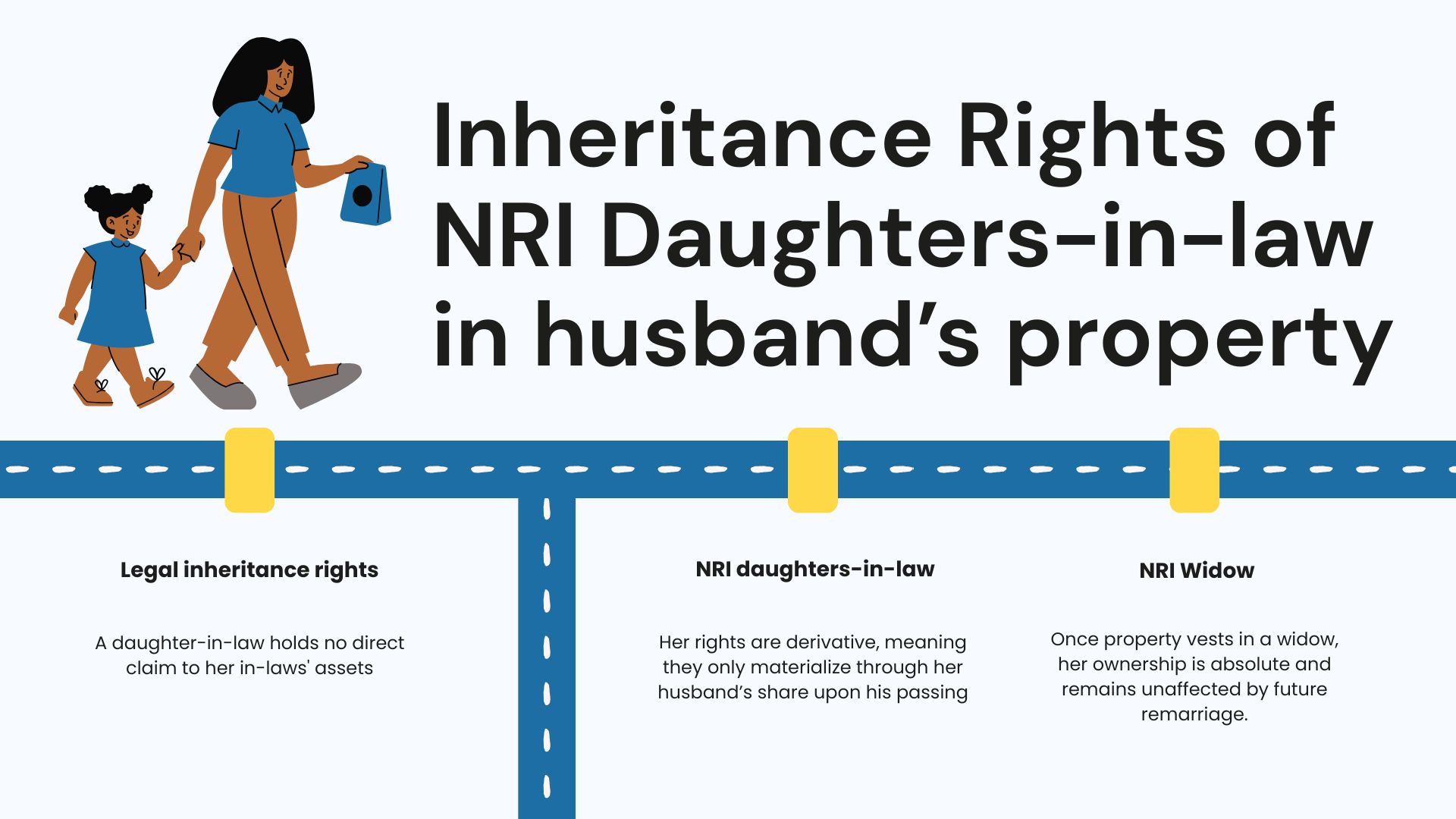
Under Indian law, a daughter-in-law does not have any independent or direct right in the property of her in-laws. Her claim is not solely based on marriage. Instead, her rights are derivative in nature, which means her rights in her in-law’s property flow through her husband.
While her husband is alive, she cannot claim any share in her father-in-law’s property, regardless of whether that property is ancestral or self-acquired. The legal position changes upon the death of the husband, and even then, her entitlement is limited to the share that her husband had or would have inherited. This principle prevents indirect claims against the property of in-laws and maintains clarity in succession.
Courts have consistently supported this position. In the case of Bhanwar Singh v. Puran Civil Appeal No. 1233 of 2008, the Supreme Court of India stated that a person can inherit a property only through a legally recognized line of succession, this reinforces that a daughter-in-law cannot claim property directly from her in-laws.
Inheritance Rights in Civil Partnerships and Non-Marital Relationships
It is also important to differentiate legally recognized marriages from other types of relationships, such as civil partnerships or live-in arrangements in the absence of marriage. Under the Hindu Succession Act, 1956, inheritance rights stem only from relationships that are legally recognized as marriage. Therefore, an NRI woman who is in a civil partnership or in live-in relationship or any other similar arrangement with her partner does not acquire the status of a “wife” under the Indian succession law.
Without a valid marriage, she is not considered a legal heir, and she cannot inherit the property of her partner, including his share in ancestral or parental property, unless she is specifically named as a beneficiary in a valid will.
This position highlights that inheritance rights in India are strictly determined by legal status rather than the nature or duration of the relationship.
Position of an NRI daughter-in-law in the line of inheritance
Being a Non-resident Indian (NRI) does not affect inheritance rights. Indian inheritance laws are neutral regarding residency of a person.
- An NRI widow has the same legal status and rights as a widow who is a resident of India
- An NRI widow can inherit, hold and transfer an ancestral property in India if she has a share in the ancestral property of her deceased husband
- An NRI widow can enforce her rights through Indian courts
Under the Foreign Exchange Management Act, 1990, the following conditions apply:
- An NRI widow can inherit ancestral property in India without any prior approval from the RBI or FEMA
- She can freely hold and continue to own the property without any FEMA restrictions
- An NRI widow can sell the property without any approval from the RBI, and agricultural/plantation property inherited by her as ancestral property can be sold only to a resident Indian
- As per FEMA, if an NRI widow sells the inherited property, she can repatriate only up to USD 1 million per financial year, subject to payment of applicable taxes and compliance with banking regulations
Devolution of property after the husband’s death
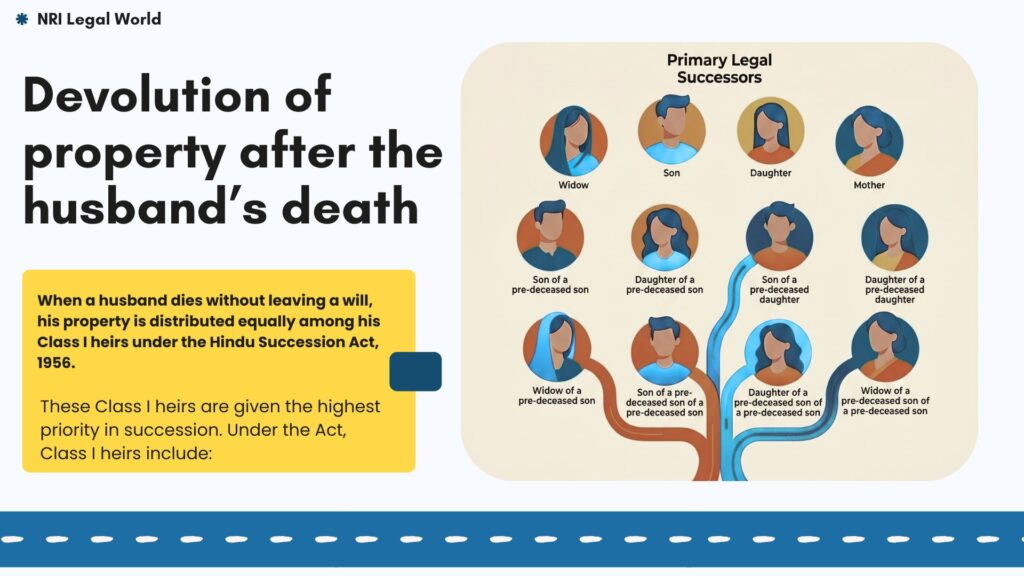
When a husband dies without leaving a will, his property is distributed equally among his Class I heirs under the Hindu Succession Act, 1956. These Class I heirs are given the highest priority in succession. Under the Act, Class I heirs include:
- Widow
- Son
- Daughter
- Mother
- Son of a pre-deceased son
- Daughter of a pre-deceased son
- Son of a pre-deceased daughter
- Daughter of a pre-deceased daughter
- Widow of a pre-deceased son
- Son of a pre-deceased son of a pre-deceased son
- Daughter of a pre-deceased son of a pre-deceased son
- Widow of a pre-deceased son of a pre-deceased son
All these heirs inherit the property of the deceased simultaneously and in equal proportion. The widow, even if she is an NRI, is placed on equal footing with other heirs. Indian law does not discriminate on the basis of residence, and therefore, an NRI widow enjoys the same inheritance rights as a resident Indian widow.
The principle that succession occurs immediately upon death and property rights vest at that moment has been emphasized in the case of Gurupad Khandappa Magdum v. Hirabai Khandappa Magdum Civil Appeal No. 182 828 of 1975. The court held that the share of a deceased coparcener must be determined as if a partition had occurred immediately before his death (notional partition), ensuring that the widow receives her rightful share.
It is essential to note that the widow does not inherit the entire parental property of her husband. She inherits only the share that belonged to her husband, which is then divided equally among all Class I heirs of the deceased.
Distinction based on the nature of the property
The nature of the property plays a crucial role in determining the extent of rights:
- Ancestral or coparcenary property: In ancestral property, a coparcener is a person who has a legal right by birth in ancestral property in a Hindu Undivided Family (HUF). Even if the property is not physically divided, a coparcener is deemed to have a share in ancestral property. Upon the death of the coparcener, his/her share is first determined through notional partition and share devolves upon his/her legal heirs, including the widow and children.
- Self-acquired property of the father-in-law: The daughter-in-law has no direct claim over such property. After the death of the father-in-law, the property is distributed among his own legal heirs. The daughter-in-law can benefit only indirectly, i.e., if her husband had inherited or would have inherited a share. If the husband never had any share in such property, the daughter-in-law cannot claim anything.
- Property governed by a will: Testamentary succession overrides intestate succession. If the husband or father-in-law leaves behind a valid will, then the property is distributed strictly as per the will, and the widow gets a share only if she is named as a beneficiary.
Effect of remarriage of the widow on the inheritance
A significant aspect of inheritance law is the principle of vesting right. The moment the husband dies, the widow’s right to his property vests immediately. This means:
- Her share becomes her absolute property
- Her share cannot be taken away if she remarries after her husband’s death
In Cherotte Sugathan v. Cherotte Bharathi (2008) 2 SCC 610, the Supreme Court of India reinforced that once a property is distributed equally among legal heirs, their rights become absolute over the property and cannot be revoked except by due process of law.
Thus, if the widow remarries after her husband’s death, it does not affect her inheritance rights. Her entitlement remains intact because her rights over her deceased husband’s property had already vested at the moment of her husband’s death.
However, if she had remarried before the husband’s death, she would no longer be considered his legal wife at the time of succession. Therefore, she would not be entitled to inherit any property.
Circumstances where a widow may not get a share in the property of her in-laws
Although the law generally protects the widow’s rights, there are specific situations where she may not be entitled to any share in the deceased husband’s parental property.
- If the husband has left behind a valid will excluding the widow, the property will be distributed according to the will, and she may receive nothing.
- A widow who has remarried before the husband’s death or whose marriage has been dissolved by divorce before the husband’s death loses the legal status of “wife” and therefore the wife cannot inherit the property of the husband.
- In cases where the property is the self-acquired property of the father-in-law, and the husband never had any share or interest in it, the widow cannot claim any portion in that property, as her rights are limited to her husband’s share alone.
- Additionally, in rare cases, a person may be disqualified from inheritance under legal principles, such as where the heir is responsible for the murder of the deceased, in such cases the law bars such a person from benefiting from the succession. In the case of Vellikannu v. R. Singaperumal (2005) 6 SCC 622, the Supreme Court of India applied the doctrine that a person responsible for the death of the deceased cannot inherit the property.
Share of children in succession
Children of the deceased inherit the property as independent Class I heirs. Their right to inherit the property is direct and does not depend on the mother.
Key points:
- Sons and Daughters have equal property rights
- Each child gets an equal share in the property
- The property rights of children in father’s property are unaffected by the mother’s remarriage
The property is divided equally among all heirs. For instance, if the deceased is survived by a widow, two children, and his mother, the estate will be divided into four equal parts, each receiving one-fourth.
The remarriage of the widow does not affect the rights of the children in any manner. Each heir acquires an absolute and independent interest in the property of the deceased.
Absolute nature of inherited property
Once the widow inherits her share in the property, it becomes her absolute property.
After getting the share, the widow has the following rights:
- The widow has full legal authority to deal with the property in any manner
- The widow has the right to sell, gift, transfer, or dispose of the property
- This right is not affected by remarriage or any subsequent personal circumstances
This position was solidified in Eramma v.Veerupana, AIR 1966 SC 1879, where the court recognized the full ownership rights of heirs over property devolved upon them.
In a nutshell, the property rights of an NRI daughter-in-law in India are based on her being the wife of the person who died, not because she is a daughter-in-law. While she has no direct claim over her in-laws’ property, she becomes a rightful heir to her husband’s share upon his death. She can only claim her husband’s share in his parental property after her husband’s death.
Her rights remain protected irrespective of her NRI status, and these rights are not extinguished by remarriage after the husband’s death. However, these rights are subject to certain limitations, particularly where a valid will exists, where the marital relationship has ceased before death, or where the husband himself had no inheritable interest in the parental property.
This legal framework ensures clarity and fairness in succession matters, especially in modern cross-border arrangements.For more information regarding the issue contact NRI Legal World: info@nrilegalworld.com / +919709692096
Frequently Asked Questions
Q.) Does the widow inherit the entire property of her deceased husband?
Ans.) No, the widow does not inherit the entire property of her deceased husband unless she is the sole Class I heir. As per the Hindu Succession Act, 1956, the property is divided equally among all the Class I heirs. If there are multiple Class I heirs, such as children and the mother of the deceased, then the property is distributed equally among all the heirs. The widow receives only her proportionate share along with other heirs, this ensures equitable distribution among all Class I heirs.
Q.) Can a daughter-in-law claim rights in her father-in-law’s self-acquired property?
Ans.) No, a daughter-in-law cannot claim any direct right in the self-acquired property of her father-in-law. Self-acquired property remains under the absolute control of the owner during his lifetime and the owner is free to dispose of the property as his wishes. After the death of the owner of self-acquired property, the property devolves upon his own legal heirs. The daughter-in-law can benefit from such property indirectly, i.e., if her husband inherits a share in that property, and after the husband’s death she can inherit his portion or share of the property.
Q.) In what situations can a widow be denied a share in property?
Ans.) A widow may be denied a share in certain specific situations. These include cases where a valid will excludes her, where the marriage has been legally dissolved before the husband’s death, or where she had remarried prior to the husband’s death. Additionally, if the husband himself had no share in the property, the widow cannot claim any share or portion in the property. In rare cases, legal disqualification may arise, such as when a person involved in the death of the deceased, the law prevents such a person from inheriting property.
Q.) Can a widow claim her share in Indian property while living abroad?
Ans.) Yes, an NRI widow can claim her share in property situated in India even while residing abroad. She can initiate legal proceedings in Indian courts through a power of attorney or legal representative. Indian courts have jurisdiction over property located within India, regardless of the residence of the parties.
Q.) What happens if the widow remarries before the husband’s death?
Ans.) If the woman had remarried before the death of her husband, she would no longer be considered his legally wedded wife at the time of succession. Since inheritance rights depend on the legal relationship existing at the time of death, she would not qualify as a “widow” under the Indian law. Consequently, she would not be entitled to inherit any share in the husband’s property.