
Understanding everything about the Proclaimed Offender case against NRI under the Indian law (the BNSS, 2023, earlier these proceedings used to be under section 82 of the criminal procedure code, 1973).
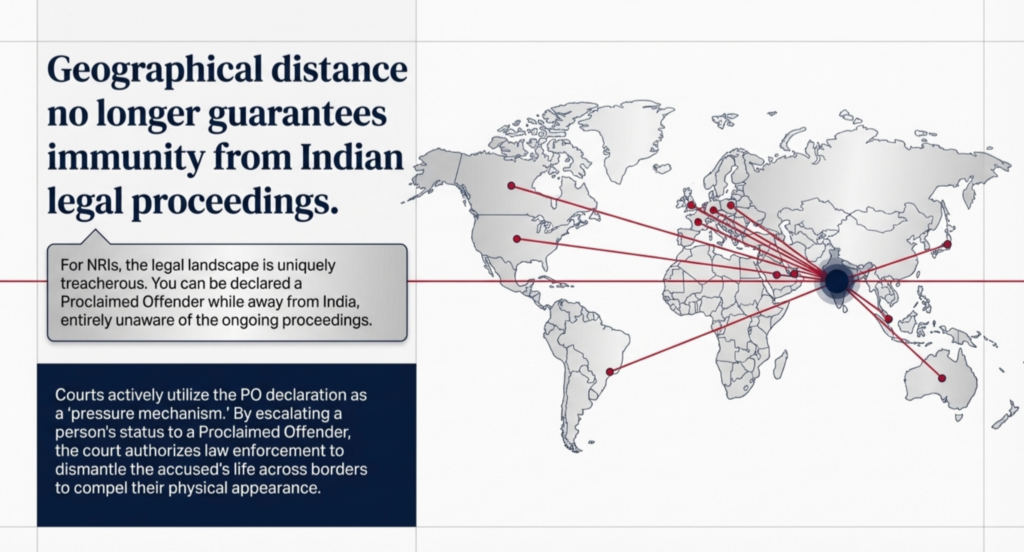
The term “Proclaimed Offender” carries a serious weight. It represents not just a legal label, but a situation where the justice system is forced to chase someone who is deliberately avoiding the law. A Proclaimed Offender (PO) is a person who is accused of hiding (absconding) after committing an offence and does not appear before the court or police even after several notices and warrants are issued. It is a legal declaration by the court that a person is intentionally avoiding arrest and is absconding after committing an offence.
But behind this legal term, there are real human stories- people who panic and disappear out of fear, those who misuse the system to harass others and those who escape to avoid accountability are declared proclaimed offenders. However, in case of NRIs things become more complicated. NRIs can be declared a proclaimed offender while they are away from India and are sometimes not even aware about the fact that a case has been registered against them in India. Understanding what it means to be an NRI proclaimed offender is of utmost importance.
Circumstances under which a person can be declared a Proclaimed Offender
A whole procedure is followed by the courts and the police before declaring a person a proclaimed offender. The process is given below:
- Issuance of Summons: Initially, summons are issued in the name of the offender to join the investigation.
- Issuance of bailable warrants: If the person fails to appear in front of the court or the police. After which a bailable warrant is issued.
- Issuance of non-bailable warrants: If the accused person fails to appear in the court or does not join the investigation, a non-bailable warrant is issued and the police are given the instructions to arrest the person and present him in the court. If the accused is not found and the police report that the accused has absconded or is deliberately avoiding arrest.
- Issuance of Proclamation order: The Court issues a proclamation order of the accused under the Section 84 of BNSS. The court publishes the proclamation orders as a public notice requiring the accused to appear within 30 days. This notice is pasted at the house of the offender, on the prominent places in the locality, and it may also be published in newspapers.
- Declaration of proclamation order: The accused still does not appear after several notices and the person still does not come before the court/police within 30 days, then the court can declare that person as a proclaimed person (for normal offences) or proclaimed offender (for serious offences listed under section 86 of BNSS).
Service of summons to NRIs living abroad
Here is the procedure of serving summons abroad:
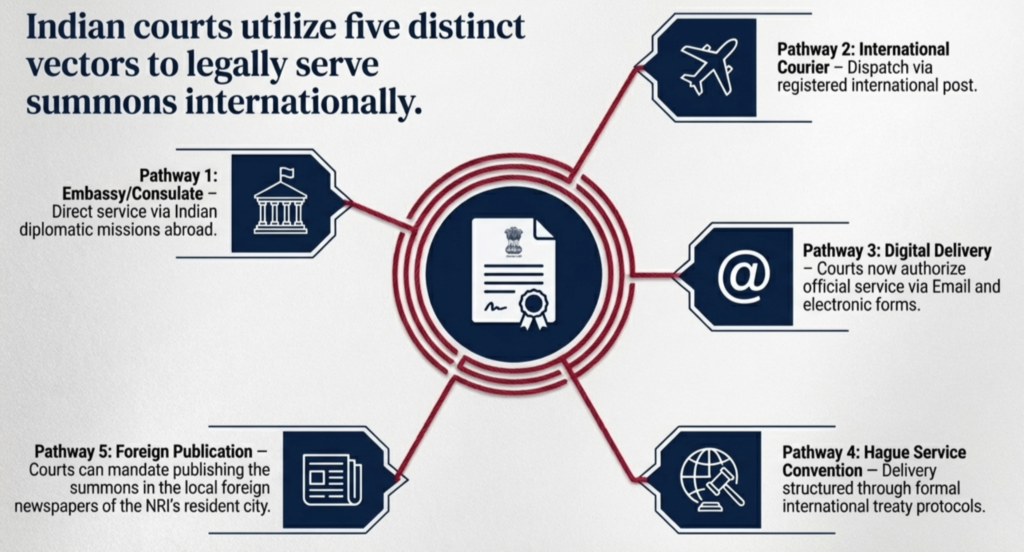
- Through embassy/consulate: The Indian embassy or consulate can serve summon to the NRI person
- Through Registered international posts or courier: The court sends the summons to the NRIs who are residing abroad through international posts or courier
- Through Email or electronic forms: The court allows service of summons through email
- Hague service convention: The summons can be delivered under Hague service convention
The courts can add additional steps to serve the summons abroad like publishing the summons in foreign local newspapers.
Reasons behind declaring a person a proclaimed offender:
Proclamation order is issued to:
- To compel the accused to appear before the court, this is used as a pressure mechanism by the court
- To allow police to take a stronger action towards the accused, after PO declaration, police can attach or seize the property of the accused, raid the house of the accused, freeze his/her bank accounts, publish photos publically, etc.
- To legally justify the accused’s absconding status, this helps police in filing a chargesheet for a PO, non- cooperation etc. against those who are intentionally helping him.
Consequences of being declared a Proclaimed Offender in case of NRIs
Once a person is declared a proclaimed offender:
- Police get enhanced powers to arrest a proclaimed offender immediately
Once the court declares someone a proclaimed offender, the police can:
- Arrest the person anywhere, anytime, without needing a fresh warrant.
- Police can conduct the raids in a more free manner.
- The police can trace phone, location, and bank activity with permission from the court.
- The police can coordinate with the police of other states and even with immigration in case the person is an NRI.
- Property attachment can occur in Proclamation status (section 85 BNSS)
After Proclamation the court can authorise the police to seize the properties and other assets of the proclaimed offender – a person’s movable and immovable property can be attached with the case. This is done to compel the accused to appear in front of the court/police. The courts can attach the properties of proclaimed offenders either temporarily or it can be confiscated if the person continues not to appear in the court / police. Hence, the property can be forfeited.
NRI can take legal remedy to defend the confiscation of his property.
- The police can post a name on public boards
A name, address and case details may be published for the public eye. The details can be:
- Displayed in public areas.
- Published in newspapers.
- Circulated in your locality.
- Shared with village panchayat in the village or resident welfare association (RWA) in the urban settings.
- Issuance of the Look-out circular (LOC)

For NRIs, the most serious consequence is the Look-out Circular (LOC), which empower the authorities to stop the person at:
- Airport immigration /Entry or exit points
- Foreign travel systems
- The person may be detained
- The person may even be arrested as soon as landed at the airport.
- The tag of an absconder:
Once declared a proclaimed offender, the authorities legally consider the person as an absconder.
- The bail becomes hard in the proclaimed offender status:
Once the proclaimed offender order is passed by the court it is seen in the light of dishonour of the respectable courts. It is seen as a contempt of court. Hence, the physical appearance in the court becomes a quintessential. In case the declared proclaimed offender applies for the bail it is most likely that the bail could be rejected by the court.
- Impact of Proclaimed offender order on the Indian living aboard/ NRI
Once a person who is based in a foreign country, either temporarily or permanently, is declared a proclaimed offender can face another set of complications. Few of which are mentioned below:
- The Police may inform the passport authorities regarding proclaimed offender status of the person living abroad.
- The Indian authorities may impound the passport.
- The Indian authorities may raise objections to the renewal of visa from abroad.
- Foreign employment may be affected due to visa objections raised by the law enforcing authorities in India.
- The extradition of the proclaimed offender is possible from the countries who are signatory partners on extradition treaties.
- Stigma and Social Impact
Being declared a proclaimed offender damages the reputation and social standing of the person in his community leading to adversely affecting the financial, matrimonial and social prospects.
Legal remedy for NRI Proclaimed Offender
The appropriate legal strategy varies from case to case as the details are different for each and every case. It is recommended for the NRI proclaimed offender to always consult a professional legal advisor before proceeding further on his case. The NRIs should never ignore or delay seeking the expert opinion for resolving the matter. Here are some key points for the general information.
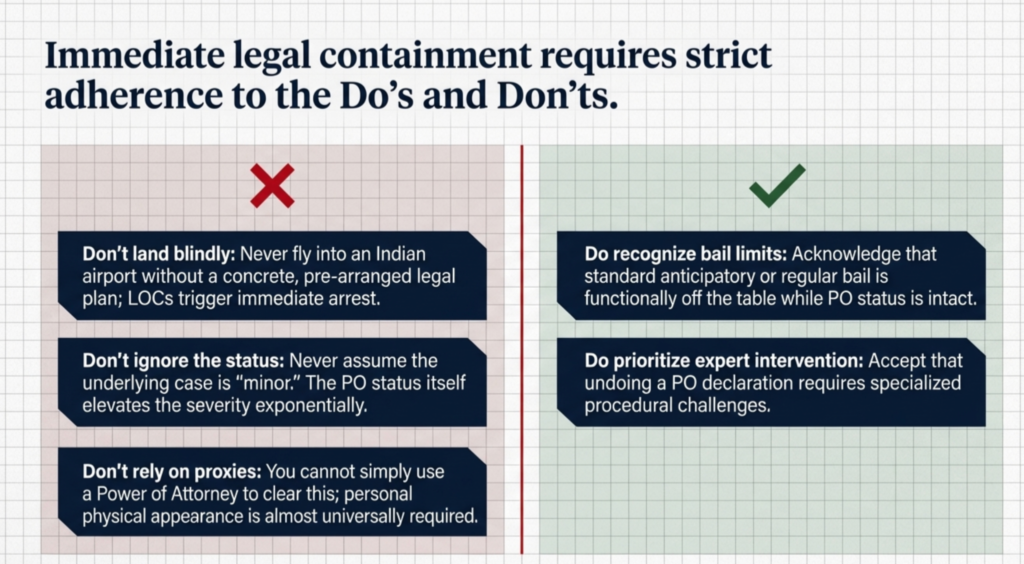
- Seeking bail can be hard in PO cases. Neither anticipatory bail nor the regular bail can be taken as a legal remedy as the courts tend to reject bails while the Proclaimed offender status is intact. The ideal legal strategy for the NRI who is declared a proclaimed offender is that the NRI can challenge the proclamation order after seeking the expert legal advice.
- The NRI can voluntarily surrender in the court and can join the investigation after proper legal consultation.
Tips for NRI who is declared a Proclaimed Offender
- Don`t land at the airport without any legal plan
- Don`t ignore PO status thinking “case is minor”
- Can’t use power of attorney—personal appearance is usually required in proclaimed offender cases
IMPORTANT: NRI should proceed further only after seeking professional legal advice.
This blog is for general information only. To know more on the topic you can contact info@nrilegalworld.com / Call us at +919709692096
Frequently Asked Questions
Q) Can an Indian court declare an NRI a proclaimed offender ?
Ans: Yes, an Indian court can declare an NRI proclaimed offender if they ignore the court summons.
Q) Can an NRIs be declared a proclaimed offender in India even if he is living abroad?
Ans: Yes, the NRI can be declared a proclaimed offender in India under the Bhartiya Nagarik Suraksha Sanhita 2023, even while residing abroad. If the NRI ignores the summons of the court or NRI does not join the ongoing investigation of the case where he/she is required then the authorities start the proceedings of proclamation.
Q) can an NRI get anticipatory bail in a proclaimed offender case?
Ans: NRI or any resident Indian getting the anticipatory bail in proclaimed offender case is a rare or exceptional circumstance only. We can say that it is generally seen that anticipatory bail is not granted in proclaimed offender cases.
Q) How can an NRI not get arrested in a proclaimed offender case in India?
Ans: An NRI who is declared a proclaimed offender should seek legal help to avoid arrest by engaging a professional and expert lawyer.
Q) When can the police arrest an NRI as soon as he lands at the airport?
Ans: Yes, the police can arrest an NRI if they land at the airport in India, and the look-out circular or non-bailable proclaimed offender warrant is issued on his name.
Comments are closed