
Maintenance and alimony are essential components of matrimonial law in India, which are designed to ensure that a financially dependent spouse is not left destitute after separation or divorce. These provisions exist under statutes such as the Hindu Marriage Act, 1955, the Special Marriage Act, 1954 and Section 125 of the Code of Criminal Procedure, 1973.
However, the right to maintenance is not absolute. Indian law clearly lays down specific statutory disqualifications and judicial principles under which a spouse may be denied maintenance or alimony. Among the most significant limitations is the situation where a spouse chooses to live separately without sufficient cause – a ground that has repeatedly come under judicial consideration.
Separation without any sufficient cause and its legal consequences
A recurring issue before courts in maintenance proceedings is the entitlement of a spouse who is living separately from the other. The law does not grant maintenance merely based on separation, rather it examines the reason behind such separation. A spouse who chooses to live separately without any “sufficient cause” cannot claim maintenance under Section 125 of the Code of Criminal Procedure (now Section 144(4) BNSS).
This principle flows directly from section 125(4) of the Code of Criminal Procedure (now Section 144(4) BNSS), which disqualifies a wife from receiving maintenance if she refuses to live with her husband without any reasonable justification.
Thus, the focus of the law is not merely on whether the parties are living separately, but why they are living separately.
Understanding the “Sufficient Cause” For Separation
Sufficient cause means a legally valid, reasonable and justifiable ground for a spouse (usually the wife) to live separately from the husband. It is not defined in the statute, so courts interpret it based on:
- The facts of each case.
- The conduct of parties.
- The evidence presented to the court.
Valid grounds for divorce in India
Courts have recognized the following as valid grounds for separation and divorce:
- Physical or mental cruelty to the spouse
- Domestic violence
- Dowry harassment with wife
- Husband’s extramarital relationship
- Threat to the safety, dignity or life of the spouse
In such circumstances, the spouse is justified in living separately and retains the right to maintenance.
Lack of valid ground for the separation of the couple
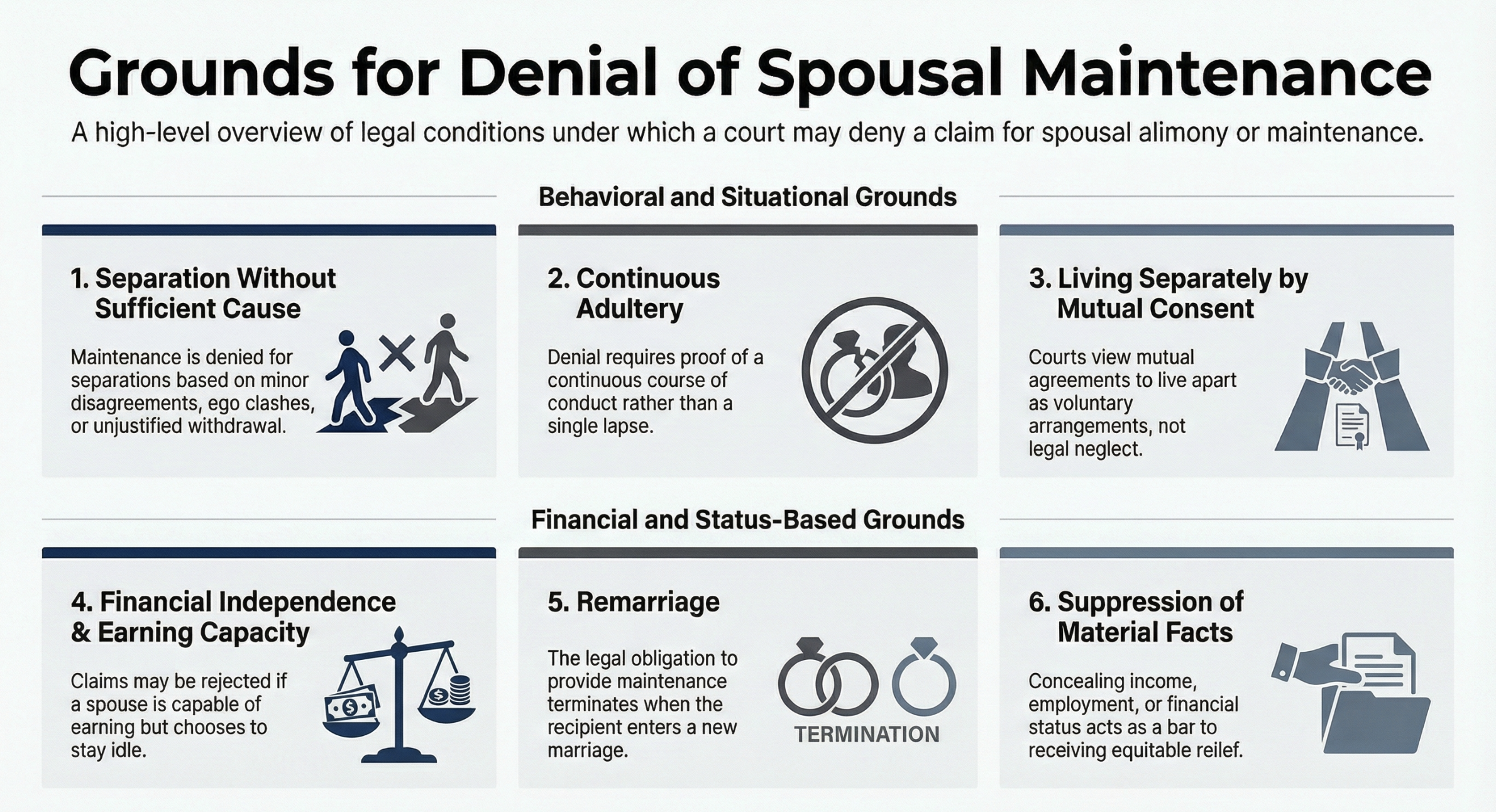
On the other hand, courts have denied maintenance where separation lacks a valid ‘sufficient cause/ground. The invalid sufficient cause could mean any of the key points given below:
- Minor disagreements or routine marital discord
- Ego clashes or incompatibility
- Voluntary withdrawal without any justification
- Unproven or false allegations
Thus, mere dissatisfaction with marital life does not entitle a spouse to claim maintenance while living apart.
Burden of proof and evidentiary requirement
A key aspect in such cases is the burden of proof:
- The claimant spouse (who is seeking the maintenance) must establish in the court, by providing sufficient evidence, a valid and sufficient reason for living separately from the estranged spouse.
- The opposing party has the legal right to rebut the claimant’s allegations by showing the absence of cruelty or willingness to cohabit through evidence.
Courts insist on credible evidence, as mere allegations are insufficient to justify the separation.
Judicial Approach
Indian courts adopt a balanced approach while dealing with such cases, to protect genuinely aggrieved spouses. The Indian courts also aim to prevent the misuse of maintenance provisions. Maintenance is a remedy for genuine need arising out of justified circumstances, not a right flowing from unjustified separation from the spouse.
Landmark case law – Amit Kumar Kachhap v. Sangeeta Toppo in the High Court of Jharkhand at Ranchi Cr. Revision No. 512 of 2023
Chronology of events in the case:
- The wife (Sangeeta Toppo) filed an application under section 125 of the Code of Criminal Procedure seeking maintenance from her estranged husband
- The Family Court in Ranchi allowed her to claim and directed he husband to pay Rs.15,000 per month as maintenance
- The husband (Amit Kumar Kachhap) challenged this order before the Jharkhand High Court.
- The husband contended that the wife left the matrimonial home without any valid reason, which is why she is not entitled to claim maintenance under section 125(4) CrPC
- The wife contended allegations of cruelty, neglect and extramarital relationship by the husband
Judgment:
The Jharkhand High Court allowed the husband’s revision petition and held that a wife who is residing separately without any sufficient cause is not entitled to claim maintenance under section 125(4) CrPC. The court examined evidence from both sides and found that the wife failed to prove valid justification for leaving the matrimonial home. Her allegations lacked evidentiary support, so the court concluded that the wife was residing aloof from the husband without any reasonable cause and hence she is disentitled to claim maintenance. The maintenance order of granting Rs.15,000 per month was set aside by the court.
Other conditions where maintenance is denied
- Adultery – Under section 125(4) CrPC, a wife is not entitled to maintenance if living in adultery. It must be continuous adulterous conduct, not a one-time lapse, and the burden of proof lies with the other spouse. The principle is that maintenance is meant to support a legally recognised relationship, and continued adulterous conduct breaks the foundation of that claim.
In the case of Kanchan v. Kamalendra AIR 1992, the Supreme Court of India clarified that adultery must be clearly proved through evidence and it must reflect a continuous course of conduct. Once established, it acts as a complete bar to maintenance.
- Living separately by mutual consent – where both spouses agree to live separately, the element of neglect and refusal disappears. Section 125 CrPC is designed to protect a spouse who is neglected, not the one who voluntarily agrees to separation.
Thus, if separation is by mutual consent:
- Maintenance may not be granted unless agreed upon by the parties
- Courts treat it as a voluntary arrangement, not a legal wrong
If the spouse stops paying maintenance agreed in a mutual consent separation, then the other spouse can enforce the settlement through execution proceedings or claim maintenance independently, as such agreements are legally binding once recorded by the court.
- Financial independence – Maintenance is based on the inability to maintain oneself, not merely on the existence of the marriage. Courts closely examine whether the claimant is financially dependent or not. If the spouse has sufficient income or if the spouse is capable of earning and sustaining themselves, then the maintenance may be denied or reduced by the court.
In the case of Mamta Jaiswal v. Rajesh Jaiswal DMC170 (2000), the court held that an educated and capable spouse cannot deliberately remain idle. Maintenance is meant for support, not for creating dependency by choice. This case highlights the expectation that individuals must make reasonable efforts to be self-reliant
- Remarriage – Under Section 25 of the Hindu Marriage Act, maintenance ceases upon remarriage. The principle is that remarriage creates a new legal relationship of support, thereby extinguishing the previous obligation. Courts may terminate maintenance or modify earlier orders in case of remarriage. It applies to both spouses.
- Suppression of material facts – Maintenance is an equitable relief, requiring full and honest disclosure. If a spouse conceals income, hides employment or misrepresents financial status, the court may reject the claim. This is because maintenance decisions depend heavily on accurate financial disclosure, and any suppression undermines the fairness of the process.
Maintenance claims by husband under Indian law
Maintenance under Sections 24 and 25 of the Hindu Marriage Act is gender-neutral. However, a husband is not entitled to claim maintenance in the case, where either he is capable of earning enough to sustain himself, but deliberately chooses to stay unemployed or he has sufficient means of income to sustain a healthy lifestyle.
Thus, the principle remains consistent that maintenance is based on dependency, not gender.
Key points for NRIs
- The reason for separation is central to seek maintenance from the spouse
- In the absence of a “sufficient cause” the court may deny maintenance
- Courts require evidence – based justification, mere allegations are not legally valid, hence the reason for separation must be justified
- Maintenance is a measure of social justice, it is granted only where genuine need and fairness exist
- Courts consider the conduct of parties, financial capacity and reason for separation while deciding the case
To conclude, the Indian matrimonial laws ensure protection for dependent spouses while preventing the misuse of maintenance provisions. At the same time the requirement of a sufficient cause serves as a critical legal threshold that distinguishes genuine claims from unjustified ones. The statutory exceptions under section 125(4) CrPC, along with evolving judicial interpretations, create a balanced framework that prevents unjust claims while safeguarding the genuine ones. The law makes it clear that the right to maintenance arises not from mere separation but from justified separation supported by evidence, fairness and necessity.
For more information about the topic contact NRI Legal World: info@nrilegalworld.com / +919709692096
Disclaimer: This blog is for information purpose only. Always seek professional legal advice before taking any legal advice.
Frequently asked questions
Q.) Can a husband claim maintenance from his wife in divorce cases?
Ans.) Yes, a husband can claim maintenance from his wife in divorce cases under Indian law, but it depends on specific conditions. Under the Hindu Marriage Act, 1955, either husband or wife can claim interim maintenance during the case as per Section 24 of the act, and either spouse can claim permanent alimony after divorce as per Section 25 of the act. A husband can seek maintenance if:
- He is unable to maintain himself because of a lack of sufficient income or financial resources
- Wife is earning more and is financially stronger than the husband, courts look at comparative financial status
- If there is a genuine incapacity, such as illness, disability, or unemployment despite many efforts
The maintenance can be denied to the husband if:
- He is qualified but deliberately remains unemployed
- He has sufficient earning capacity
- He is trying to avoid his own responsibility
Q.) Can a wife seek monthly maintenance from an NRI husband?
Ans.) Yes, a wife can seek monthly maintenance from an NRI husband under the Hindu Marriage Act, 1955 (sections 24 and 25), the Special Marriage Act, 1954 (if the marriage was inter-religious), the Domestic Violence Act, 2005 (in case of domestic violence) or Section 144 of the BNSS.
Indian courts can assume jurisdiction in NRI cases if:
- Marriage was solemnized in India
- Either spouse is residing in India
- Parties last lived together in India
The courts can order the NRI husband to pay monthly maintenance after considering his foreign income, his cost of living abroad and family responsibilities. Living abroad does not protect a husband from maintenance liability.
Q.) What should a husband do if he does not want to give maintenance to his wife?
Ans.) A husband cannot simply refuse to pay maintenance, he must legally contest it. If he wants to avoid or reduce liability, he should focus on proving valid grounds before the court. He should contest the maintenance claim in court under applicable laws, such as the Hindu Marriage Act, 1955, or the Code of Criminal Procedure, 1973. The husband needs to prove legal grounds for denial, such as:
- Wife is living in continuous adultery
- Wife is living separately without any sufficient cause
- Wife has sufficient sources of income to sustain a healthy lifestyle
- Disclose his true financial status to show inability to provide maintenance
- Provide evidence such as documents, messages, witnesses, etc. to support his defense
If a husband ignores the court orders to provide maintenance, it can lead to serious legal consequences, such as recovery proceedings may take place, salary or property can be attached by the court and in some cases, it can also lead to imprisonment. The law does not allow “avoidance”, it only allows justified refusal through evidence.
Q.) How can a wife get maintenance for a lifetime from her husband?
Ans.) A wife can seek lifetime maintenance (permanent alimony) through a proper legal order. It is not automatic, but it can be granted based on need and circumstances. Under the Hindu Marriage Act, 1955, Section 25 allows the court to grant permanent alimony, which can be monthly or a one-time lump sum amount. To get a lifetime maintenance, the wife should prove that:
- She is unable to maintain herself
- Husband has sufficient sources of income
- There is a clear financial imbalance between the two spouses
- Her standard of living during marriage should be maintained
Maintenance may continue till her lifetime only if:
- She does not remarry
- She remains financially dependent
- No major changes in circumstances occur
The husband can apply for the modification and cancellation of maintenance if circumstances change later, for example, if the wife starts earning later or if she remarries, then the husband can apply for cancellation or modification of maintenance.
Comments are closed