
Obtaining a firearm licence in India is not a matter of right, Indian law regulates firearms very strictly to ensure public safety and prevent their misuse. Every application is examined carefully by the licensing authority, and a licence is granted only when the applicant satisfies the legal requirements laid down under the Arms Act, 1959 and the Arms Rules, 2016 in India.
The possession, acquisition, carrying, manufacturing, sale, transfer, import, export, and use of firearms in India are governed by the Arms Act, 1959 and the Arms Rules, 2016. These laws were enacted to strike a balance between an individual’s legitimate need to possess a firearm and the larger objective of maintaining public safety and law and order. The licensing authority is empowered to examine every application individually. Even if an applicant satisfy the basic eligibility conditions, the authority must still be satisfied that granting a firearm license is appropriate in the circumstances of the case. Therefore, no applicant including an NRI is automatically entitled to receive a firearm license.
Can an NRI Obtain a Firearm License in India?
Yes, an NRI can obtain a firearm licence in India only if he/she is an Indian citizen. It is important to understand that the Indian law does not define any separate set of rules, requirements and categories exclusively for NRIs for the purpose of issuing the firearm licences.
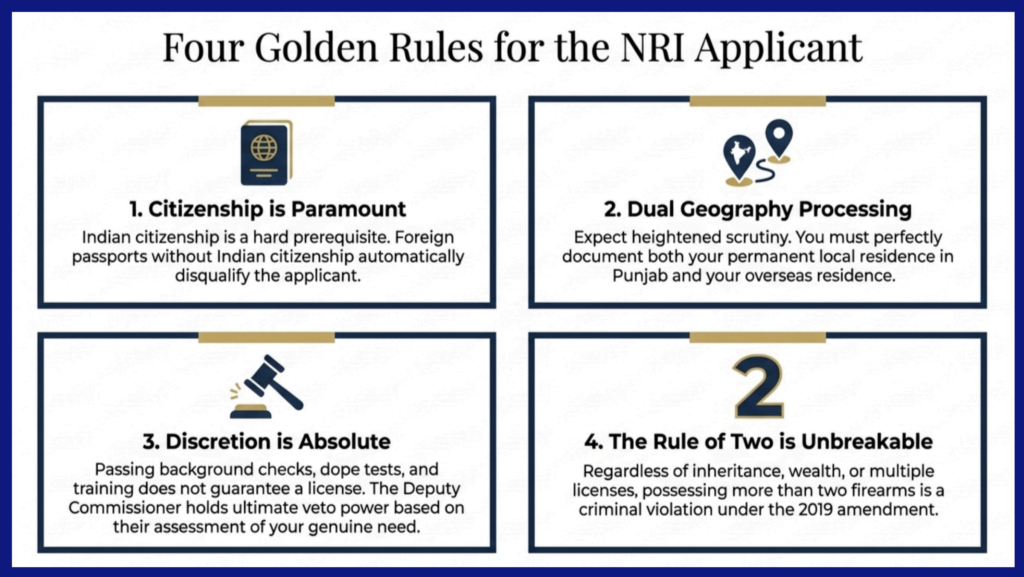
NRI applications are considered under the same legal framework applicable to other eligible Indian residents/citizens. However, because an NRI resides outside India, the licensing authority may conduct additional verification regarding the applicant’s identity, residence, purpose of obtaining the license, criminal background, and overall eligibility before making a decision. Merely owning property in India, having family members in India, or visiting India frequently does not automatically qualify an NRI for a firearm license.
Eligibility Criteria for an NRI to Obtain a Firearm License in India:
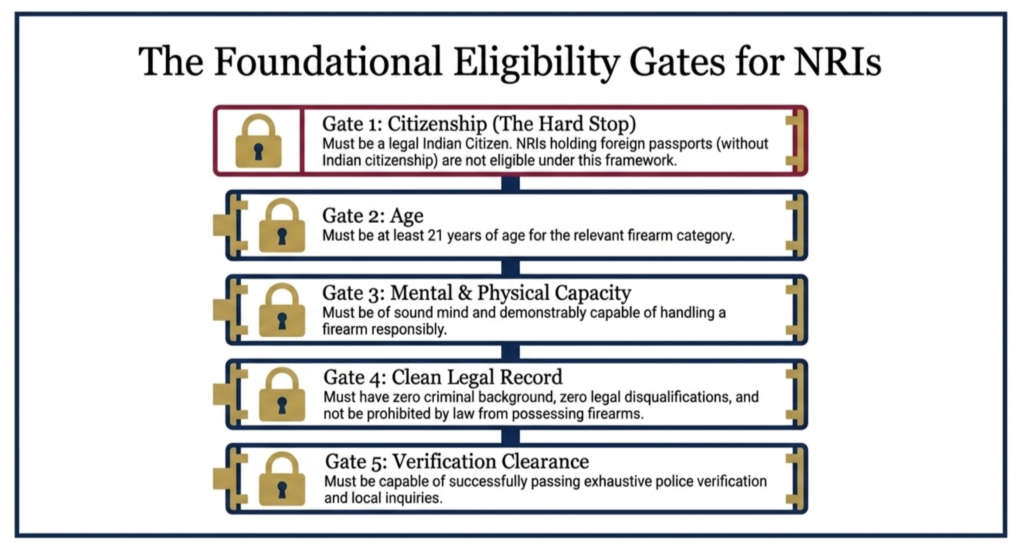
The Arms Act lays down certain conditions that every applicant must satisfy before a firearm license can be granted.
- An applicant should be an Indian citizen eligible to apply under the Arms Act.
- An applicant should be at least 21 years of age for the relevant category for firearm license.
- An applicant must be sound mind and capable of handling a firearm responsibly.
- An applicant should not be prohibited by law from possessing firearms.
- Applicants do not have a criminal background or other legal disqualifications that may affect the eligibility.
- An applicant successfully completes a police verification and any other enquiries conducted by the licensing authority.
Documents required for an NRI for applying a Firearm License in India:
The Arms Act, 1959 and the Arms Rules, 2016 do not prescribe a separate list of documents specifically for NRIs. The documents required may vary depending on the State or Union Territory and the facts of each application. Additionally, the licensing authority has the power to seek any further information or documents that it considers necessary before deciding the application.
An NRI applicant should be prepared to submit the following documents:
- Duly Filled Firearm License Application Form: The applicant must submit the prescribed firearm license applicant form, complete in all respects. All personal details, contact information, and the purpose for seeking the license should be failed in accurately. Providing false or incomplete information may result in the rejection of the application.
- Passport-Size Photographs: Recent passport- size photographs of the applicant must be submitted as part of the application. These photographs are used for identification and official records maintained by the licensing authority.
- Valid Indian Passport: A copy of the applicant’s valid Indian passport serves as proof of identity and Indian citizenship. Since NRIs reside outside India, the passport is one of the most important documents for verifying their identity.
- Proof of Indian Citizenship: In case the applicant is a Non Resident Indian, documentary proof establishing Indian citizenship is required. This is an essential requirement because the licensing authority must verify that the applicant is legally eligible to apply under the applicable provisions of law.
- PAN Card: A copy of the permanent Account Number card is generally required as an identity document and may also assist in financial and background verification during the application process.
- Aadhar Card (Where applicable): If the applicant possesses an Aadhar card, it may be submitted as an additional proof of identity and address. However, its requirement may vary depending on the applicable State Government procedures and the circumstances of the case.
- Proof of address in India. The licensing authority requires proof of the applicant’s address within India. This may include documents such as electricity bills, property documents, rental agreement, or any other acceptable proof of residence.
- Proof of Overseas Residence: The applicant should also provide documentary evidence of their residential address outside India. This enables the licensing authority to verify the applicant’s overseas residence and maintain accurate records.
- Proof of Age: The applicant must submit a document establishing their date of birth, such as a passport, birth certificate, or any other officially accepted document.
- Declarations or Undertakings: The licensing authority may require the applicant to furnish declarations or undertakings relating to the safe custody and lawful use of the firearm, compliance with the Arms Act, or any other conditions considered necessary before granting the license.
Procedure for Applying for an Arms Licence in Punjab, India
The process of obtaining an arms license in Punjab is governed by the Arms Act, 1959, the Arms Rules 2016, and the licensing procedure followed by the Punjab Government. The applicants must satisfy the prescribed eligibility conditions and undergo a thorough background verification before a licence is issued.
 NRI Legal World
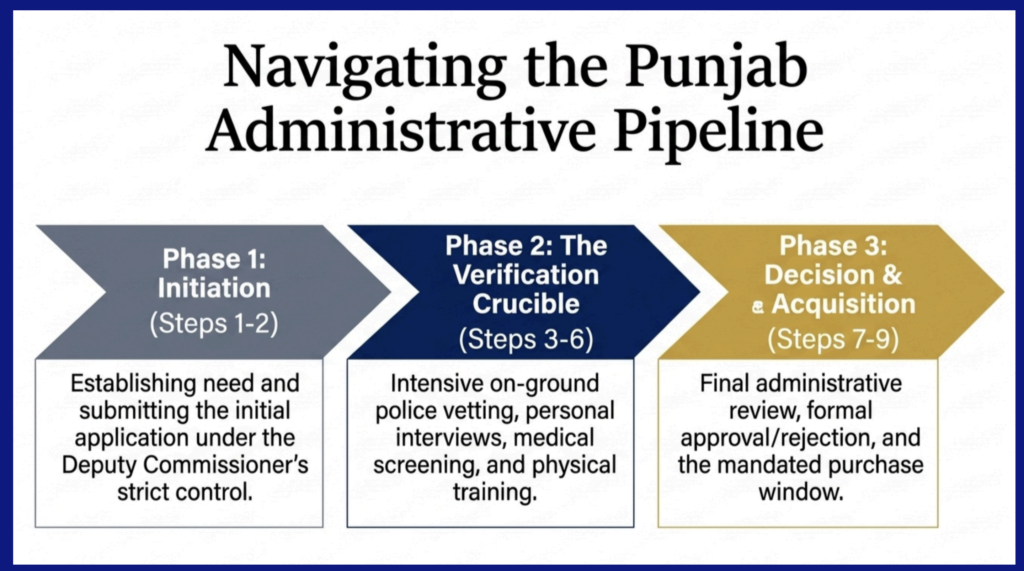
- Step 1. Check Your Eligibility. Before applying for a Firearm license ensure that you are at least 21 years of age on the date of application. You must be an Indian citizen and you can apply in the District where you are a permanent resident. You must have a genuine reason for seeking an arms license, such as self-defence, crop protection, or sports shooting.
- Step 2. Obtain and Submit the Application: The application form can generally be obtained from the Sewa Suvidha Kendra (citizen Service Centre) in your district but there is a strict control on it, which is done by the Deputy Commissioner (DC) of the District concerned. In a way the application for issuance of Firearms license is given to the applicant on the discretion of the Deputy Commissioner. The completed application must be submitted along with the prescribed fee and supporting documents.
- Step 3: Police Verification: After the application is submitted, the Deputy Commissioner’s office, it is forwarded to the Senior Superintendent of Police (SSP). The SSP then gets it verified through the Deputy Superintendent of Police (DSP) and the SHO concerned.
- Step 4. Training to handle the weapon: The applicant is sent to the authorised training center to learn the handling and firing of the weapon.
- Step 5. Background and Residence Verification: The SHO conducts a detailed inquiry, which generally includes verification of the applicant’s residence, Interaction with neighbours and local residents, assessment of the applicant’s character, criminal record, involvement in unlawful activities, and behaviour. The verification report is submitted through the same channel to SSP. The SSP generally calls the applicant for a personal interview to assess the applicant’s need of license, capability of handling and safety of the weapon.
- Step 6. Medical Examination: Applicants are then required to undergo a drug screening (dope test) in the state of Punjab to establish that they are not hooked to the narcotic or psychotropic substances. Failure to satisfy the medical requirements results in rejection of the application.
- Step 7. Submission of the application as recommended/Not recommended to DC: Once the SSP gets the complete verification report to his satisfaction, the complete file is sent to the office of DC as recommended or not recommended.
- Step 8. Decision on the Application: A licensing authority considers the police verification report, supporting documents, and other relevant factors before deciding whether to grant or refuse the license. Even if all formal requirements are fulfilled, the authority has the discretion to reject the application if the DC is not satisfied that the license should be issued.
- Step 9. Purchase and Registration of the Firearm: Once the arms license is granted, the licensee may purchase a firearm only from an authorised dealer/license holder. The details of the firearm must then be endorsed on the arms license in accordance with the prescribed procedure. The records of the police station and the respective branch in the DC office are updated.
Note: The exact procedure, fees, documentation requirements, and administrative practices may vary slightly from one district in Punjab to another. Applicants should always verify the latest requirements with the concerned District Administration or licensing Authority before submitting their application.
Understanding the important sections of the Arms Act, 1959:
How many Firearms can an NRI Hold in India?
Section 3 of the Arms Act, 1959 governs the acquisition and possession of firearms in India. The law does not create a separate category for NRIs. Therefore, if an NRI is an Indian citizen and is granted a firearm license, the same legal provisions apply to them as to any other license holder.
A Firearm License is Mandatory:
Section 3(1) clearly states that no person can acquire, possess, or carry any firearm or ammunition unless they hold a valid license issued under the Arms Act, 1959 and the Arms Rules, 2016. This means an NRI cannot legally purchase, keep, or carry a firearm in India without first obtaining a valid firearm licence from the competent licensing authority.
Carrying a Firearm without holding the license:
The Act also provides a limited exception. A person who does not personally hold a firearm license may carry a licensed firearm only in the presence of the license holder and with the written authority of the license holder. This permission is available only for specific purposes such as taking the firearm for repair, producing it for renewal of the license or using it under the supervision of the license holder. This does not give ownership or independent possession rights to the person carrying the firearm.
Maximum Number of firearms allowed:
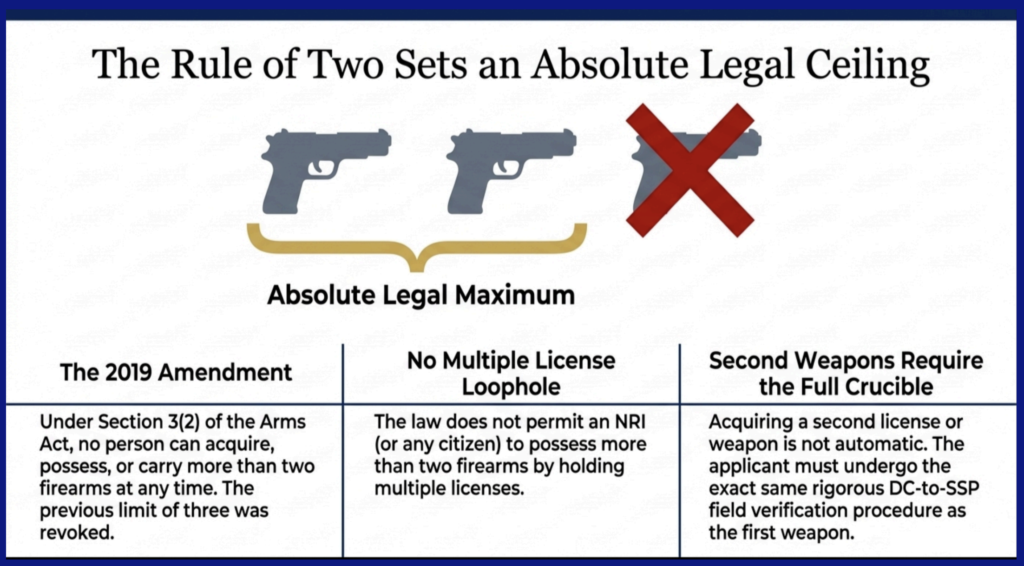
The Section 3(2), as amended by the Arms (Amendment) Act, 2019, provides that no person can acquire, possess or carry more than two firearms at any time. Therefore, an eligible NRI who obtains an Indian firearm license is also subject to this restriction. The law does not permit an NRI to possess more than two firearms merely because they hold multiple licences. To acquire the second license weapon by the same person the applicant has to go through the same procedure from the DC office to the field verification by SSP. Once the license is issued to the applicant, the weapon has to be bought within a specified period which is generally 6 months to avoid cancellation of the license.
What Happens to a person who already has more than two Firearms registered to his name?
Before the 2019 amendment, the law permitted a person to possess up to three firearms. After the amendment reduced the limit to two firearms, the Act allowed such persons to retain any two firearms of their choice. Deposit the remaining firearm with the officer in charge of the nearest police station, a licensed arms dealer, or if serving in the Armed Forces, the unit armoury. The act provided one year from the commencement of the 2019 amendment. If the extra firearm was not disposed of within the prescribed period, it was liable to be de-licensed or even invite a criminal case under Arms Act.
Firearms Received by inheritance or as Family Heirlooms.
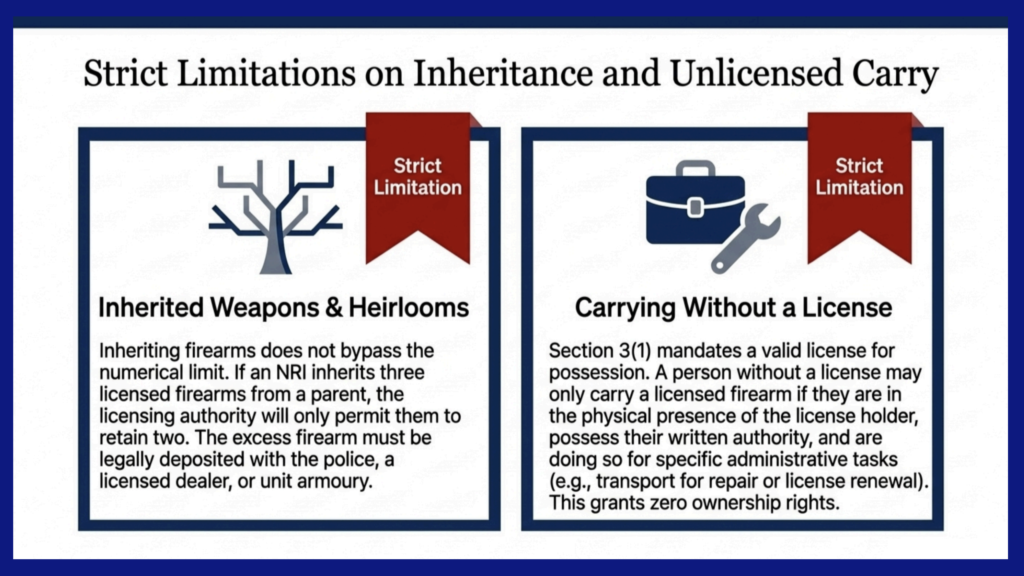
Many people believe that inherited firearms are exempt from the numerical limit. However, the Act specifically clarifies that even while granting a firearm license on inheritance or heirloom basis, the total number of firearms cannot exceed two.
For example, if an NRI inherits three licensed firearms from a deceased parent, the licensing authority may permit the NRI to retain only two firearms. The remaining firearms must be dealt with according to the Arms Act and the Arms Rules.
Renewal of Firearms License:
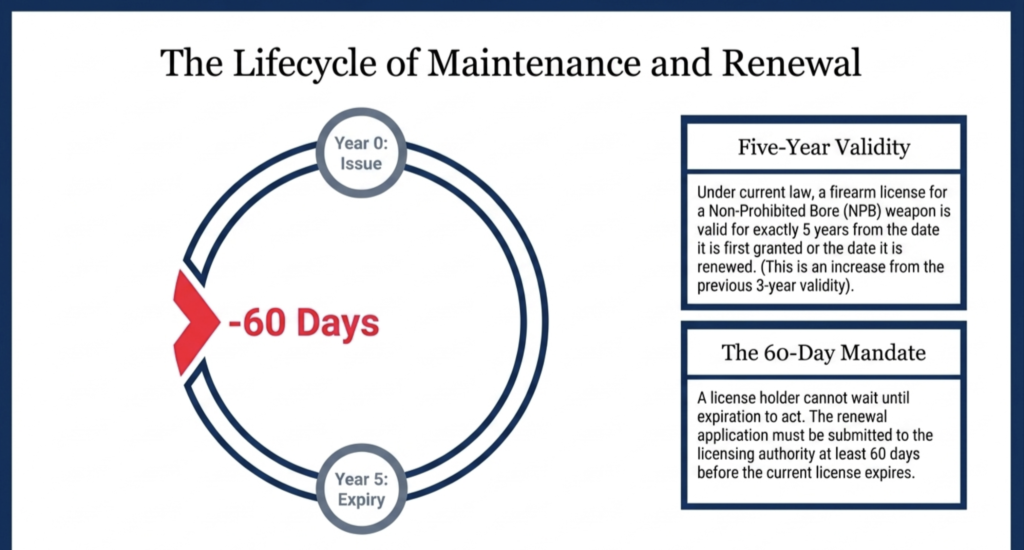
The earlier validity of 3 years has been changed. Under the current law, a firearm licence for Non-prohibited bore (NPB) weapons is valid for 5 years from the date it is first granted or the date it is renewed. After every five yers, the license holder must apply for renewal. The license holder should submit the renewal application at least 60 days before the license expires.
For more information contact NRI Legal World: info@nrilegalworld.com / +919709692096
Frequently Asked Questions:
Q1. Can an NRI apply for an arms license in Punjab, India?
Ans. Yes, as per the law, an NRI who is an Indian citizen may apply for an arms license in Punjab, provided they fulfill the eligibility conditions under the Arms Act, 1959, the Arms Rules, 2016, and the licensing requirements of the Punjab Government, However the online to get the application form and submission is not possible for the simple reason to restrict the number of applicants/license applications.
Q2. Does an NRI need to be physically present in India to apply for the firearm license?
Ans. Yes, physical presence is required for documents verification, police inquiry, medical examination, and other formalities and even for getting the application form. The exact requirement depends on the licensing authority.
Q3. Which authority issues an arms license in Punjab?
Ans. The licensing authority is the District Magistrate/Deputy Commissioner (DC) of the concerned district, after considering the police verification report and other statutory requirements.
Q4. Is Police verification mandatory for NRIs?
Ans. Yes, police verification is an essential part of the licensing process for all the applicants including the NRIs. The applicant’s background, residence, criminal record, and overall suitability are examined before a decision.
Q5. Can an application for the firearm license be rejected even if all documents are submitted?
Ans. Yes, submission of complete documents does not guarantee approval. The licensing authority has the discretion to grant or refuse an Arms license after considering the police verification report and other relevant factors.
For more information talk to our experts: +919709692096