
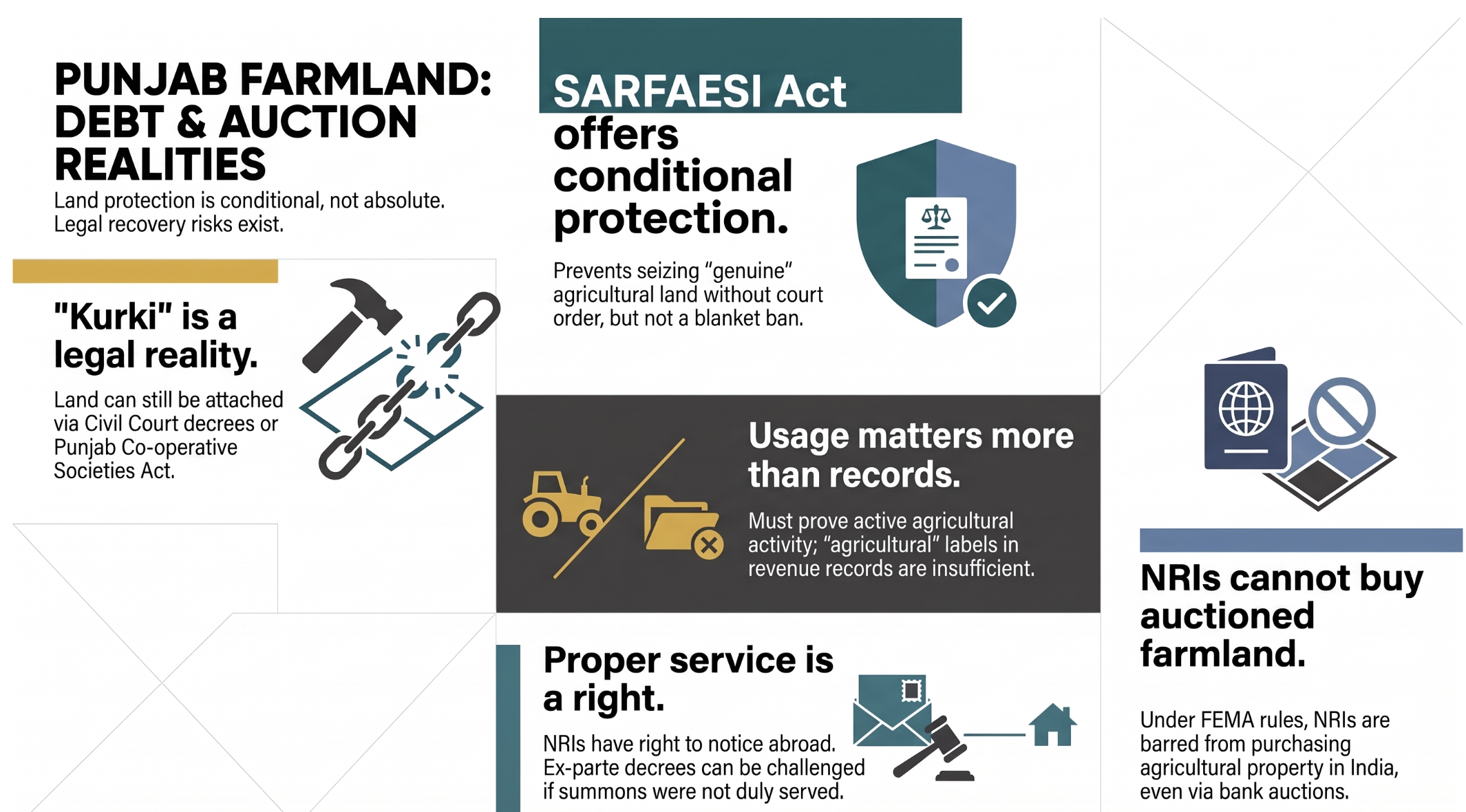
A common belief is that agricultural land can never be auctioned for recovery of a loan. However, the legal position is different. Certain laws provide specific protection to agricultural land, while other laws may permit recovery in particular circumstances. The result depends on the type of loan, the lender, the security created over the property, the actual nature and use of the land, and the recovery mechanism being followed.
However any NRI cannot bid himself to buy such property in the auction process. At the same time he can lawfully save his land being auctioned under the Punjab Co-operative Society Act 1961 by depositing the defaulting amount in the bank after carrying out the negotiation process.
For an NRI, the matter becomes even more important because the property may have been inherited from a person in India, while FEMA rules, Punjab land laws, banking laws and debt-recovery laws may operate together.
The expression “Kurki” is commonly used in Punjab to describe attachment and recovery proceedings against a person’s property for recovery of dues. In the context of cooperative loans, an important historical provision of Section 67-A of Co-operative Societies Act, 1961. Before the omission of Section 67-A, it provided a mechanism under which a cooperative society could approach the registrar for recovery of certain loan arrears from its member. The registrar could issue a certificate, and the amount could be recovered in the manner of arrears of land revenue.
The Punjab Co-operative Societies (Amendment) Act, 2017 expressly omitted Section 67-A from the Punjab Co-operative Societies Act, 1961. The amendment received assent on 8 July 2017 and came into force on publication in the official gazette on 21 July 2017. Therefore, the earlier Section 67-A mechanism of coercive methods like arrest of defaulting farmers for recovery of certain cooperative loan arrears as arrears of land revenue is no longer available in its previous statutory form.
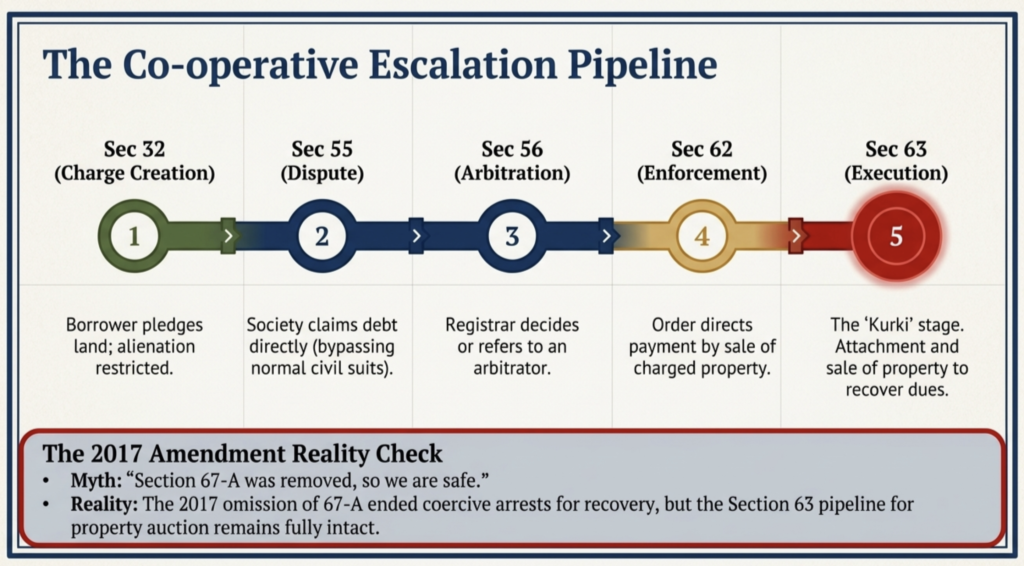
This was an important development particularly for farmers who had taken loans from co-operative societies. In simple words, the specific recovery mechanism available under Section 67-A was removed. The effect of this change, however, should not be misunderstood, as it does not mean that every agricultural land in Punjab is now completely protected from every kind of loan recovery. However, it did not create a blanket protection saying that agricultural land can never be attached or sold under which recovery is being made. However, the removal of section 67-A of the Punjab Co-operative Societies Act, 1961, does not mean that the borrower no longer has to repay the loan. The co-operative institution may still have other legal remedies, depending upon the facts of the case, the loan documents, the security created, and the law applicable to that particular recovery.
Loan recovery law and mechanism is different for commercial banks, or other financial institutions. The private and the commercial banks recover loans under the central laws such as the SARFAESI Act, 2002, However, in case an agricultural land is pledged for a bank loan, the SARFAESI Act 2002, has a special provision for auctioning of agricultural land.
Protection under the SARFAESI Act
The Securitisation and Reconstruction of Financial Assets and Enforcement of Security Interest Act, 2002 (SARFAESI Act) gives banks and other secured creditors a speedy mechanism for recovery of loans without having to file an ordinary civil suit in every case. Normally, under Section 13 of SARFAESI Act, 2002 a secured creditor can enforce its security interest when the borrower defaults in repayment of loan, subject to the requirements of the Act. This may include taking possession of the secured property and selling it to recover the outstanding loan. However, the law provides an important protection in respect of agricultural land under Section 31(i) of the Act
Section 31 (i) of the SARFAESI Act provides that “The provisions of this The Act shall not apply to any security interest created in agricultural land.”
In simple words, where the security interest is genuinely created over agricultural land, the bank cannot ordinarily invoke the SARFAESI Act to take possession of that land and sell it for recovery of its dues. Therefore, a borrower whose agricultural land has been mortgaged to a bank may have a statutory defence against SARFAESI proceedings, provided the land actually qualifies as agricultural land.
The protection for agricultural land is not based merely on the label attached to the property. The borrower must be able to establish that the property was genuinely agricultural in nature and was being used or set apart for agricultural purposes at the relevant time.
For instance, if a land is genuinely agricultural land, a bank generally cannot use the SARFAESI mechanism under Section 13 to take possession of the land and sell that land. But if the land has been converted, developed, or actually used for commercial, residential or other non-agricultural purposes, the borrower may not be able to claim the protection merely because the revenue record still describes it as agricultural.
In the case of Indian Bank v. K. Pappireddiyar (2018), The Supreme Court held that agricultural land is excluded from the SARFAESI Act under Section 31(i). However, merely recording land as “agricultural” in revenue records is not sufficient. The Court said that it must examine whether the land was actually being used for agriculture, considering its nature, actual use, and purpose at the time the security interest was created.
Can a Civil Court Order Auction or “Kurki” of Agricultural Land for Recovery of Debt?
Yes, agricultural land may still be subject to attachment, “kurki” or auction pursuant to an order or decree of a competent civil court, depending on the nature of the debt, the applicable law, and the facts of the case. This is an important distinction. The protection available under Section 31(I) of the SARFAESI Act means that a secured creditor cannot ordinarily use the SARFAESI mechanism to enforce a security interest created in genuine agricultural land. However, that protection should not be confused with a complete prohibition on every form of recovery against agricultural land.
Where a lender or creditor has a legally enforceable debt and obtains a decree from a competent civil court, the court can proceed with execution of that decree in accordance with the applicable provisions of the Code of Civil Procedure, 1908. Depending upon the circumstances and the nature of the property, this may include attachment of the debtor’s property
Therefore, the simple statement that “agricultural land cannot be auctioned in Punjab” would be legally incorrect. The correct position is that the method being used for the recovery matters for deciding whether an auction can be done or not.
How can NRIs maintain their agricultural land “Purely Agricultural” in character and usage?
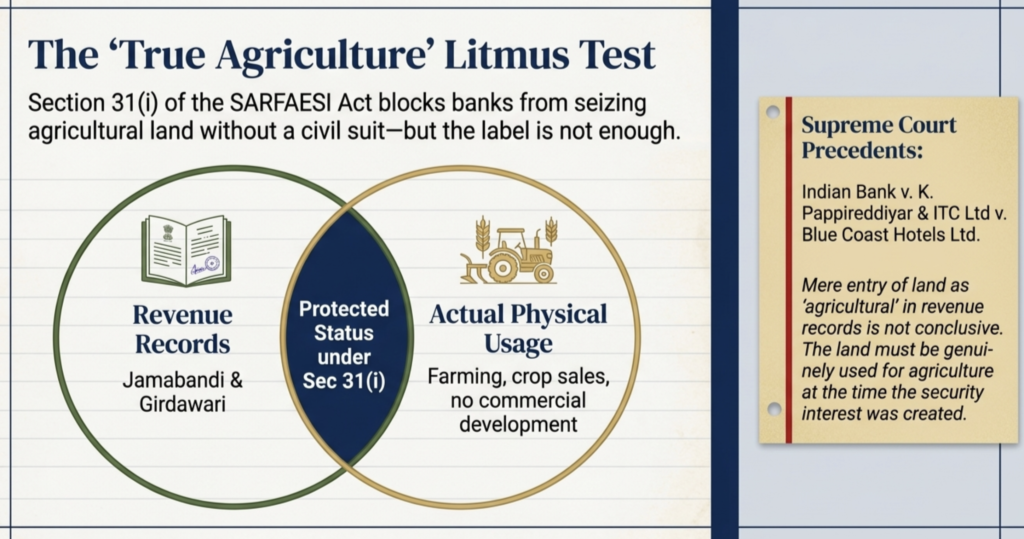
For an NRI owning agricultural land in Punjab, maintaining the land as genuinely agricultural is important, particularly where the owner wants to rely upon the statutory protections available to agricultural property.
Section 31(i) of the SARFAESI Act provides that the Act does not apply to any security interest created in agricultural land. However, the Supreme Court has clarified that merely describing land as agricultural in revenue records is not conclusive. The borrower must be able to establish that the land was actually being used for agricultural purposes when the security interest was created. Therefore, an NRI should take the following steps:
- Continue actual agricultural activity on the land.
- Maintaining revenue records properly Jamabandi, Girdawari and other relevant revenue records should correctly reflect the agricultural nature. The product should be sold as per the existing marketing laws and such records should be kept for any reference.
- Avoid change of land use to non-agricultural use without proper permissions from the authorities. If the land is used for the construction of residential commercial structures, development of plots, or other non-agricultural use may create evidence that the property is no longer being used for agriculture purposes. The auction of such agriculture property is bound to follow the civil court orders, if any.
- Section 60 (1) generally makes property liable to attachment and sale in execution, but its provision creates certain exemptions. For an agriculturist, section 60(1) (b) protects implements of animal husbandry, necessary cattle and seed grain, and certain agricultural produce. Section (1) (c) also protects certain houses/buildings occupied by an agriculturist.
Note: Section 60 of CPC should not be presented as a blanket exemption saying that all agricultural land of every NRI can never be attached or sold. The statutory protection depends upon the precise clause the person’s status as an “agriculturist” and the applicable state amendments. This is particularly important in Punjab because Punjab specific amendments to Section 60 of CPC modify the protection and define “agriculturist” as a person who depends mainly on income from agricultural land, whether as owner, tenant, partner or agricultural labourer.
Case law:
ITC Ltd v. Blue Coast Hotels Ltd. (2018)
The Supreme Court held that mere entry of land as “agricultural” in revenue records is not conclusive for determining whether the land is agricultural land under Section 31(i) of the SARFAESI Act. The court examined the actual nature and use of the land, the purpose for which it was acquired, the intention of the parties, and the circumstances in which the security interest was created. Although certain portions of the property were recorded as agricultural and some cultivation was taking place, the property was substantially connected with a five star hotel project and was intended for non-agricultural use. Therefore, the court held that the land could not be treated as agricultural land merely on the basis of its revenue entries. Agricultural Land and Co-operative Society Recovery
A separate situation arises where the lender is a Co-operative Society/Co-operative bank and recovery is being pursued under the applicable Co-operative Societies Act. Under the Punjab Co-operative Societies Act, 1961, the Act contains its own mechanism for recovery and execution of awards/ orders.
Section 32 Charge over Property: Section 32 The Punjab Co-operative Societies Act, 1961 is very important when a member borrows money from a specified co-operative society and owns land or has an interest in land as a tenant. The borrower makes a declaration creating a charge over the specified land/interest for repayment of the loan, future advances within the prescribed limit, and interest. The provision also restricts alienation of the land until the dues are paid, subject to the statutory permission mechanism. A first charge in favour of the society is also provided, subject to prior government claims relating to land revenue or money recoverable as land revenue.
Section 55 Dispute: Section 55 The Punjab Co-operative Societies Act, deals with disputes touching the constitution, management or business of a co-operative society. Importantly, a claim by the society for a debt or demand due from a member is expressly treated as such a dispute. So, where applicable, the society does not necessarily have to start an ordinary civil suit merely to recover the member’s co-operative debt.
Section 56: ARBITRATION/DECISION: Under Section 56, after a dispute is referred under Section 55, the Registrar may decide it himself, transfer it to an authorised person or refer it to an arbitrator. The Registrar can also withdraw or re-refer the matter in the circumstances provided by the section.
Section 62: Enforcement of Charge: There is another important provision in this section that allows the Registrar or an authorised person, on an application by co-operative society, to make an order directing payment of a debt/ outstanding demand by sale of property or an interest in property subject to the statutory charge, after the required notice.
Suppose the dispute is decided and an award/order is passed against the borrower the borrower still does not pay. Then the execution stage begins. This is where Section 63 becomes extremely important.
Section 63 Execution: Section 63 is important because it concerns the execution of an award/order. An award/order that has not been complied with may be executed through the modes provided by the Act, including mechanisms involving execution as a Civil Court decree, attachment and sale of property or recovery in the manner provided for recovery of certain amounts as arrears of land revenue, subject to the applicable statutory procedure. Therefore, Section 63 should not be described as a section that itself says, “agricultural land can be auctioned”. This section provides the statutory modes for execution/ recovery of an award or order which may include attachment and sale of property.
For NRIs who own agricultural land or other immovable property in Punjab, loan default can create serious risk of attachment recovery and auction. However, whether the property can actually be auctioned depends upon the legal route adopted by the lender, such as SARFAESI proceedings, Civil Court execution, or recovery proceedings under the Co-operative Societies Act.
For NRIs, timely legal advice is especially important because they may be residing abroad and may not be immediately aware of notices, attachment proceedings or auction dates.
Contact NRI Legal World for more information: info@nrilegalworld.com / +919709692096
Frequently asked Questions:
Q1. Can a bank auction agricultural land under the SARFAESI Act?
Ans. Section 31(i) of the SARFAESI Act excludes a security interest created in agricultural land from the Act. Therefore, where the land genuinely falls within this protection, the bank cannot ordinarily use the SARFAESI mechanism to enforce that security interest.
Q2. Can an NRI’s agricultural land be attached through civil court proceedings for a bank loan recovery ?
Ans. Yes, if the creditor obtains a valid decree, execution proceedings may be initiated. Whether the particular agricultural land can be attached or sold will depend on the CPC, applicable exemptions and the facts of the case.
Q3. What is “kurki” of agricultural land?
Ans. “Kurki” is commonly used to refer to attachment of property for recovery. The exact legal procedure depends on the authority and statute under which the attachment is being carried out.
Q4. What if the NRI never received the auction notice because they live abroad?
Ans. Where the owner or borrower is an NRI residing outside India, proper service of summons and notices becomes particularly important. Under Order V Rule 25 of CPC, where a defendant resides outside India and has no agent in India authorised to accept service, the summons is required to be addressed to the defendant at the place where he or she resides and may be sent through the modes prescribed by the CPC and applicable High Court rules.
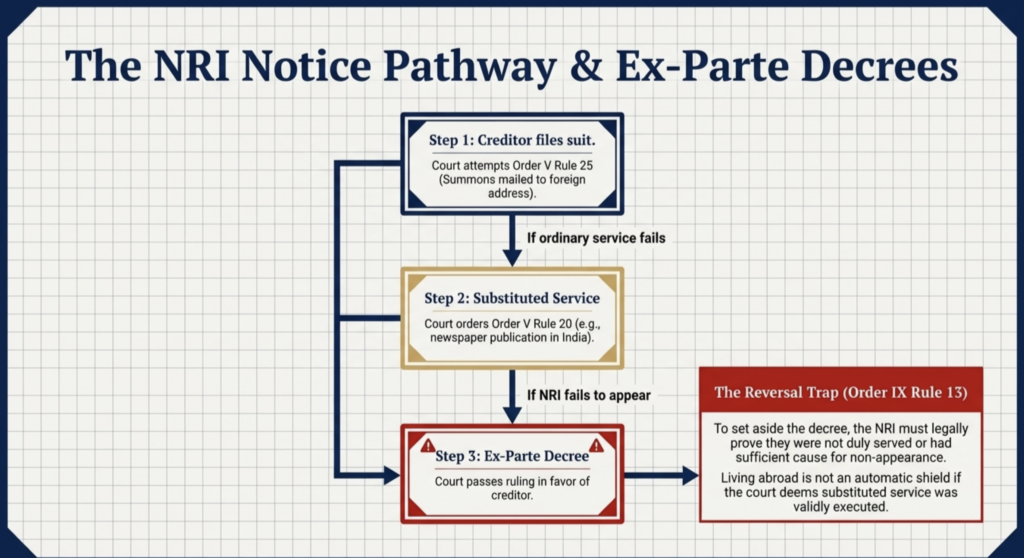
If ordinary service cannot be effected, the court may, if appropriate circumstances, resort to substituted service under Order V Rule 20 of CPC, including publication in a newspaper when ordered by the Court, However, substituted service is not something that a creditor can simply assume or carry out on its own, it requires an order of the court and compliance with the prescribed procedure.
Note: Order V Rule 20 only deals with substituted service; it does not itself prescribe a general requirement that an embassy must be involved.
This becomes significant where the NRI does not appear and an ex-parte decree is subsequently passed. Under Order IX Rule 13 CPC, the defendant can apply to the court, which passed the decree for setting it aside if the summons was not duly served or if the defendant was prevented by sufficient cause from appearing. The Court may impose appropriate terms while setting aside the decree.
Therefore in NRI cases, the fact that the person was living abroad did not personally receive the proceedings does not automatically invalidate the entire recovery or auction proceedings. The court would examine the actual mode of service, whether the NRI had notice of the hearing, and whether there was sufficient opportunity to appear and contest the matter. Order IX Rule 13 itself provides that an ex-parte decree is not to be set aside merely for an irregularity in service if the defendant actually had notice of the hearing and sufficient time to appear.
Q5. Can the NRI stop the auction of property by paying the outstanding amount?
Ans: It may be possible depending on the stage of recovery and the applicable statute/rules. The exact amount, interest, costs and deadline should be verified immediately from the recovery authority.
Q6. Can an NRI purchase agriculture Land in bank auction India:
Ans. No, an NRI cannot purchase agricultural land in India merely because the property is being sold through a bank auction. Under the FEMA framework, an NRI or OCI may acquire immovable property in India by purchase, but agricultural land, plantation property and farm house are specially excluded from such purchase.