
For many Non-Resident Indians (NRIs), India remains closely connected to their financial and personal lives. NRIs purchase homes and plots in India, maintain bank accounts, purchase insurance policies, book flights and hotels, use healthcare and professional services, and increasingly make purchases through Indian online platforms.
However, when a company, builder, bank, insurer, hospital, travel company, or other service provider fails to deliver what was promised to the client. In such cases, even though NRIs feel dissatisfied with the service or quality of the product, they hesitate to take legal action against the company. The important point is that being an NRI does not, by itself, take away a person’s protection under Indian consumer law. An NRI can seek redressal before the Consumer Commissions in India where the transaction falls within the Consumer Protection Act, 2019 and the person qualifies as a consumer.
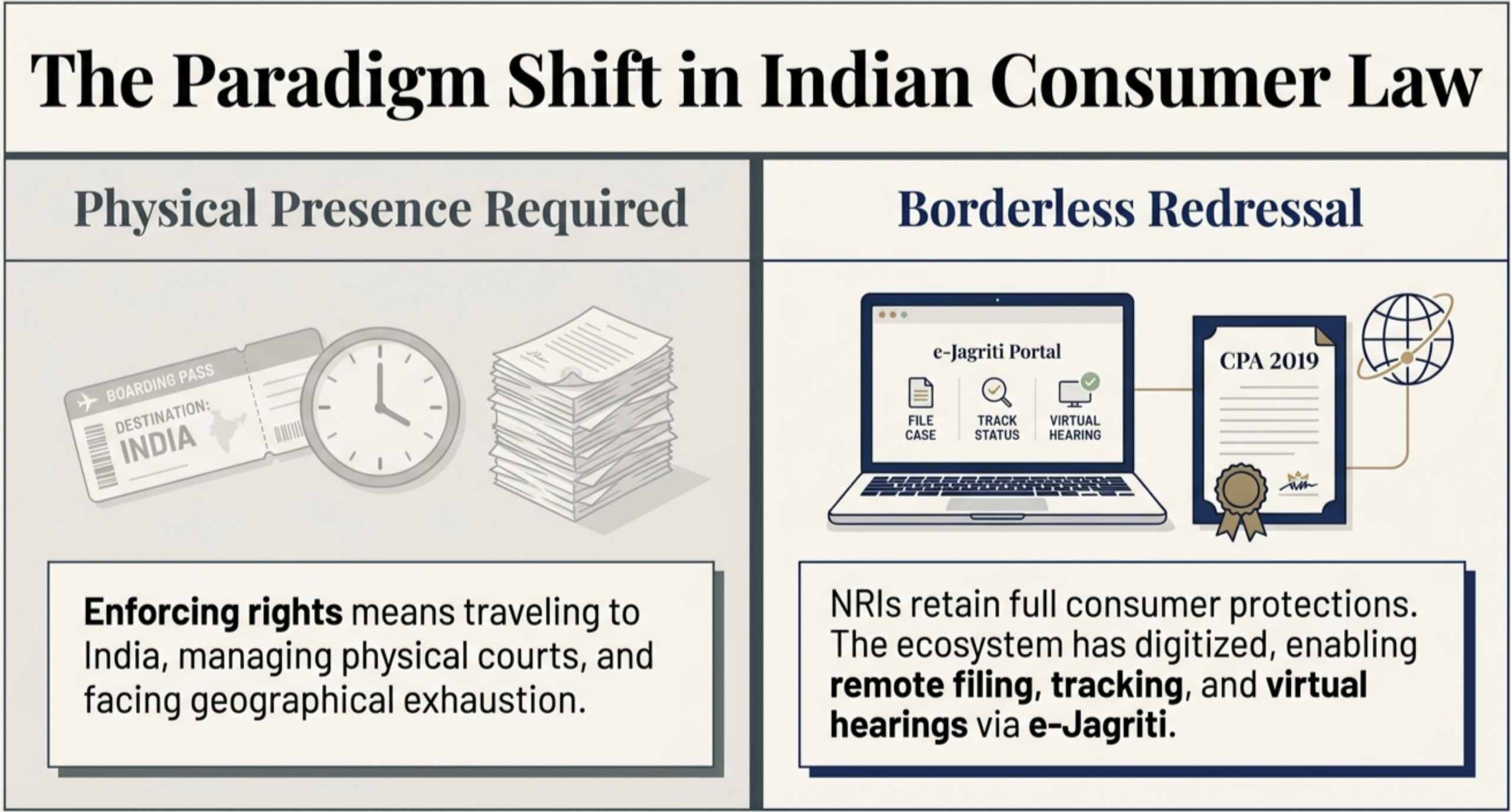
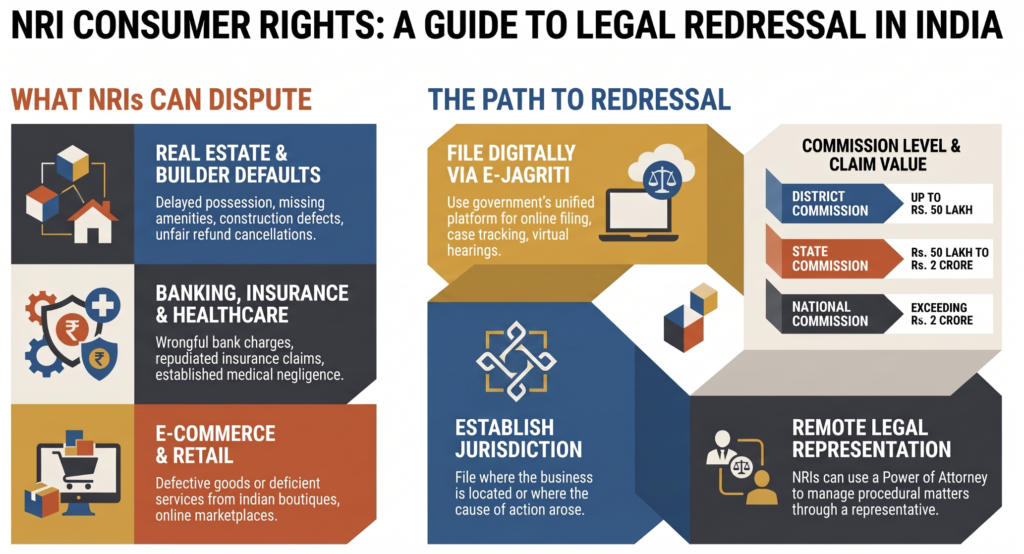
The law has also become convenient for people who cannot remain physically present in India. The consumer dispute system now provides for online filing and digital case management, and the Government’s e-Jagriti platform enables consumers (NRIs/Residents/OCI card holders) to file complaints, track cases and access proceedings or judgments online.
The Consumer Protection Act, 2019 protects a person who buys goods or hires or avails services for consideration, subject to the conditions prescribed by the Act. The protection covers not only traditional purchases from physical shops but also many modern transactions, including online purchases and services.
For an NRI, this could include purchasing a residential property in India, obtaining banking or insurance services, paying for a particular service, purchasing goods from an Indian seller or using other services for consideration.
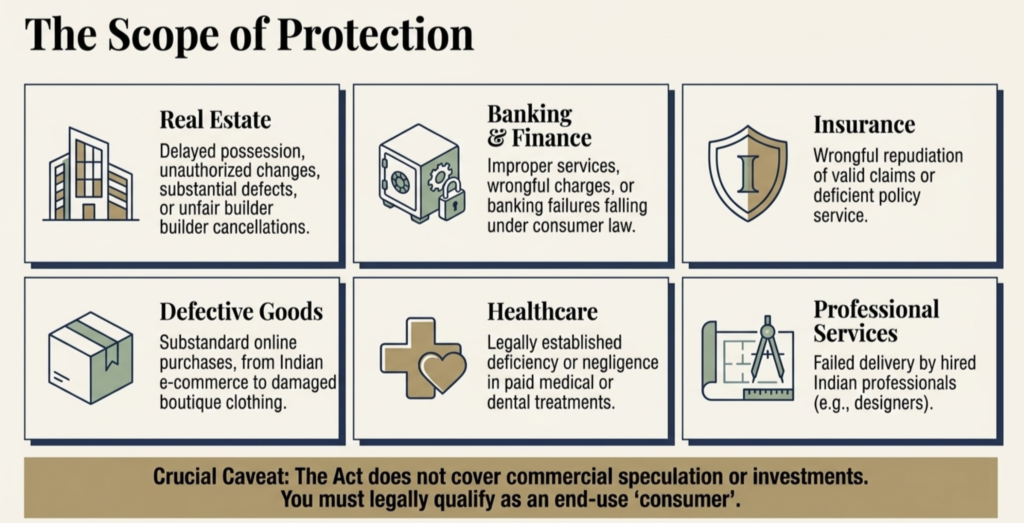
However, every dispute involving money is not automatically a consumer dispute. The transaction must fall within the scope of consumer law, and the complainant must satisfy the statutory definition of a consumer.
What Kinds of Problems Can an NRI Take to a Consumer Commission?
Consumer Commissions can provide a remedy where there is a defect in goods, deficiency in services, unfair trade practice or another consumer dispute falling within the Act. For NRIs, some of the most relevant situations include:
Builder and real-estate disputes- This is one of the most important areas for NRIs. An NRI may approach a Consumer Commission where, for example:
- Possession of a flat, house or plot is delayed
- The builder has failed to provide promised amenities
- The property is delivered with substantial defects
- The builder demands an amount contrary to agreed terms
- The builder fails to provide promised services
- The builder unfairly cancels an allotment
- The builder fails to refund money after cancellation where a refund is legally due
- An unfair trade practice or deficiency in service has occurred
Banking and Financial Services- Consumer proceedings may arise from certain deficiencies in banking services, such as improper service, wrongful charges or other failures falling within consumer law. However, an NRI should first determine whether the dispute is genuinely a consumer dispute and whether another specialized statutory remedy applies.
Insurance disputes- If an insurance company wrongfully repudiates a claim or otherwise provides deficient service, consumer law may provide a remedy, subject to the facts and the applicable legal framework.
Defective Goods- If an NRI purchases a product in India and the product has a defect or does not conform to what was promised, the Consumer Protection Act may provide remedies available under the Act. Example: home decor ordered from India, clothes ordered from Indian boutiques, etc.
E-Commerce and Online Purchases- Consumer protection is not limited to purchases made from traditional shops. The 2019 legislation also introduced specific provisions concerning e-commerce and unfair trade practices in the digital marketplace. For example, online shopping from Indian e-commerce sites.
Healthcare and other paid services- NRIs who pay for medical or dental treatment in India may also have consumer remedies where the treatment or services involve a legally established deficiency or negligence. This can include appropriate cases involving doctors, dentists, hospitals, diagnostic centres and other healthcare providers. However, an adverse medical outcome, unsuccessful treatment or complication does not automatically amount to medical negligence. Whether a consumer complaint is maintainable depends on the nature of the service, the circumstances of the treatment and the evidence establishing deficiency or negligence. The important point is that an NRI should not assume that a dispute is outside consumer law simply because the transaction took place in India while the NRI was living abroad.
Understanding the Consumer Commission Procedure and Jurisdiction
Consumer disputes are handled through a three-tier system:
- District Consumer Disputes Redressal Commission
- State Consumer Disputes Redressal Commission
- National Consumer Disputes Redressal Commission
The appropriate Commission depends upon the applicable pecuniary (monetary limit determining which court can hear a case) and territorial jurisdiction. Under the Consumer Protection (Jurisdiction of the District Commission, the State Commission and the National Commission) Rules, 2021, the present pecuniary (monetary limit determining which court can hear a case) limits are:
- A District Commission can entertain complaints where the value of goods or services paid as consideration does not exceed Rs.50 Lakh
- A State Commission can entertain complaints where that value exceeds Rs.50 lakhs but does not exceed Rs.2 crores.
- The National Commission has jurisdiction where the value of goods or services paid as consideration exceeds Rs.2 crores.
These limits are based on the statutory jurisdiction rules currently applicable and should not be confused with the older limits that appeared under the original Consumer Protection Act, 2019.
Jurisdiction for Filing the Complaint in Consumer Commission
Territorial jurisdiction is particularly important for an NRI because the NRI may not be living in India. The Consumer Protection Act provides territorial jurisdiction based on the following criteria:
- The place where the opposite party resides or carries on business,
- Where the complainant resides or works
- Where the cause of action wholly or partly arises, subject to the statutory requirements.
For an NRI, therefore, the place where the transaction occurred or where a substantial part of the cause of action arose in India can become particularly relevant. For example, if an NRI purchased a property in Punjab and the dispute concerns the builder’s failure to deliver that property, the facts of the transaction and the location of the property may be relevant to determining the proper Consumer Commission.
In Jang Bahadur Singh v. Emaar MGF Land Ltd., Jang Bahadur Singh and his wife had purchased an apartment from Emaar MGF Land Ltd. The builder raised several objections when the purchasers approached the State Consumer Commission, Chandigarh. Among other things, the builder argued that the Commission did not have territorial jurisdiction because the property was situated in Punjab, the company’s registered office was in Delhi, and the payments had been made in Delhi. The builder also argued that the complainants could not be treated as consumers because the first complainant was allegedly an NRI and already had another plot and a house, suggesting that the apartment had been purchased for investment or speculation. The Commission rejected the territorial jurisdiction objection. It noted that the apartment buyer’s agreement had been executed at Chandigarh and certain letters had been sent by the builder from its Chandigarh office. Therefore, at least part of the cause of action had arisen in Chandigarh, giving the State Consumer Commission, Chandigarh territorial jurisdiction to hear the complaint.
The Commission also rejected the builder’s argument that the purchaser should be treated as a non-consumer merely because he was allegedly an NRI and owned another property. The complainants had stated that the apartment was purchased for residential purposes, and the builder could not produce sufficient evidence showing that it had been purchased for commercial speculation. Ultimately, the complaint was partly allowed. The builder was directed to refund Rs.51,36,376 with 9% interest, pay Rs.1.5 lakh as compensation for mental agony and harassment and escalation in prices, and Rs.33,000 towards litigation costs.
The correct forum should therefore be determined from the actual facts rather than simply choosing the Commission closest to the NRI’s family or attorney.
Legal Remedies that an NRI Can Seek
A Consumer Commission is not limited to simply declaring that a service provider was at fault. Depending upon the facts and the relief legally available, a consumer complaint can seek remedies such as refund of money, replacement or removal of defects, compensation, correction of deficiency, discontinuation of unfair trade practices and litigation costs.
In appropriate cases, compensation may also be claimed for loss or injury suffered because of the deficiency or unfair trade practice. An NRI can even pursue the case through a representative. Living abroad does not necessarily mean that an NRI must personally travel to India every time something has to be done in a consumer case.
This makes a properly executed Power of Attorney or authority in favour of a suitable representative particularly useful where an NRI wants someone in India to assist with procedural matters. The authority given through a Power of Attorney should, however, be carefully drafted according to the actual requirements of the case.
In the case of Yash Pal Marwaha v. Pushpa Builders Ltd. & Anr., Yash Pal Marwaha, an NRI residing in the United Kingdom, booked a residential flat with Pushpa Builders Ltd. In 1989. The builder had advertised a project called Pushpa Akash Apartments in Vaishali, Ghaziabad, including a special “NRI Exclusive” Krishna Block, which was promoted with various facilities and features. Marwaha paid the instalments for the flat as required. However, the Krishna Block was never constructed. Instead, the builder offered him a different flat in Kaveri Block, which was meant for Indian purchasers and was inferior to the apartment originally promised. Marwaha objected to this through his solicitor in London and initially sought a refund. Ultimately, because a substantial amount of his money had already been paid to the builder, he accepted the alternative flat and took what was described as technical possession. However, the building itself remained incomplete and did not have the required completion certificate from the Ghaziabad Development Authority.
Marwaha was living in the United Kingdom, but he did not have to personally handle the proceedings from India. He filed the consumer complaint through his duly appointed General Power of Attorney holder. The NCDRC examined the power of attorney and found that the attorney had the authority to pursue the complaint
This case demonstrates something practically important for NRIs that living outside India does not mean that you have to abandon your consumer claim in India.
How can an NRI file a Consumer Complaint from Abroad?
The consumer dispute system has increasingly moved towards digital access, which is particularly useful for NRIs. The government’s e-Jagriti platform is now the unified digital platform for consumer dispute redressal. The platform provides online filing, case tracking, document exchange and access to judgments, with digital facilities including virtual hearings.
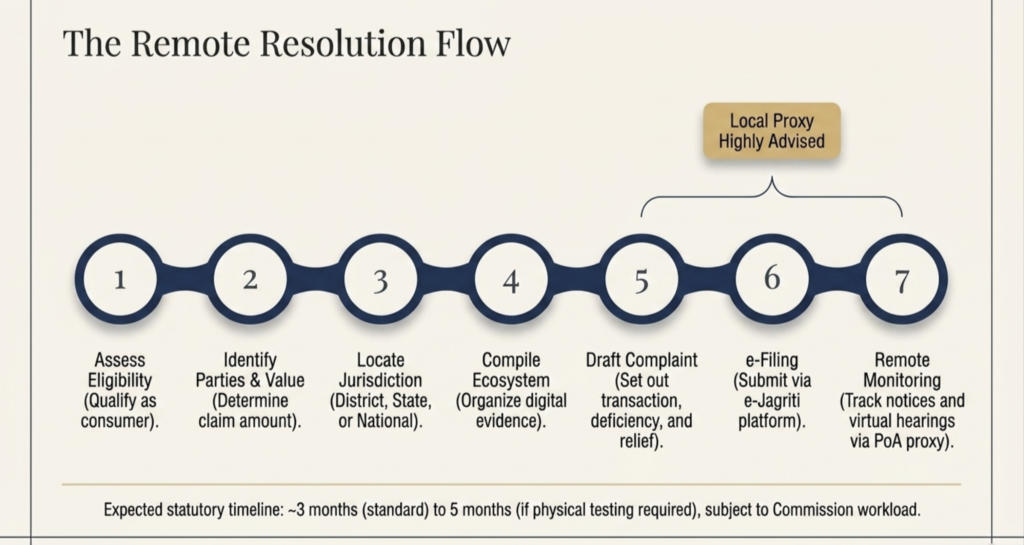
This means that an NRI does not necessarily have to begin the process by travelling to India. The practical process generally involves:
- Identify whether the dispute actually falls within consumer law in India
- Identify the correct opposite party or parties and identify how much your claim is for.
- Determine the correct Consumer Commission based on pecuniary (monetary limit determining which court can hear a case) and territorial jurisdiction
- Collect the documentary evidence such as agreement or contract, invoices and payment receipts, bank statements showing payments, allotment letters, insurance policies, medical records, etc.
- Draft the consumer complaint setting out the transaction, deficiency, or unfair trade practice, cause of action, and reliefs claimed. Take advice from a Consumer Commission expert.
- File the complaint through the applicable online or prescribed procedure
- Monitor notices, replies, evidence, hearings and orders, either personally where required or through properly authorized representation.
For an NRI, maintaining a reliable representative and lawyer in India can make the process substantially easier, particularly when original documents, affidavits or other procedural requirements become relevant.
Documents that NRIs Should Preserve
An NRI should never depend only on oral assurances when dealing with an Indian service provider or builder. Important documents may include:
- Agreement or contract of purchase or order placed
- Allotment letter in case of property
- Invoices and receipts of the order
- Bank statements showing payments and all the transaction history
- Emails and written correspondence or any communication with the service or goods provider
- Relevant WhatsApp messages and other electronic communications exchanged with the builder, seller, bank, insurer or service provider.
- Brochures and advertisements
- Photographs and videos
- Possession letters
- Demand letters
- Cancellation or refund correspondence
- Legal notices and replies
- Proof of complaints made to the service provider
- Documents showing promised specifications or amenities
- Any other document establishing the transaction and the deficiency
For NRIs, digital preservation is especially important because they may be managing the dispute from another country. It is advisable to maintain a chronological record of the transaction rather than sending scattered documents to a lawyer without explaining what happened and when.
The Consumer Protection Act, 2019 requires consumer complaints to be dealt with as expeditiously as possible. The Commission is expected to endeavour to decide a complaint within three months from the date the opposite party receives notice, where no analysis or testing of goods is required, and within five months where such analysis or testing is required. However, these are not guaranteed completion periods, and the actual time may be longer depending on the complexity of the case, evidence, hearings and the workload of the Commission.
Consumer rights are meaningful only when they are exercised. For NRIs who have invested their hard-earned money in India, understanding these rights can be the difference between repeatedly requesting a company to resolve a problem and actually taking a legally enforceable step towards obtaining relief.
For more information contact NRI Legal World: info@nrilegalworld.com/ +919709692096
Frequently Asked Questions
Q.) Can an NRI file a consumer complaint in India?
Ans.) Yes, an NRI can approach a Consumer Commission in India if the transaction falls within the Consumer Protection Act, 2019 and the NRI qualifies as a consumer. Simply living outside India does not take away consumer rights.
Q.) Can an NRI file a complaint against an Indian builder for delayed delivery of the flat?
Ans.) Yes, an NRI who has purchased a residential property from a builder can approach the Consumer Commission for issues such as delayed possession, construction defects, failure to provide promised amenities, wrongful cancellation or refund-related disputes, subject to the facts of the case.
Q.) Can an NRI file a consumer complaint for an online purchase made in India?
Ans.) Yes, the Consumer Protection Act, 2019 covers various forms of e-commerce transactions and provides protection against issues such as defective goods, deficient services and unfair trade practices.
Q.) Where can an NRI file the consumer complaint in India?
Ans.) The Consumer Protection Act provides several bases for territorial jurisdiction, including the place where the opposite party carries on business or resides and where the cause of action wholly or partly arises. The complainant’s place of residence or work can also be relevant under the Act.
Q.) Can several NRI buyers jointly file a complaint against the same builder?
Ans.) Yes, where the statutory requirements for a representative consumer complaint are satisfied, and the purchasers have the same interest. This can be particularly relevant when multiple buyers in the same project face a common deficiency.
Q.) Can an NRI file a consumer complaint against an Indian designer for poor service?
Ans.) Yes, if an NRI hires and pays an Indian designer for services and the designer fails to provide the agreed service or otherwise commits a deficiency in service, the NRI may be able to approach the Consumer Commission. For example, this could involve failure to deliver the agreed design work, substantial deviation from the agreed specifications or failure to complete the contracted work. However, simple dissatisfaction with a designer’s creative choices may not by itself constitute a consumer dispute. The NRI should be able to establish the promised service and the deficiency through documents such as the contract, quotation, payment records and communications.
Q.) Can an NRI file a consumer complaint against a boutique owner in India after receiving a damaged Indian-wear order?
Ans.) Yes, if an NRI purchases Indian wear from a boutique in India and receives a damaged or defective product, the NRI may be able to approach the Consumer Commission, particularly where the boutique refuses to provide an appropriate replacement or refund. The NRI should preserve the order details, payment receipt, photographs or videos of the damage, product description, and communications with the boutique. Depending on the facts, the Commission may grant remedies such as replacement, refund and compensation.