
Indian law does not permit the direct application of foreign judgment merely because it has been validly passed by a foreign court. Before an enforcement proceeding can commence, the judgment must satisfy the legal requirements prescribed under the Code of Civil Procedure, 1908 (CPC).
The procedure for initiating proceedings depends upon several factors, including the country where the judgment was passed, whether the judgment has been delivered by a court situated in a reciprocating territory or non-reciprocating territory, the nature of the judgment, and whether it satisfies the requirements prescribed under Indian law. Commencing the correct proceedings before the appropriate court is essential, as following the wrong procedure may lead to delays or even dismissal of the case.
Indian courts may refuse to enforce a foreign judgment if it falls within any of the exceptions provided under Section 13 of the Code of Civil Procedure. As a general rule, a judgment delivered by a foreign court is conclusive between the same parties on matters directly decided. However, it will not be treated as conclusive if it falls under any of the following six exceptions:
- Lack of Jurisdiction- If the Indian courts decide that the foreign court violated the jurisdictional jurisprudence.
- Decision Not on the merits – In case the foreign judgement fails to satisfy Indian courts about the merits of the case on which the The judgment was issued.
- Incorrect view of international law or refusal to recognize India law- In the cases where the Indian court concludes that the Indian law should have been applied, by the foreign court, before passing the judgement.
- Principal of natural Justice:- The foreign court proceedings violated the principles of natural justice, such as denying a fair opportunity to be heard for any of the parties.
- Fraud- The foreign judgment was procured by fraud by any of the party.
- Founded on a breach of Indian law- The foreign judgment enforces a claim that violates a law in force in India
Documentation
Before filing the proceedings, the decree holder should ensure that all necessary documents have been collected and are ready for submission to the Indian court. Although the exact documentation may vary depending on the nature of the proceedings, the following documents are commonly required:
- A certified copy of the foreign judgment or decree
- A certificate issued by the foreign court, wherever applicable, indicating the extent to which the decree has been satisfied or adjusted.
- Certified translations if the judgment or supporting documents are in a language other than English
- Identity and authorization documents of the decree holder or authorized representative
- A valid Power of Attorney where the proceedings are initiated through an attorney or authorized representative.
- Any other supporting documents that may be required to establish the claim before the Indian court.
Petition or Suit for Execution of Foreign Judgement in India
The nature of the proceedings depends upon whether the judgment has been passed by a court in a reciprocating or non-reciprocating territory. Where the judgment is capable of direct execution under Section 44A of the Code of Civil Procedure, the decree holder is required to prepare an execution petition containing the particulars of the foreign decree, details of the parties, the relief sought, the amount remaining due, the basis of the court’s jurisdiction, and the documents relied upon.
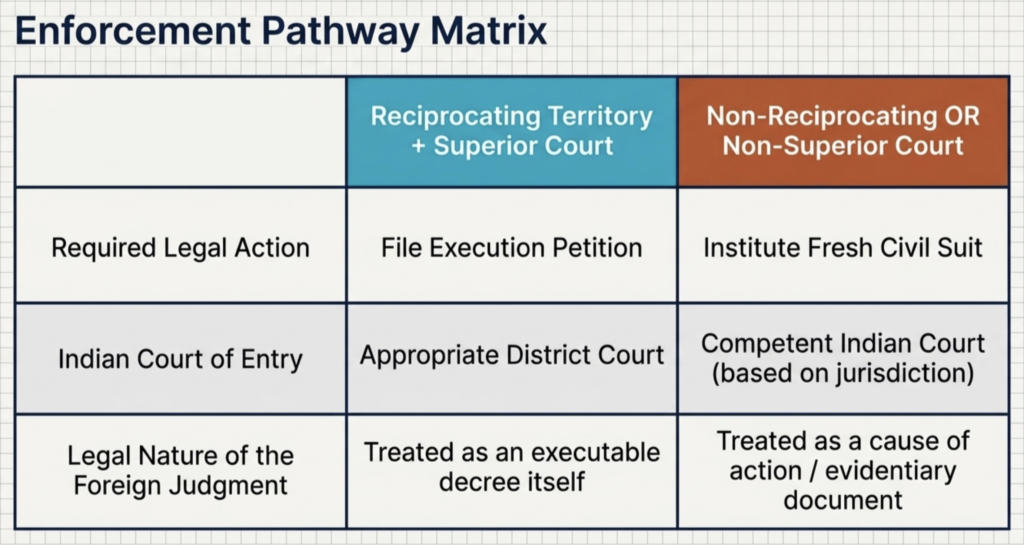
If the judgment has been passed by a court situated in a non-reciprocating territory, a fresh civil suit must be prepared. In such cases, the foreign judgment serves as the basis of the claim, and the plaintiff seeks an Indian decree that can subsequently be enforced in accordance with Indian law. Care should be taken to ensure that all pleadings accurately set out the relevant facts and comply with the procedural requirements applicable to the proceedings.
File the Proceedings Before the Competent Court
After the petition has been prepared along with the supporting documents, the proceedings are filed before the competent Indian court.
How to know the jurisdiction of the court to file the petition: The decree holder must determine the court in India to file the petition for execution of foreign judgement. In case of reciprocating territories, the execution petition is generally filed before the District Court having jurisdiction over the place where the judgment debtor resides, carries on business, or where the assets sought to be proceeded against are located.
While in case of a non-reciprocating territory, the fresh civil suit must be filed before the court having the appropriate territorial and pecuniary jurisdiction in accordance with the provisions of the Code of Civil Procedure,1908. Approaching the correct court at the initial stage helps avoid procedural objections and unnecessary delays.
How to know if your country is a reciprocating territory of India:
The Central Government has notified the following 13 territories as reciprocating territories:
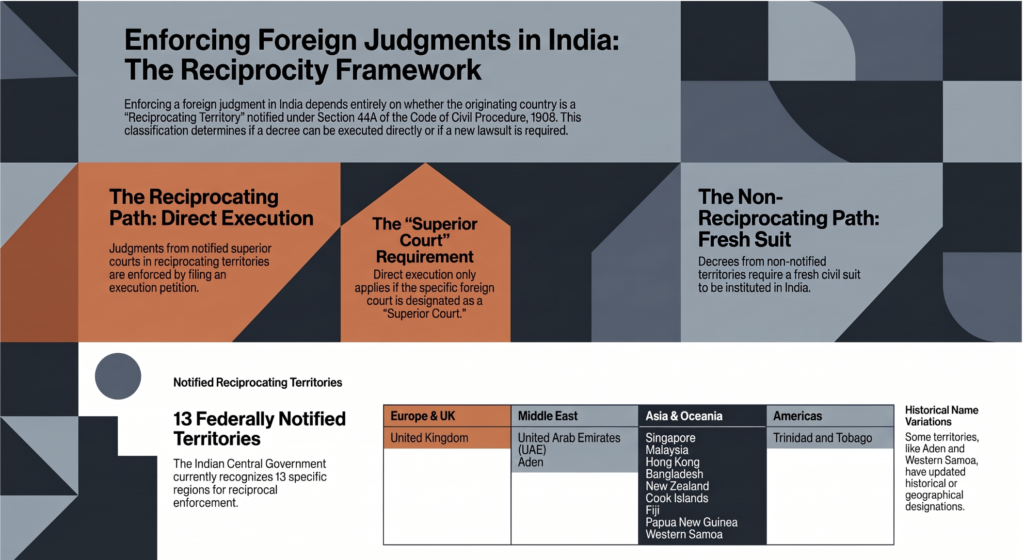
- United Kingdom
- Aden- historically noted as a territory, Aden is now part of Yemen
- Fiji
- Singapore
- Malaysia- originally notified as the Federation of Malaya
- Trinidad and Tobago
- New Zealand
- Cook Islands (including Niue)
- Western Samoa- now known as Samoa
- Hong Kong
- Papua New Guinea
- Bangladesh
- United Arab Emirates (UAE)
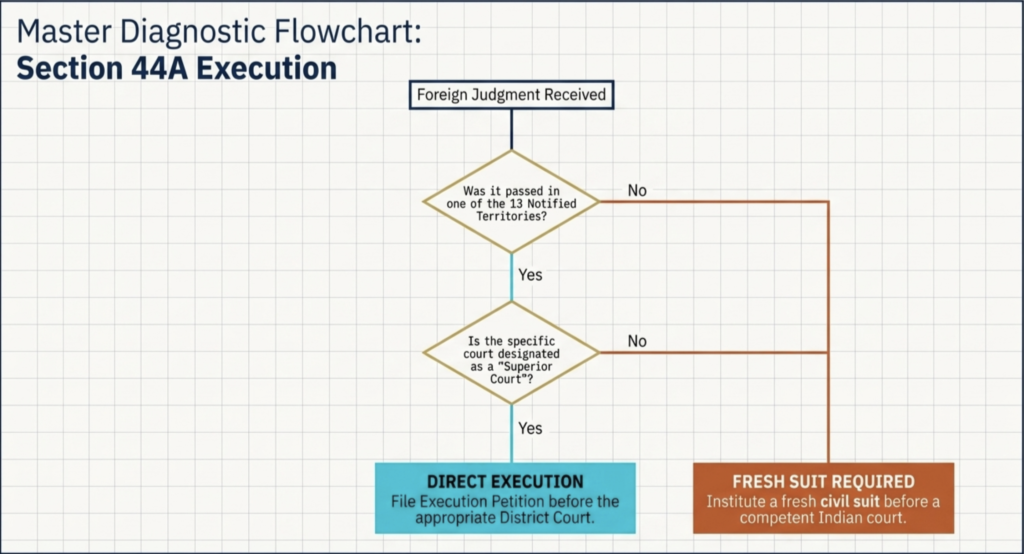
If the judgment has been passed by a notified superior court in a reciprocating territory, the decree may generally be enforced by filing an execution petition before the appropriate District Court in India. However, if the judgment has been passed by a court situated in a non-reciprocating territory, the decree holder cannot directly execute the foreign judgment. Instead, a fresh civil suit must be instituted before the competent Indian court based on the foreign judgment.
But there is an important distinction: being a reciprocating territory does not mean that every judgment/order passed by every court in that country can be directly executed in India. The particular foreign court must also be one of the “Superior Courts” specified in the relevant notification.
Therefore, identifying the status of the foreign court is one of the first and most important steps before commencing legal proceedings. Following the filing of the proceedings, the court undertakes a preliminary scrutiny of the documents and pleadings to ensure that they comply with the local legal and procedural requirements.
Proceedings Continue in Accordance with Indian Law
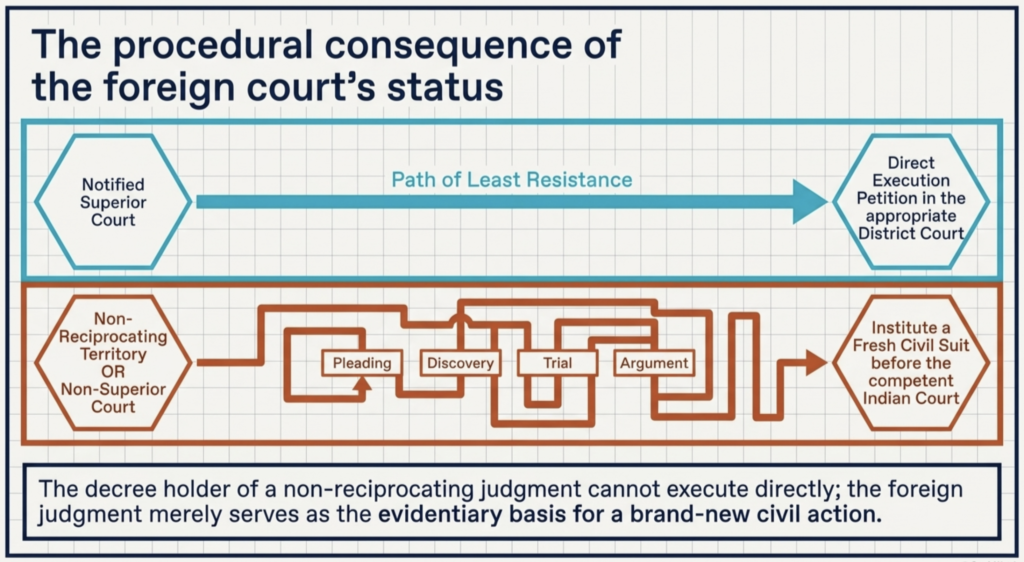
If the Indian court is satisfied that the foreign judgment fulfills the requirements prescribed under the Code of Civil Procedure, it permits the proceedings to continue in accordance with Indian law. Where the judgment has been passed by a court in a reciprocating territory, the decree may be executed as if it had been passed by an Indian court depending on the discretion of the courts.
While, in case of non-reciprocating territories, enforcement of foreign decree can proceed once the Indian court passes its own decree at the conclusion of a fresh civil suit. The subsequent stages of execution are governed by the provisions of the Code of Civil Procedure applicable to the enforcement of decrees in India.
Initiating proceedings for the enforcement of a foreign judgment in India involves more than simply producing a judgment passed by a foreign court.
For more information contact NRI Legal World: info@nrilegalworld.com/ +919709692096
Frequently Asked Questions
Q.) Can every foreign judgment be enforced in India?
Ans.) No, a foreign judgment can be enforced in India only if it satisfies the conditions prescribed under the Code of Civil Procedure, 1908. Indian courts may refuse enforcement if the judgment falls within any of the exceptions under Section 13 of the CPC.
Q.) How long does it take to enforce a foreign judgment in India?
Ans.) The duration depends on factors such as the nature of the proceedings, whether the judgment originates from a reciprocating or non-reciprocating territory, the complexity of the case, and whether any objections are raised by the judgment debtor.
Q.) Can the judgment debtor oppose the enforcement of a foreign judgment in India?
Ans.) Yes, the judgment debtor may raise objections on the grounds recognized under the Code of Civil Procedure, such as lack of jurisdiction, fraud, violation of natural justice, or other statutory grounds that may affect the enforceability of the foreign judgment.
Q.) What happens if the foreign judgment is from a non-reciprocating territory?
Ans.) The decree holder cannot directly execute the judgment in India. Instead, a fresh civil suit must be filed before the competent Indian court, which will examine the foreign judgment before deciding whether to grant an Indian decree or not.
Q.) Does the Indian court reconsider the entire dispute while enforcing a foreign judgment?
Ans.) No, Indian courts do not ordinarily re-examine the merits of the dispute. They primarily determine whether the foreign judgment satisfies the legal requirements for recognition and enforcement under Indian law.