

Can Wife Get a Share in her husband’s Indian property as Alimony if Divorce is filed Abroad?
When a married couple files for divorce in a foreign country, questions may arise about the wife’s right to claim alimony from her husband, particularly when he owns property in India. The wife may seek financial support even if the husband lives abroad or holds assets in India. However, claiming alimony and obtaining ownership of a property are two different legal matters. A foreign court may consider the husband’s Indian assets while determining his financial capacity, provided it has jurisdiction over the matrimonial dispute. However, transferring or enforcing a claim against Indian property requires compliance with Indian law. Therefore, the outcome depends on the applicable matrimonial law, the nature of the property, and the recognition and enforcement of the foreign court’s order in India.
Can a Foreign court Directly Transfer the Husband’s Indian Property to the Wife?
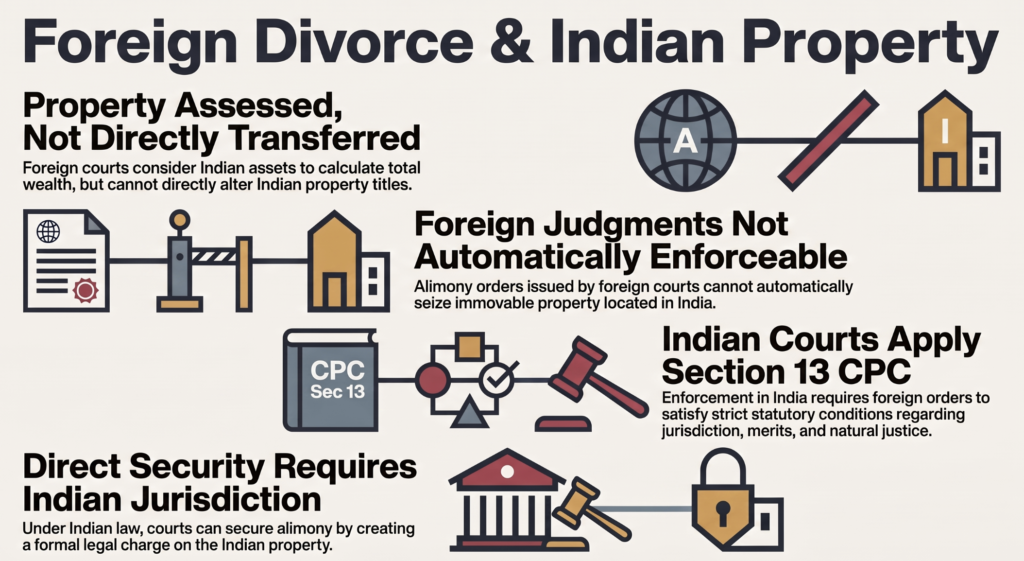
Suppose both spouses live in the United States, their marriage took place in India, and the husband owns a house in India worth ₹ 2 Crore. The wife initiates divorce proceedings in the United States and seeks financial support or division of marital assets. The foreign court may consider the husband’s Indian property when assessing his financial position. Depending on the applicable law, he may be required to disclose his property, salary, business income investments, bank accounts, and liabilities.
However, considering the property’s value for alimony is different from transferring its ownership. The wife does not automatically become entitled to ₹ 1 crore or the entire house merely because it is worth ₹ 2 Crore.
The Court may consider the following factors.
- Nature of ownership: Whether the property is marital, separate, inherited, or jointly owned.
- Date of acquisition: Whether it was purchased, before or during marriage.
- Contributions: Whether the wife contributed financially or through refinished non-financial contributions.
- Financial circumstances: The income assets, liabilities, needs and responsibilities of both spouses.
Can a wife take her husband’s Indian house as Alimony?
The wife does not automatically acquire ownership of her husband’s Indian house because divorce proceedings have been initiated or concluded abroad. Indian matrimonial law does not establish a universal rule granting a wife a fixed percentage, such as 25% or 50 % of her husband’s property as alimony. Nevertheless, property value may be relevant when calculating maintenance or permanent alimony. Courts may consider income assets, liabilities, financial needs, the duration of marriage, the standard of living, and dependent children.
Permanent alimony under Section 25 of the Hindu Marriage Act 1955
Where the Hindu Marriage Act applies, Section 25 allows the competent court to grant permanent alimony and maintenance as a lump sum or through monthly or periodical payments, subject to statutory conditions. The court may also secure payment by creating a charge on the husband’s immovable property. Such a charge provides security for payment but does not, by itself transfer ownership to the wife.
In Rajnesh v. Neha, (2021) 2 SCC 324, the supreme court established important maintenance guidelines, including financial disclosure and assessment of both parties’ circumstances. The Judgement does not prescribe a fixed percentage of property or income as maintenance. Therefore, entitlement to financial support must be distinguished from ownership of a particular asset.
Can the Indian court protect the Husband’s Indian Property from being sold?
In case the wife fear that her husband can sell, transfer, or mortgage his Indian property while foreign divorce or alimony proceedings are pending. In such circumstances, she may approach a competent Indian court seeking an interim injunction to preserve the property. Interim injunction (under Order XXXIX Rule 1 and 2 of the Code of Civil Procedure, 1908 ) provides for temporary injunction depending on the merits of the case. The wife may request an order from the Indian court restraining the sale or transfer of her husband’s property, until the alimony proceedings are pending. The court examines the jurisdiction of the property, ownership documents, and the legal basis of the application.
How do Foreign Courts assess the value of Indian Property?
A foreign court considering Indian property for alimony or financial decision may require reliable evidence of its value. The procedure depends on the foreign jurisdiction’s rules and the nature of the dispute.
The following evidence may be relevant:
- Financial disclosure: Details of the parties income assets, liabilities, and financial interests, including Indian property where required.
- Property documents: Sale deeds, conveyance deeds, ownership records, property tax receipts, and mortgage documents.
- Independent Valuation: A qualified valuer’s report estimating the property’s market value.
- Liabilities and ownership: Outstanding loans, co-ownership interests, encumbrances and competing claims.
- Judicial assessment: The court examines the evidence under its applicable procedural and evidentiary rules.
However, a valuation of the property accepted abroad does not automatically determine the property’s value for every purpose under Indian law.
Can a Foreign Alimony Judgement be enforced Against Property in India?
Yes, a foreign alimony judgement may be enforceable against a husband’s assets in India, but it is not automatic. The procedure depends on the country where the judgement was passed, the type of order, and whether it satisfies Indian legal requirements.
Under Section 44A of the Code of Civil Procedure, 1908 (CPC), certain eligible monetary decrees passed by superior courts of notified reciprocating territories may be executed in India. The Indian court can then permit lawful recovery against the husband’s assets, including attachment and sale of property where legally permissible.
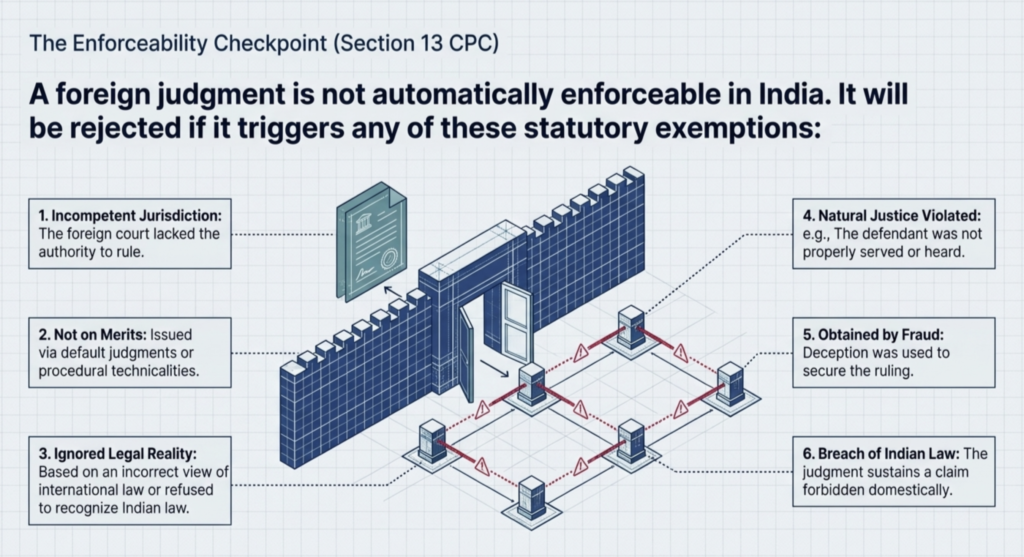
For Judgements from non-reciprocating territories, the wife generally needs to file a fresh suit in India based on the foreign judgement. Section 13 CPC determines whether the judgement is conclusive, including whether the foreign court had jurisdiction and whether the proceedings complied with natural justice.
Note: An alimony order does not automatically transfer ownership of the husband’s Indian property to the wife. The available enforcement route must be assessed based on the specific order and applicable law.
Can the Husband challenge a Foreign Alimony Judgement in India?
Yes, where legally available grounds exist. The husband may contest recognition or execution of a foreign judgement, but the mere fact that the judgement was passed abroad does not invalidate it. Depending on the circumstances, possible objections may include:
- The foreign court lacked competent jurisdiction.
- The Judgement was not given on the merits.
- The proceedings violated the principles of natural justice.
- The judgement was obtained by fraud.
- The judgement falls within another exception under Section 13 CPC.
- The decree does not qualify for execution under Section 44A.
- The relief sought in India goes beyond what the foreign judgement lawfully permits.
Contact Information:
Call at +919709692096/ info@nrilegalworld.com
FAQs:
Q1. Does the wife get 25% of the husband’s Indian property as alimony?
Ans. No, there is no general Indian rule providing that a wife automatically receives 25% of her husband’s property as alimony. The amount of alimony depends on the facts of the case, including the income, assets, liabilities, needs and financial circumstances of both spouses.
Q2. Can the wife get ownership of the husband’s house in India as alimony?
Ans. Not automatically, a court may take the value and other financial aspects of the house into consideration while determining alimony. In appropriate cases, permanent alimony may also be secured through a charge on immovable property under Section 25 of the Hindu Marriage Act 1955 where that provision applies.
Q3. Can the wife claim alimony based on her husband’s NRI bank account or foreign income?
Ans. Yes, the wife can claim alimony based on her husband’s NRI bank account or foreign income and financial assets may be considered, depending on the applicable law and the court’s jurisdiction.
Q4. Is there a fixed formula for calculating alimony in India?
Ans. No, there is no fixed formula for calculating alimony in India. The court determines the amount based on factors such as the income and assets of both spouses, their reasonable needs, financial liabilities, standard of living during marriage and the duration of the marriage. The alimony is decided on the facts of each case, not through a fixed percentage of the husband’s salary or property.
Q5. Can the wife claim the husband’s property if it is jointly owned with someone else?
Ans. Yes, a wife may seek alimony based on her husband’s share in jointly owned property. However, she cannot automatically claim ownership of the entire property or the share belonging to another co-owner. The court may consider the husband’s ownership interest, income, assets and financial circumstances when determining alimony.
Q6. Can the husband challenge a foreign alimony judgement in India?
Ans. Yes, a husband can challenge a foreign alimony judgement in India if there are valid legal grounds. Under Section 13 of the Code of Civil procedure, 1908 (CPC), a foreign judgement may be challenged if, for example, the foreign court lacked competent jurisdiction, the judgement was not given on the merits, or it was obtained through fraud or violates Indian law. However, a foreign alimony order is not automatically invalid in India. Its recognition and enforcement depend on the applicable law and circumstances of the case.
Q7. Can the wife claim the husband’s property in India if both spouses live abroad?
Ans. Yes, a wife can claim alimony based on her husband’s property in India even if both spouses live abroad. However, she does not automatically acquire ownership of his Indian property. The court may consider his assets and financial circumstances when determining alimony. The applicable law, jurisdiction of the court, and enforceability of any foreign order in India must also be considered.