
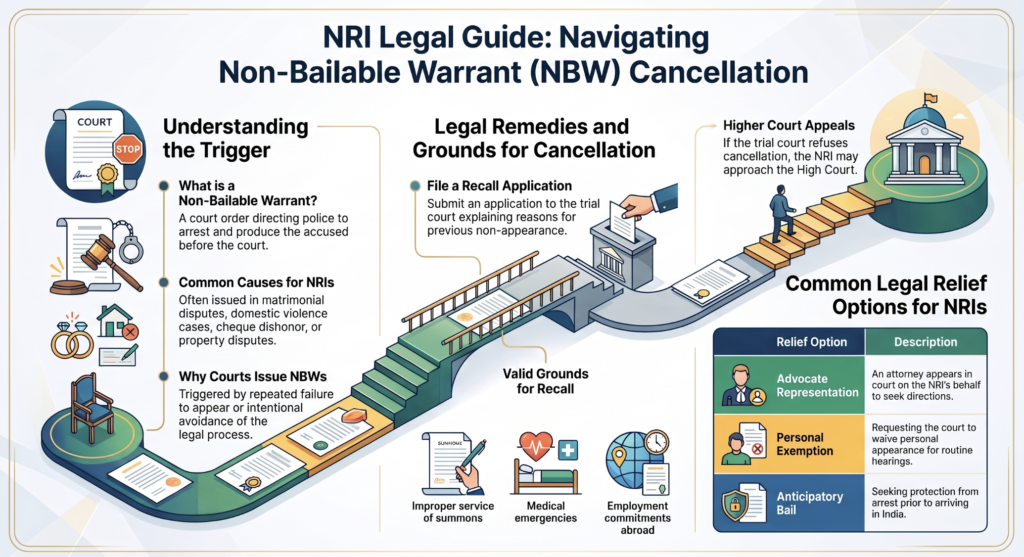
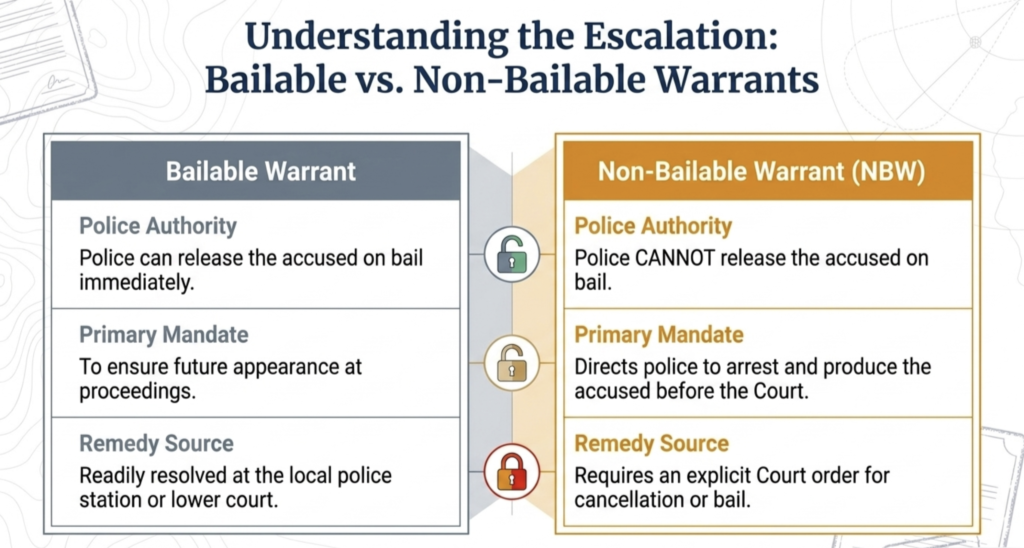
A Non-Bailable Warrant is an order issued by a Court directing the police to arrest an accused person and produce them before the Court. Unlike a bailable warrant, the police cannot release the accused on bail without the court orders. Here are a few situations which may lead courts in issuing a Non-Bailable Warrant:
- The accused repeatedly fails to appear before the court whenever summoned by police/Court.
- The accused person has continuously ignored the Summons and bailable warrants issued by the court.
- The court believes that the accused is intentionally avoiding the legal process.
- When the offence is serious and it requires the accused’s presence in Court.
Commonly reasons for which NRIs face Non-Bailable Warrant in India:
- Matrimonial disputes between husband and wife
- Cases of domestic violence
- Cheque dishonour cases
- Property disputes involving criminal allegations
- Financial fraud cases
- Family disputes involving criminal offences
In several cases, NRIs are living abroad for employment or permanent basis therefore they are unable to attend every hearing in the court, which further leads to the issuance of a Non-Bailable Warrant for their non-representation in the court.
Cancellation of Non-bailable warrants
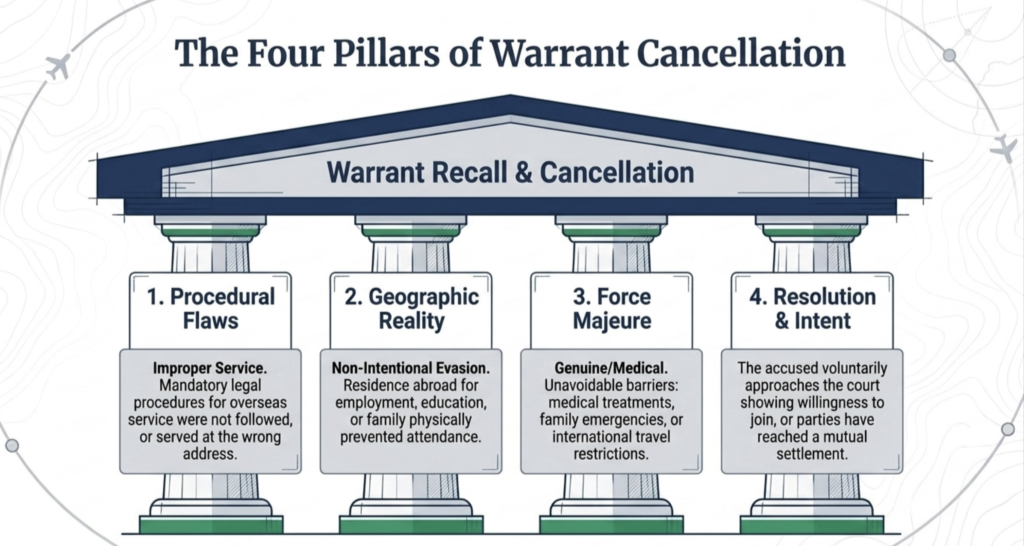
The Court has the discretion to cancel a non-bailable warrant if provided with sufficient reasons and grounds such as:
- Non intentional avoidance of court proceedings: If the NRI against whom a non bailable warrant is issued can prove in court that he never intended to avoid/evade the legal proceedings and was residing abroad for employment, education or family commitments, the court may consider for recalling of the warrant
- Improper service of summons: Many non bailable warrants are issued because the court assumes that the accused had ignored the summons. If summons were not properly served at the overseas address or if the mandatory legal procedures for the service of summons were not followed, the warrant issued can be challenged in court
- Genuine/Medical reasons for missing the summons/ hearings: If an NRI has a genuine or medical reason for missing the court hearing, such as medical treatment, serious illness, family emergency, visa restrictions, or international travel restrictions, etc., they can appeal in the court to cancel the non-bailable warrant by providing sufficient documents and evidence.
- Willingness of the accused to join the legal proceedings: If the accused voluntarily approaches the court through an advocate or appears personally before the court and assures the judge that he is willing to join the proceedings regularly, he may get relief from the court by getting his non-bailable warrant cancelled
- Out of the court settlement between the parties: In matrimonial and family disputes, if the parties reach a friendly settlement or through mediation, the court may recall the non-bailable warrant by considering the nature of the offence and stage of the proceeding
Legal Strategy for cancellation of Non-Bailable Warrants
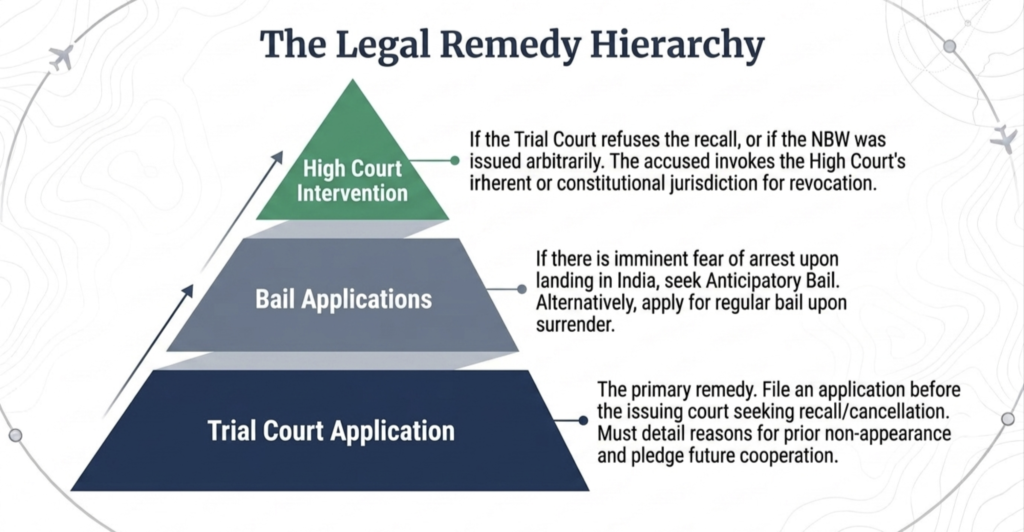
- File an application before the trial Court: The first and most common remedy is to file an application before the court that has issued the warrant, seeking the recall and cancellation of the warrant. The application must include the reasons for non-appearance and future willingness to cooperate with the trial and investigation of the case
- Appear through an advocate: In many cases, an advocate can appear before the court and seek appropriate directions. Depending on the facts, the court may grant time, an exemption for certain hearings or may direct the accused to appear on a specific date
- Apply for anticipatory or regular bail: If there is any fear of arrest upon arrival in India, the accused may seek anticipatory bail to protect himself from arrest or can also apply for regular bail after the surrender
- Approach the High Court: If the trial court refuses to recall the warrant or the non-bailable warrant issued arbitrarily or in an unfair manner, the accused may approach the High Court seeking appropriate relief from the High Court, such as recall or revocation of warrants, under the inherent or constitutional jurisdiction depending on the circumstances of the case
- Seek exemption from personal appearance: For NRI if regular travel to India for every court hearing is difficult, they can request the court to exempt them from appearing in person for routine hearings. If the court is satisfied with the reasons and the nature of the case, the court may grant exemption and the lawyer of the NRI can appear on their behalf.
For more information contact NRI Legal World: info@nrilegalworld.com / +919709692096
Frequently asked questions:
Q1) I am an NRI living abroad, I have never received any summons at my address, and a non-bailable warrant has been issued against me in a case in India. How can I challenge the warrant?
Ans: Yes, improper service of summons is a valid ground to challenge or seek cancellation of the warrant because the accused was not properly informed about the proceedings. Many non bailable warrants are issued because the court assumes that the accused had ignored the summons. If summons were not properly served at the overseas address or if the mandatory legal procedures for the service of summons were not followed, the warrant issued can be challenged in court
Q2) I am an NRI living in Canada. I missed court hearings in India due to a medical emergency. Can I get my non bailable warrant recalled by the court?
Ans: Yes, if you have genuine medical records and evidence, the court may consider it a valid reason to recall the warrants issued against the NRI. NRI can appeal in the court to cancel the non-bailable warrant by providing sufficient documents and evidence to support his reason.
Q3) My wife and I have reached an out-of -court settlement in our family dispute case. Can the warrant issued against me in the same case be recalled?
Ans: Yes, if the dispute has been genuinely settled between both of you, the court may recall the non-bailable warrant after considering the nature of the offence and stage of the case.
Q4) The trial Court had refused to cancel the non-bailable warrant against me in a case, what should I do now?
Ans) You can approach the High Court to recall the warrant or seek an appropriate relief from the Court.