

Many NRIs believe that once they move abroad, they are no longer required to pay taxes or file Income Tax Returns (ITRs) in India. However, this is one of the most common misconceptions. The rule is that even if you live outside India, you may still have tax obligations in India, if you earn any income from Indian sources, such as bank interest, rental income, dividends, capital gains, or investments.
The introduction of the Income Tax Act, 2025 has also simplified several tax concepts, making compliance easier for taxpayers, including NRIs. Understanding your residential status, knowing which income is taxable in India, reviewing your tax statements, and filing your Income Tax Return correctly are essential steps to avoid notices, penalties, and unnecessary legal complications under Indian taxation law.
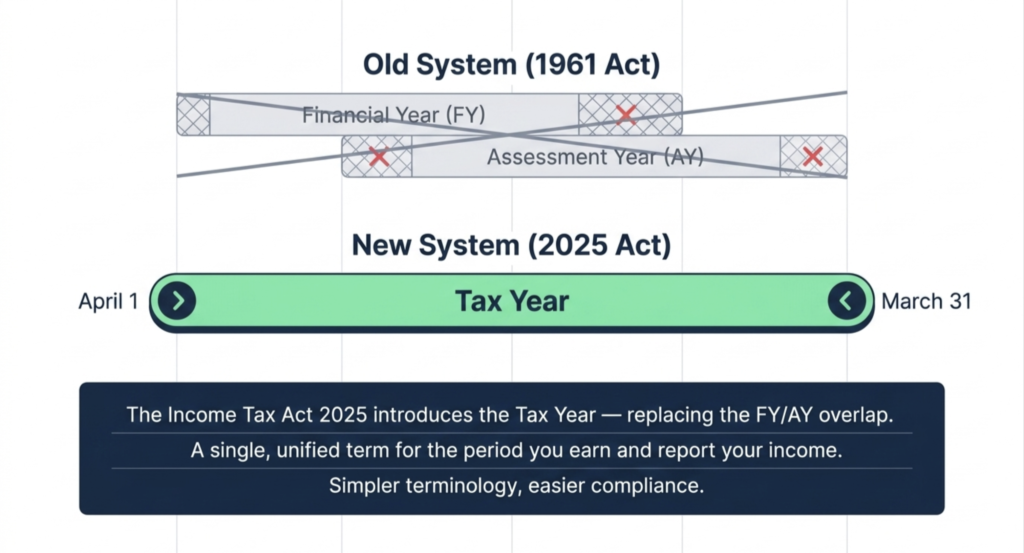
One of the biggest changes in India’s tax framework is the introduction of the Income Tax Act, 2025, which replaces the Income Tax Act 1961. Although the fundamental tax principles remain largely unchanged, the new Act simplifies terminology and aims to make tax compliance easier to understand. A significant change is the replacement of the confusing concepts of Financial Year (FY) and Assessment Year (AY) with a single term known as the tax year. The Tax year runs from 1 April to 31 March. This simple change makes it easier for taxpayers, especially NRIs, to understand the period for which they are filing their tax returns.
Three Essential Tax Statement Every NRI should review:
Before filing an Income Tax Return in India, every NRI should carefully review three important tax statements.
Form 26AS: Form 26AS is a consolidated tax statement that generally contains Tax Deducted at Source (TDS), Tax Collected at Source (TCS), Advance Tax payments, Self-assessment tax, tax refunds, Certain specified financial transactions. It helps taxpayers by verifying whether taxes deducted against their PAN have been correctly credited to their accounts.
Annual Information Statement (AIS): The Annual Information Statement provides a much more comprehensive view of a taxpayer’s financial activities like income received from all the source. It includes interest income, Dividend income, Mutual funds investments, Securities transactions, Property transactions, foreign remittances. AIS enables taxpayers to compare the information available with the income Tax Department against their own records before filing the return. This form can be accessed online. Link given below: https://share.google/RbBggENhoL35VUXOj
Tax Information Statement (TIS): The Tax Information Statement (TIS) is a summarized version of the information available in AIS. It presents processed values that assist taxpayers while preparing and filing their Income Tax Returns.
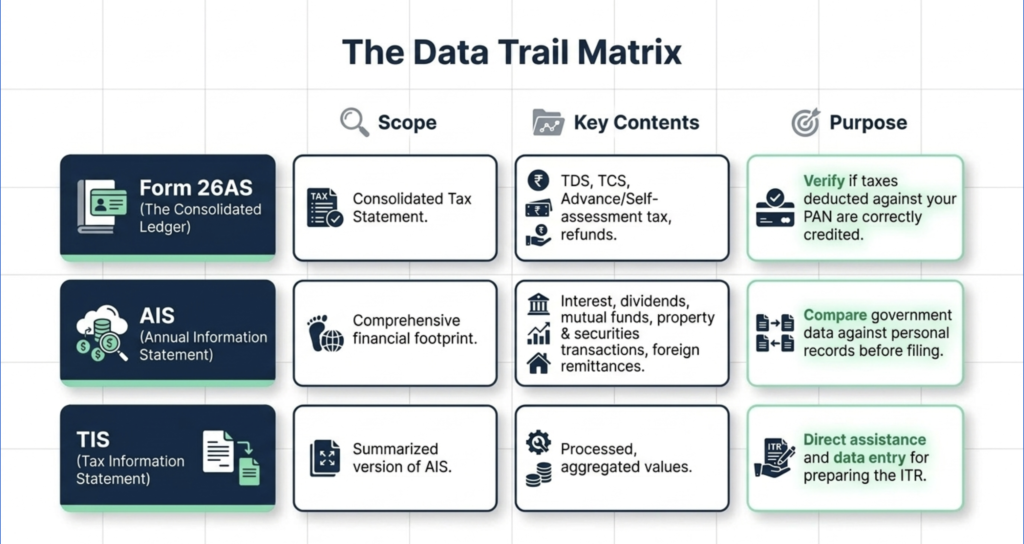
Reviewing all three statements before filing the ITR can help reducing the chance of mistakes and ensures that reported income matches the information available with the tax authorities.
Condition for NRIs for filling Income Tax in India: 2026
NRIs should file Income Tax return in India in case the NRIs earns taxable income in India and have some common sources of Indian income including:
- Interest earned on bank accounts and fixed deposits in India.
- Rental income from any property situated in India.
- Capital gains from the sale of property, shares, or mutual funds.
- Dividend income in India.
- Income from any business or profession in India.
- Income from any other investments made in India.
If your income is taxable under Indian law or if tax has been deducted at source (TDS) then filing an Income Tax Return is important. Even when no additional tax is payable, filing your return may help you for claiming refunds, carry forward certain losses, and maintain proper tax records for future.
Many NRIs avoid filing returns because they assume they will have to pay a large amount of tax. This is not always true. An Income Tax Return is simply a declaration of your income and taxes. In many cases, tax has already been deducted through TDS. Your total tax liability may be lower than the already deducted you may even be entitled to a refund.
For Example: If an NRI has a fixed deposit in India. During the year, the bank deducts ₹ 30,000 as TDS on the interest earned. However, after considering the applicable deductions and tax liability, the actual tax payable comes to only ₹ 18,000. If the NRI files an Income tax Return, they may receive a refund of ₹12,000. If they fail the return, they may lose this refund altogether.
Furthermore, any individual (Resident or an NRI) if he/she has any Indian source of Income of more than ₹4 lakh they must file the tax return. If the total income from Indian sources exceeds from ₹4 lakhs rupees, you have an obligation to file the tax under the Indian law.
There are few other conditions for NRIs to file the tax return. Even if you don’t have more ₹4 lakh income from India but you have to file ITR i.e.
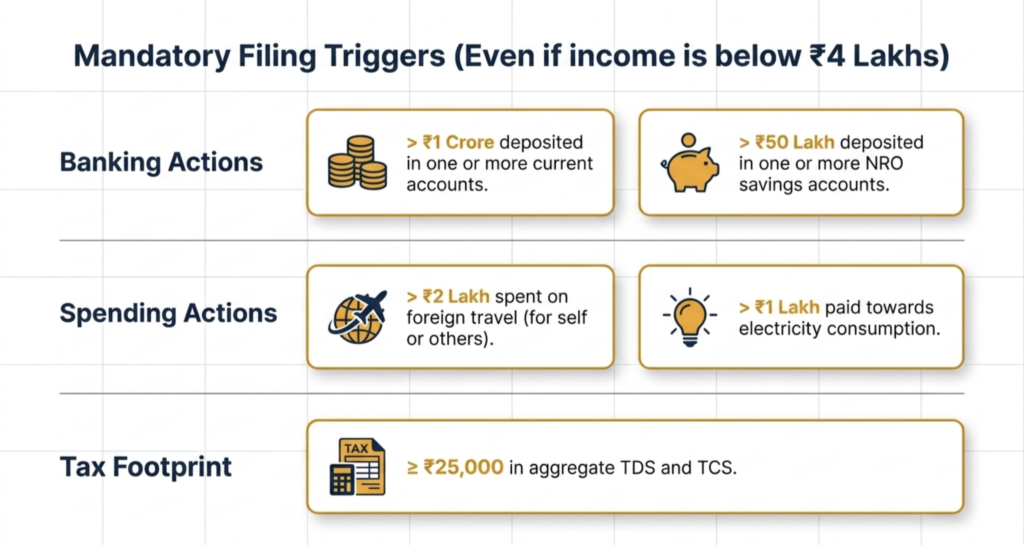
- If you have deposited an amount or aggregate of the amounts exceeding one crore rupees in one or more current accounts maintained with a banking company or a cooperative bank then you have to file the ITR.
- If you have incurred expenditure of an amount or aggregate of the amount exceeding two lakh rupees for yourself or any other person for travel to a Foreign Country during the last financial year or reporting tax year then you are required to file ITR.
- If you incurred expenditure of an amount or aggregate of the amounts exceeding one lakh rupees towards consumption of electricity. Even if you are earning no income from India, but paying an electricity bill then it is an enough condition for filing an ITR.
- If the aggregate of tax deducted at source and tax collected at source during the previous year, in the case of the person, is twenty five thousand rupees or more then you have obliged to file a Income tax Return.
- If you have deposited in one or more savings NRO bank account of the person, in aggregate, is rupees 50 lakh or more during the previous year then you are required to file the tax return.
In case an NRI satisfies these conditions then He/she are required to file Income tax return in India.
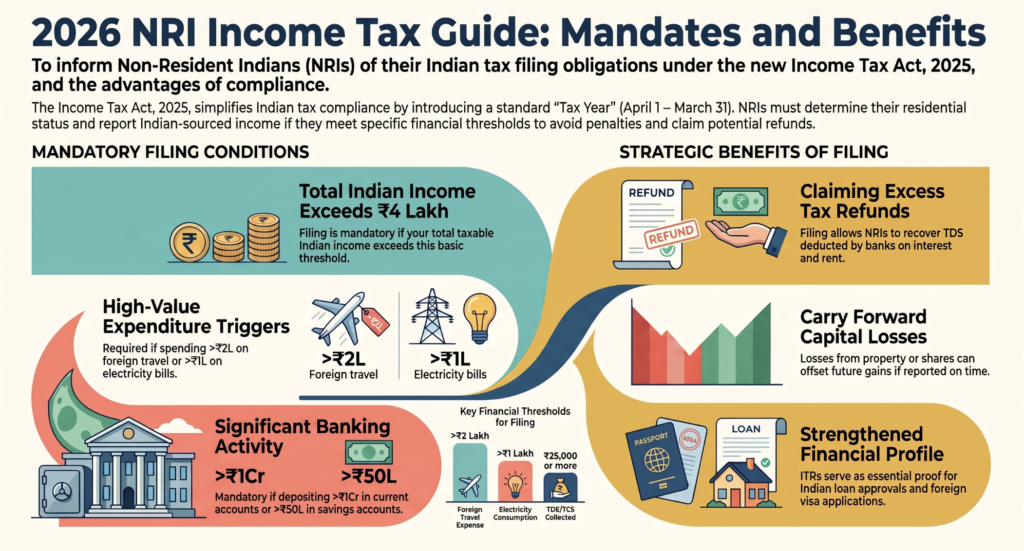
Strategic Benefits for Filing an Income Tax Return (ITR) for NRIs
Many NRIs believe that filing an Income Tax return is only about paying taxes, but ITR offers some advantages here are some of the key advantages:
- Financial Compliance and peace of Mind: Filing your Income Tax return demonstrates that you are complying with Indian tax laws. If you earn taxable income in India such as rental income, bank interest, dividends, or capital gains, reporting this income correctly can help to maintain a clean tax record in India. A properly filled Income tax return also reduces the chances of receiving notices from the income tax department due to mismatches between your reported income and the information available in Form 26AS, AIS or TIS.
- Claiming Tax Refunds: Banks often deduct Tax Deducted at source (TDS) on interest earned from NRO accounts, fixed deposits, or property transactions. In many cases, the TDS deducted is higher than the actual tax payable. By filing an Income Tax Return, NRIs can claim a refund of the excess tax deducted.
- Carry forward of capital losses: If an NRI incurs a capital loss from selling property, shares or mutual funds in India, filing the Income Tax Return within the prescribed due date allows that loss to be carried forward and adjusted against eligible future capital gains, subject to the provisions of the Income Tax Act.
- Easier Loan Approval: Income Tax Return serves as reliable proof of income and financial stability, if an NRI plans to apply for a home loan, loan against property, or any other financial facility in India, banks and financial institutions often ask for copies of recent Income Tax Returns. A consistent ITR filing history strengthens the applicant’s financial profile and may improve the chances of loan approval.
- Useful for Visa and Immigration Applications: Many foreign embassies and immigration authorities require proof of income and financial stability while processing visa or residency applications. A filed Income Tax Return can serve as an important financial document, particularly when an applicant has income or investments in India.
Why checking your residential status is important before filing an Income Tax Return?
Before an NRI files an Income Tax Return (ITR) in India, the first step is to determine their residential status under the Income tax Act. This is important because your residential status decides whether you are required to file an ITR, what income you must report, and whether your foreign income will be taxable in India. In simple terms, the Income tax Department first determines whether you are a Non-Resident (NR). Resident but Not Ordinarily Resident RNOR, or Resident and ordinarily Resident (ROR). Once your residential status is identified, the applicable tax rules are determined accordingly.
How NRIs can know their residential status for the tax purpose in India?
Your residential status is primarily determined by the number of days you stay in India during a Tax year (1 April to 31 March). A person is treated as a resident Indian if they satisfy with one of the following basic conditions: They stay in India for 182 days or more during the relevant Tax year or they stay in India for 60 days or more during the tax year and 365 days or more during the four Tax years immediately proceeding that Tax year. However, special rules apply to Indian citizens and OCIs who visit India or return to India permanently. Therefore, NRIs should carefully determine their residential status before filing their return in India.
Income tax filling in India and the Residential status for NRIs:
Many NRIs are confused about their residential status as according to Indian tax law and conditions for filing an Income Tax return (ITR) in India. Although they are closely connected but serves the different purposes.
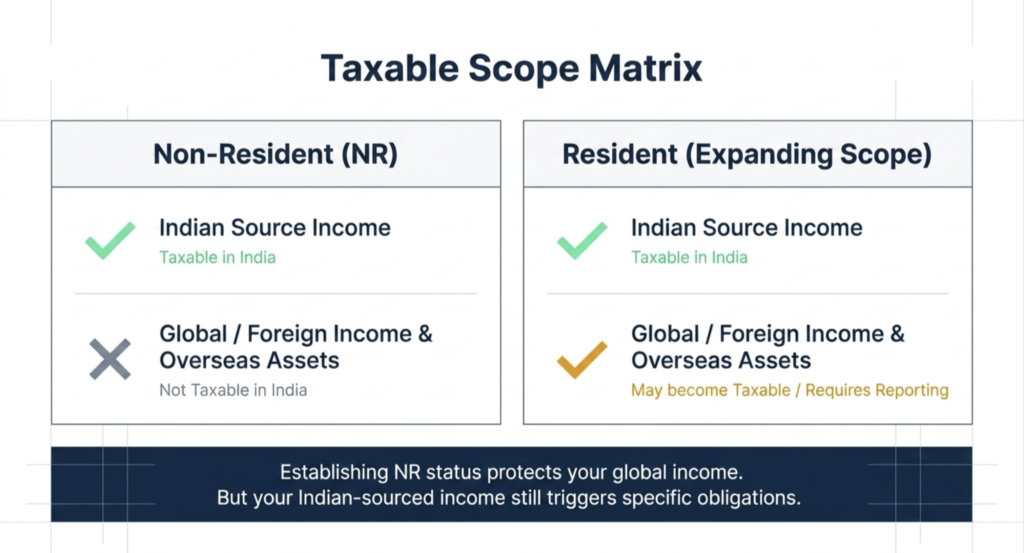
Step 1: Determine Your residential status: The first step is to determine whether you are a Non Resident (NR), Resident but Not Ordinarily Resident, or Resident and Ordinarily Resident (ROR) based on the number of days you stayed in India during the tax year and the conditions prescribed under the Income tax Act. Your residential status decides what income is taxable in India. For example: If you are an NRI (Non Resident), only your Indian source income is taxable in India.
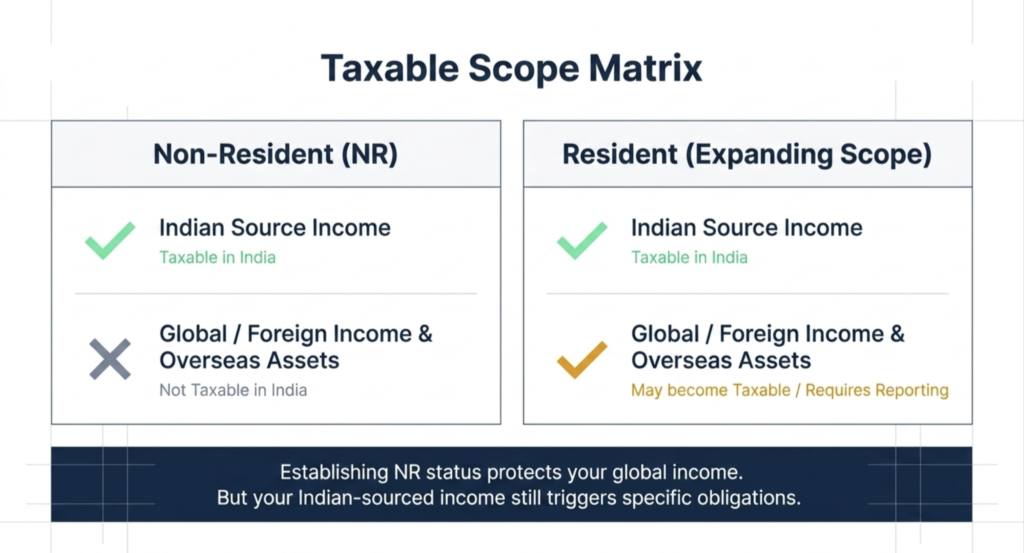
If you become a Resident, the scope of taxation may expand, and depending on your residential category, you may have to report your foreign income and overseas assets.
Step 2. Check whether you are required to file an ITR:
Once your residential status is determined, the next step is to check whether you are required to file an Income Tax Return. For an NRI, an ITR may generally be required if your total taxable income in India exceeds the applicable basic exemption limit, if you want to claim a refund of excess TDS deducted. If you have capital gains from the sale of property, shares or mutual funds, you are required to file a return under any other provision of the Income Tax Act.
In addition, the Income Tax Act prescribes a certain situations where filing an ITR may be mandatory even if your income is below the basic exemption limit. These include specified high value financial transactions, such as:
- Depositing more than ₹1crore in one or more current accounts with a bank.
- Spending more than ₹2 lakh on foreign travel for yourself or another person.
- Paying electricity bills exceeding ₹1 lakh during the financial year.
- Where TDS/TCS exceeds the prescribed threshold under the Act.

Check ITR requirement for NRIs
What happens if an NRI does Not file an Income Tax Return?
Non-filing of an ITR may result in a penalty or late filing fee, where applicable under the provisions of the Income Tax Act, Interest on any unpaid tax, if there is an outstanding tax liability. You receive notice from the Income Tax Department, especially if your income or financial transactions appear in Form 26AS, AIS, or TIS but are not reported in your return.
Frequently Asked Questions:
Q1. What Documents should an NRI check before filing an Income tax Return?
Ans. Before filing an ITR, an NRI should review
- Form 26AS.
- Annual Information statement (AIS).
- Tax Information Statement (TIS).
- Bank interest certificates.
- Property income records.
These documents helps you to ensure that all income is correctly reported. These documents are available online in the official tax website. Link given: https://share.google/RbBggENhoL35VUXOj
Q2. Can an NRI claim a refund of TDS deducted in India?
Ans. Yes if excess TDS has been deducted and your actual tax liability is lower, you can claim a refund by filing your Income Tax Return in India.
Q3. Can the Income Tax Department track an NRIs financial transaction abroad?
Ans. Yes, the Income Tax Department receives information from banks, stock exchanges, mutual fund companies, property registration authorities, and other reporting entities. Many financial transactions are reflected in form 26 AS, AIS, and TIS.
Q4. Do NRIs have to report foreign bank accounts in their Indian ITR?
Ans. NRIs are not required to report foreign income or foreign assets merely because they are not resident in India. However, if an individual becomes a Resident Indian based on the stay in India then the law requires such disclosures, foreign bank accounts and overseas assets may need to be reported.