
For Indians living abroad, voting in Indian elections can raise several practical questions. An NRI may be an Indian citizen living permanently or temporarily in another country, but that does not, by itself, prevent the person from registering as a voter in India. At the same time, simply having an Indian passport in the past, holding an OCI card or having property and family in India does not automatically give a person the right to vote.
Indian citizens residing outside India can register as Overseas Electors if they satisfy the conditions prescribed under Indian election law. The Election Commission of India has a specific registration process for overseas electors through Form 6A. However, registration as an overseas elector should not be confused with the ability to vote from abroad. Under the present system, an overseas elector must be physically present at the concerned polling station in India to cast the vote.
Eligibility to Register as an Overseas Elector
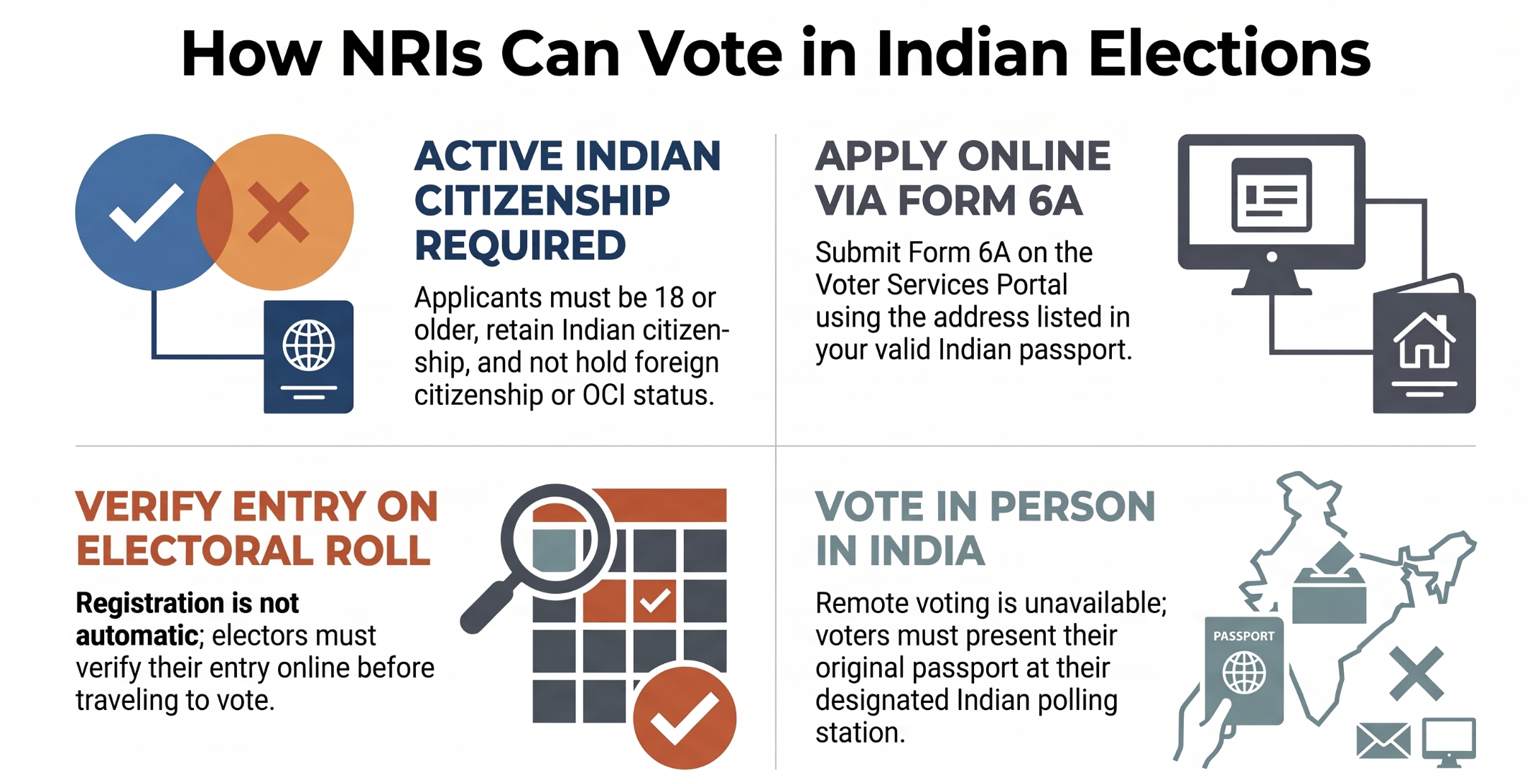
An Indian citizen residing outside India can apply for registration as an Overseas Elector if the person satisfies the statutory requirements. The applicant must be a citizen of India, must have attained the age of 18 years on the applicable qualifying date, must not have acquired citizenship of another country and must not otherwise be disqualified from registration as an elector.The Election Commission’s Form 6A guidelines also cover Indian citizens who are absent from India because of employment, education or otherwise. Therefore, an NRI does not have to return to India merely to become eligible for registration. What is important is that the person continues to be an Indian citizen and satisfies the requirements for electoral registration.
The overseas elector is registered in the constituency corresponding to the Indian address mentioned in the person’s passport. An NRI therefore cannot simply choose any constituency in India for registration because the person owns property there or has relatives living there. The Indian residential address recorded in the passport is relevant for determining the constituency.
The applicant must also satisfy the applicable age requirement for registration as an elector. The Form 6A guidelines specifically provide that an overseas elector must have completed 18 years of age as on 1 January of the relevant year. The four qualifying dates- 1 January, 1 April, 1 July and 1 October are the qualifying dates recognized under the current electoral registration framework; generally, they should not be understood as four separate deadlines for an NRI to submit Form 6A. The application and electoral-roll inclusion are subject to the applicable revision and registration process of the Election Commission.
Form 6A and Documents Required for Registration
Form 6A is the prescribed form for an Indian citizen residing outside India who wants to be included in the electoral roll as an Overseas Elector. The form is titled “Application for inclusion of Name in Electoral Roll by an Overseas Elector”. It requires information including the applicant’s personal details, Indian address, passport particulars and details concerning the applicant’s residence abroad.
The application can be submitted through the Election Commission of India’s Voter Services Portal. It can also be submitted to the concerned Electoral Registration Officer or Assistant Electoral Registration Officer in accordance with the prescribed procedure. The applicant has to provide a recent passport-size coloured photograph and the relevant pages of the Indian passport containing the applicant’s photograph, personal particulars and Indian address. The relevant page showing the valid visa endorsement for the country where the applicant is residing is also required.
The documents are important because the electoral authorities have to establish the applicant’s identity, Indian citizenship and connection with the constituency in which registration is being sought. Where the application is submitted personally, the original passport is required for verification. Where it is submitted by post, the prescribed self-attested copies of the documents are submitted along with Form 6A.
Registration Process for NRIs
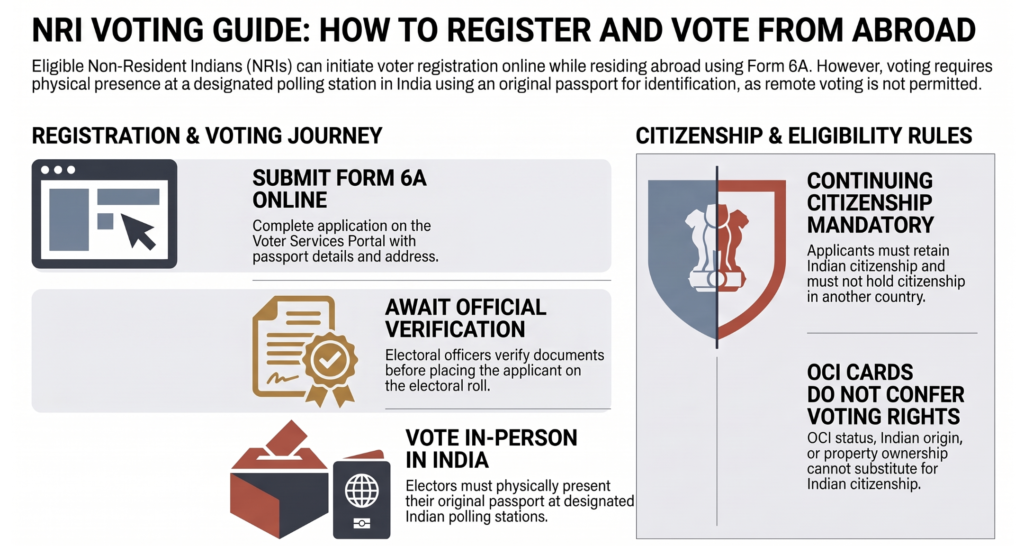
An eligible NRI can begin the process by accessing the Election Commission’s Voter Services Portal and selecting the facility for overseas voter registration. The applicant has to complete Form 6A, provide the required personal and passport details, enter the Indian address appearing in the passport and submit the prescribed supporting documents.
Submitting Form 6A does not by itself mean that the person’s name has been added to the electoral roll. The application is examined by the concerned Electoral Registration Officer and the information and documents are subject to verification. Depending on the manner in which the application is submitted, verification of the Indian address and other particulars may be carried out through the prescribed electoral machinery.
The Election Commission’s procedure also provides for verification through the concerned Indian Mission in certain circumstances. Once the application is accepted, the applicant’s name is included in the electoral roll as an Overseas Elector. The name is entered in the relevant electoral roll for the constituency connected with the Indian address mentioned in the passport. An NRI should therefore check the electoral roll after submitting Form 6A instead of assuming that registration has automatically been completed. The Election Commission provides an online facility through which the voter can check whether the name appears in the electoral roll and obtain information concerning the polling station.
How an Overseas Elector Can Vote in India?
Registration and voting are two separate stages. Although an eligible NRI can apply for registration while residing abroad, the present system does not provide general online voting from a foreign country for overseas electors. After registration, the overseas elector has to be physically present at the designated polling station in India on the day of polling to cast the vote. The Form 6A guidelines specifically provide that an overseas elector must be present at the polling station and produce the original passport for identification.
This means that an NRI living in Canada, the United States, the United Kingdom, Australia, the UAE or another country cannot register through Form 6A and then cast the vote electronically from that country. The registration may be completed from abroad, but the voting process requires the overseas elector to come to India and vote at the polling station where the person’s name is registered.
An overseas elector is not issued an EPIC in the ordinary manner. The original Indian passport is used for identification at the polling station. It is therefore advisable for an NRI planning to vote to verify the electoral-roll entry and polling-station details before travelling to India.
OCI Card Holders and Persons Who Have Acquired Foreign Citizenship
An OCI card holder cannot register as a voter or vote in Indian elections merely because of holding an OCI card. OCI status does not amount to Indian citizenship and does not confer the right to be registered as an elector. The Citizenship Act, 1955 specifically provides that an Overseas Citizen of India is not entitled to the right of registration as a voter under Section 16 of the Representation of the People Act, 1950.Therefore, an individual who has acquired citizenship of another country and subsequently obtained an OCI card cannot use the OCI card to register as an Indian voter. The same principle applies to an Indian citizen who has acquired foreign citizenship. One of the requirements for registration as an Overseas Elector is that the applicant must not have acquired citizenship of another country.
Indian ancestry, an Indian-origin background, ownership of property in India or an OCI card cannot substitute for Indian citizenship for the purpose of voter registration. Accordingly, the right to register as an overseas elector is based on continuing Indian citizenship, not merely on a person’s connection with India.
Existing Voter Registration and Change of Residence
An NRI cannot maintain multiple electoral registrations. A person cannot be enrolled in more than one electoral roll at the same time. Therefore, an applicant who is already registered as a general elector has to follow the prescribed procedure when applying for registration as an overseas elector, including surrender of the existing EPIC where required.
The electoral registration should also reflect the person’s actual status. If an overseas elector subsequently returns to India and becomes ordinarily resident in India, the person can seek registration as a general elector at the place where he or she is ordinarily resident, following the applicable procedure. These requirements are important because voter registration is not simply a matter of having an identity document.
Important Points for NRIs:
An NRI who wants to participate in elections in India should keep the following points in mind:
- The person must continue to be an Indian citizen
- The person must satisfy the applicable requirement of being 18 years old
- The person must not have acquired citizenship of another country
- Form 6A is used for registration as an Overseas Elector
- The Indian address mentioned in the passport determines the constituency for registration
- The prescribed passport and visa documents have to be submitted with the application
- Submitting Form 6A does not automatically mean that the name has been added to the electoral roll.
- An NRI must verify that the name actually appears in the electoral roll before planning to vote
- An overseas elector must currently be physically present in India to cast the vote.
- The original Indian passport is required for identification at the polling station.
- An OCI card holder does not have voting rights in India merely because of OCI status.
- A person who has acquired foreign citizenship cannot register as an Overseas Elector.
- A person cannot maintain more than one electoral registration.
For more informations contact NRI Legal World: info@nrilegalworld.com/+919709692096 / https://nrilegalworld.com/contact-us/
Frequently Asked Questions
Q.) I have been living abroad for many years. Can I still register as a voter in India?
Ans.) Yes, an Indian citizen can register as an Overseas Elector even if he or she has been living abroad for several years, provided the person has not acquired citizenship of another country and satisfies the other eligibility requirements. The registration is made in the constituency corresponding to the Indian address mentioned in the passport.
Q.) I have an Indian passport but live permanently in Canada. Can I have a voter registration in India?
Ans.) Yes, provided you continue to be an Indian citizen and have not acquired Canadian citizenship of any other country. Your registration will be connected with the Indian residential address mentioned in your passport.
Q.) I became a US citizen but still have an OCI card. Can I vote in India?
Ans.) No, acquiring foreign citizenship means you are no longer eligible to register as an Indian voter. An OCI card does not restore Indian citizenship or give an OCI card holder the right to register in India’s electoral rolls.
Q.) I own a house and agricultural land in India. Does that make me eligible to vote in India?
Ans.) Ownership of property in India does not by itself give a person voting rights. For an overseas elector, the important requirement is Indian citizenship and eligibility under the election law. The electoral registration is connected with the Indian address mentioned in the passport, not merely with ownership of property.
Q.) I am already registered as a voter in India. Do I need to apply again as an NRI?
Ans.) If you are already registered as a general elector and are now seeking registration as an Overseas Elector, you cannot maintain both registrations. The Election Commission requires an overseas elector who is already registered as a general voter to surrender the EPIC along with Form 6A.