
A Gift Deed can be a suitable legal instrument for the NRIs who wish to transfer their land/property to their children, parents or siblings who continue to live in India.
Understanding the Difference Between Gift Deed and Transfer Deed
A Gift Deed is a legal instrument used to transfer ownership of existing property voluntarily and without monetary consideration. Under Section 122 and 123 of the Transfer of Property Act, 1882, a gift is a voluntary transfer of existing property made without consideration and accepted by the recipient during the donor’s lifetime. A gift of immovable property must be made through a registered instrument signed by or on behalf of the donor and attested by at least two witnesses.
A Title/Transfer Deed, on the other hand, is a broader term for a document through which property rights are transferred. The correct document depends on the nature of the transaction. A sale deed is used for sale, a Gift Deed for a gift, and a release deed may be used when a co-owner relinquishes their share in favour of another person.
Can an NRI Gift Agricultural Land in Punjab?
Yes, an NRI can gift agricultural land in Punjab to a person who lives in India. However, an NRI or OCI cardholder generally cannot gift agricultural land, a farmhouse or plantation property in India to another NRI or OCI under the applicable FEMA rules.
Before preparing the deed, confirm that the recipient lives in India and is legally allowed to receive the land. Also check that the land belongs to you and is not affected by a court case, mortgage or other restrictions that prevent the transfer.
Which Family Members Can Receive Property as a Gift?
The relationship covered by Punjab’s stamp-duty exemption may differ from the definition of “relative” under Income-tax law. For Punjab’s family transfer stamp-duty and registration exemptions, the specified relationships include a spouse, son, daughter, father, mother, brother, sister, grandson and granddaughter.
For Income-tax purposes, Section 56(2)(x) of the Income-tax Act, 1961, defines relatives more broadly. The list includes:
- spouse of the individual;
- brother or sister of the individual;
- brother or sister of the spouse of the individual;
- brother or sister of either of the parents of the individual;
- any lineal ascendant or descendant of the individual;
- any lineal ascendant or descendant of the spouse of the individual;
- spouse of the person referred to in clauses (ii) to (vi);
A spouse is not a blood relative in the ordinary sense, but is expressly included in the relevant legal definitions. Do not assume that a person exempt from income tax on a gift is automatically covered by Punjab’s stamp-duty exemption.
What Type of Property Can Be Gifted in India?
A Gift Deed can be used to transfer immovable property, including agricultural land, residential houses, flats, commercial property and property situated within a Lal Lakir.
Read more about Registration of Lal Lakir Properties in India https://nrilegalworld.com/registration-of-lal-dora-lal-lakir-properties-in-punjab-india/
Gold and other movable property can also be gifted. Under Section 123 of the Transfer of Property Act, a gift of movable property can be completed by delivery or through a registered instrument. Cash gifts should be properly documented and transferred through lawful, traceable banking methods.
Also, Income tax rules exempt movable gifts received from specified relatives (blood relatives). The tax treatment of gifts from other persons depends on the type and value of the gift.
Can NRI Gift land to a minor child in India?
Yes, a minor can receive a gift through a legally competent guardian who accepts the gift on the child’s behalf. The guardian does not become the owner simply by acting on the child’s behalf.
The parents or guardians must act as the child’s lawful guardians and they cannot sell the land simply because they are the parents or guardians. Section 8 of the Hindu Minority and Guardianship Act, 1956, generally requires the guardian to obtain prior permission from the competent court before selling the minor’s immovable property. The court permits a sale only when it is necessary or clearly beneficial to the child.
Can NRI Gift transfer his share from a Jointly Owned or Inherited Land in India?
Yes, NRI co-owner can gift his/her own share to any resident Indian within the family or outside the family. NRI cannot gift agriculture to another NRI or OCI card holder.
Tip: The donor should confirm that the inheritance and succession records establish his/her ownership. NRI can check the ownership title by obtaining a copy of Fard/Jamabandi. Gift Deeds should be discouraged in case the property is under litigation or any kind of stay order issued by the court.
Stamp Duty and Registration Fees for a Gift Deed in Punjab
Stamp Duty and Registration Fees For transfer of land in Blood Relatives
In Punjab, a Gift Deed transferring agricultural land to a qualifying family member can be exempt from stamp duty and registration fees under the applicable government notifications. The exemption covers specified relationships, including a spouse, son, daughter, father, mother, brother, sister, grandson and granddaughter. For example, if an NRI gifts agricultural land worth Rs.20 Lakh to their son or daughter and the transaction qualifies for the exemption, the stamp duty and registration fee are nil.
Stamp Duty and Registration Fees For transfer of land in For Non-Blood Relatives
If the recipient does not qualify for the family-gift exemption, Article 33 of the Punjab Stamp Act provides the basis for calculating stamp duty on a Gift Deed.
How to Calculate Stamp Duty on Property Transfer in Punjab?
In the registration of land /property after a sale, total charges include 7% of the collector rate for male buyers, 5% of the collector rate for female buyers and 6% of the collector rate for joint male-female buyers. A 1% Social Infrastructure Cess as well as 1% registration charges also apply to non-exempt property-transfer instruments. All the percentages are of the value of the market rate rate.
On the other hand due to applicable exemptions given the state government only nominal charges apply on the transfer of property under gift deed within the blood relations. However if it is to the non-blood relationships then stamp duty charges on the collector rate will be applicable.
NRIs might also have to bear the cost of deed drafting and any other legal assistance. All these costs are exempted in gift deed transfers within the blood relations.
Procedure for Execution and Registration of the Gift Deed
- Drafting a Gift Deed: A well drafted Gift Deed would include all the details regarding the property, the name and address of the donee’s and donor’ and any condition attached to the gifting. NRI can also take professional help for drafting the deed.
- Documentation: Arrange the necessary documents to be attached along with the gift deed, such as original title documents of the land, Khasra number, Fard copy/ Jamabandi copy, relevant mutation records, identity proofs like Aadhar cards, PAN details, passport ( in case of NRI), of both the parties.
- Local Sub registrar office: Visit the local Tehsil/Sub-Registrar office where the land is situated; both parties need to be present at the sub-registrar office, where a picture and signatures of both parties will be captured by the authorities in the presence of 2 witnesses. Both parties must sign the Gift Deed in the presence of two witnesses; one of the witnesses must be a Lambardar of the village.
- Waseeka Number: After the execution of the gift deed the parties should use the Waseeka number of the deed to obtain a copy of the executed Gift Deed.
- Mutation of Property: Lastly, the recipient party can apply for mutation so that the revenue authority can update the land records in the donee’s name. Both parties should check the Fard/Jamabandi regularly to make sure the right legal owner is reflected in the owner column in the fardd/Jamabandi.
How Can an NRI Complete the Process while sitting Abroad?
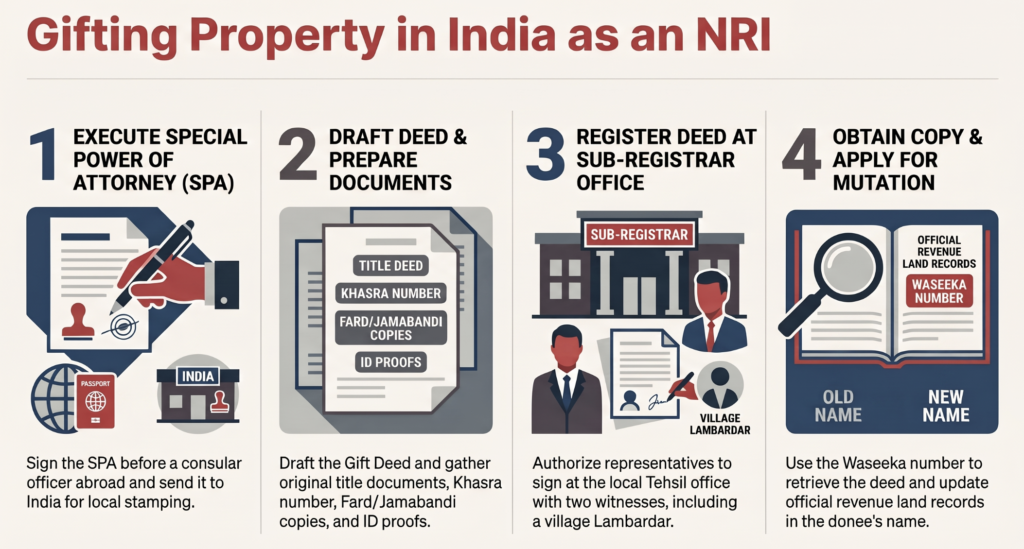
Yes, if the NRI donor cannot visit India, the process can generally be handled through a Special Power of Attorney (SPA).
1) Prepare the Special Power of Attorney:
Draft a Special Power of Attorney authorizing a trusted person in India to execute and register the Gift Deed on the donor’s behalf. The donor must execute it before the appropriate Indian consular officer or Notary Public, following the authentication requirements.The authorized representative receives the original document . The authorized representative can get the SPA stamped or embossed in Punjab at the local DC office.
2) Drafting a Gift Deed:
A well drafted Gift Deed would include all the details regarding the property, the name and address of the donee’s and donor’and any condition attached to the gifting. NRI can also take professional help for drafting the deed.
3) Documentation:
Arrange the necessary documents to be attached along with the gift deed, such as original title documents of the land, Kasra number, Fard copy/ Jamabandi copy, relevant mutation records, identity proofs like aadhar cards, PAN details, passport ( in case of NRI), of both the parties.
4) Local Sub registrar office:
Visit the local Tehsil/Sub-Registrar office where the land is situated; both parties need to be present at the sub-registrar office, where a picture and signatures of both parties will be captured by the authorities in the presence of 2 witnesses. Both parties must sign the Gift Deed in the presence of two witnesses; one of the witnesses must be a Lambardar of the village.
5) Waseeka Number:
After the execution of the gift deed the parties should use the Waseeka number of the deed to obtain a copy of the executed Gift Deed.
6) Mutation of Property:
Lastly, the recipient party can apply for mutation so that the revenue authority can update the land records in the donee’s name. Both parties should check the Fard/Jamabandi regularly to make sure the right legal owner is reflected in the owner column of the fardd/Jamabandi.
Tax Implications of Gifting Agricultural Land
- Tax implications for the NRI donor: Gifting property without receiving payment does not trigger capital gains tax for the donor, provided it qualifies as a gift under the Income-tax Act. Section 47(iii) excludes gifts from the definition of taxable transfers. For example, if an NRI gifts agricultural land in Punjab to their son or daughter without receiving money, the donor does not pay capital gains tax.
- Tax implications for the resident recipient: The tax liability of the recipient depends mainly on their relationship with the donor and the nature of the land. A gift from a specified relative (blood relatives) is exempt from tax under Section 56(2)(x) of the Income-tax Act. In case of a gift from a non- blood relative, if the land qualifies as a capital asset and its stamp duty value exceeds Rs.50,000, the recipient has to pay income tax on the entire stamp duty value as “income from other sources”.
- Capital gains tax when the gifted land is sold later: Under Section 49(1) of the Income-tax Act, the recipient inherits the previous owner’s cost of acquisition for tax purposes. For example, if a father purchased land in 2005 and gifted it to his daughter in 2026, the daughter’s capital gain calculation on a later sale will take account of the father’s original acquisition cost, rather than treating the gift date as a fresh purchase at market value.
Rural agricultural land in India is not treated as a capital asset, so its sale does not attract capital gains tax.
Urban agricultural land qualifies as a capital asset; capital gains tax may apply on sale.
Revocation of a Gift Deed
A donor cannot ordinarily cancel a completed gift deed simply because they have changed their mind. The legal effect of revocation depends partly on whether the Gift Deed is unconditional or conditional.
An unconditional Gift Deed is one in which the donor transfers the property voluntarily and without consideration, without reserving a contractual right to revoke the gift merely at the donor’s discretion. Once the gift has been accepted and validly registered, the donor generally cannot revoke it simply because of a change of mind, family disagreement or a later desire to recover the property.
A conditional Gift Deed may include a clearly drafted condition or an agreed event on the occurrence of which the gift may be revoked. Under Section 126 of the Transfer of Property Act, 1882, the condition must be agreed between the donor and recipient, and the event must not depend solely on the donor’s will.
A conditional gift is not automatically revocable merely because the donor believes that the recipient has breached an understanding. The alleged condition, the wording of the deed and the evidence of breach must be examined.
A Gift Deed may also be challenged on legally recognized grounds such as fraud, coercion, undue influence, misrepresentation, lack of acceptance, incapacity, defective execution or absence of a valid donor’s title. These grounds must be established on the facts and do not arise merely because the donor later regrets the transfer.
For more information contact NRI Legal World: info@nrilegalworld.com/ +919709692096 / https://nrilegalworld.com/contact-us
Frequently Asked Questions
Q.) I live in Canada and own agricultural land in Punjab. Can I gift it to my son who lives in India?
Ans.) Yes, provided you have a valid title, your son is legally eligible to acquire the land, and the transfer complies with Punjab land laws and other applicable restrictions. A properly drafted and registered Gift Deed is generally used where no consideration is paid. Before proceeding, verify your ownership records, any landholding restrictions and the applicable stamp-duty and registration requirements.
Q.) I want to gift five acres to my brother, but the land is jointly owned by me and my two siblings. Can I gift the entire five acres?
Ans.) Not automatically, you can generally transfer only the ownership interest that legally belongs to you, not the shares of your co-owners. If you own an undivided share in the joint holding, gifting that share does not necessarily give your brother exclusive ownership of a particular five-acre parcel. The revenue records and partition status must be checked before deciding how the gift should be documented.
Q.) My father left agricultural land in Punjab, but the Jamabandi still shows his name. Can I gift the land to my daughter from abroad?
Ans.) You should first establish how ownership devolved after your father’s death and whether the necessary inheritance and mutation formalities have been completed. Being a legal heir does not mean you can automatically execute a Gift Deed for the entire land if other heirs also have rights in it. Your ownership share must be established before the proposed transfer can proceed.
Q.) My brother says we can use a simple Transfer Deed instead of a Gift Deed to save registration expenses. Is that legally safe?
Ans.) The document’s title does not determine the nature of the transaction or the charges payable. If you intend to transfer agricultural land voluntarily without receiving consideration, a properly drafted and registered Gift Deed is generally appropriate. Calling it a Transfer Deed does not automatically reduce the charges or avoid the legal requirements applicable to a gift.
Q.) I live in Australia and cannot travel to Punjab. Can my brother complete the Gift Deed registration on my behalf?
Ans.) You may be able to authorize him through a properly executed Special Power of Attorney, subject to the applicable registration requirements. The Power of Attorney must clearly authorize the relevant acts, and any required consular authentication, apostille, stamping or adjudication formalities must be completed. A Power of Attorney itself does not transfer ownership. The Gift Deed must still satisfy the legal requirements for the transfer.